What Is Sex? —— Alenka Zupančič
What Is Sex? —— Alenka Zupančič
Ivoripuion丛书前言
A short circuit occurs when there is a faulty connection in the network—faulty, of course, from the standpoint of the network’s smooth functioning. Is not the shock of short-circuiting, therefore, one of the best metaphors for a critical reading? Is not one of the most effective critical procedures to cross wires that do not usually touch: to take a major classic (text, author, notion) and read it in a short-circuiting way, through the lens of a “minor” author, text, or conceptual apparatus (“minor” should be understood here in Deleuze’s sense: not “of lesser quality,” but marginalized, disavowed by the hegemonic ideology, or dealing with a “lower,” less dignified topic)? If the minor reference is well chosen, such a procedure can lead to insights which completely shatter and undermine our common perceptions. This is what Marx, among others, did with philosophy and religion (short-circuiting philosophical speculation through the lens of political economy, that is to say, economic speculation); this is what Freud and Nietzsche did with morality (short-circuiting the highest ethical notions through the lens of the unconscious libidinal economy). What such a reading achieves is not a simple “desublimation,” a reduction of the higher intellectual content to its lower economic or libidinal cause; the aim of such an approach is, rather, the inherent decentering of the interpreted text, which brings to light its “unthought,” its disavowed presuppositions and consequences.
短路发生在网络中出现错误连接的时候——当然,所谓“错误”,是从网络顺畅运行的角度看的。因此,短路的冲击难道不是批判性阅读最好的隐喻之一吗?最有效的批判操作之一,难道不正是把通常并不相接的线路交叉接通:拿一部重要经典(文本、作者、概念),透过一个“次要”作者、文本或概念装置的透镜,对它作短路式阅读?(这里的“次要”要按德勒兹的意思理解:不是“质量较低”,而是被边缘化、被霸权意识形态否认,或处理“较低”、不那么体面的话题。)如果这个次要参照选得准,这种操作就能产生洞见,彻底击碎并瓦解我们的常识感知。马克思对哲学和宗教做的就是这样:用政治经济学的透镜——也就是经济投机/思辨——去短路哲学思辨;弗洛伊德和尼采对道德做的也是如此:用无意识力比多经济的透镜去短路最高的伦理观念。这样的阅读所达到的,不是简单的“去升华”,不是把较高的智识内容还原为较低的经济或力比多原因;相反,这种进路的目标,是被解释文本的内在去中心化,让它暴露出自身的“未思”、它被否认的前提与后果。
And this is what “Short Circuits” wants to do, again and again. The underlying premise of the series is that Lacanian psychoanalysis is a privileged instrument of such an approach, whose purpose is to illuminate a standard text or ideological formation, making it readable in a totally new way—the long history of Lacanian interventions in philosophy, religion, the arts (from the visual arts to the cinema, music, and literature), ideology, and politics justifies this premise. This, then, is not a new series of books on psychoanalysis, but a series of “connections in the Freudian field”—of short Lacanian interventions in art, philosophy, theology, and ideology.
而这正是“短路”想做、并且会一次又一次去做的事。该丛书的基本前提是:拉康派精神分析是这种路径的一个优先工具;它的目的,是照亮一部标准文本或一种意识形态构造,让它以全新的方式变得可读——拉康派在哲学、宗教、艺术(从视觉艺术到电影、音乐和文学)、意识形态和政治中的长期介入史,足以证明这一前提。因此,这不是一套关于精神分析的新书,而是一套“弗洛伊德场域中的连接”——即拉康派对艺术、哲学、神学和意识形态所作的一系列简短介入。
“Short Circuits” intends to revive a practice of reading which confronts a classic text, author, or notion with its own hidden presuppositions, and thus reveals its disavowed truth. The basic criterion for the texts that will be published is that they effectuate such a theoretical short circuit. After reading a book in this series, the reader should not simply have learned something new: the point is, rather, to make him or her aware of another—disturbing—side of something he or she knew all the time.
——Slavoj Žižek
“短路”丛书想复兴一种阅读实践:让经典文本、作者或概念面对它自身隐藏的预设,从而揭示出它被否认的真理。将要出版的文本,基本标准就是它们能实现这样一种理论短路。读完本丛书中的一本书,读者不该只是学到某种新东西;关键更在于,让他/她意识到自己一直知道的东西还有另一面——令人不安的一面。
——斯拉沃热·齐泽克
Introduction
“For the moment, I am not fucking, I am talking to you. Well! I can have exactly the same satisfaction as if I were fucking.” This is the example that Lacan comes up with to illustrate the claim that sublimation is satisfaction of the drive, without repression. We usually tend to think of sublimation in terms of a substitute satisfaction: instead of “fucking,” I engage in talking (writing, painting, praying …)—this way I get another kind of satisfaction to replace the “missing” one. Sublimations are substitute satisfactions for a missing sexual satisfaction. The point that Lacanian psychoanalysis makes, however, is more paradoxical: the activity is different, yet the satisfaction is exactly the same. In other words, the point is not to explain the satisfaction in talking by referring to its “sexual origin.” The point is that the satisfaction in talking is itself “sexual.” And this is precisely what forces us to open the question of the very nature and status of sexuality in a radical way. Marx famously wrote that “human anatomy contains the key to the anatomy of the ape” (and not, perhaps, the other way around). In a similar way, we should insist that the satisfaction in talking contains a key to sexual satisfaction (and not the other way around), or simply a key to sexuality and its inherent contradictions. Hence the simple (and yet the most difficult) question that orients this book: What is sex? The way in which I propose to approach the question of sexuality is to consider it a properly philosophical problem of psychoanalysis—with everything that resonates with this term, starting with ontology, logic, and the theory of the subject.
“眼下,我并不是在操,我是在跟你们说话。好吧!我可以得到和正在操时一模一样的满足。”这就是拉康举的例子,用来说明:升华就是冲动的满足,而且无需压抑。我们通常倾向于把升华理解为一种替代性满足:不去“操”,而是去说话(写作、绘画、祈祷……)——这样我就得到另一种满足,来替代那个“缺失的”满足。升华是对缺失的性满足的替代性满足。然而,拉康派精神分析的要点更悖论:活动不同,满足却完全一样。换言之,要点并不是借助其“性起源”来解释说话中的满足。要点在于,说话中的满足本身就是“性的”。而这恰恰迫使我们从根本上重新打开性的本性与地位这一问题。马克思有句名言:“人体解剖包含着猴体解剖的钥匙”(或许并非反过来)。类似地,我们也应坚持:说话中的满足包含着理解性满足的钥匙(而不是反过来),或者干脆说,包含着理解性及其内在矛盾的钥匙。因此,本书所围绕的简单(也最难)的问题就是:性是什么?我建议这样接近性问题:把它当作精神分析的一个真正哲学问题——连同这个说法所唤起的一切,从本体论、逻辑和主体理论开始。
note:这里要注意的是,升华并没有替换冲动对象(一直围绕者对象a),而是把冲动对象崇高化,也就是说把一个客体升华为到了对象a的位置上。
Psychoanalysis (in its Freudo-Lacanian lineage) has been, among other things, a very powerful conceptual invention, with direct and significant resonances in philosophy. The encounter between philosophy and psychoanalysis has turned out to be one of the most productive construction sites in contemporary philosophy. It has produced some impressive new and original readings of classical philosophers and of classical philosophical concepts (such as subject, object, truth, representation, real), and opened a genuinely new vein in contemporary philosophy. At the moment when philosophy itself was just about ready to abandon some of its classical notions as belonging to its own metaphysical past, from which it was eager to escape, along came Lacan, and taught us an invaluable lesson: it is not these notions themselves that are problematic; what is problematic (in some ways of doing philosophy) is the disavowal or effacement of the inherent contradiction (or antagonism) they all imply, and are part of. That is why, by simply abandoning these notions, we are abandoning the battlefield, rather than winning any significant battles. In a similar, albeit not symmetrical, way, psychoanalysis (also in its clinical context) has gained a great deal by hanging onto and operating with philosophical concepts, and by playing a part in philosophical debates. For in this way it remained involved in the general intellectual landscape, its struggles and antagonisms, which it has itself brought to light, rather than enclosing itself in a safely circumscribed, specialized field of expertise and practice. And this was precisely the divide that Lacan kept pointing out, and which has been at the heart of his quarrel with (that is, his expulsion from) the International Psychoanalytic Association: the divide between psychoanalysis as a recognized therapeutic practice, appropriately confined to, or allocated, its field/feud, and what seemed to be Lacan’s intellectual (and practical) extravagances which were, quite literally, all over the place (philosophy, science, literature …). It was here, and not simply in the battle between different psychoanalytic orientations, that Lacan situated the real divide. Apart from the famous short sessions, “intellectualization” was the key word and the key insult aimed at what he was doing in his “teaching” (which itself took place outside of psychoanalytic practice, and had a universal destination)—an insult aimed by analysts whom Lacan did not hesitate to insult back, calling them “orthopedists of the unconscious” and “guarantors of the bourgeois dream.” The alleged “intellectualization” was not due simply to Lacan’s persona (his own intelligence, erudition, ambition), but to what he recognized to be at the very core of Freud’s discovery, causing its main scandal. “The unconscious thinks” is how Lacan liked to formulate the gist of that discovery. Ingenious dreams, slips of the tongue, jokes, as well as many (other) highly spiritual forms and creations, are all manifestations of the work of the unconscious. … There is nothing simply irrational about the unconscious. Lacan also liked to point out how the biggest scandal provoked by the Freudian notion of sexuality (as related to the unconscious) was not its alleged dirtiness, but the fact “that it was so ‘intellectual.’ It was in this respect that it showed itself to be the worthy stooge of all those terrorists whose plots were going to ruin society” (Lacan 2006b, 435). In this precise sense, to say that the satisfaction in talking (or in any kind of intellectual activity) is “sexual” is not simply about abasement of intellectual activities, it is at least as much about elevating sexuality to a surprisingly intellectual activity…
精神分析(在其弗洛伊德—拉康谱系中)一直是一项极强的概念发明,并且在哲学中产生了直接而重要的回响。哲学与精神分析的相遇,已成为当代哲学中最富生产性的建构现场之一。它带来了一些令人印象深刻、新颖而原创的解读,既针对古典哲学家,也针对古典哲学概念(如主体、客体、真理、表象、实在界),并开启了一条真正新的当代哲学脉络。就在哲学本身正准备把某些古典概念当作属于自己形而上学过去、并急于摆脱的东西而抛弃时,拉康登场了,给我们上了极宝贵的一课:问题不在于这些概念本身;问题在于(在某些做哲学的方式中)对它们全都隐含、并且本身也参与其中的内在矛盾(或对抗)的否认或抹除。正因如此,仅仅放弃这些概念,我们就是在放弃战场,而不是赢得任何重要战斗。以类似但并不对称的方式,精神分析(在其临床语境中也是如此)通过抓住并运用哲学概念、通过在哲学论争中发挥作用,而获益良多。因为这样一来,它仍然卷入一般的思想景观、其中的斗争与对抗——而这些正是它自己揭示出来的——而不是把自己封闭在一个安全划定的、专业化的知识与实践领域里。而这也正是拉康不断指出的分裂,也是他与国际精神分析协会争执(也就是他被该协会逐出)的核心所在:一边是作为被承认的治疗实践、被恰当地限定于或分配给它自己的领域/纷争的精神分析;另一边则是拉康那些显得像智识(和实践)上越界挥霍的东西——它们简直无处不在(哲学、科学、文学……)。拉康把真正的分裂定位在这里,而不只是定位在不同精神分析取向之间的斗争里。除了著名的短会谈之外,“理智化”是分析家们针对拉康在其“教学”中所做之事的关键词和关键侮辱(教学本身发生在精神分析实践之外,并具有普遍指向);拉康毫不犹豫地回敬这些分析家,称他们为“无意识的矫正师”和“资产阶级梦想的担保人”。所谓“理智化”并不只是源于拉康的个人形象(他自己的智力、博学、抱负),而是源于他认作弗洛伊德发现最核心之处、并造成其主要丑闻的东西。拉康喜欢用“无意识会思考”来概括这一发现的要点。精巧的梦、口误、笑话,以及许多(别的)高度精神性的形式和创造,都是无意识工作的显现。……无意识并非单纯非理性的。拉康也喜欢指出,弗洛伊德式性概念(作为与无意识相关的概念)所引发的最大的丑闻,并不是它据说很肮脏,而是这样一个事实:“它竟然如此‘智识化’。”正是在这一点上,它显现为所有那些阴谋要毁掉社会的恐怖分子的称职跟班(Lacan 2006b, 435)。在这个确切意义上,说言说(或任何智识活动)中的满足是“性的”,并不只是贬低智识活动,至少同样是在把性提升为一种令人惊讶的智识活动。
There is thus little doubt about where Lacan situated the most important divide and struggle in psychoanalysis: “I would like to say, to those who are listening to me, how they could recognize bad psychoanalysts: by the word they use to depreciate all research on technique and theory that furthers the Freudian experience in its authentic dimension. That word is ‘intellectualization’ …” (Lacan 2006b, 435).
因此,拉康把精神分析中最重要的分界与斗争放在哪里,几乎没有疑问:“我想对正在听我讲的人说:他们怎样认出糟糕的分析家?就看他们用哪个词来贬低一切在技术和理论上推进弗洛伊德经验真正维度的研究。这个词就是‘理智化’……”(Lacan 2006b, 435)
If, however, the encounter between psychoanalysis and philosophy has proved to be a most inspiring and fruitful construction site for both, it seems that avoiding this site has recently become more and more of the mot d’ordre (or fashion) in both fields. Philosophers have rediscovered pure philosophy, and particularly ontology; engaged as they are in producing new ontologies, they see little interest in what looks at best like a regional theory corresponding to a particular therapeutic practice. (Lacanian) psychoanalysts, on the other hand, are busy rediscovering the “experimental” (clinical) core of their concepts, which they sometimes like to present as their holy grail—the ultimate Real that they, and nobody else, are in touch with.
然而,如果说精神分析与哲学的相遇已经被证明是双方一个极富启发、成果丰硕的“建构工地”,那么近来,回避这个工地似乎越来越成为两个领域的口号(或者说时髦)。哲学家重新发现了纯粹哲学,尤其是本体论;他们正忙于生产新的本体论,因此对那个顶多看起来像是一种对应于某种特定治疗实践的局部理论的东西兴趣寥寥。另一方面,(拉康派)精神分析家则忙着重新发现其概念中的“实验性”(临床)内核;他们有时喜欢把这个内核呈现为自己的圣杯——终极的实在界,只有他们、没有别人能触及。
In this respect, this book goes—both methodologically and ideologically—against the grain of the “times we live in,” refusing to abandon the construction site in favor of more polished “conceptual products,” “services,” or “singular experiences.” The pages that follow grew out of a double conviction: first, that in psychoanalysis sex is above all a concept that formulates a persisting contradiction of reality. And, second, that this contradiction cannot be circumscribed or reduced to a secondary level (as a contradiction between already well-established entities/beings), but is—as a contradiction—involved in the very structuring of these entities, in their very being. In this precise sense, sex is of ontological relevance: not as an ultimate reality, but as an inherent twist, or stumbling block, of reality.
在这方面,这本书无论在方法论上还是在意识形态上,都与“我们所处的时代”格格不入:它拒绝放弃工地,转去追求更精致的“概念产品”“服务”或“独特经验”。下文源于双重信念:第一,在精神分析中,性首先是一个概念,它表述的是现实中一种持续存在的矛盾。第二,这一矛盾不能被限定或还原到次级层面(仿佛它只是已经稳固确立的实体/存在者之间的矛盾),而是——作为矛盾——参与到这些实体本身的结构化之中,参与到它们的存在本身之中。正是在这个精确意义上,性具有存在论相关性:它不是作为终极现实,而是作为现实内在的扭结,或者说现实的绊脚石。
The question of “Lacan and philosophy” is thus taken up and tackled here at the point where the stakes appear to be highest. Sex is the question usually left out in even the most friendly philosophical appropriations of Lacan and his concepts; and ontology is something that Lacan saw as related to the discourse of the master, playing on the homonymy between maître (master) and m’être (from being, être). Ontology implies “being at someone’s heel,” “being at someone’s beck and call” (Lacan 1999, 31).
因此,“拉康与哲学”这一问题,就在其利害显得最大之处被提出并加以处理。性,通常是连最友好的、对拉康及其概念的哲学挪用也会漏掉的问题;而本体论,则是拉康认为与主人话语相关的东西——这里玩弄的是 maître(主人)与 m’être(来自存在,être)之间的同音异义。本体论意味着“跟在某人脚后跟转”,意味着“听凭某人呼来喝去”(Lacan 1999, 31)。
And yet, or, more precisely: exactly because of this, it seems imperative to posit the question of “sex and ontology.” It is here, I claim, that the destiny of the encounter between philosophy and psychoanalysis is being decided and played out.
然而,或者更准确地说:恰恰因为这一点,提出“性与本体论”的问题似乎已经势在必行。我主张,正是在这里,哲学与精神分析之相遇的命运正在被决定,并正在上演。
As Louis Althusser argued in his powerful essay “On Marx and Freud,” one of the things Marxism and psychoanalysis have in common is that they are situated within the conflict that they theorize; they are themselves part of the very reality that they recognize as conflictual and antagonistic. In such a case the criterion of scientific objectivity is not a supposed neutrality, which is nothing other than a dissimulation (and hence the perpetuation) of the given antagonism, or of the point of real exploitation. In any social conflict, a “neutral” position is always and necessarily the position of the ruling class: it seems “neutral” because it has achieved the status of the dominant ideology, which always strikes us as self-evident. The criterion of objectivity in such a case is thus not neutrality, but the capacity of theory to occupy a singular, specific point of view within the situation. In this sense, the objectivity is linked here to the very capacity of being “partial” or “partisan.” As Althusser puts it: when dealing with a conflictual reality (which is the case for both Marxism and psychoanalysis) one cannot see everything from everywhere (on ne peut pas tout voir de partout); some positions dissimulate this conflict, and some reveal it. One can thus discover the essence of this conflictual reality only by occupying certain positions, and not others, in this very conflict (Althusser 1993, 229).
正如路易·阿尔都塞在《论马克思与弗洛伊德》这篇有力文章中所论证的,马克思主义和精神分析有一个共同点:它们都处在自己所理论化的冲突之中;它们本身就是它们所承认的那个冲突性、对抗性现实的一部分。在这种情况下,科学客观性的标准并不是一种被假定的中立——这种中立不过是对既定对抗、对实际剥削点的掩饰(并因此使之延续)。在任何社会冲突中,一个“中立”位置总是且必然是统治阶级的位置:它看起来“中立”,是因为它已经取得主导意识形态的地位,而主导意识形态总让我们觉得不言自明。因此,这种情形下的客观性标准不是中立,而是理论有能力在情境中占据一个单一而具体的视点。在这个意义上,客观性在这里联系于成为“片面”或“党派性”的能力。正如阿尔都塞所说:面对冲突性现实时(马克思主义和精神分析都是如此),人不可能从所有地方看到一切(on ne peut pas tout voir de partout);有些位置掩饰这种冲突,有些位置揭示它。因此,只有在这场冲突中占据某些位置而非另一些位置,才能发现这种冲突性现实的本质(Althusser 1993, 229)。
note:$S_1->S_2$
What this book aims to show and argue is that sex, or the sexual, is precisely such a “position,” or point of view, in psychoanalysis. Not because of its (“dirty” or controversial) contents, but because of the singular form of contradiction that it forces us to see, to think, and to engage with.
本书想说明并论证的是:在精神分析中,性(sex),或性的维度(the sexual),恰恰就是这样一个“位置”,或者说一种视角。这样讲,不是因为它的内容(“脏”或有争议),而是因为它迫使我们去看、去想、去与之打交道的那种独特矛盾形式。
Although this may not be evident from its length, this book is the result of many years of conceptual work. This work has not been linear, but consisted of going forward and then coming back to the most difficult issues from different angles and perspectives, and finally of cutting out a lot of things—that is to say, words. Inevitably, several parts of this book have already appeared, over those years, as presentations of what has been ongoing research. In order to avoid any misunderstanding in this respect, however, I want to emphasize not only that this is not a collection of essays (which is quite obvious), but also that the already published parts constitute material which, quite simply, cannot pass for being the same in this book. Not only because it was significantly reshaped and modified at crucial conceptual points and junctures, but also because it is only in the present work that it becomes what it is, namely, part of developing a central, book-length argument.
尽管从篇幅上未必看得出来,这本书是多年概念工作的成果。这项工作不是线性的,而是往前走,又从不同角度和视角回到最困难的问题上,最后还砍掉了很多东西——也就是说,砍掉了很多词。多年来,本书的若干部分不可避免地已经发表过,作为对当时仍在进行中的研究的呈现。不过,为了避免在这方面的误解,我想强调:这不仅不是一本论文集(这一点相当明显),而且已经发表的部分所构成的材料,简单说来,也不能被当成与本书中相同的东西。这不仅因为它们在关键的概念节点和接合处经过了大幅重塑和修改,也因为只有在这部当前著作中,它才成为它真正所是的东西,即成为展开一个贯穿全书的中心论证的一部分。
Recently, Lorenzo Chiesa’s (The Not-Two) and Aaron Schuster’s (The Trouble with Pleasure) books were published in this same series—books the topics of which intersect with mine in more than one respect. If these outstanding works do not play a significant part in my discussion, the reason is very simple: for many years we have been working on these topics in our “parallel universes,” in friendly complicity, yet each pursuing his or her particular “obsession” and path into the topics. I thought it best to maintain the independence of our “parallel universes” here—a decision that should not be mistaken for a lack of acknowledgment of these significant works.
最近,Lorenzo Chiesa 的《非二》(The Not-Two)和 Aaron Schuster 的《快感的麻烦》(The Trouble with Pleasure)也在同一套丛书里出版了——这两本书的主题不止在一个方面与我的主题相交。如果这些杰出著作没有在我的讨论中占据重要位置,原因很简单:多年来,我们一直带着友好的默契,在各自的“平行宇宙”里处理这些主题,但每个人都沿着自己特定的“执念”和进入这些主题的路径往前走。我认为在这里最好保持我们“平行宇宙”的独立性——这一决定不应被误认为是对这些重要著作缺乏认可。
Chapter 1
It’s Getting Strange in Here …
Did Somebody Say Sex?
In John Huston’s movie Freud: The Secret Passion (1962), a very powerful scene depicts Freud presenting his theory of infantile sexuality to a large audience of educated men. His brief presentation is met with strong and loudly stated disapproval, interrupted by roaring after almost every sentence; several of the men leave the auditorium in protest, spitting on the floor next to Freud. At some point the chairman, trying to restore order, cries out: “Gentlemen, we are not in a political meeting!”
有人说“性”吗?
在约翰·休斯顿的电影《弗洛伊德:隐秘的激情》(1962)中,有一个极具冲击力的场景:弗洛伊德向一大群受过教育的男士讲述他的幼儿性欲理论。他简短的陈述遭到强烈而大声的反对;几乎每句话之后都响起一片吼声,把他的发言打断。好几个人为了表示抗议离开礼堂,还在弗洛伊德身旁的地上吐口水。某个时刻,主席试图恢复秩序,喊道:“先生们,我们不是在开政治集会!”
This is a very intriguing remark, pointing us straight in the right direction: that of a strange, surprising coincidence between politics and (the Freudian theory of) sexuality—and we will return to this coincidence in some of the chapters below. But let us first stop at the outrage provoked by the Freudian notion of sexuality (and especially of infantile sexuality). It is very easy, from today’s point of view, to miss what is going on here, and to simply attribute this kind of violent reaction to the Victorian morals of Freud’s time. Since then—we tend to think—we have learned to be very tolerant and to talk about sexuality quite openly; we know that “sexuality is nothing to be ashamed of,” and that it is even good for our (mental and physical) health. We also think that Freud’s discoveries about the determinant role of the “psychosexual” in our development have become largely integrated into the therapeutic practices of psychoanalytic lineage, albeit in somewhat diluted form. So it might come as a big surprise to learn that this is far from being the case. In 2009, Ofra Shalev and Hanoch Yerushalmi published a surprising study concerning the status of sexuality among contemporary therapists involved in psychoanalytic psychotherapy.1 The results of this study prompted Kaveh Zamanian to publish an article in which he sums up some results of this study:
With respect to the first theme, the therapists in the Shalev and Yerushalmi study tended to believe that sexuality serves as a defense against deeper and more difficult issues such as intimacy and self-identity. … In fact, sexual issues were viewed as an impediment to the goal of helping patients adjust to their surroundings and overall functioning. The third factor was a blurring of lines and utter confusion about intimacy versus sexuality. … They focused on sexual encounters rather than psychosexual aspects of development. Amazingly, two therapists expressed that “sexual issues should be treated by sexologists and not by psychotherapists.” Notably, most of the therapists in the study did not separate sexuality from intimate relationships and even confused love and sexuality. As an example, one therapist concluded that his patients “rarely talk about sexual issues” and that their discussion of romantic relationships “never [has] sexual connotations.” The fourth and final factor, and for me the most troubling, was the therapists’ tendency to avoid sexual issues out of discomfort. Several therapists in the study experienced discussion of sexual matters as a “form of hostility directed at them” and even felt “abused by their patients.” Again, shockingly, one therapist described one of her patients in the following manner: “It was as if he was thinking, this is therapy so I can talk about everything.” (Zamanian 2011, 38)
这是一个很耐人寻味的说法,它把我们直接指向正确的方向:政治与(弗洛伊德式)性欲理论之间那个奇怪而令人惊讶的巧合——下文若干章我们还会回到这个巧合。不过,先让我们停一下,看看弗洛伊德式性欲概念(尤其是婴儿性欲)所激起的愤怒。从今天的视角看,我们很容易错过这里真正发生的事,而只是把这种激烈反应简单归因于弗洛伊德时代的维多利亚道德。我们倾向于认为,从那以后我们已经学会非常宽容、相当公开地谈论性;我们知道“性没什么可羞耻的”,甚至有益于我们的(心理和身体)健康。我们也以为,弗洛伊德关于“心理性欲”在我们发展中具有决定作用的发现,大体上已被吸收进精神分析谱系的治疗实践,尽管形式有所稀释。因此,得知事实远非如此,可能会让人大吃一惊。2009年,Ofra Shalev和Hanoch Yerushalmi发表了一项令人意外的研究,考察当代从事精神分析取向心理治疗的治疗师如何看待性欲的地位。研究结果促使Kaveh Zamanian发表文章,总结这项研究的部分结果:
关于第一个主题,沙莱夫和耶鲁沙尔米研究中的治疗师倾向于认为,性欲充当一种防御,用来抵挡更深、更难的问题,比如亲密与自我身份。……事实上,性问题被视为一种阻碍,妨碍帮助病人适应周围环境和整体功能这一目标。第三个因素是亲密与性欲之间界限模糊、彻底混乱。……他们关注的是性遭遇,而不是发展中的心理性欲层面。令人惊讶的是,两位治疗师表示“性问题应由性学家处理,而不应由心理治疗师处理”。值得注意的是,研究中的大多数治疗师没有把性欲与亲密关系分开,甚至把爱与性欲混为一谈。例如,一位治疗师断定,他的病人“很少谈性问题”,而他们讨论恋爱关系时“从来[没有]性意涵”。第四个也是最后一个因素,对我而言最令人不安,是治疗师因不适而倾向于回避性问题。研究中若干治疗师把讨论性事务体验为“一种针对他们的敌意”,甚至感到“被病人侵犯”。同样令人震惊的是,一位治疗师这样描述她的一位病人:“就好像他在想,这是治疗,所以我可以什么都谈。”
ps:真有这样的治疗师的话,很难想象他是怎么能承担起心理治疗的道德责任的。。。
Considering Freud’s formulation of the one and only rule or imperative involved in psychoanalytic treatment, which is to say absolutely anything that comes to our mind, however unimportant or improper it may seem to us, this last line actually sounds like an excellent psychoanalytic joke. …
考虑到弗洛伊德对精神分析治疗中唯一一条规则或命令的表述——即把任何浮现在脑子里的东西都说出来,不管它在我们看来多么无关紧要、多么不得体——这最后一句听起来倒真像是一个绝妙的精神分析笑话……
If this is the state of things in “psychoanalytic psychotherapy,” we should not be surprised that the general Stimmung concerning sexuality, and particularly infantile sexuality, is not very different. This is in no way contradicted by the blatant media exposure and their abundant use of sexuality. There is no contradiction, because what is involved here is a systematic reduction of the notion of sexuality—its reduction to (different) “sexual practices” as constituting “sexual intercourse,” and surrounded by obligatory sexual innuendo, that is, by a vast ocean of sexual meanings. This is clearly how sexuality comes across for the therapists involved in Shalev’s and Yerushalmi’s study: as naughty things that one does or does not do, and that one can eventually harass one’s therapist with. If we understand it in this way, we can indeed agree with the claim that “sexuality serves as a defense against deeper and more difficult issues.” The ironic point is, of course, that for Freud sexuality was the “deeper and more difficult issue” behind different sexual practices, innuendos and meanings—that it was something inherently problematic, disruptive, rather than constructive, of identities. Sexual activity appeared to Freud as redoubled by its own inherent impasse and difficulty, and as such it called for serious, ontological inquiry. What was, and still is, disturbing about the Freudian discussion of sexuality is not simply sexuality itself—this kind of resistance, indignant at psychoanalytic “obsession with dirty matters,” was never the strongest one, and was soon marginalized by the progressive liberalism of morals. Much more disturbing was the thesis concerning the always problematic and (ontologically) uncertain character of sexuality itself. To the Victorians screaming “Sex is dirty,” Freud did not answer something like “No, it is not dirty, it is only natural,” but rather something like: “What is this ‘sex’ that you are talking about?”
如果“精神分析心理治疗”中的状况就是如此,那么,围绕性、尤其是幼儿性欲的一般 Stimmung(氛围/情调)与此没有太大不同,也就不足为奇。媒体对性的赤裸展示及其对性的大量使用,丝毫不与此矛盾。并不矛盾,因为这里发生的是对“性”这一观念的系统性缩减:把它缩减为各种(不同的)“性实践”,仿佛这些实践就构成了“性交”,并且其四周还环绕着强制性的性暗示,也就是一片浩瀚的性意义海洋。在 Shalev 与 Yerushalmi 的研究所涉及的治疗师那里,性显然就是这样被理解的:它是一些“淘气事”,人做或不做,最后还可以拿这些事去骚扰自己的治疗师。若这样理解,我们确实可以同意这个说法:“性欲充当了对更深、更困难问题的防御。”当然,讽刺之处在于:对弗洛伊德来说,性欲恰恰是各种性实践、性暗示和性意义背后的那个“更深、更困难的问题”——它内在地就是有问题的、扰乱性的,而不是建构身份认同的。性活动在弗洛伊德看来,被自身固有的僵局与困难所叠加,因此它要求一种严肃的存在论探究。弗洛伊德关于性的讨论之所以过去、现在都令人不安,并不只是性本身——那种对精神分析“迷恋脏事”感到愤怒的抵抗,从来不是最强的抵抗,而且很快就被道德上的进步自由主义边缘化了。更令人不安的,是关于性本身始终成问题、并且在(存在论上)不确定这一论点。面对高喊“性是肮脏的”的维多利亚人,弗洛伊德并没有回答“不,它不脏,它只是自然的”之类的话,而更像是回答:“你说的这个‘性’,究竟是什么?”
Psychoanalysis does, of course, start out from the vicissitudes of human beings, on which it focuses its investigations. What keeps it from becoming a kind of “psychologized” human-interest philosophy, however, is precisely its discovery of and insistence on the sexual as a factor of radical disorientation, a factor that keeps bringing into question all our representations of the entity called “human being.” This is why it would also be a big mistake to consider that, in Freudian theory, the sexual (in the sense of constitutively deviational partial drives) is the ultimate horizon of the animal called “human,” a kind of anchor point of irreducible humanity in psychoanalytic theory; on the contrary, it is the operator of the inhuman, the operator of dehumanization.
精神分析当然是从人的种种遭际和起伏出发的,并把研究聚焦于此。然而,使它不至于变成一种“心理学化”的人文关怀哲学的,恰恰是它发现并坚持:性(the sexual)是一个造成根本性失向的因素,一个不断质疑我们关于“人”这个实体的一切表象的因素。也正因此,如果认为在弗洛伊德理论中,性——即构成性偏离的部分冲动意义上的性——是那种叫作“人”的动物的最终视域,是精神分析理论中某种不可化约之人性的锚定点,那同样会是个大错;恰恰相反,它是非人的操作项,是去人性化的操作项。
And, incidentally, this is precisely what clears the ground for a possible theory of the subject (as developed by Lacan), in which the subject is something other than simply another name for an individual or a “person.” Moreover, it is precisely the sexual as the operator of the inhuman that opens the perspective of the universal in psychoanalysis, which it is often accused of missing because of its insistence on the sexual (including sexual difference). What Freud calls the sexual is thus not that which makes us human in any received meaning of this term, it is rather that which makes us subjects, or perhaps more precisely, it is coextensive with the emergence of the subject. And this “inhuman” aspect of sexuality is what Lacan emphasizes in various different ways, including his famous invention of the “lamella.”2
顺带说一句,正是这一点为一种可能的主体理论(如拉康所发展的)清出了场地:在这种理论里,主体并不只是个体或“人格”的另一个名称。更进一步说,正是作为非人之算子的性,打开了精神分析中普遍性的视角——精神分析常因坚持性(包括性差异)而被指责错失这种普遍性。因此,弗洛伊德所说的性,并不是按这个词任何通常含义使我们成为人的东西;它倒是使我们成为主体的东西,或者更准确地说,它与主体的出现同延。而性的这种“非人”面向,正是拉康以各种不同方式所强调的,包括他著名的“拉梅拉”发明。
note:性不是把人锚定在“人”里的东西,而是把主体从“人”的定义中剥离东西。
What is going on in the contemporary psychotherapeutic take on sexuality could thus be described as follows. In the first step, one diverges completely from the Freudian notion of sexuality, reducing it to a description of empirical features related to certain kinds of practice. Then, in a second step, one (dismissively) discovers that sexuality is exactly what one has reduced it to in the first step: namely, an overrated epiphenomenon. When one assumes, for example, that psychoanalysis claims that all our (neurotic) problems come from bad or insufficient sex, there is no more room left for—what? Psychoanalysis, precisely. This is the perhaps surprising point that Freud makes in his essay “Wild Psychoanalysis”; and it is exactly what the two seemingly opposite therapeutic perspectives (the one claiming that sex is the answer to everything, and the one dismissing sex as overrated) have in common: there is no room left for psychoanalysis in either of them. There is no room left for psychoanalysis, because psychoanalysis sees the impossibility of full sexual satisfaction—in the absence of all external obstacles—as a constitutive and integral part of unconscious sexuality as such.
因此,当代心理治疗对性的处理可以这样描述。第一步,它完全背离弗洛伊德的性概念,把性化约为对与某些实践类型相关的经验特征的描述。第二步,它(带着轻蔑地)发现,性恰恰就是它在第一步里被化约成的那个东西:一种被高估的副现象。比如,当人们假定精神分析主张我们所有(神经症性的)问题都来自糟糕或不足的性,那么还剩下空间给——什么呢?恰恰不再有空间留给精神分析。这也许正是弗洛伊德在《野蛮精神分析》(“Wild Psychoanalysis”)一文中提出的、令人意外的观点;它也恰恰是两个看似相反的治疗视角的共同点:一个声称性是一切问题的答案,另一个把性斥为被高估之物;两者都没有给精神分析留下空间。没有空间留给精神分析,是因为精神分析把“即便没有任何外部障碍,完全的性满足也不可能”这一点,看作无意识的性本身的一个构成性且不可分割的部分。
The same goes for the idea that for psychoanalysis, (almost) everything has sexual meaning, and that to understand this meaning is the key to psychological recovery. To see how this misses the point, we simply need to bear in mind how Freud was led to his theory of the sexual as constitutively problematic. He was not led to it simply by discovering and deciphering the sexual meaning “behind” symptoms and different formations of the unconscious; rather, the opposite: he was led to it by stumbling against the “therapeutic failure” of the ultimate revelation of sexual meaning. Sexual meanings were revealed, connections leading to it established and reconstructed; yet the problem/symptom persisted.
同样,那种认为“对精神分析来说,(几乎)一切都有性的意义,而理解这种意义就是心理康复的关键”的想法,也犯了同样的错误。要看出它错在哪里,我们只需记住:弗洛伊德是怎样被引向“性本身在构成上就是有问题的”这一理论的。他并不是仅仅靠发现并破译症状和各种无意识形成物“背后”的性的意义,就被引向这个理论;恰恰相反:他是在对性的意义作最终揭示却遭遇“治疗失败”时,撞上了这个理论。性的意义被揭示出来,导向它的联系被建立、被重构;但问题/症状仍然持续。
And this opens the space for a different hypothesis: it is as if sexual meaning, so generously produced by the unconscious, were here to mask the reality of a more fundamental negativity at work in sexuality, to separate us from it by a screen that derives its efficacy from the fact that it is itself a means of satisfaction—satisfaction through meaning, satisfaction in the production of sexual meaning, and (as the obverse of this) in the production of meaning of the sexual. Paradoxical as this might sound, one of the primary tasks of psychoanalysis is to slowly but thoroughly deactivate the path of this satisfaction, to render it useless. To produce sex as absolutely and intrinsically meaningless, not as the ultimate horizon of all humanly produced meaning. That is to say: to restore sex in its dimension of the Real.
这就为另一个假设打开了空间:仿佛性意义——由无意识如此慷慨地生产出来的性意义——在这里就是为了掩盖性中运作着的一种更根本的否定性的现实,用一个屏障把我们与它隔开;而这个屏障之所以有效,恰恰因为它本身就是一种满足的方式——通过意义获得满足,在性意义的生产中获得满足,并且(作为其反面)在对性的意义的生产中获得满足。听起来可能很悖论:精神分析的首要任务之一,就是缓慢而彻底地停用这条满足之路,让它失效。要让性被生产为绝对地、内在地无意义的东西,而不是把它当作人类所生产的一切意义的终极视域。也就是说:把性恢复到它在实在界中的维度。
note:其实也就是批评一下两种典型对“性”的理解,一种是贬低为朴素的实践,一种是笼统为一切意义的原因,实则性是一种不可能——也在这个维度上,性问题就是存在问题。
However, if we accept Zamanian’s thesis that at stake in contemporary psychotherapeutic practices is a “defense” against something involved in the Freudian theory of sexuality, what exactly is this something? For one thing is sure: we must resist the temptation to take the defense against sexuality as self-explanatory; it is not “sex” that can explain that defense; rather, it is the defense that could shed some light on something inherently problematic about the nature of sexuality—something which repeatedly, and as if inevitably, puts us on the track of deeply metaphysical issues.
不过,如果我们接受 Zamanian 的论点:当代心理治疗实践的关键,是对弗洛伊德性欲理论中涉及的某种东西的“防御”,那么这个某种东西究竟是什么?有一点确定无疑:我们必须抵制一种诱惑,即把对性欲的防御看成不言自明;能够解释这一防御的并不是“性”;相反,恰恰是防御才可能让我们看清性欲本性中某个本身就有问题的地方——这个东西一再地、仿佛不可避免地,把我们引向深层的形而上学问题。
note:就和对象a一样,实在界的东西是只能从象征界的裂隙回溯性推断出来的。
Where Do Adults Come From?
One explanation—let us call it the “progressive psychoanalytic explanation”—traces the discomfort in sexuality not so much to the difference as to the irreducible proximity or continuity between infantile and adult sexuality.
成年人从何而来?
一种解释——我们姑且称之为“渐进式精神分析解释”——并不把性欲中的不适主要归因于婴儿性欲与成人性欲之间的差异,而是归因于二者之间不可化约的邻近性或连续性。
The paradoxical status of infantile sexuality as discovered by Freud could be summed up in two points. First, it exists, children are sexual beings; yet secondly, it exists in the absence of both biological and symbolic frameworks for its existence. It exists in the absence of both natural and cultural parameters. Biologically speaking, sexual organs are not up to their function; and symbolically speaking, children have no means of understanding properly and making sense of what is happening to them (sexually). One can understand that this kind of undefined, free-floating zone, unattached to any symbolic chain, can function as particularly sensitive—both in itself as well as in the imagination of adults. But there is a further and more important reason. If infantile sexuality constitutes such a dangerous and sensitive “zone,” it is not simply because of its difference and contrast with adult sexuality but, rather, the opposite: because of their proximity. If infantile sexuality is something that is covered neither by biology nor by the symbolic (“culture”), the next and perhaps greatest scandal of Freudian theory consists in suggesting that, all in all, this state of things doesn’t change all that much when we become adults. The “maturity” of sexual organs dramatically fails to make these organs function as exclusive sites of sexuality, as well as to produce a solid basis for clearly understanding and making sense of our sexuality.
弗洛伊德发现的幼儿性欲,其悖论式地位可以概括为两点。第一,它确实存在,孩子就是有性欲的存在者;第二,它的存在又缺少生物性与象征性两方面的框架来支撑。它是在缺少自然与文化参数的情况下存在的。从生物学上说,性器官还没有达到其功能;从象征上说,孩子也没有办法恰当地理解并赋予发生在自己身上的(性)事情以意义。可以理解,这样一个未被定义、自由漂浮、不附着于任何象征链的区域,会格外敏感——对它自身如此,在成人的想象中也是如此。但还有进一步、也更重要的原因。如果幼儿性欲构成这样一个危险而敏感的区域,那并不只是因为它与成人性欲不同、形成对照,恰恰相反,是因为二者离得太近。如果幼儿性欲既不被生物学也不被象征界(“文化”)所覆盖,那么弗洛伊德理论下一个、也许最大的骇人之处就在于:它暗示,归根到底,当我们成为成人时,这种状况并没有改变多少。性器官的“成熟”明显做不到两件事:让这些器官成为性欲的专属位置,以及为清楚理解和赋予我们的性欲以意义提供一个稳固基础。
Jean Laplanche probably went the furthest to expose this conflict and duality of the sexual by introducing the difference between drive sexuality (which he calls le sexual) and instinctual sexuality (le sexuel). In brief: le sexual is essentially related to different partial drives and their satisfaction; it is not innate, not object-based, and not procreative. It refers to autoerotic, polymorphous, perverse, non-gender-constricted, protean sexuality. Instinctual sexuality, on the other hand, is hormonally based, and more or less preprogrammed. This is the type of sexuality that arrives after prepuberty, that is, after drive or infantile sexuality. So that
When it comes to sexuality, man is subject to the greatest of paradoxes: What is acquired through the drives precedes what is innate and instinctual, in such a way that, at the time it emerges, instinctual sexuality, which is adaptive, finds the seat already taken, as it were, by infantile drives, already and always present in the unconscious. (Laplanche 2002, 49)
让·拉普朗什可能走得最远。他引入“冲动性欲”(他称为 le sexual)与“本能性欲”(le sexuel)的区分,从而揭示了性的这种冲突与二元性。简言之:le sexual 本质上与不同的部分冲动及其满足有关;它不是天生的,不建立在对象上,也不以生殖为目的。它指的是自体情欲的、多形态的、倒错的、不受性别限定的、变化多端的性。另一方面,本能性欲以激素为基础,或多或少是预先编程好的。这类性欲在青春期前阶段之后才出现,也就是在冲动或婴儿性欲之后才出现。因此:
“就性而言,人受制于最大的悖论:通过冲动获得的东西,先于天生和本能的东西;以至于在本能性欲出现时,这种具有适应性的性欲发现,位置可以说已经被婴儿冲动占了;这些冲动已经且始终存在于无意识中。”(Laplanche 2002, 49)
In the same line of reasoning, and based on Freud’s “Three Essays on the Theory of Sexuality,” one can sum these issues up by the following narrative: so-called “genital sexual organization” is far from being primordial. It involves a unification of the originally heterogeneous, dispersed, always-already compound sexual drive, composed of different partial drives, such as looking, touching, sucking, and so on. This unification has two major characteristics: First, it is always a somehow forced and artificial unification (it cannot be viewed simply as a natural teleological result of reproductive maturation). Secondly, it is never really fully achieved or accomplished, which is to say that it never transforms the sexual drive into an organic unity, with all its components ultimately serving one and the same purpose. “Normal,” “healthy” human sexuality is thus a paradoxical, artificial naturalization of the originally denatured drives (denatured in the sense of departing from the “natural” aims of self-preservation and/or the logic of a pure need as unaffected by another supplementary satisfaction). One could even say that human sexuality is “sexual” (and not simply “reproductive”) precisely insofar as the unification at stake, the tying of all the drives to one single purpose, never really works, but allows for different partial drives to continue their circular, self-perpetuating activity.
沿着同样的思路,并根据弗洛伊德的《性学三论》,可以把这些问题概括为下面这种叙述:所谓“生殖器性组织”远不是原初的。它涉及对原初异质、分散、总是已经复合的性冲动的统一;这种性冲动由不同的部分冲动组成,比如看、触摸、吸吮等等。这种统一有两个主要特征:第一,它总是一种多少带有强制性的、人为的统一(不能简单把它看成生殖成熟带来的自然目的论结果)。第二,它从未真正完全实现或完成;也就是说,它从未把性冲动转变为一个有机统一体,让所有组成部分最终都服务于同一个目的。因此,“正常”“健康”的人类性欲,是一种悖论性的、人为的自然化:它把原初已经被去自然化的冲动加以自然化(“去自然化”是指偏离自我保存的“自然”目的,和/或偏离纯粹需要的逻辑,而纯粹需要是不受另一种补充性满足影响的)。甚至可以说,人类性欲之所以是“性的”(而不只是“生殖的”),恰恰是因为这里涉及的那种统一——把所有冲动绑到单一目的上——从未真正成功,反而让不同的部分冲动得以继续它们循环的、自我延续的活动。
Yet there might be something slightly wrong with this narrative, at two points. First, in how it advances from the supposedly original, free, and chaotic multiplicity of the drives to an (always) forced sexual unification; and, secondly, in the way in which (much in line with Laplanche and his notion of “le sexual”) it situates the properly (or “humanly”) sexual of sexuality simply on the side of the drives and their satisfaction (as opposed to instinctual/reproductive sexuality). It is not that this is simply wrong; rather, things are slightly more complicated, and something crucial is missing in this account. This something concerns precisely the point of the encounter between the enjoyment involved in the drives (the surplus pleasure or the “other satisfaction” that tends to be produced in the process of the satisfaction of vital needs) and sexuality. It is precisely at this point that the strongest resistance to the notion of infantile sexuality is at work: What is it that makes, for example, the child’s sucking of its thumb (or any other pleasure-seeking activity) sexual? Is it simply that we can deduce this retroactively from the adult sexuality in which these surplus satisfactions carried by the drives play an obvious and important role? This seems to be the answer of what I referred to above as the “progressive psychoanalytic explanation”: if we look at adult sexuality, we can see that many of its elements (that is, many ways of finding satisfaction) are things that children “practice” as well, which clearly indicates the existence of some kind of continuity.
不过,这个叙述可能有两个地方不太对。第一,它如何从被设想为原初、自由而混乱的冲动多重性,推进到一种(总是)被迫的性统一化;第二,它(与 拉普朗什 及其“le sexual”概念很一致)把性本身中真正(或“属人”)的性,简单放在冲动及其满足这一边(与本能/生殖的性相对)。这并不是说它完全错;而是事情稍微更复杂,这个说法漏掉了某个关键的东西。这个关键的东西,恰恰涉及冲动中的享乐(在生命需要得到满足的过程中往往会产生的剩余快感,或“另一种满足”)与性之间的相遇点。正是在这一点上,对婴儿性欲概念最强的抵抗在起作用:例如,究竟是什么让孩子吮拇指(或任何别的寻求快感的活动)成为性的?是不是仅仅因为我们可以从成人性欲中回溯地推出这一点,而在成人性欲里,冲动所携带的这些剩余满足扮演着明显而重要的角色?这似乎就是我上面所说的“渐进式精神分析解释”的答案:如果我们看成人性欲,就能看到它的许多要素(也就是许多找到满足的方式)也是孩子会“做”的,这清楚表明存在某种连续性。
One major drawback of this linear account of sexuality and its development is that it leaves out completely the central concept of psychoanalysis, that is, the unconscious. Repression, it would seem, can enter this account only as repression performed on the sexual (content or activity), not as intrinsically and constitutively bound up with it. Hence the value of Laplanche’s adjustment of this theory, which could be briefly put as follows: (Infantile) enjoyment is sexual because it is contaminated, from the very outset, by way of the child’s universe being constantly intruded upon by “enigmatic signifiers,” that is, by the unconscious and sexually charged messages of adults.3 In other words, it is not pleasure or satisfaction as such, but the unconscious that makes a pleasure “sexual.” The further crucial point is that these “messages” are not enigmatic only for children, but for the adults emitting them as well—this is perhaps the most fundamental example of the famous Hegelian dictum that the secrets of the Egyptians were secrets for the Egyptians themselves. What sexualizes the pleasure experienced by children is thus first and foremost the encounter with the unconscious of adults; not an encounter with an additional (“adult”) surplus knowledge (incomprehensible to children and hence “enigmatic”), but with a minus, with something that first comes to them only as missing from its place in the Other. Infantile activities that seek pleasure for the sake of pleasure are “sexual” because of their entanglement with the signifiers which, by default, involve and support the unconscious of the Other. To repeat: what makes the enjoyment related to the drives sexual is its relation to the unconscious (in its very ontological negativity) and not, for example, its entanglement and contamination with sexuality in the narrower sense of the term (relating to sexual organs and sexual intercourse).
这种关于性欲及其发展的线性叙述有一个重大缺陷:它完全漏掉了精神分析的核心概念,也就是无意识。在这个叙述里,压抑似乎只能作为对性(性内容或性活动)的压抑出现,而不能作为与性内在地、构成性地绑在一起的东西出现。所以,拉普朗什 对这一理论的调整就有价值,可以简单说成:(婴儿期)享乐是性的,因为它从一开始就被污染了:孩子的世界不断被“谜样能指”侵入,也就是被成人无意识的、带性负荷的信息侵入。换言之,使一种快乐成为“性的”,不是快乐或满足本身,而是无意识。更进一步的关键点是:这些“信息”不只对孩子是谜样的,对发出它们的成人也一样谜样——这或许是黑格尔那句名言最根本的例子:埃及人的秘密对埃及人自己也是秘密。因此,性化儿童所体验的快乐的,首先是遭遇成人的无意识;不是遭遇一种额外的(“成人的”)剩余知识(孩子无法理解,所以显得“谜样”),而是遭遇一个减号,遭遇某种最初只能以“在大他者中缺席”的方式来到他们那里的东西。婴儿那些为快乐而快乐的活动之所以是“性的”,是因为它们与能指纠缠在一起;这些能指默认就涉及并支撑大他者的无意识。再重复一遍:使与冲动相关的享乐成为性的,是它与无意识的关系(就在其本体论否定性中),而不是例如它与狭义性欲——与性器官和性交有关的性欲——的纠缠和污染。
The unconscious thus enters our horizon as the unconscious of the Other; it does not start with the first thing we repress, it starts (for us) with repression as the signifying form pertaining to discursivity as such. (Further on in our argument we will relate this to the concept of a “minus one,” which plays a crucial role in Lacan’s later work.) The unconscious comes to us from the outside. This also constitutes a strong (Lacanian) reading of the Freudian (hypo)thesis of the Urverdrängung, primal repression as the ground and condition of all repression proper. In his conceptualizations of the unconscious and of repression, Freud was led to introduce the hypothesis according to which what we usually refer to as repression is actually and already an “after-pressure” (Nachdrängen). Actual repression or repression proper is already based on repression; repression is constitutively redoubled (Freud 2001a, 148, 180). Moreover, Freud emphasizes that it is a mistake to focus the discussion of repression solely on “the repulsion which operates from the direction of conscious upon what is to be repressed; quite as important is the attraction exercised by what is primally repressed upon everything with which it can establish a connection” (ibid., 148). Already in Seminar XI Lacan will radicalize this Freudian hypothesis by linking it directly to the signifying structure and to “a necessary fall of the first signifier” (Lacan 1987, 251). This “fall” coincides with the constitution of the subject: “the subject is constituted around the Urverdrängung.” In other words, Urverdrängung is not a repression “performed” by the subject, but coincides with its emergence. And already here Lacan briefly introduces a theme that will become much more prominent in his later seminars, relating this instance to the Kantian notion of “negative quantities,” pointing out that “minus one (−1) is not zero” (ibid., 252).
因此,无意识是作为大他者的无意识进入我们视野的;它并非从我们压抑的第一样东西开始,而是(对我们而言)始于压抑,而压抑是属于话语性本身的能指形式。(在后文中,我们会把这与“负一”的概念联系起来;“负一”在拉康后期工作中起着关键作用。)无意识从外部来到我们这里。这也构成对弗洛伊德关于原初压抑(Urverdrängung)的(假)设的一种强的(拉康式)解读:原初压抑是一切严格意义上的压抑的基础与条件。在弗洛伊德对无意识和压抑的概念化中,他被引导去引入这样一个假设:我们通常所说的压抑,实际上已经是一种“后压”(Nachdrängen)。实际的压抑,或严格意义上的压抑,已经建立在压抑之上;压抑在构成上被加倍了(Freud 2001a, 148, 180)。此外,弗洛伊德强调,把压抑的讨论只集中在“从意识方向对将要被压抑之物运作的排斥”上是错误的;同样重要的是“原初被压抑之物对一切能与它建立联系的东西所施加的吸引”(ibid., 148)。在《研讨班XI》中,拉康已经把这个弗洛伊德式假设激进化:他把它直接与能指结构、以及“第一个能指的必然坠落”联系起来(Lacan 1987, 251)。这个“坠落”与主体的构成同时发生:“主体是围绕原初压抑被构成的。”换言之,原初压抑不是主体“施行”的压抑,而是与主体的出现同时发生。也正是在这里,拉康简要引入了一个后来在其研讨班中会变得更突出的主题:他把这一环节与康德的“负量”概念联系起来,并指出“负一(−1)不是零”(ibid., 252)。
And it is in this perspective that we should understand one of the key emphases of this book: that something concerning sexuality is constitutively unconscious. That is to say: unconscious even when it first occurs, and not simply due to a subsequent repression. There is something about sexuality that appears only as repressed, something that registers in reality only in the form of repression (and not as something that first is, and is then repressed). And it is this something (and not some positive feature) that makes sexuality “sexual” in the strong meaning of the word. This is to say that the relation between the unconscious and sexuality is not that between some content and its container; sexuality pertains to the very being-there of the unconscious, in its very ontological uncertainty.
正是在这个视角下,我们才应理解本书的一个关键重点:与性有关的某个东西,在构成上就是无意识的。也就是说:即便它初次发生时,它就已经是无意识的,而不只是由于后来才发生的压抑。关于性的某个东西只以被压抑的形式出现,它在现实中只能以压抑的形式被登记(而不是先作为某个东西存在,然后才被压抑)。正是这个“某物”(而不是某种实证性的特征)使性在强意义上成为“性”。也就是说,无意识与性之间的关系,并不是内容与容器之间的关系;性关涉的是无意识本身的“在那里存在”,关涉其本体论上的不确定性本身。
note:阳具能指Φ/对象a。
Before we examine this in more detail, we will briefly stop to consider another problematic notion related to sexuality: the much too simple opposition between the “subversive” chaotic multiplicity of the drives and “normative sexuality.” It is beyond question that a lot of violence has always been done in the name of the alleged norm, but the question remains as to what is it that binds this norm to such violence: is it simply fear of the “untamed” multiplicity of the drives, or is it something else?
在进一步细看之前,我们先停一下,看看与性有关的另一个有问题的说法:把冲动的“颠覆性”混沌多重性与“规范性性欲”对立起来——这种对立实在太过简单。毫无疑问,一直以来,大量暴力都打着所谓规范的旗号;但问题仍然是:究竟是什么把这种规范与这样的暴力绑在一起?它仅仅是对冲动那种“未被驯服”的多重性的恐惧,还是别的东西?
Christianity and Polymorphous Perversity
基督教与多形性倒错
According to the common perception, cultural (social, moral, religious) normativity promotes so-called natural sexuality (heterosexual intercourse) and tends to ban or repress drive sexuality, which is seen as perverse, asocial, serving no purpose outside itself, and hence escaping individual and social means of control. … But is this really so? Is it not possible that—beyond a very superficial level—this perception could be dramatically wrong? Christianity is usually taken as the magisterial example of the kind of attitude that bans drive sexuality and promotes only “purposeful” reproductive coupling. Yet it suffices to shift the perspective just a little bit (and at the right end), as Lacan does in the following passage, to get a very different picture:
Christ, even when resurrected from the dead, is valued for his body, and his body is the means by which communion in his presence is incorporation—oral drive—with which Christ’s wife, the Church as it is called, contents itself very well, having nothing to expect from copulation.
In everything that followed from the effects of Christianity, particularly in πart … everything is exhibition of the body evoking jouissance—and you can lend credence to the testimony of someone who has just come back from an orgy of churches in Italy—but without copulation. If copulation isn’t present, it’s no accident. It’s just as much out of place there as it is in human reality, to which it nevertheless provides sustenance with the fantasies by which that reality is constituted. (Lacan 1999, 113)
按通常看法,文化(社会、道德、宗教)的规范性会提倡所谓的自然性欲(异性性交),并倾向于禁止或压抑冲动性性欲;后者被视为倒错的、非社会的、在自身之外没有目的,因而逃逸于个体和社会的控制手段之外。……但真是这样吗?有没有可能——只要越过很表层的层面——这种看法会错得离谱?基督教通常被当作权威范例,代表那种禁止冲动性性欲、只推崇“有目的的”生殖配对的态度。然而,只要稍微变换一下视角(而且换到正确的一端),像拉康在下面一段所做的那样,就能得到一幅大不相同的图景:
基督即便从死里复活,被看重的仍是他的身体;而他的身体就是手段:在他的临在中的共融由此成为摄入——即口欲冲动。基督的妻子,也就是所谓的教会,对这种摄入心满意足,完全不指望性交。
在基督教效果所带来的一切之中,尤其是在艺术中……一切都成了身体的展示,唤起享乐——你完全可以相信一个刚从意大利教堂狂欢中回来的人的证词——但没有性交。如果性交不在场,这并非偶然。性交在那里和在人的现实中一样不合时宜;不过,正是通过构成人的现实的那些幻想,性交还是给人的现实提供了养料。(Lacan 1999, 113)
note:在场的肉体的影响。
What is the point of this amazing passage, which rings so true? On the one hand, there is nothing necessarily asocial in partial drives: as autofocused as they may well be, they can nevertheless function as the glue of society, as the very stuff of communion. On the other hand, there seems to be something profoundly disruptive at stake in “copulation.” For the kind of (social) bond it proposes, Christianity does not need copulation, which functions as the superfluous element, something on top of what would be (ideally) needed, and hence as disturbing. This is why even the “purest” sort of procreative sexual copulation is connected with sin. Or, as Saint Augustine has famously pointed out:Sexuality is not the original sin (the latter refers to the original pair’s disobedience when eating from the tree of knowledge), but the punishment for it, and the locus of its perpetuation—it is a subsequent addition to the original creation. In other words, in Saint Augustine’s account, sexuality itself is problematic enough to be seen as a punishment, a curse.
这段精彩的文字为何如此真切,它的要点究竟在哪里?一方面,部分冲动并不必然是非社会的:它们尽可以高度自我聚焦,却仍能充当社会的黏合剂,甚至成为共融的质料。另一方面,“交媾”中似乎总有某种极具扰乱性的东西在起作用。就基督教所提出的那种(社会)纽带而言,它并不需要交媾;交媾是多余元素,是加在(理想上)本已所需之物之上的东西,因此令人不安。正因如此,哪怕是最“纯粹”的、以生育为目的的交媾,也与罪相关。或者,正如圣奥古斯丁著名地指出:性不是原罪(后者指的是原初那一对在吃知识树果实时的不服从),而是对原罪的惩罚,也是原罪得以延续的场所——它是对原初创造的后续添加。换言之,在圣奥古斯丁的叙述中,性本身已经足够成问题,足以被看作一种惩罚、一种诅咒。
Indeed, favored as it is in religion’s doxa, “natural (procreative) intercourse” is utterly banned from the religious imaginary, whereas this same imaginary does not recede from, for example, images of canonized saints eating the excrements of another person5—an action that is usually cataloged at the very peak of perversions. If we take a look at famous stories (and pictures) of Christian martyrdom, they are surprisingly full of partial objects in the strict Freudian meaning of the term: a real treasury of images of objects related to different partial drives. Saint Agatha’s cut-off breast and Saint Lucy’s gouged-out eyes are two of the most well-known images, portrayed hundreds of times by different artists.6 Here are just two examples.
确实,尽管“自然(生殖性)交合”在宗教教义中备受推崇,它却完全被排除在宗教想象界之外;而同一个想象界却不回避——比如——被封圣的圣人吃他人排泄物的图像,这种行为通常被归到倒错的最顶端。如果我们看看著名的基督教殉道故事(以及图画),会惊讶地发现它们充满严格弗洛伊德意义上的部分对象:真是一座与不同部分冲动相关的对象图像的宝库。圣阿加莎被割下的乳房、圣露西被挖出的眼睛,是其中最广为人知的两个图像,被不同艺术家描绘过数百次。这里只举两个例子。
Viewed from this perspective, Christianity can indeed appear to be centered around the “jouissance of the body.” Partial drives and the passion or satisfaction they procure are abundantly present in many aspects of Christianity, and constitute an important part of its official imaginary. In this precise sense, one could even go so far as to say that in its libidinal aspect the Christian religion massively relies on what belongs to the register of “infantile sexuality” (defined by Freud as polymorphous perversity), that is, to the satisfaction and bonds derived from partial objects, with the exclusion of sexual coupling. Pure enjoyment, “enjoyment for the sake of enjoyment,” is not exactly what is banned here; what is banned, or repressed, is its link to sexuality.
从这个视角看,基督教确实可以显得是围绕“身体的享乐”组织起来的。部分冲动,以及它们带来的激情或满足,在基督教的许多方面都大量存在,并构成其官方想象界的重要部分。正是在这个确切意义上,人们甚至可以进一步说:在其力比多方面,基督教宗教大量依赖属于“婴儿性欲”界域的东西(弗洛伊德把它界定为多形倒错),也就是说,依赖由部分对象得来的满足与联结,同时排除性结合。这里被禁止的,并不完全是纯粹享乐,即“为享乐而享乐”;被禁止或被压抑的,是它跟性的联系。
note:基督教没有禁止享乐,而是把享乐从性交中剥离出来,允许人们通过一些行动去体验类似婴儿期的、局部的、升华了的肉体与心理满足。
In other words, it is clearly of paramount importance for the Christian religion not to acknowledge these polymorphously perverse satisfactions of the drives as sexual, while not banning them in themselves. But why exactly? Why this necessity not simply to fight all enjoyment, as is often erroneously believed, but to separate enjoyment from sexuality as neatly as possible; that is, to refuse to conceive of it in sexual terms? It is as if the strong social pressure put on “natural sexuality” (copulation) to function as the norm were there to hide an abyssal negativity of natural sexuality itself, much more than to keep the supposedly disruptive partial drives away.
换句话说,对基督教而言,显然极其重要的是:不把冲动的这些多形倒错满足认作是性的,同时又不禁止这些满足本身。但究竟为什么?为什么有必要不是简单地对抗一切享乐——人们常常误以为如此——而是尽可能干净地把享乐与性欲分开;也就是说,拒绝用性的框架来设想享乐?这就像是:社会对“自然性欲”(交配)施加强大压力,要它充当规范,与其说是为了把那些被设想为扰乱性的部分冲动挡在外面,不如说是为了遮蔽自然性欲本身的深渊式否定性。
In other words, this questioning brings us not so much to the cultural as to the “natural” aspect of sexuality. It is as if this “natural” aspect were in fact the most problematic, the most uncertain. There seems to be something in nature itself that is dramatically wrong at this point. The problem is not simply that nature is “always-already cultural,” but rather that nature lacks something in order to be Nature (our Other) in the first place. Culture is not something that mediates, splits, denatures natural sexuality (as supposedly present in animals, for instance); it is being generated at the very locus where something in nature (as sexual nature) is lacking.
换句话说,这一追问与其说把我们带向性的文化面,不如说带向性的“自然”面。仿佛这个“自然”面其实才是最麻烦、最不确定的。自然本身在这一点上好像出了严重问题。问题不只是自然“总是已经文化的”,而是:自然为了首先成为自然(我们的大他者),本身就缺了某物。文化并不是对自然性欲进行中介、切割、去自然化的东西(比如人们以为动物身上现成就有那种自然性欲);文化恰恰是在自然(作为性的自然)中某物缺失的那个位置上被生成出来的。
note:当下的文化为了掩盖性的不可能,往往的做法就是淫荡化性,遮蔽它。
One way of putting this would be to say that there is no sexual instinct, that is, no knowledge (“law”) inherent to sexuality which would be able to reliably guide it. Yet this claim can itself be understood in two ways. According to the usual perspective, this lack of sexual instinct (as a reliable autopilot) is perceived as something specifically human, induced by the human constitution (and the culture following from it). In this line of reasoning we usually say that while there is sexual instinct in Nature (in animals), there is none in human beings (who are thus the point of exception in respect to Nature). Humanity, at its most fundamental level, is thus seen as a deviation from Nature, and notably from the Animal. With humanity, something particular occurs that makes it decline from Nature, and complicates the way the laws of Nature function on the territory of the human. We will discuss this human/animal difference in more detail in chapter 4, so let us just briefly sketch out here what could be another possible perspective on this: to conceive humanity not as an exception to Nature, but as that point of Nature where its lack of “knowledge” (of sexual law) acquires a singular epistemic form. In this perspective, humanity is not an exception to Nature, a deviation from it, but the point of a specific articulation of Nature’s own inherent negativity. There is knowledge in Nature (“knowledge in the real,” as Lacan calls it), but this knowledge is lacking at the point of sexuation, and that includes sexuated animals.
换一种说法就是:不存在性本能,也就是说,不存在内在于性之中的、能够可靠地引导性的知识(“法则”)。不过,这个说法本身可以有两种理解。按通常的看法,性本能的缺失(即缺少一个可靠的“自动驾驶”)被看成人类特有的东西,由人的构造(以及随之而来的文化)造成。沿着这条思路,我们通常会说:自然中有性本能(动物有),而人没有(于是人成了相对于自然的例外点)。因此,在最根本的层面上,人被看作对自然的偏离,尤其是对动物的偏离。在人这里发生了某种特别的事情,使人从自然中坠落,并使自然法则在人的领域中的运作方式变得复杂。我们会在第四章更详细地讨论人与动物的差异,所以这里只简要勾画另一种可能的看法:不把人类设想为自然的例外,而把它设想为自然的一个点——在这一点上,自然对“知识”(关于性法则的知识)的缺乏获得了一种独特的认识形式。在这个视角下,人类不是自然的例外、不是对自然的偏离,而是自然自身固有否定性得以特定接合的那个点。自然中有知识(拉康称之为“实在界中的知识”),但这种知识在性化的点上缺失,而这包括已经性化的动物。
note:我猜测是人类对性的态度反而彰显了性的不可能,回溯性推断。
What, then, would be the difference between the human animal and other (sexual) animals? A difference based not on human exception from nature, but on a different kind of articulation of a certain impasse of sexuated nature as such? Our answer will go in the following direction: human sexuality is the point at which the impossibility (ontological negativity) pertaining to the sexual relation appears as such, “registers” in reality as its part. It registers in the singular form discovered by Freud as that of the unconscious.
那么,人类动物与其他(有性)动物之间的差别究竟会是什么?这种差别是否并非基于人类例外于自然,而是基于对性化自然本身的某种僵局的不同接合方式?我们的回答将朝以下方向展开:人类性欲正是这样一个点——与性关系相关的不可能性(本体论否定性)作为其本身在此显现,并作为现实的一部分“登记”在现实中。它以一种由弗洛伊德发现的独特形式被登记下来,即无意识的形式。
If we start out from a fundamental lack of knowledge (instinct) in nature at the point of sexuation (nature doesn’t know how to be in the sexual sense, and we share this with other sexed animals), the difference is the difference between two ways of not knowing: a simple way, and a way that actually involves a singular kind of knowledge, namely, the unconscious. Animals do not know (that they do not know). Not completely in jest, we could say that sexuality is not problematic for animals because they do not know that it actually is problematic.What distinguishes the human animal is that it knows (that it doesn’t know). Yet at stake here is not simply that humans are aware, conscious of this lack of sexual knowledge in nature; rather, the right way of putting it would be to say that they are “unconscious of it” (which is not the same as saying that we are not conscious of it). The unconscious (in its very form) is the “positive” way in which the ontological negativity of a given reality registers in this reality itself, and it registers in a way which does not rely on the simple opposition between knowing and not knowing, between being or not being aware of something. And the reason is that what is at stake is precisely not “something” (some thing, some fact that we could be aware of or not) but a negativity that is itself perceptible only through its own negation. To be “unconscious of something” does not mean simply that one does not know it; rather, it implies a paradoxical redoublement, and is itself twofold or split: it involves not knowing that we know (… that we don’t know). This is one of the best definitions of the unconscious (Žižek 2008, 457). As Lacan put it, unconscious knowledge is a knowledge that does not know itself.
如果我们从这一点出发:在性化点上,自然中存在一种根本的知识(本能)缺失——自然在性的意义上不知道如何存在,而我们与其他有性动物共享这一点——那么区别就在于两种不知的方式之间的差异:一种是简单的不知,另一种则实际涉及一种独特的知识,即无意识。动物不知道(自己不知道)。我们可以说——不完全是开玩笑——性对动物并不构成问题,因为它们不知道它其实是个问题。人类动物之所以不同,在于它知道(自己不知道)。但这里关键并不只是:人类觉察到、意识到自然中这种性的知识缺失;更准确的说法是,他们“对其无意识”(这不等于说我们没有意识到它)。无意识(就其形式本身而言)是某一既定现实的本体论否定性在这现实自身中被铭写的“肯定”方式;而且它的铭写方式并不依赖知与不知、对某物有意识或无意识之间的简单对立。原因在于,这里的关键恰恰不是“某物”(某个东西、某个我们可以意识到或意识不到的事实),而是一种只有通过自身否定才可感知的否定性。对某物“无意识”并不只是说一个人不知道它;它意味着一种悖论性的双重化,本身是双重的、分裂的:它涉及“不知道我们知道”(……“不知道我们不知道”)。这是无意识最好的定义之一(Žižek 2008, 457)。如拉康所说,无意识知识是一种不知道自身的知识。
The singular and revolutionary Freudian notion of the unconscious is thus not simply about not knowing as opposed to knowing. It is about a singular form of not-knowing as a form of knowing. There is a particular kind of knowledge that exists only in, and as, the very form of the unconscious, its work and its formations. And I am not talking about some kind of prereflective intuition—the latter may well exist, but it has nothing to do with the unconscious and its structure. The unconscious is the very form of existence of an ontological negativity pertaining to sexuality (“there is no sexual relation”). Because of its link to a singular mode/split of knowledge (I don’t know that I know), this form is actually epistemic.
因此,弗洛伊德式无意识概念那种独特而革命性的地方,并不只是说它讲“不知”与“知”相对立。它讲的是一种独特的“不知”形式,本身就作为一种“知”的形式。有一种特别的知识,只存在于无意识的形式之中,并且只能作为这种形式——作为无意识的运作及其形成物——而存在。我并不是在说某种前反思的直觉——那种东西也许存在,但它跟无意识及其结构没有关系。无意识是那种与性相关的本体论否定性的存在形式本身(“不存在性关系”)。由于它连接着知识的独特模式/分裂(“我不知道自己知道”),这种形式实际上是认识论性的。
Let us now link this to our previous investigation: what can it tell us about the functioning of the norm (of purely reproductive coupling) in the Christian tradition? What exactly is being banned or veiled by this norm? It seems to concern precisely the ontological negativity of sexuation and sexuality as such. What one attempts to hide or repress in imposing the norm (of purely reproductive coupling) is not simply something else (for instance, a perverse debauchery, or pure self-perpetuating enjoyment), but rather the something which is not there (something missing). In other words: what is being banned is not the Signifier of the sexual (or its Image), but rather the (unconscious) knowledge of the nonexistence of such a Signifier. Sexuality is regulated in all kinds of ways not because of its debauchery, but insofar as it implies (and “transmits”) the knowledge of this ontological negativity.
现在让我们把这与先前的考察联系起来:关于基督教传统中(纯粹生殖性结合的)规范如何运作,它能告诉我们什么?这个规范究竟禁止或遮蔽了什么?看起来,它恰恰涉及性化与性本身的本体论否定性。人们在强加这一规范时试图隐藏或压抑的,并不只是别的东西(例如某种倒错的淫荡,或纯粹自我延续的享乐),而是那个并不在场的东西(某种缺失)。换句话说:被禁止的并不是性的能指(或它的意象),而是关于这种能指并不存在的(无意识)知识。性以各种方式被规制,并不是因为它的淫荡,而是因为它蕴含(并“传递”)着这种本体论否定性的知识。
The quintessential biblical story that presents sexuality and knowledge as inseparably bound to the scene of original sin is thus pointing in the right direction. What exactly is it that Adam and Eve got to know when they ate from the tree of knowledge? In the Bible this is not clear at all. What is clear, however, is that the expression “good and evil” (rov wa-ra)—in the formulation “tree of the knowledge of good and evil”—does not refer to the knowing of, and distinguishing between, good and evil (this would already be a highly tendentious reading), but is actually a fixed expression denoting “everything” (as when we say “this and that”). Thus all the Bible tells us is that when they ate from the tree of knowledge, knowledge was imparted to Adam and Eve. And if we venture a Lacanian reading of this, we could add: not knowledge of this or that particular thing, but the (signifying) structure of knowledge as such. And what comes with the “(signifying) structure of knowledge as such” is the gap of the unconscious: the latter is precisely what distinguishes knowledge from information or data. In other words, what was transmitted to them was precisely the gap of the Urverdrängung as constitutive of knowledge. And this is why, once they ate from the tree of knowledge, the immediate result was an affect, namely that they found the sight of their naked bodies shameful. This shame is properly ontological: it appears at the place of the lacking signifier (−1), because of the signifying lack built into the structure of knowledge: it appears because no signifier appears there. …
这个典型的圣经故事把性与知识不可分割地系在原罪场景上,因此它指向了正确的方向。那么,当亚当和夏娃从知识树上吃下果子时,他们究竟知道了什么?在《圣经》里,这一点根本不清楚。但清楚的是,“善与恶”(rov wa-ra)这个说法——在“善恶知识树”这一表述中——并不是指知道并区分善与恶(那已经是一种很有倾向性的读法),而其实是一个固定说法,表示“一切”(就像我们说“这个那个”)。所以,《圣经》告诉我们的全部内容只是:当他们吃了知识树的果子,知识就被传给了亚当和夏娃。如果我们大胆对此作一种拉康式阅读,还可以补充:传给他们的不是关于这个或那个具体事物的知识,而是知识本身的(能指)结构。而伴随“知识本身的(能指)结构”而来的,就是无意识的缝隙:正是后者把知识与信息或数据区分开来。换句话说,传给他们的正是作为知识之构成的原初压抑(Urverdrängung)的缝隙。这就是为什么,他们一旦吃了知识树的果子,直接结果就是一种情感:他们觉得看到自己赤裸的身体很羞耻。这种羞耻恰切地说是本体论的:它出现在缺失的能指(−1)的位置上,因为知识结构中内建着能指缺失;它出现,是因为那里没有能指出现……
This significant link between knowledge and sex is not limited in the Bible only to the scene of original sin, but has a further and repetitive insistence. Hence the idiom “knowledge in the biblical sense.” This particular way in which the Bible refers to sexual intercourse (as “knowing the other”) is obviously not of the same kind as the other most common euphemisms for intercourse that we find there: “to enter,” “to lie with,” and “to go into.” These are simply descriptive euphemisms. On the other hand, could we not recognize, in the way knowledge is used to refer to sexual intercourse, a signifying trace of the sexual relation falling into its own ontological void, which registers only as a peculiar (negative) epistemological score? That is to say: “knowing the other in the biblical sense” is to engage with the point in the Other where knowledge is lacking. And from the religious perspective, this lack of knowledge in the Other (missing signifier of the sexual relation) is no small matter. Hence the shame. The sight of naked bodies is not “shameful” because of these bodies as such, but because of what these naked bodies fail to convey, namely, the sexual relation.
知识与性之间的这一重要联系,在《圣经》里并不只限于原罪场景,而是还进一步、反复地坚持自身。因此才有“《圣经》意义上的认识”这一说法。《圣经》用这种方式来指性交(即“认识他者”),显然不同于我们在其中见到的其他最常见的性交委婉语:“进入”、“同寝”、“进去”。这些只是描述性的委婉说法。另一方面,我们难道不能在“用知识来指性交”的方式里,辨认出性关系的一道能指痕迹吗?——性关系坠入自身的本体论虚空,只被登记为一种奇特的、(否定性的)认识论记录。也就是说,“在《圣经》意义上认识他者”,就是去触及大他者中知识缺失的那个点。而从宗教视角看,大他者中这种知识缺失(性关系之能指的缺失)绝不是小事。羞耻由此而来。看到赤裸的身体之所以“可耻”,并不是因为这些身体本身,而是因为这些赤裸身体没能传达出来的东西,即性关系。
We find a similar constellation if we consider sexuality on the level of the imaginary: all we can see in representations of sexuality is bodies enjoying parts of other bodies. In Lacan’s words:
As is emphasized admirably by the kind of Kantian that Sade was, one can only enjoy a part of the Other’s body, for the simple reason that one has never seen a body completely wrap itself around the Other’s body, to the point of surrounding and phagocytizing it. That is why we must confine ourselves to simply giving it a little squeeze, like that, taking a forearm or anything else—ouch! (Lacan 1999, 23)
如果在想象界层面来考察性,我们会发现一种相似的构型:在性的各种表象里,我们能看到的只是身体在享乐其他身体的某些部分。用拉康的话说:
正如萨德这位多少算得上康德主义者的人精彩地强调的那样,人只能享乐大他者身体的一部分,原因很简单:从来没人见过一个身体完全包裹住大他者的身体,乃至把它围住、吞噬掉。所以我们只能止步于简单捏它一下,就这样,抓住一条前臂或别的什么——哎哟!(Lacan 1999, 23)
The norm (normative prescriptions of sexuality) emerges precisely at the point of this lack in the representation. More precisely, the norm could be seen as taking the place of the image that “one has never seen,” that of a body completely wrapping itself around the Other’s body. This image, in its very impossibility, is its other side, it is the fantasmatic underpinning of the norm; it is what helps to sustain the norm, and our complicity in it. It is the fantasy sustained by the very imposition of the norm, and sustaining the norm in turn: the fantasy of the sexual relation.
规范(性欲的规范性规定)恰恰出现在表征中这个缺失的点上。更准确地说,可以把规范看作占据了那个“从未见过”的形象的位置,即一个身体完全包裹住大他者身体的位置。这个形象正因其不可能性,成为规范的另一面;它是规范的幻想性支撑;它帮助维持规范,也维持我们对规范的共谋。这个幻想由规范的强加本身所维持,又反过来维持规范:它就是性关系的幻想。
The further crucial thing to point out at this juncture, however, is that non-relation is not simply an absence of relation, but is itself a real, even the Real. What does this mean? We must not make the mistake of conceiving the existence of the sexual relation as a fantasy, which psychoanalysis would invite us to get rid of, and to accept instead the reality of partial drives and fleeting pleasures (“squeezing” here and there) as the ultimate raw reality, as all there is. The sexual relation is not simply a fantasy of something that is not there, but which we would, for some reason, like to be there (why exactly we would be so eager for it to exist is not clear in this sort of argument). Why would something like the nonexistence of the sexual relation be “unbearable,” if we can get actual satisfaction by “squeezing” here and there, by enjoying parts of the other’s body (or our own, for that matter)? The lack of sexual relation is real in the sense that, as lack or negativity, it is built into what is there, determining its logic and structure in an important way. This brings us back to the erroneous opposition between what seems to be a full positivity of the drives (in their very partial character) and the negativity at work in sexuality (as relational). What psychoanalysis teaches us is not that, because of this non-relation, we have access to only partial and fleeting pleasures and satisfactions (“squeezing” here and there). The claim is stronger: these partial pleasures and satisfactions are already (in-)formed by the negativity implied by the non-relation. They do not exist independently of it, so that we could have recourse to them, for lack of anything better. They are essentially and intrinsically constituted by “the lack of anything better”: they are the way in which the lack of anything better (the lack of sexual substance or signifier) exists in reality. It is not—to put it simply—that we have, on the one hand, the pure positivity of the drives and their satisfactions and, on the other, this (catastrophic) idea that we need something else or more, namely, for them to form or represent a relation. And since this does not happen, we feel bad and erect the fantasy of the relation. The fantasy (and imperative) of the relation comes from (within) the very structuring of the drives. Let us now look more closely at what this could mean.
不过,这里还要指出的另一个关键点是:非关系并不只是关系的不在场,它本身就是一种实在,甚至是实在界。这是什么意思?我们不要犯错,把性关系的存在当成一种幻想,以为精神分析会邀请我们摆脱它,转而接受部分冲动和转瞬即逝的快感(这里捏一下、那里捏一下)的实在性,把它当作最终赤裸的现实、当作全部。性关系并不只是对某个不在之物的幻想——我们不知为何希望它在(在这种论证里,我们为什么如此渴望它存在,其实并不清楚)。如果我们可以通过到处“捏一把”、通过享用他人身体的部分(或我们自己的身体)而获得实际满足,那么像“性关系不存在”这样的事为什么会“难以承受”?性关系的缺失是实在的,意思是:作为缺失或否定性,它被内建在现存之物中,并以重要方式决定后者的逻辑和结构。这把我们带回一个错误对立:一边似乎是冲动的完整肯定性(恰恰在其部分性中),另一边是性(作为关系性的)中运作的否定性。精神分析教给我们的并不是:因为这种非关系,我们只能获得部分而短暂的快感和满足(这里捏一下、那里捏一下)。它的主张更强:这些部分快感和满足已经被非关系所蕴含的否定性(从内部)塑形。它们并不独立于非关系而存在,好像我们因为别无更好选择才退而求其次。它们在本质上、内在地由“没有更好的东西”构成:它们就是“没有更好的东西”(性实体或能指的缺失)在现实中存在的方式。简单说,并不是一边有冲动及其满足的纯粹肯定性,另一边又有这个(灾难性的)观念:我们需要别的东西或更多东西,也就是需要它们形成或代表一种关系;而既然这没有发生,我们就感觉糟糕,并树立起性关系的幻想。性关系的幻想(以及律令)来自冲动结构化本身,从其内部产生。现在让我们更仔细地看看,这可能意味着什么。
note:面对这套解释的错误想法往往是菲勒斯享乐本身作为一种部分享乐,那么就一定存在一种更多的享乐形式——并不是的,即便是大他者享乐也是不存在的。
Chapter 2
… and Even Stranger out There
The Quandary of the Relation
Let us return to John Huston’s movie Freud: The Secret Passion. The remark of the chairman, trying to restore order in the passionate outrage provoked by Freud’s lecture on infantile sexuality (“Gentlemen, we are not in a political meeting!”), does indeed point us in a most interesting direction, that of a surprising coincidence between politics and the (Freudian) theory of sexuality. It is as if every time one reopens the question of sexuality, something is decided that is of a political order. This certainly held true for the politics of the psychoanalytic movement itself, and for the ruptures it produced within the movement. But it might also be true in the more specific sense of politics as referring to what can be articulated around some fundamental social antagonism(s).
让我们回到 John Huston 的电影《弗洛伊德:秘密的激情》。弗洛伊德关于幼儿性欲的演讲激起了群情激愤;会议主席试图恢复秩序时说的那句话——“先生们,我们不是在开政治集会!”——确实把我们引向一个非常有趣的方向:政治与(弗洛伊德式)性理论之间存在一种令人意外的重合。就好像每当性的问题被重新打开,就会有某种政治性的东西被决定。这对精神分析运动自身的政治,以及它在运动内部造成的断裂来说,当然成立。但若在更具体的意义上理解政治,即政治指的是能够围绕某些根本性的社会对抗而被接合起来的东西,那么这一点或许也同样成立。c2_1
When speaking about psychoanalysis and politics today, one usually adopts one of two attitudes. The first is to leave sexuality out, put it aside, and pursue other concepts, such as the (barred) Other, surplus-enjoyment, the Lacanian theory of the four discourses, the Lacanian contribution to the ideology critique. … All of these are of course crucial, yet they cannot be exempted from the issue of the sexual without losing something central, namely, a conceptual articulation of a negativity at work at their core, sustaining them as well as relating them to one another. There is also a second attitude which, in tune with the prevailing (Western) ideology of our time, combines moral liberalism (anything goes, and should be tolerated, as long as there is no abuse involved) with political conservativism (of the status quo, in which every zealous political engagement is by definition “pathological,” unbefitting to “normal,” “non-neurotic” human beings). These two attitudes share a symmetrical (albeit not identical) mistake. The philosophical and politically more radical reading of Lacan dismisses sexuality as something that has only a secondary, anecdotal, or “regional” relevance. And the liberal psychoanalytic reading dismisses politics as something that is necessarily pathological (blind to the impossibility at work in it). The mistake of the first reading is not that it misunderstands the relevance of sexuality, but that it considers it as something (something which simply is, and can be deemed of lesser or greater importance). In the same way, the mistake of the second reading is not that it fails to see that an essentially different politics is nevertheless possible, but again that it takes politics as something, as a fully fledged entity with certain characteristics. In other words, it fails to see that politics is by definition the politics of the impossible (relation). What relates sexuality to politics is that they are not simple ontological categories but essentially imply, depend on, and deploy something which is not of the order of being, and which Lacan refers to as the Real. The Real is precisely not being, but its inherent impasse.
今天谈精神分析与政治时,人们通常采取两种态度之一。第一种是把性排除在外、搁到一边,转而使用其他概念,比如(被划杠的)大他者、剩余享乐、拉康的四种话语理论、拉康对意识形态批判的贡献……这些当然都很关键,但它们不可能绕开性的问题而不丢掉某个核心东西,也就是对其核心处运作的否定性作出概念性表述——这种否定性既支撑它们,也使它们彼此关联。第二种态度则与我们时代主流的(西方)意识形态合拍,把道德自由主义(怎样都行,只要不涉及侵害,就应被容忍)同政治保守主义(维护现状,在其中一切狂热的政治投入按定义都是“病理性的”,不适合“正常的”“非神经症的”人)结合起来。这两种态度共有一个对称的(尽管并不相同的)错误。对拉康作哲学上和政治上更激进的解读,把性贬低为只有次要的、轶事性的或“局部性的”相关性。而自由主义精神分析的解读,则把政治贬为必然病理性的东西(看不到其中运作的不可能性)。第一种解读的错误,不在于它误解了性的相关性,而在于它把性当成一个“东西”(一个单纯存在、可被判定为更重要或不那么重要的东西)。同样,第二种解读的错误,不在于它没看到一种本质上不同的政治仍然可能,而在于它又把政治当成一个东西,当成一个带有某些特征的完整实体。换言之,它看不到:政治按定义就是不可能(关系)的政治。把性与政治联系起来的,是它们并非简单的本体论范畴,而是在根本上蕴含、依赖并展开某种不属于存在秩序的东西,拉康称之为实在界。实在界恰恰不是存在,而是存在自身固有的僵局。
The Lacanian concept of the sexual is not one that provides the best description so far of a certain reality (called sexuality); what it does is develop a unique model of thinking a fundamental non-relationship as dictating the conditions of different kinds of ties (including social ties, or “discourses”). For this is what the Lacanian concept of sexuality is primarily about. It conceptualizes the way in which a fundamental impasse of being is at work in its structuring (as being). It is important, however, to stress the following: by insisting that the Lacanian concept of the sexual is not simply about any kind of sexual content (or sexual practice) we are in no way aiming at its “purification,” trying to produce something like its pure form or pure (philosophical) idea, and hence making it philosophically more acceptable. The point is that beyond all sexual content and practices the sexual is not a pure form, but refers instead to the absence of this form as that which curves and defines the space of the sexual. In other words, this is an “absence” or a negativity that has important consequences for the field structured around it. How do we understand this?
拉康的“性”概念,并不是迄今为止对某种现实(所谓“性”)作出最好描述的概念;它实际做的,是发展出一种独特的思考模型:把一种根本的非关系,设想为规定着不同种类纽带(包括社会纽带,或“话语”)之条件的东西。因为这正是拉康的“性”概念主要处理的问题。它概念化的是:存在的一个根本僵局,如何在(作为存在的)结构化中发挥作用。不过,重要的是要强调下面这一点:我们坚持拉康的“性”概念并不只是关于某种性内容(或性实践),这绝不是要把它“纯化”,也不是要造出某种类似其纯粹形式或纯粹(哲学)观念的东西,从而让它在哲学上更容易被接受。关键在于:在一切性内容和性实践之外,“性”并不是一个纯粹形式,而是指向这种形式的缺席;正是这种缺席弯曲并界定了“性”的空间。换句话说,这是一种“缺席”或否定性,它对围绕它而被结构化的场域有重要后果。我们如何理解这一点?
The paradoxical status of sex is the opposite of, say, the status of unicorns: it is not about an entity that is nowhere to be found empirically, although we know exactly what it would look like if it were found empirically; rather, the opposite: empirically, there is no doubt that sex exists (and we are pretty well able to recognize, “identify” it); what seems to be missing—to put this in Platonic terms—is the Idea of sex, its essence: what exactly do we recognize when we say “this is sex”? Plato went so far as to say that even the lowest things, like mud and dirt, have their corresponding ideas (ideal essences), but what about sex? Is there an Idea, a pure form, of sex? The answer seems to be negative. And this is not because sex would be situated even “lower” on the chain of being than mud or dirt, but for some other reason. Presenting sex as low and “dirty” is already a response, a “solution” to its more fundamental scandal—namely, that we don’t even know what it is. I have already insisted on this point: the embarrassment at and covering up of sexuality, as well as its controlling and regulating, should not be taken as self-explanatory, that is, as explained by the “traditional” cultural ban on sexuality, but rather the other way around: this ban should be explained by an ontological lapse involved in the sexual as sexual. The cause of embarrassment in sexuality is not simply something which is there, on display in it, but on the contrary, something that is not there—something which, if it existed, would determine what sex actually is, and name what is “sexual” about sex. Sex is all around, but we don’t seem to know what exactly it is. We could perhaps go so far as to say: when—in the human realm—we come across something and have absolutely no clue what it is, we can be pretty certain that it “has to do with sex.” This formula is not meant to be ironic. Il n’y a de sexe que de ce qui cloche: there is sex only in something that does not work.
性的悖论地位,和独角兽之类的地位正好相反:问题不在于有一个经验上哪儿都找不到的实体,同时我们又完全知道它若真被找到会像什么;恰恰相反:在经验上,性存在毫无疑问(我们也相当能辨认、 “识别” 它);看上去缺的——用柏拉图式的话说——是性的理念,是它的本质:当我们说“这就是性”时,到底认出了什么?柏拉图甚至说,连泥巴、脏土这类最低下的东西都有对应的理念(理想本质),那么性呢?有没有一个性的理念、一种纯粹形式?答案似乎是否定的。这并不是因为性在存在链条上比泥巴、脏土还“低”,而是另有原因。把性说成低贱、“肮脏”,本身已经是一种回应,一种对更根本丑闻的“解决”——那丑闻就是:我们根本不知道它是什么。我已经强调过这一点:对性的尴尬与遮盖,以及对性的控制和调节,不应被当作自明之事,也就是说不应由“传统”文化对性的禁令来解释;相反,应该反过来:这道禁令要由性作为性本身所涉及的存在论缺失来解释。性中引起尴尬的原因,并不简单是性中展示出来的某个东西,相反,是某个不在那里的东西——如果它存在,就会决定性实际是什么,并命名性中“性的”东西。性无处不在,但我们似乎不知道它究竟是什么。也许我们甚至可以进一步说:在人类领域,当我们碰到某个东西却完全不知道它是什么时,我们就能相当确定,它“与性有关”。这个公式并不是反讽。Il n’y a de sexe que de ce qui cloche:只有什么东西出故障,才有性。
note:一股子海德格尔重提存在问题的味道(自明、但未知诸如此类)。
In this precise sense culture is not simply a mask/veil of the sexual, it is the mask or, rather, a stand-in for something in the sexual which “is not.” And it is also in this precise (indirect) sense that culture, civilization, is—as the classical Freudian stance goes—sexually driven, “motivated.” It is not driven by that in the sexual which is, but rather by that which is not.
正是在这个意义上,文化并非只是性的面具/面纱;它就是那个面具,或者更准确地说,是性中某个“并不存在”之物的替身。也正是在这个精确而间接的意义上,文化、文明——按经典弗洛伊德立场来说——是由性驱动的,是“有动机的”。驱动它的,不是性中“存在”的东西,而是性中“不存在”的东西。
That in the sexual which is not is the relation: there is no sexual relation. This famous Lacanian claim is often understood too hastily as a learned and clever-sounding formulation of something that people, poems, literature, films have always known and kept repeating in different ways: “(lasting) true love is impossible,” “love is mostly unhappy,” “Men are from Mars, women are from Venus,” “relationships don’t work,” “there are only series of (missed) encounters,” “there are only atomized particles.” … It is easy to show where this kind of understanding moves too quickly and overrides, covers up, the Real expressed by Lacan’s formula. What it does is immediately move to ontologize the non-relation(ship). And so we exclaim: “But of course, there is no sexual relation(ship)! This explains it all (and especially the history of our love life).” The fundamental ontological category, “being as being,” is the non-relation, and this is why we are where we are!
在性之中,那不存在的东西就是关系:不存在性关系。这个著名的拉康命题常常被过于仓促地理解成一种博学而听起来聪明的表述,用来包装人们、诗歌、文学、电影一直知道、并不断以不同方式重复的东西:“(持久的)真爱不可能”,“爱情多半不幸福”,“男人来自火星,女人来自金星”,“关系总是不成”,“只有一连串(错过的)相遇”,“只有原子化的粒子”……很容易指出,这种理解在哪里走得太快,并且压过、掩盖了拉康公式所表达的实在界。它所做的,是立刻把非关系(关系的不存在)本体论化。于是我们喊道:“当然啦,性关系不存在!这就解释了一切(尤其是我们爱情生活的历史)。”基本本体论范畴——“存在之为存在”——就是非关系,而这就是为什么我们成了现在这样!
In this way the non-relation is thus (wrongly) understood as the ultimate truth, the ultimate code or formula of reality. This truth is admittedly not very pleasant, but that is how it is, and at least we can understand why things are as they are. And it seems to make a lot of sense—compared to, for example, the formula produced by the superpowerful computer in Douglas Adams’s famous novel The Hitchhiker’s Guide to the Galaxy. After thousands and thousands of years of processing the question “What is the meaning of life?,” the computer finally comes up with the answer, which is: 42. So—compared with this, Lacan’s formula is literally bursting with sense or, more precisely, with the capacity to make sense of our miseries.
这样一来,非关系就被(错误地)当成了终极真理,当成了现实的终极密码或公式。这个真理诚然不太令人愉快,但事情就是这样;至少我们能明白,事情为什么会是现在这个样子。而且它看起来很有道理——比如,与道格拉斯·亚当斯那本著名小说《银河系漫游指南》里那台超级强大的计算机给出的公式相比,就更是如此。那台计算机处理“生命的意义是什么?”这个问题,处理了千千万万年,最后终于给出答案:42。所以——和这个答案相比,拉康的公式简直意义满溢;更准确地说,它满溢着一种能力:为我们的苦难赋予意义,让我们的苦难变得可理解。
In this “understanding,” we are thus led to conclude that the non-relation is the cause of the oddities and difficulties within all concrete relationships. More precisely: the ontologically stated non-relation is seen in this perspective as the obstacle to the formation of any “successful” concrete, empirical relationship. Lacan’s point, however, is paradoxically almost the opposite: it is only the inexistence of the relation that opens up the space for relationships and ties as we know them. In Lacan’s own words: “the absence of the relation does of course not prevent the tie (la liaison), far from it—it dictates its conditions” (Lacan 2011, 19). The non-relation gives, dictates the conditions of, what ties us, which is to say that it is not a simple, indifferent absence, but an absence that curves and determines the structure with which it appears. The non-relation is not the opposite of the relationship, it is the inherent (il)logic (a fundamental “antagonism”) of the relationships that are possible and existing.
在这种“理解”中,我们于是被引向这样的结论:非关系是所有具体关系内部的怪异之处与困难的成因。更确切地说:从这个视角看,在本体论上被表述的非关系,被视为任何“成功的”具体、经验性关系得以形成的障碍。然而,拉康的要点悖论地几乎相反:正是关系的不存在,才为我们所知的关系与纽带打开了空间。用拉康自己的话说:“关系的不存在当然不阻止纽带(la liaison),远非如此——它规定纽带的条件”(Lacan 2011, 19)。非关系给出并规定那联结我们的东西的条件;也就是说,它并非单纯、无关紧要的缺席,而是一种会弯曲并规定与它一同显现的结构的缺席。非关系不是关系的对立面,而是可能且现存的关系所固有的(非)逻辑(一种根本性的“对抗”)。c2_2
note:这个弯曲其实是拓扑学的含义,就像爱和恨拓扑学上在一个平面一样。不是“因为非关系存在,所以关系失败了”;而是“恰恰因为性关系不存在,各种具体的经验关系才有可能被创造出来”
This represents a new and original conceptual model of the discursive space as generated out of, and around, a missing link in the ontological chain of its own reality. Biased by its constitutive negativity, this structure is always more or less than what it is, that is to say, more or less than the sum of its elements. Moreover, the causal link between these (signifying) elements is determined by what appears at the place of this negativity as both heterogeneous to and inseparable from the signifying order: the impossible substance of enjoyment, conceptualized by Lacan in terms of the (partial) object a. Object a is not a sexual object. Rather, it is a-sexual. It is the objective counterpart of the non-relation (we could say that it is non-relation as object). Yet it is also what is at work in all forming of ties, in the very structuring of (discursive) being qua being. With this in mind it is more than a pun, a play on words, to suggest that what follows from this Lacanian conceptualizations is an “object-disoriented ontology.” If there is an ontology that follows from psychoanalytic (Lacanian) theory, this can only be an ontology as “disoriented” by what he calls the object a.
这代表了一个新的、原创性的话语空间概念模型:它由自身现实的本体论链条中的一个缺环所生成,并且围绕这个缺环生成。受其构成性否定性所偏斜,这个结构总是多于或少于它之所是,也就是说,总是多于或少于其元素之和。此外,这些(能指)元素之间的因果联系,由出现在这一否定性位置上的东西所决定;这东西既异质于能指秩序,又与能指秩序不可分离:它就是享乐的不可能实体,拉康用(部分)对象a来概念化它。对象a不是性对象。更准确地说,它是非性的(a-sexual)。它是非关系的客观对应物(我们可以说,它就是作为对象的非关系)。然而,它也总是在一切纽带的形成中起作用,甚至就在(话语性)存在之为存在的结构化本身中起作用。由此可以说,从这些拉康式概念化中引出的是一种“对象—失向的本体论”;这就不只是双关或文字游戏了。如果确实有一种本体论可以从精神分析(拉康)理论中推出,那它只能是一种被他所说的对象a“弄得失向”的本体论。
So, again, what is most valuable in the Freudo-Lacanian concept of sexuality is that it introduces a conceptual model of thinking the non-relation as dictating the conditions of different kinds of ties, including social ties (or discourses).
所以,再次强调,弗洛伊德-拉康的性概念最有价值的地方在于:它引入了一个概念模型,让我们能够把“非关系”思考为规定各种联结——包括社会联结(或话语)——之条件的东西。c2_3
It is in this precise sense that one could reaffirm the well-known slogan “the sexual is political” and give it a new, more radical meaning. “The sexual is political” not in the sense of sexuality as a realm of being where political struggles also take place, but in the sense that a true emancipatory politics can be thought only on the ground of an “object-disoriented ontology” as sketched above—that is, an ontology that pursues not simply being qua being, but the crack (the Real, the antagonism) that haunts being from within, in-forms it.
正是在这个确切意义上,人们可以重申“性的即政治的”这一众所周知的口号,并赋予它一种新的、更彻底的含义。“性的即政治的”,并不是说性是一个存在领域,政治斗争也在这个领域里展开;而是说,真正的解放政治只能建立在如前所述的“对象—失向的本体论”之上——也就是说,这种本体论所追索的,不只是存在之为存在,而是那个从内部纠缠存在、并内在地给存在赋形的裂口(实在界、对抗)。
In what follows I will develop this with reference to an example which will help us explore and articulate more closely what is at stake in these claims. The example is that of a most peculiar encounter between sexuality and politics as staged in an ingenious text by the Russian Marxist author Andrei Platonov, “The Anti-Sexus,” situated at the very heart of the twentieth century’s discussions of a possible emancipatory politics.
接下来,我会借助一个例子来展开这一点。这个例子能帮助我们更切近地探索并阐明,这些主张究竟牵涉什么。这个例子,是性与政治之间一次极为奇特的相遇,它在俄罗斯马克思主义作者 Andrei Platonov 那个别出心裁的文本《The Anti-Sexus》中被搬演出来;而这个文本,正处在20世纪关于一种可能的解放政治的讨论的核心。
The Anti-Sexus
In his introduction to the recent English (re)publication of Andrei Platonov’s “The Anti-Sexus,” Aaron Schuster made the following observation:
If part of the twentieth century’s revolutionary program to create a radically new social relation and a New Man was the liberation of sexuality, this aspiration was marked by a fundamental ambiguity: Is it sexuality that is to be liberated, delivered from moral prejudices and legal prohibitions, so that the drives are allowed a more open and fluid expression, or is humanity to be liberated from sexuality, finally freed from its obscure dependencies and tyrannical constraints? Will the revolution bring an efflorescence of libidinal energy or, seeing it as a dangerous distraction to the arduous task of building a new world, demand its suppression? In a word, is sexuality the object of or the obstacle to emancipation? (Schuster 2013, 42)
Aaron Schuster 在为安德烈·普拉东诺夫《The Anti-Sexus》最近英文版(重新出版)所写的导言中,作了如下观察:
如果说,二十世纪创造一个彻底全新的社会关系和一个新人的革命纲领,其中一部分就是性的解放,那么这一诉求本身就带着一种根本的含混:要被解放的究竟是性本身——把它从道德偏见和法律禁令中解放出来,让冲动得以更开放、更流动地表达——还是人类要从性中被解放出来,最终摆脱性那些晦暗的依赖和暴虐的束缚?革命会带来力比多能量的迸发,还是会把性视为对建设新世界这一艰巨任务的危险干扰,并要求压制它?一句话,性是解放的对象,还是解放的障碍?(Schuster 2013, 42)
Schuster is quite right to suggest that this may be a mistaken alternative, in the sense that it misses something crucial about the psychoanalytic take on sexuality—as well as, we may add, about its take on emancipation. Whereas emancipation is most often conceived in terms of freeing ourselves from the (social) non-relation—or as approaching the Ideal of the Relation, even if it is unattainable—Lacan presents us with a very different perspective. The aim to abolish the non-relation (and to replace it with a Relation) is, rather, the trade- mark of all social repression. Sexual difference and the oppression of women are very good examples of this. The most oppressive societies have always been those which axiomatically proclaimed (enforced) the existence of the sexual relation: a “harmonious” relation presupposes an exact definition of essences (involved in this relation) and of roles pertaining to them. If there is to be a relation, women need to be such and such. A woman who doesn’t know her place is a menace to the image of the relation (as a totality of two elements that complement each other, for example, or as any other kind of “cosmic order”). To this psychoanalysis does not respond by saying that woman is in fact something other than what these oppressive orders make her out to be, but with a very different, and much more powerful, claim: Woman does not exist. (We shall return to this later on, in our discussion of the sexual difference or divide.)
Schuster 很正确地说,这可能是一个错误的替代选项,因为它漏掉了精神分析对性的把握中某个关键的东西——我们还可以补一句,也漏掉了精神分析对解放的把握中某个关键的东西。解放最常被设想成从(社会)非关系中解放出来——或者被设想成趋近关系的理想,哪怕这个理想无法达到——但拉康给我们的却是一个很不一样的视角。废除非关系(并代之以关系)这一目标,恰恰是一切社会压抑的标志。性差异和对女人的压迫就是很好的例子。最具压迫性的社会,总是那些以公理方式宣告(并强制执行)性关系存在的社会:一种“和谐的”关系,预设了对(参与这一关系的)各种本质以及与之相关的各种角色作出精确界定。如果要有关系,女人就得是某某样子。一个不知道自己的位置的女人,对关系的形象——比如关系作为两个相互补充的元素的总体,或任何别的“宇宙秩序”——就是一种威胁。对此,精神分析并不回应说:女人实际上并不是这些压迫性秩序所说的那样;它提出的是一个非常不同、也强大得多的主张:女人不存在。(后文讨论性差异或性分野时,我们会再回到这一点。)
If we look at the history of political (and class) oppression, we can also see how the enforced idea of a “harmonious” system or social organism has always been accompanied by the most brutal forms of exclusion and oppression. The (Lacanian) point, however, is not simply something like: “Let’s acknowledge the impossible (the non-relation), and instead of trying to ‘force’ it, rather, put up with it.” This, indeed, is the official ideology of the contemporary “secular” form of social order and domination, which has abandoned the idea of a (harmonious) totality to the advantage of the idea of a non-totalizable multiplicity of singularities forming a “democratic” network. In this sense it may even seem that the non-relation is the dominant ideology of “capitalist democracies.” We are all conceived as (more or less precious) singularities, “elementary particles,” trying to make our voices heard in a complex, non-totalizable social network. There is no predetermined (social) relation, everything is negotiable, depending on us and on concrete circumstances. This, however, is very different from what Lacan’s non-relation claim aims at. Namely: the (acknowledged) absence of the relation does not leave us with a pure pluralistic neutrality of (social) being. This kind of acknowledging of the non-relation does not really acknowledge it. What the (Lacanian) non-relation means is precisely that there is no neutrality of (social) being. At its most fundamental level, (social) being is already biased. The non-relation is not a simple absence of relation, but refers to a constitutive curving or bias of the discursive space—the latter is “biased” by the missing element of the relation. In this sense, to conceive democracy, for example, as a more or less successful negotiation between elements of a fundamentally neutral social being is to overlook—indeed, to repress—this consequential negativity, operative at the very core of the social order. It is in fact just another form of the narrative of the relation, which becomes quite clear if we think about how the political and economic ontology of the non-totalizable multiplicity of neutral singularities is usually accompanied by the idea of some kind of self-regulation. “The invisible hand of the market” is the showcase example of this.
如果我们回顾政治(以及阶级)压迫的历史,也能看到:那种被强加的“和谐”体系或社会有机体的观念,总是伴随着最残酷的排斥和压迫形式。不过,拉康的要点并不是简单地说:“让我们承认不可能(非关系),然后不要试图‘强行’建立关系,而是忍受它。”这其实是当代“世俗”形式的社会秩序与支配的官方意识形态:它放弃了(和谐的)总体性观念,转而主张一种不可总体化的独异性多元性,由这些独异性构成一个“民主”网络。在这个意义上,非关系甚至看起来像是“资本主义民主”的主导意识形态。我们都被设想为(或多或少珍贵的)独异性、“基本粒子”,试图在一个复杂、不可总体化的社会网络中让自己的声音被听见。没有预先决定的社会关系,一切都可以协商,取决于我们和具体处境。但这与拉康的非关系主张非常不同。也就是说:关系(被承认)的缺席,并不会把我们留在一个纯粹多元主义的中性社会存在里。 这种对非关系的承认,其实并没有真正承认它。拉康意义上的非关系恰恰意味着:不存在社会存在的中性。在最基本的层面上,社会存在已经是有偏斜的。非关系不是简单的关系缺席,而是指话语空间的构成性弯曲或偏斜——后者被关系中缺失的元素所“偏斜”。在这个意义上,比如把民主设想为根本上中性的社会存在诸要素之间或多或少成功的协商,就是忽视——甚至压抑——这种在社会秩序最核心处运作、具有后果的否定性。事实上,它只是关系叙事的另一种形式;只要想想,中性独异性的不可总体化多元性这一政治与经济本体论,通常如何伴随着某种自我调节的观念,就很清楚。“市场看不见的手”就是其典型例子。
note:举例:劳资关系其实本身并非中立,它本身已经被资本主义弯曲了;大数据的推荐算法本身也并非中立,而是偏向于极端、对立、情绪化的言论。
For Lacan, the non-relation is a priori in the precise sense that it appears with every empirical relation as inherent to its structure, and not as its other. The choice is never that between relation and non-relation, but between different kinds of relations (bonds) that are being formed in the discursive space curved by the non-relation. The non-relation does not mean that there is no (fixed, predetermined) relation between particular elements, but refers to a declination, a twist in these elements themselves: “in themselves” these elements already bear the mark of the non-relation (and this mark is the surplus-enjoyment adhering to them). Acknowledging the non-relation does not mean accepting “the impossible” (as something that cannot be done), but seeing how it adheres to all things possible, how it in-forms them, what kind of antagonism it perpetuates in each concrete case, and how. This is the kind of acknowledgment that—far from closing it—only opens up the space of political invention and intervention.
对拉康来说,非关系是先验的,严格说来,它的意思是:非关系随每一种经验关系一同出现,内在于这种关系的结构,而不是作为它的他者。选择从来不是在关系与非关系之间,而是在不同种类的关系(纽带)之间;这些关系在由非关系所弯曲的话语空间里形成。非关系并不意味着特定元素之间没有(固定的、预先规定的)关系,而是指这些元素自身的一种偏转、一种扭转:“就其自身而言”,这些元素已经带有非关系的标记(而这个标记就是附着于它们的剩余享乐)。承认非关系,并不意味着接受“不可能”(仿佛它是做不到的事),而是要看它如何附着于一切可能之物,如何内在地形塑它们,在每一个具体情形中它维持的是何种对抗,以及如何维持。这种承认远非关闭它,反而恰恰打开了政治发明与介入的空间。
But let us return to the “The Anti-Sexus” and to how it can help us see and define the core of the problem. So, what is this text? To sum it up, I will rely once more on Schuster’s presentation:
In 1926, Russian Marxist author Andrei Platonov composed The Anti-Sexus, a remarkable text which remained, like so many of his other writings, unpublished during his lifetime. The work is a fictional brochure, issued by the company Berkman, Chateloy, and Son, Ltd. and “translated” from French by Platonov, that advertised an electromagnetic instrument promising to relieve sexual urges in an efficient and hygienic manner. The device, available in both male and female models, had a special regulator for the duration of pleasure and could be fitted for either personal or collective use. The purported occasion for the pamphlet was the company’s expansion into the Soviet market after its success in many other parts of the world. The brochure includes a statement touting the virtues of the “Anti-Sexus” and the company’s mission to “abolish the sexual savagery of mankind,” and is followed by testimonials by a number of illustrious figures, from Henry Ford and Oswald Spengler to Gandhi and Mussolini. The Anti-Sexus, we are told, has many benefits and applications: it is perfect for maintaining soldiers’ morale during wartime, for improving the efficiency of factory workers, for taming restless natives in the colonies. It also fosters true friendship and human understanding by taking sexual folly out of the social equation. The “translator” has added a critical preface where he condemns the cynicism and vulgarity of the enterprise, even while praising the pamphlet’s writerly merits. He explains that the reason he decided to publish the text was to openly reveal the bourgeoisie’s moral bankruptcy. No Bolshevik can read this capitalist drivel without a hearty laugh. The Anti-Sexus thus advertises itself as the surest form of “contra-‘antisexual’ agitprop.” (Schuster 2013, 42–45)
但让我们回到《反性爱机》(The Anti-Sexus),回到它如何帮助我们看见并界定问题的核心。那么,这个文本究竟是什么?为了概括它,我再借助 Schuster 的陈述:
1926年,俄国马克思主义作家 Andrei Platonov 写了《反性爱机》(The Anti-Sexus)。这是一部引人注目的文本,像他许多其他作品一样,生前未能发表。这部作品是一本虚构的广告册,由 Berkman, Chateloy, and Son, Ltd. 公司发行,并由 Platonov “译自法文”;它为一种电磁仪器做广告,承诺以高效而卫生的方式缓解性冲动。这种装置有男用和女用两种型号,带有一个控制快感持续时间的特殊调节器,并且可以装配成个人使用或集体使用。据称,这本小册子问世的契机,是该公司在世界许多地区取得成功后,正要把市场扩展到苏联。小册子里有一则声明,吹捧“反性爱机”的优点,以及公司“废除人类性野蛮”的使命;随后是若干显赫人物的推荐语,从 Henry Ford、Oswald Spengler 到 Gandhi、Mussolini,不一而足。据我们被告知,“反性爱机”有许多好处和用途:它非常适合在战时维持士兵士气,提高工厂工人的效率,驯服殖民地躁动不安的土著。它还能把性愚行从社会方程中剔除出去,从而促进真正的友谊和人类理解。这位“译者”加了一篇批评性序言,谴责这一企划的犬儒和粗俗,同时又称赞小册子的写作优点。他解释说,自己决定出版这个文本,是为了公开揭露资产阶级的道德破产。任何一个布尔什维克读这种资本主义的胡言乱语,都不可能不开怀大笑。因此,《反性爱机》把自己标榜为最可靠的一种“反‘反性’宣传鼓动”。(Schuster 2013, 42–45)
We will not go into the (very interesting) question of where Platonov stands in this debate, staged as it is by him in a multilayered and multigenre way, in which a text of literary fiction is presented as a translation of an advertising pamphlet accompanied by comments by prominent men (yes, they are all men) and by a critical introduction from the alleged “translator.” We will simply take the text at face value, and start by interrogating the presuppositions and paradoxes of the device (called the Anti-Sexus) advertised and discussed in the alleged pamphlet.
我们不去讨论一个(很有意思的)问题:Platonov在这场辩论中站在哪一边——这场辩论由他本人以多层次、多文类的方式编排出来,其中一部文学虚构文本被呈现为一份广告小册子的翻译,还配有显要人物(没错,全是男人)的评论,以及据称的“译者”所写的批判性导言。我们只按文本表面来读,先从这份所谓小册子所宣传和讨论的装置(名为Anti-Sexus)的预设与悖论开始追问。
These are the presuppositions of the Anti-Sexus device: Sexuality is problematic because it involves the Other who, as everybody knows, is utterly unpredictable, unreliable (has her own will, caprices, indispositions …) or simply unavailable. On the other hand, and at the same time, our relations with others are complicated and conflict-ridden because expectations and demands concerning sex are always in the air, complicating things: sex stands in the way of good social relations. This is the double quandary presumably resolved by the Anti-Sexus device, which is claimed to be able to isolate, extirpate what is sexual about enjoyment, from all other pleasures and relations in which it appears—to distillate, as it were, the pure essence of sex (and then administer it in just the right dosages). In this way, the Anti-Sexus provides an “Other-free” enjoyment (enjoyment free of the Other) and at the same time makes it possible for us to relate to others in a really meaningful way: to create real, lasting bonds (pure spiritual friendship).
这些就是 Anti-Sexus 装置的预设:性之所以成问题,是因为它牵涉大他者,而众所周知,大他者完全不可预测、不可靠(她有自己的意志、任性、身体不适……),或者干脆不可得。另一方面,与此同时,我们与他人的关系之所以复杂、充满冲突,是因为关于性的期待和要求总悬在空气里,把事情搞复杂:性妨碍了良好的社会关系。这就是 Anti-Sexus 装置大概要解决的双重困境。据说它能从享乐中把属于性的东西隔离、切除出来,使之脱离它出现于其中的所有其他快感和关系——可以说,就是蒸馏出性的纯粹本质(然后以恰到好处的剂量加以施用)。这样一来,Anti-Sexus 就提供了一种“无须大他者”的享乐(摆脱大他者的享乐),同时也让我们有可能以真正有意义的方式与他人发生关系:建立真实、持久的联结(纯粹的精神友谊)。
It is clear that two operations are at stake here, or two aims: on the one hand, the aim is to extract sex from the Other; on the other hand, it is to exempt the Other from sex. In this way we get two separate entities: as the result of the first operation, we get a sexless Other (to whom one can now relate in a friendly and non-problematic way); as the result of the second operation, we get a pure substance of sex, which we can enjoy directly whenever we want to.
显然,这里涉及两种操作,或者说两个目标:一方面,目标是从大他者中把性抽离出来;另一方面,是让大他者免于性。这样一来,我们就得到两个彼此分离的实体:作为第一种操作的结果,我们得到一个无性的大他者(现在人们可以以一种友好、无碍的方式与之建立关系);作为第二种操作的结果,我们得到一种纯粹的性实体,我们可以随时直接享乐它。
The Anti-Sexus is said to accomplish both things:
We have been called upon to solve the global human problem of sex and the soul. Our company has transformed sexual feeling from a crude elemental urge to an ennobling mechanism, we have given the world moral behavior. We have removed the element of sex from human relationships and cleared the way for pure spiritual friendship.
Still, keeping in mind the high-value instant pleasure that necessarily accompanies contact of the sexes, we have endowed our instrument with a construction affording a minimum of three times this pleasure, as compared to the loveliest of women used at length by a prisoner recently released after ten years in strict isolation. (Platonov 2013, 50)
据说,Anti-Sexus能同时达成两件事:
我们受命去解决性欲与灵魂这一全人类问题。我们公司已经把性感受从一种粗糙的原初冲动改造成一种使人高尚的机制,我们给了世界道德行为。我们已经把性的元素从人际关系中抽离出去,为纯粹的精神友谊铺平了道路。
不过,考虑到两性接触必然伴随高价值的即时快感,我们也给器具设计了一种构造,使它至少能提供这种快感的三倍——哪怕拿一个在十年严格隔离后刚刚获释、随后长时间享用最漂亮女人的囚犯来比,也是如此。(Platonov 2013, 50)
As much as we can be tempted to laugh here, this addresses a problem that has been all but constantly raised in modern debates concerning the possible (and radical) emancipation of humankind: the crucial obstacle to global human emancipation is humanity (“human nature”) itself. Human emancipation is actually emancipation from the human. Human nature is the weak link in the project of social emancipation. In this line of thought we usually get a harder and a softer mode of resolving this dilemma: either to build a New Man, or to “canalize” the disruptive factor of humanity, and “satisfy” it in a way that cannot interfere with building and maintaining the social Relation.
尽管我们在这里很可能会忍不住发笑,但这里所触及的问题,在现代关于人类可能(且彻底)解放的争论中几乎一直不断被提出:全人类解放的关键障碍,就是人类(“人性”)本身。人的解放实际上就是从“人”中解放出来。人性是社会解放工程中的薄弱环节。沿着这种思路,我们通常会得到解决这一困境的两种方式,一硬一软:要么造就一个新人,要么把人性中的破坏性因素“疏导”,并以一种不干扰社会关系之建立与维持的方式去“满足”它。2_4
The proposition of the Anti-Sexus is to canalize the disruptive element. But this is the problem: can this “disruptive element” really be thought of in terms of an element, that is, in terms of something that one can define, circumscribe, isolate? The answer seems to be no, and this is most evident in the way in which the basic operation of the Anti-Sexus immediately falls into two different operations: extracting, removing sex from the Other, and exempting, removing the Other from sex. Not much is said about how the first is done; the device basically provides the method of the second. It exempts the Other from sexual pleasure, and the idea is, it would seem, that this automatically accomplishes the other task as well: it extracts, removes sex from the Other, or produces a sexless Other, ready to form spiritual bonds with me. Since the sexual needs of the Other are always perfectly satisfied, she or he becomes sexless (sex is not a player in the relationship between people). This, of course, is a strange presupposition, to say the least. The Other is sexless if he or she “is being masturbated” most of the time.
Anti-Sexus 的主张,是把那个扰乱性要素加以疏导。可问题就在这里:这个“扰乱性要素”真的能作为一个要素来想吗?也就是说,能作为某种可定义、可界定、可孤立出来的东西来想吗?答案似乎是否定的;这一点最清楚地表现在,Anti-Sexus 的基本操作立刻分裂成两种不同的操作:把性从大他者中抽取出来、移除掉;以及把大他者从性中豁免出去、排除出去。关于第一种操作如何进行,说得不多;这个装置基本上提供的是第二种的方法。它把大他者从性快感中豁免出来,而其设想似乎是:这也会自动完成另一项任务——把性从大他者中抽取、移除,或者生产出一个无性的大他者,随时准备与我建立精神纽带。既然大他者的性需要总是被完美满足,她/他就变得无性了(性不再在人与人的关系中起作用)。当然,至少可以说,这是一个奇怪的前提。如果大他者“大部分时间都在被手淫”,他/她就是无性的。
And here we come to the very “matheme” of the Anti-Sexus device, which I propose to formulate as follows: “to make oneself masturbated,” “se faire masturber”—to paraphrase the grammatical form used by Lacan in his conceptualization of the drive.5 In order to properly conceptualize the drive as something that escapes the active/passive opposition, Lacan proposes a formula that introduces something active at the very heart of passivity, and vice versa. In the case of the scopic drive, for example, he dismantles what looks like reversal(s) between seeing and being seen with the formulation making oneself seen. In this sense the Anti-Sexus and its formula (“to make oneself masturbated”) could be said to provide the formula of the nonexistent “sexual drive.” We saw how its task is actually twofold and twisted: in order to remove enjoyment from the Other, one has to remove the Other from enjoyment. This suggests in fact that enjoyment and the Other are structured like a matryoshka: enjoyment is “in” the Other, but when we look “in” the enjoyment, there is also the Other “in” it, and so on. … Enjoyment is in the Other, and the Other is in enjoyment. —This is perhaps the most concise formulation of the structure of the non-relation, the non-relation between the subject and the Other. If enjoyment is what disturbs this relation, it does so not simply by coming between them (and hence holding them apart), but rather by implicating, placing them one in the other.
于是,我们就来到 Anti-Sexus 装置最核心的“数学型”。我建议把它表述为:“让自己被手淫”(to make oneself masturbated),“se faire masturber”——这是对拉康在把冲动概念化时所使用的语法形式的改写。2_5为了恰当地把冲动理解为某种逃出主动/被动对立的东西,拉康提出一个公式,在被动性的正中心引入某种主动的东西,反过来也一样。比如在观看冲动中,他用“让自己被看见”这一表述,拆解了看与被看之间看起来像是倒转的关系。在这个意义上,可以说 Anti-Sexus 及其公式(“让自己被手淫”)提供了那个并不存在的“性冲动”的公式。我们已经看到,它的任务实际上是双重的,也是扭曲的:为了从大他者那里移除享乐,就必须从享乐中移除大他者。这其实暗示,享乐和大他者像俄罗斯套娃一样被结构起来:享乐在“大他者里”,但当我们往享乐“里”看时,里面也有大他者,如此等等。……享乐在大他者之中,大他者也在享乐之中。——这或许是主体与大他者之间非关系的最简洁表述,也就是非关系的结构。如果享乐是扰动这一关系的东西,那么它并不是单纯地来到两者之间(因而把它们隔开),而是让两者彼此卷入、把一个放进另一个之中。
note:其实举个例子,比如 Anti-Sexus 虽然移除了肉体接触的过程并保证了性快感(从大他者那里移除了享乐),但是其本身作为倒错式的自慰行为却又一直保证着大他者的不在场的在场(自反性的凝视等等。。),于是 Anti-Sexus 无法从享乐中将大他者移除掉——以为保证了纯净的享乐,结果享乐内部依旧是大他者。
Let us take a moment here and look more closely at both sides of this configuration.
我们在这里稍作停留,更仔细地看看这个构型的两个方面。
What we have on the one hand is this: all enjoyment already presupposes the Other, regardless of whether we “get it” with the help of the “real other” (another person) or not. This is Lacan’s fundamental point. Even the most solitary enjoyment presupposes the structure of the Other. This is also why, the more we try to get rid of the Other and become utterly self-dependent, the more we are bound to find something radically heterogeneous (“Other”) at the very heart of our most intimate enjoyment. There is no enjoyment without the Other, because all enjoyment originates at the place of the Other (as the locus of the signifiers). Our innermost enjoyment can occur only at that “extimate” place. (And this is not the same as saying that enjoyment is mediated by the Other, or that we “need” the Other in order to enjoy.) It is of the utmost importance to grasp that the radical heterogeneity, incommensurability, and antagonism between the signifier and enjoyment is not due to their heterogeneous origins (for example, that one comes from the body and the other from the symbolic order), but on the contrary to the fact that they originate at the same place. The Other is both the locus of the signifier and the locus of enjoyment (mine, as well as the enjoyment of the Other).
一方面,我们面对的是这一点:一切享乐都已经预设了大他者,不管我们是否借助“真实的他人”(另一个人)“得到它”。这是拉康的根本观点。哪怕是最孤独的享乐,也预设了大他者的结构。也正因如此,我们越是试图摆脱大他者、变得完全只靠自己,就越必定会在我们最私密的享乐的核心,遇到某种根本异质的东西(“他者”)。没有大他者就没有享乐,因为一切享乐都起源于大他者的位置(作为能指的场所)。我们最内在的享乐只能发生在那个“外隐”的位置。(这并不等于说,享乐是由大他者中介的,或者我们为了享乐而“需要”大他者。)最关键的是要把握住:能指与享乐之间根本的异质性、不可通约性和对抗性,并不是因为它们来源异质(比如一个来自身体,另一个来自象征秩序),而恰恰是因为它们起源于同一个位置。大他者既是能指的场所,也是享乐的场所(我的享乐,以及大他者的享乐)。
On the other hand (and as we saw in chapter 1), what we find, for example, at the very heart of the most sex-free, spiritual (Christian) love is a proliferation of partial objects and their enjoyment. It is not pure enjoyment, “enjoyment for the sake of enjoyment,” that is being banned in this discourse; what is banned, or repressed, is the link between enjoyment and sexuality.
另一方面(正如我们在第一章所见),比如,在最不涉性、最精神性的(基督教)爱的核心,我们发现的恰恰是部分对象及其享乐的增殖。在这个话语中被禁止的,并不是纯粹的享乐,即“为享乐而享乐”;被禁止、或被压抑的,是享乐与性之间的联系。
But why exactly? Because this link exposes the non-relation at the very heart of every relation. Like all religions, Christianity presupposes and enforces the Relation. The idea of a “nonsexual sexual enjoyment” that we find here is actually the same as the one at work in the Anti-Sexus device. What is needed for the Relation to exist is a “sexless sex,” or an “otherless Other” (an Other free of otherness).
但究竟是为什么呢?因为这一纽带恰恰暴露出:非关系就处在每一种关系的最核心。像所有宗教一样,基督教预设并强制推行“关系”。我们在这里看到的“非性的性享乐”,其实与“Anti-Sexus device”中运作的那种观念是一回事。要让关系存在,所需要的恰恰是一种“无性的性”,或者一个“无他者的大他者”(一个免除了他者性的大他者)。
This, then, is the double paradox that we are trying to formulate: if we remove the Other from enjoyment, we find the Other at the very heart of the most autofocused, masturbatory enjoyment. On the other hand: if we remove enjoyment from the Other, we find enjoyment at the very heart of the (most spiritual) bond with the Other. The Other and enjoyment are “extimately” related. This is why, in order to remove enjoyment from the Other, a second operation is immediately called for: that of removing the Other from enjoyment. The two “elements” imply each other, each carries the other “in” itself, and this is what twists what may look like a symmetry (or relation) in a way that resembles some of Escher’s drawings of impossible objects.
那么,这就是我们要试着说清的双重悖论:如果我们把大他者从享乐中抽走,就会在最自我聚焦、最手淫式的享乐的核心处发现大他者。反过来:如果我们把享乐从大他者中抽走,就会在与大他者(最具精神性的)联结的核心处发现享乐。大他者与享乐是以“外隐”的方式联系在一起的。正因如此,为了把享乐从大他者中抽走,马上就需要第二个操作:把大他者从享乐中抽走。这两个“要素”彼此蕴含,每一个都把另一个“带在”自身之中;正是这一点扭结了那看似对称(或关系)的东西,方式近似于埃舍尔那些不可能物体的画。
“The Invisible ‘Handjob’ of the Market”
Lacan’s point is that, since it is one with the discursive order, the non-relation is at work in all forms of social bond; it is not limited to the “sphere of love.” (The latter is, rather, distinguished by the fact that in its field it actually happens, from time to time, that the relation “stops not being written.”) And his further point is that the social relations of power—domination, exploitation, discrimination—are first and foremost forms of exploitation of the non-relation.
拉康的意思是,既然非关系与话语秩序是一体的,那么它就在一切社会联结形式中起作用;它并不局限于“爱的领域”。(后者反而特殊:在它的场域里,关系确实会时不时地“停止不被书写”。)他进一步指出,权力性的社会关系——支配、剥削、歧视——首先是对非关系的利用形式。
This is a delicate point, for it seems to contradict a point made earlier: namely, that the most authoritarian social orders are those which aim at freeing the social from the non-relation, that is to say, social orders built in the name of the Relation. Yet this is not necessarily in contradiction with exploiting the non-relation. Perhaps we even find here a good way of distinguishing between the abolition of the non-relation as emancipatory project, and what we may call “narratives of the Relation” which are actually in the service of the most vicious (social and economic) exploitation of the non-relation. Abolition of the non-relation has been in fact the way in which the authentic revolutionary projects of the twentieth century often understood the path to radical emancipation. The catastrophic results of this kind of politics were inherent in the very honesty of the will to abolish the non-relation. The modus operandi of engineering a New order (and a New man) has been that of exposing the non-relation and attempting to force it out of the social equation, by all possible means. And this is very different, in its logic, from what we may call the exploitation and segregation of people by presenting a given form of social antagonism (non-relation) as the ultimate Relation, supposedly protecting us from the utter Chaos of the non-relation. In this way, social injustice directly translates into a higher Justice. At work here is not a crazy attempt to abolish the non-relation as the fundamental negativity, but disavowing it while at the same time appropriating it as the generic (and productive) point of social power. This is a truly political lesson of psychoanalysis: Power—and particularly modern forms of power—works by first appropriating a fundamental negativity of the symbolic order, its constitutive non-relation, while building it into a narrative of a higher Relation. This is what constitutes, puts into place and perpetuates, the relations of domination. And the actual, concrete exploitation is based on, made possible (and fueled) by, this appropriation, this “privatization of the negative.” This is what distinguishes—to take the famous Brechtian example—the robbing of a bank (common theft) from the founding of a bank (a double theft which appropriates the very lever of production and its exploitation).
这是一个微妙之处,因为它似乎与前面提出的一个点相矛盾:最威权主义的社会秩序,恰恰是那些想要把社会从非关系中解放出来的秩序,也就是以“关系”之名建立起来的社会秩序。然而,这未必与利用非关系相矛盾。也许我们甚至可以在这里找到一种好办法,用来区分两种东西:作为解放计划的废除非关系,以及我们可称为“关系叙事”的东西——后者实际上服务于对非关系最恶毒的(社会与经济)榨取。事实上,20世纪真正的革命方案常常就是把废除非关系理解为通向彻底解放的道路。这类政治造成的灾难性后果,恰恰内在于废除非关系这一意志的诚实之中。工程化地制造一个新秩序(和新人)的运作方式,一直是把非关系暴露出来,并试图用一切可能的手段把它从社会等式中强行剔除出去。而在逻辑上,这与我们可称为“通过把某种既定的社会对抗形式(非关系)呈现为终极关系,来剥削和隔离人”的做法非常不同——据说这种终极关系能保护我们,使我们免于非关系的彻底混沌。这样一来,社会不义就直接转化为一种更高的正义。这里运作的,不是一种要把作为根本否定性的非关系废除掉的疯狂尝试;而是对非关系加以否认,同时把它据为社会权力的普遍(且生产性)支点。这是精神分析真正具有政治性的教训:权力——尤其是现代形式的权力——首先占有象征秩序的根本否定性,也就是它构成性的非关系,同时把它编入一个更高关系的叙事之中,以此来运作。正是这一点构成、安置并延续了支配关系。而实际的、具体的剥削,正是以这种占有、这种“否定性的私有化”为基础,并由它成为可能(且被它推动)。正是这一点——以著名的布莱希特式例子来说——把抢银行(普通偷窃)与创办银行(一种双重偷窃,它占有了生产及其剥削的杠杆本身)区分开来。
note:也就是说,避免非关系被发现的方式就是否定非关系,就像恋足癖导致了现在很多的擦边短视频开始给脚打码一样——打码本身蕴含着宏大叙事(绿色互联网秩序、资本主义的暧昧等等)。
Nowhere is this more evident than in the case of capitalism, which starts off with two revolutionary ideas: “the economic Relation does not exist” and “the non-relation could be very profitable.” The first idea corresponds to the eighteenth-century economists, led by Adam Smith, putting into question the previous “mercantile” doctrine and belief that the amount of the world’s wealth remained constant and that a nation could increase its wealth only at the expense of another nation. This is the image of a “closed” totality in which the relation ensures the visibility of the difference (in wealth): if you want more, you have to take it from somewhere, so someone else has to lose. The relation is that of subordination (of the weak to the powerful), but it is still a relation. The new economic idea undermines this (totality-based) relation, while at the same time prizing the productivity of the newly discovered non-relation. The world’s wealth can also increase “by itself,” with the Industrial Revolution and the new organization of labor being the primary sources and carriers of this increase. I am deliberately putting this in the crudest and most simple terms, so as to expose the most salient structural traits of this shift. What is the fundamental “discovery” of capitalism? That non-relation is profitable, that it is the ultimate source of growth and profit. And with this came the idea that, this being so, there is no reason why everybody couldn’t profit from it. This is how we got the narrative of a new, higher Relation, the foundational myth of modern capitalism, known as “the invisible hand of the market.”
没有什么比资本主义的例子更能说明这一点。资本主义一开始就带着两个革命性观念:“经济关系不存在”和“非关系可能非常有利可图。”第一个观念对应的是以亚当·斯密为首的十八世纪经济学家,他们质疑先前的“重商主义”学说和信念:世界财富总量保持不变,一国要想增加财富,只能以另一国受损为代价。这是“封闭的”总体性图像,其中关系保证了差异(财富差异)的可见性:你想多拿,就得从别处拿,所以别人必须失去。这种关系是从属关系(弱者从属于强者),但它仍然是关系。新的经济观念瓦解了这种(基于总体性的)关系,与此同时又看重新发现的非关系的生产性。随着工业革命和新的劳动组织成为这种增长的主要来源和载体,世界财富也可以“自行”增长。我故意用最粗陋、最简单的话来说,以便暴露这一转变最突出的结构特征。资本主义的根本“发现”是什么?非关系是有利可图的,它是增长和利润的终极来源。随之而来的是这样一种观念:既然如此,就没有理由所有人不能从中获利。我们由此得到了一个新而更高的关系的叙事,即现代资本主义的基础神话,被称为“市场看不见的手”。
note:哈耶克的大手。。。
Adam Smith’s “capital” idea starts out from positing a social non-relation as a fundamental state also on another level: as elements of social order, individuals are driven by egotistic drives and the pursuit of self-interest. But out of these purely egotistic pursuits grows a society of an optimal general welfare and justice. It is precisely by ruthlessly pursuing one’s own interest that one promotes the good of society as a whole, and much more efficiently so than when one sets off to promote it directly. As Smith puts it in a famous quote from The Wealth of Nations: “It is not from the benevolence of the butcher, the brewer or the baker, that we expect our dinner, but from their regard to their own self- interest. We address ourselves, not to their humanity but to their self-love, and never talk to them of our own necessities but of their advantages” (Smith 2005, 30).
亚当·斯密的“资本”观念,起点是把社会非关系设定为一种根本状态,并且也在另一个层面上如此:作为社会秩序的元素,个体受利己冲动和自利追求的驱动。可是,从这些纯粹利己的追求中,却生长出一个普遍福利与正义达到最优的社会。恰恰是通过无情地追逐自身利益,人才促进整个社会的善,而且这比一开始就径直去促进它要高效得多。正如亚当·斯密在《国富论》中那句著名的话所说:“我们指望晚餐,不是出于屠夫、酿酒师或面包师的仁慈,而是出于他们对自己利益的考虑。我们求助的不是他们的人性,而是他们的自爱;我们从不跟他们谈我们自己的需要,只谈对他们有什么好处”(Smith 2005, 30)。
What is interesting about this idea in the context of our previous discussion is how it takes a first step in the right direction and then stops short. To put it in the terms we were using earlier, the idea is that what we find at the very core of the most selfish individual enjoyment is actually the Other (looking after a general welfare). What is missing is the next step: and what we find, at the same time, at the core of this Other, is a most “masturbatory” self-enjoyment. Adam Smith’s mistake is not that he saw the dimension of the Other possibly at work in the most selfish pursuits of individual interests—all in all, this thesis is not simply wrong: we never do just what we think we are doing and what we intend to do (this is even a fundamental lesson of both Hegel and Lacan). His mistake was that he did not follow this logic to the end: he failed to see where and how the Other and its invisible hand also do not do only what they think they are doing. … This is what becomes obvious with every economic crisis, and became overwhelmingly clear with the last one: left to itself, the market (the Other) is bound to discover “solitary enjoyment.” At some point in his comments on Platonov’s “Anti-Sexus,” Schuster uses the expression: “the invisible ‘handjob’ of the market,” which I am borrowing here, since one could hardly find a better way of putting what I am trying to articulate. The invisible hand of the market, supposedly looking after general welfare and justice, is always also, and already, the invisible handjob of the market, putting most of the wealth decidedly out of common reach.
在我们先前讨论的语境中,这个想法有意思的地方在于:它朝正确方向迈出了第一步,却中途停住了。用我们前面使用的说法,这个想法是:在最自私的个体享乐的最核心处,我们实际找到的其实是大他者(它在照看普遍福利)。缺失的是下一步:与此同时,在这个大他者的核心处,我们找到的是一种最“手淫式”的自我享乐。亚当·斯密的错误并不在于他看到大他者的维度可能作用于个体利益最自私的追逐之中——总的来说,这个论点并不简单是错的:我们从来不只是做我们以为自己正在做、并且有意去做的事(这甚至是黑格尔和拉康共同的基本教训)。他的错误在于没有把这一逻辑贯彻到底:他没有看到,大他者及其看不见的手,在何处、又如何也并不只做它们以为自己正在做的事。……这一点在每一次经济危机中都变得明显,并在上一次危机中变得压倒性地清楚:一旦任由市场(大他者)自行其是,它必然会发现“孤独的享乐”。Schuster 在评论 Platonov 的《Anti-Sexus》时,某处用了这个说法:“市场那只看不见的‘手淫’”;我这里借用它,因为要表达我想说的东西,几乎找不到更好的说法。市场那只据说照看普遍福利与正义的看不见的手,也总是、并且已经就是市场那只看不见的“手淫”,把绝大部分财富决然地置于大众无法触及之处。
note:没有将认同的点认同到“过度”。
Adam Smith’s idea could indeed be formulated in these terms: Let’s make the non-relation work for everybody’s profit. And one could hardly deny the fact that what we consider as wealth has increased in absolute (and not only relative) terms since the eighteenth century. Or, as we often hear, that everybody, even the poorest, is living better than two centuries ago. Yet the price of this modern economic higher Relation is, again, that the differences (between rich and poor) are also exponentially greater, fed by the non-relation in its “higher” form.
亚当·斯密的想法确实可以这样表述:让非关系运转起来,为所有人谋利。我们也很难否认:自十八世纪以来,我们所认为的财富在绝对意义上(而不只是相对意义上)增长了;或者如人们常说的,所有人,哪怕是最穷的人,也比两个世纪前过得更好。然而,这种现代经济式“更高关系”的代价,同样在于:贫富之间的差异也以指数级扩大,而滋养它的正是以“更高”形式出现的非关系。
Why is the non-relation so productive and profitable? Marx saw it perfectly: in order for the non-relation to be economically productive and profitable, it has to be built into the very mode of production. He situated this at the precise “structural” point when labor appeared on the market as yet another commodity for sale. This is a key point in what he analyzes as “the transformation of money into capital.” To put it very simply: what makes the products (namely, labor power) also appears with them on the market as one of the products, objects for sale. This paradoxical redoubling corresponds to the point of structural negativity and its appropriation as the locus of the market’s “miraculous” productivity. The money-owner finds on the market a commodity whose use value possesses the peculiar property of being a source of value, and whose actual consumption is a creation of value. This is why it is too simple to say that what the capitalists have “more of,” they have “stolen” from the workers. This kind of claim still presupposes the old, “closed,” relation-based economy. … What capital exploits is the point of negativity (“entropy”) of the social order, with the workers situated at this precise point. Capitalists are not so much “stealing” from the workers as employing them to make the negativity/entropy of the system work for them, the capitalists. Or, in other words: “they are making themselves enriched.”
为什么非关系如此具有生产性、如此有利可图?马克思看得很清楚:非关系要在经济上具有生产性、有利可图,就必须被嵌入生产方式本身。他把这一点定位在一个精确的“结构性”点上:劳动力作为又一种可出售的商品出现在市场上。这是他所分析的“货币转化为资本”中的关键点。说得非常简单:让产品成为产品的东西(也就是劳动力),也作为产品之一、作为可售对象,与产品一道出现在市场上。这种悖论性的加倍,对应着结构否定性之点,以及对该点的占有——使之成为市场“奇迹般”生产力的场所。货币持有者在市场上发现一种商品,其使用价值具有一种特殊属性:它是价值的源泉;而它的实际消费就是价值的创造。所以说资本家“多出来的”东西是从工人那里“偷来的”,就太简单了。这种说法仍然预设了旧的、“封闭的”、以关系为基础的经济。……资本所剥削的,是社会秩序的否定性(“熵”)之点,而工人正处在这个精确的点上。资本家与其说是在从工人那里“偷”,不如说是在雇佣工人,让系统的否定性/熵为资本家自己工作。或者换句话说:“他们让自己发了财。”
note:就像前面说的,“把抢银行(普通偷窃)与创办银行区分开来”,资本家雇佣工人,将工人的否定性再一次否定,从而遮蔽了其“不存在”。
This, then, is what Marx recognized as the concrete structural point of the non-relation in capitalism, serving as the condition of its type of production and exploitation. Labor power as commodity is the point that marks the constitutive negativity, gap, of this system: the point where one thing immediately falls into another (use value into source of value). Labor is a product among other products, yet it is not exactly like other products: where other products have a use value (and hence a substance of value), this particular commodity “leaps over” or “lapses” to the source of value. The use value of this commodity is to be the source of value of (other) commodities. It has no “substance” of its own. This could also be put in a formula: “The Worker does not exist.” What exists—and must exist—is the person whose work is sold and bought. This is why it is essential, according to Marx, that the person working does not sell himself (his person), “converting himself from a free man to a slave, from an owner of commodity into a commodity. He must constantly treat his labor-power as his own property, his own commodity” (Marx 1990, 271). This also shows how the usual humanist complaints about how, in capitalism, “we are all just commodities” miss the point: if we were indeed just commodities, capitalism would not work; we need to be free persons selling our labor power as our property, our commodity.
那么,这就是马克思所认识到的资本主义中“非关系”的具体结构点,它充当着其生产与剥削类型的条件。劳动力作为商品,是标记出这个系统之构成性否定性、也就是其裂隙的那个点:在这一点上,一个东西直接落入另一个东西(使用价值落入价值源泉)。劳动是诸多产品中的一个产品,却不完全像其他产品:其他产品有使用价值(因而有价值实体),而这个特殊商品则“跃过”或“滑落”到价值源泉。这个商品的使用价值,就是成为(其他)商品的价值源泉。它没有自己的“实体”。这也可以写成一个公式:“工人不存在。”存在着的——而且必须存在的——是其劳动被买卖的人。因此,在马克思看来,关键在于劳动的人不出卖自己(他的人格),“把自己从自由人变成奴隶,从商品所有者变成商品。他必须始终把自己的劳动力当作自己的财产、自己的商品”(Marx 1990, 271)。这也表明,通常那些人道主义抱怨——说在资本主义里“我们都不过是商品”——如何没抓住要点:如果我们真的只是商品,资本主义就运转不了;我们需要是自由的人,把自己的劳动力当作自己的财产、自己的商品来出售。
note:其实和女人的回溯性构建一样,工人也是回溯性构建出来的。首先其实是无产阶级本身作为什么都不是的阶级成为了一阶的否定关系,其本身是可以揭露社会的裂隙的,但是资本主义赋予了一个身份——你是一个工人你可以通过贩卖劳动力来进入社会秩序——这作为二阶的否定遮盖了裂隙。其实也可以直接用性化公式来分析这个问题:
- 条件:不存在一个人不受资本主义逻辑定义——$\neg \exists x \neg \text{Commodity}(x)$
- 因为不存在这样的人,所以这个资本主义的集合无法闭合,这导致了非全的集合,也就是无法将这个资本主义逻辑定义的人的集合封闭,于是,并非所有人都受资本主义逻辑定义——$\neg \forall x Commodity(x)$
The Marxian concept of the proletariat could be seen precisely as formulating the fact that, in capitalism, the Worker doesn’t exist (a Worker that existed would actually be a slave). This is why the proletariat is not simply one of the social classes, but rather names the point of the concrete constitutive negativity in capitalism, the point of the non-relation obfuscated and exploited by it. The proletariat is not the sum of all workers, it is the concept that names the symptomatic point of this system, its disavowed and exploited negativity. And this general Marxian idea has lost none of its pertinence today.
马克思的无产阶级概念,恰恰可以被视为表述了这样一个事实:在资本主义中,工人并不存在(一个真正存在着的工人,实际上会是奴隶)。正因如此,无产阶级并不只是诸社会阶级中的一个,而是命名了资本主义中具体的构成性否定性2_6的那个点,命名了被资本主义遮蔽并加以剥削的非关系之点。无产阶级并不是所有工人的总和;它是命名这一系统的症状性点位的概念,命名了该系统所否认并加以剥削的否定性。这一总体的马克思式观念,今天丝毫没有失去它的针对性。
In conclusion, we can return to the invisible hand, its other side and its criticism: is it enough to claim that it does not exist, and to try to put in its place a better, truly operative Other? As a matter of fact, this is precisely the theoretical question that we see today emerging on the left (for example, with Thomas Piketty’s work): is it tenable to play one’s cards on the side of distribution? In other words, is there a way in which we could make the non-relation-based profit really profitable for all (eliminate its “handjob” aspect, as it were)? Can we maintain the profitable side of the non-relation while keeping its negative side under control (by means of different social correctives and regulations concerning the distribution of wealth)?
总之,我们可以回到“看不见的手”、它的另一面及其批判:仅仅声称它不存在,并试图用一个更好、真正有效运作的大他者来取代它,这就够了吗?事实上,这正是我们今天看到在左翼那里浮现出来的理论问题(例如 Thomas Piketty 的著作):把筹码押在分配这一边,站得住脚吗?换句话说,有没有一种方式,能让以非关系为基础的利润真正惠及所有人(可以说,消除它那种“打手枪”的方面)?我们能否保住非关系中有利可图的那一面,同时把它的负面控制住(借助各种社会矫正手段,以及关于财富分配的规制)?
c2_1. 关于这些问题的全面评注,参见 Dolar 2007,第14–38页。 ↩
c2_2. 这就是为什么,处理性、谈论性,唯一的方式是把它当作一个逻辑问题(或一个本体论—逻辑问题)。这样,我们或许才有机会触及某种实在界。反过来,如果把它当成身体及其感觉的问题,我们就必定落入想象界(或形而上学)。 ↩
c2_3. 另参见 Slavoj Žižek 在 Žižek 2012, 794–802 中对“非关系”的有力讨论。 ↩
2_4. 在某种程度上,较晚近的“后人类”观念也属于这一传统:它把解放设想为本质上就是从“人类”中解放出来。 ↩
2_5. 参见拉康 1987, 194–196。 ↩
2_6. “具体的构成性否定性”这一提法还需要进一步解释。就一般理论而言,对这种构型应当这样说:并不是有一个根本的非关系,外加由它以一种否定方式所决定的多种不同关系。更准确地说,每一种关系也设定了决定它的那个不可能性的具体点。它决定了那个将会决定它的东西。在这个意义上,我们可以说,所有社会关系都是非关系的具体化;非关系是话语的普遍规定,而它除了存在于这些具体的(非)关系之中,不在任何别处存在。这也意味着,非关系不是话语的终极(本体论)基础,而是话语的表面——它只通过话语存在并显现。换种说法:并不是有一个根本的非关系(并且一直持存),任何具体关系都永远无法把它(重新)解决。更准确地说:每一种具体关系事实上都在解决非关系,但它要解决非关系,只能连同自身一起设定(“发明”)自身的否定性、自身的否定性条件/不可能性。非关系不是某种“坚持”并“持存”的东西,而是某种被重复的东西——某种“不停止不被书写”的东西(借用拉康的说法)。它不是某种抵抗一切书写、任何书写实际上都无法书写的东西——它内在于书写,并随书写一起重复自身。(泛神论。。。) ↩
Chapter 3
Contradictions that Matter
Sex or Gender?
Let us recapitulate some of the important points made so far, which will orient us in our further discussion. One of the founding gestures of psychoanalysis was to cut short the discussion of sexuality as a moral question by relating it to an epistemological difficulty, with immanent ontological relevance. What, in fact, is sexuality? Far from chaining humanity to its animal or natural heritage, sexuality is the problematic territory of being that seems to throw us out of joint, disorient us, and make us indulge in things characteristic of human society (politics, art, science, love, religion …). In his early work Freud still played with the simple idea of casting sexuality as the hidden motive: repressed sexuality resurfaces as the driving force behind all kinds of highly spiritual human creations, as well as horrors. Later, he put it in a different perspective, additionally fortified by Lacan and his “return to Freud”: if sexuality is so closely related to the unconscious and to mechanisms of repression, the reason is not its moral controversy, but its paradoxical ontological status, manifesting itself as an epistemological problem, or an epistemological limit. Moral issues surrounding sexuality (its concealment and shame, its oppression, its codification and regulation, its penalization, as well as its liberation, its revealing, displaying and endlessly discussing) have their origin in sexuality as an ontological problem. Sexuality is the paradigm of research and exploration, not in the sense of the reduction to the last instance but, on the contrary, because it brutally introduces us to the lack of the last instance. It is precisely this lack of the last instance that becomes the place of thought, including the most speculative (metaphysical) thinking. And it is no coincidence that the discussion of sexual difference in psychoanalysis, in its most venerable tradition, often sounds or reads like “high mathematics”: formulas, logical paradoxes, complicated formulations, and counterintuitive theses. Theses concerning sexuality are in fact the most speculative (or “philosophical”) part of psychoanalytic theory. It is also no coincidence that the shift from considering sexuality as a moral issue to focusing on its problematic ontological and epistemological status casts sexuality (and particularly sexual difference) as an immediate political problem. Not a cultural problem, not a problem of identity, but a political problem. Not a problem of “human rights,” but a problem of political rights. At its core, feminism has always been a political movement. This is precisely what contemporary ideology tries to make us forget (or else to make us dismiss, precisely because it was political). We get images of “hysterical,” “fanatical,” “masculine,” “wild,” “ideological” suffragettes as opposed to “calm,” “composed” women who see themselves as human beings with specific qualities and an identity, and try to democratically affirm it; women who would start by saying, “I’m not a feminist, I just …” True feminism depends on positing sexual difference as a political problem, and hence on situating it in the context of social antagonism and of emancipatory struggle. Feminism did not start from trying to affirm some other, female identity (and its rights), but from the fact that roughly half of the human race, referred to as “women,” was nonexistent in a political sense. It is this nonexistence, this political invisibility, which actually functioned as a homogeneity of the political space, that feminism transformed into a split, a division, which concerns all (hence its political dimension). In this context it is essential that at stake in this gesture is not a political affirmation of some independently existing ontological divide (between “men” and “women”), but something that first constitutes sexual difference as difference or divide. And it does so by forcing us to think of it as a division, a split of the same world. The traditional division between masculine and feminine worlds (domains, spheres: for example, public/private) actually does not see sexual difference as difference, but as a question of belonging to two separate worlds, which are “different” from a neutral bird’s-eye description, but otherwise coexist as integral parts in the hierarchy of a higher cosmic order, the wholeness and unity of which is in no way threatened by this “difference.” These are parts that “know their place.” And feminism (as a political movement) puts in question, and breaks, precisely this unity of the world, based on massive suppression, subordination, and exclusion. Once again: this exclusion is not an exclusion of female identity; on the contrary, the mythology of female identity is precisely what has made this exclusion possible, and what sustains it. The theme of “female identity” sustains the difference and exclusion on the prepolitical level, on the level of belonging to two different worlds. In this sense, (emancipatory) politics begins with “loss of identity,” and there is nothing deplorable in this loss. Preachers of traditional values usually propagate the political exclusion of women precisely by evoking their (specific) identity. They believe that the Woman exists, and they need Her to exist. Is the right response to this to fill the “Woman” up with different content and to promote her as the Other voice, the voice of alterity, which also needs to be heard and affirmed? No: the political explosiveness of “the woman question” does not lie in any specificity or positive characteristics of women, but in its capacity to inscribe the problem of division and difference into the world the homogeneity of which is based on exclusion. This exclusion—and this point is absolutely crucial—is not simply the exclusion of the other side, or half, but above all the exclusion (“repression”) of the split (social antagonism) as such; it is the erasing of a social antagonism. Its reappearance (in the form of feminist struggle) is the appearance of the social division in the pure state, and this is what makes it political, and politically explosive.
让我们回顾一下到目前为止提出的若干要点,它们将为我们接下来的讨论定向。精神分析的一个奠基性举措,就是打断把性当作道德问题来讨论的做法,转而把它与一种认识论困难联系起来,而这种困难具有内在的本体论相关性。事实上,性是什么?性远没有把人类拴在其动物性或自然遗产上;它是存在中一个成问题的领域,似乎使我们脱节、迷失方向,并使我们沉溺于人类社会的典型事物(政治、艺术、科学、爱、宗教……)。在早期工作中,弗洛伊德还在玩弄一个简单想法:把性设定为隐藏的动机——被压抑的性重新浮现,成为一切高度精神性的人类创造以及种种恐怖的驱动力。后来,他换了一个视角,这一视角又得到拉康及其“回到弗洛伊德”的加强:如果性与无意识和压抑机制如此紧密相关,那么原因并不在于它的道德争议,而在于它悖论性的本体论地位——这种地位表现为一个认识论问题,或一个认识论极限。围绕性的道德问题(它的遮掩与羞耻、它的压迫、它的编码与规制、它的惩罚,以及它的解放、揭示、展示和无休止讨论)都源于作为本体论问题的性。性是研究与探索的范式,这不是把一切还原到最终实例,恰恰相反,因为它粗暴地让我们遭遇最终实例的缺失。正是这种最终实例的缺失,成为思想的位置,包括最思辨的(形而上学)思考。也并非偶然,精神分析中最受尊崇的传统里关于性差异的讨论,常听起来或读起来像“高等数学”:公式、逻辑悖论、复杂表述和反直觉论题。关于性的论题,实际上是精神分析理论中最思辨(或“哲学”)的部分。同样并非偶然,从把性视为道德问题转向关注其成问题的本体论和认识论地位,会把性(尤其性差异)直接投置为政治问题。不是文化问题,不是身份问题,而是政治问题。不是“人权”问题,而是政治权利问题。女性主义在核心上始终是一场政治运动。这正是当代意识形态试图让我们忘记的(或者让我们轻蔑打发,恰恰因为它曾是政治的)。我们得到的形象是“歇斯底里的”“狂热的”“男性化的”“野性的”“意识形态化的”妇女参政论者,与之相对的是“平静”“镇定”的女人:她们把自己视为具有特定品质和身份的人,并试图以民主方式确认它;她们一开口就说:“我不是女性主义者,我只是……”真正的女性主义取决于把性差异设定为政治问题,因而把它置于社会对抗和解放斗争的语境中。女性主义不是从试图确认某种另外的女性身份(及其权利)开始,而是从这一事实开始:被称为“女人”的约一半人类,在政治意义上并不存在。正是这种不存在、这种政治上的不可见——它实际上曾充当政治空间的同质性——被女性主义转化为一种分裂、一种涉及所有人的区分(因此才有其政治维度)。在这个语境中,关键的是:这个举措的要害不是政治地肯定某种独立存在的本体论区分(“男人”与“女人”之间),而是某种首次把性差异构成为差异或分裂的东西。它这样做,是迫使我们把它思考为同一个世界的分裂、区分。传统上男性世界与女性世界(领域、范围:例如公共/私人)的划分,实际上并不把性差异看作差异,而看作归属于两个分离世界的问题;这两个世界从一个中立的鸟瞰描述看是“不同的”,但除此之外,它们作为更高宇宙秩序等级中的组成部分共存,而这个秩序的整体性与统一性绝不会被这种“差异”威胁。这些部分“知道自己的位置”。而女性主义(作为政治运动)恰恰质疑并打破这个世界的统一性,这种统一性建立在大量压制、从属和排斥之上。再次强调:这种排斥不是对女性身份的排斥;相反,女性身份的神话恰恰使这种排斥成为可能,并维持着它。“女性身份”这一主题在前政治层面、在归属于两个不同世界的层面上,维持着差异与排斥。在这个意义上,(解放的)政治始于“身份的丧失”,这种丧失没有什么可悲叹的。传统价值的宣讲者通常正是通过唤起女人的(特定)身份,来传播对女性的政治排斥。他们相信大写女人存在,并且需要她存在。对此的正确回应,是用不同内容填充“女人”,并把她推为大他者之声、他异性之声,说这种声音也需要被听见和肯定吗?不:“女人问题”的政治爆炸力,不在于女人的任何特殊性或正面特征,而在于它能够把分裂与差异的问题写入一个其同质性建立在排斥之上的世界。这种排斥——这一点绝对关键——不简单是对另一方、对另一半的排斥,而最重要的是对分裂(社会对抗)本身的排斥(“压抑”);它是对社会对抗的抹除。它的重新出现(以女性主义斗争的形式)就是社会分裂以纯粹状态出现,而这正使它成为政治的,并具有政治爆炸力。
Sexual difference is a singular kind of difference, because it starts out not as difference between different identities, but as an ontological impossibility (implied in sexuality) which only opens up the space of the social (where identities are also generated). This ontologically determinative negativity involved in the concept of sexual difference is precisely what is lost with the replacement of this concept with that of “gender differences.” As Joan Copjec forcefully put it:
The psychoanalytic category of sexual difference was from this date [the mid-1980s] deemed suspect and largely forsaken in favor of the neutered category of gender. Yes, neutered. I insist on this because it is specifically the sex of sexual difference that dropped out when this term was replaced by gender. Gender theory performed one major feat: it removed the sex from sex. For while gender theorists continued to speak of sexual practices, they ceased to question what sex or sexuality is; in brief, sex was no longer the subject of an ontological inquiry and reverted instead to being what it was in common parlance: some vague sort of distinction, but basically a secondary characteristic (when applied to the subject), a qualifier added to others, or (when applied to an act) something a bit naughty. (Copjec 2012, 31)
性差异是一种独特的差异,因为它一开始并不是不同身份之间的差异,而是(性中所隐含的)一种本体论上的不可能性;正是这种不可能性才打开了社会空间(身份也在其中被生成)。性差异概念所包含的这种在本体论上具有决定作用的否定性,恰恰在它被“性别差异”替换时丢失了。正如 Joan Copjec 一针见血地指出的那样:
从这时(20世纪80年代中期)起,精神分析中的“性差异”范畴就被视为可疑,并在很大程度上被放弃,转而采用被去势的“性别”范畴。对,就是被去势的。我坚持这个说法,因为当“性差异”被“性别”取代时,恰恰是性差异中的那个“性”掉落了。性别理论完成了一项大功:把性从性里拿掉了。因为性别理论家虽然继续谈论性实践,却不再追问性或者性欲是什么;简言之,性不再是本体论探究的对象,反而退回到日常用语里的样子:某种模糊的区分,但根本上是一种次要特征(当用于主体时),是加在其他特征上的限定语;或者(当用于行为时)是有点下流的东西。(Copjec 2012, 31)
If we want to avoid this move, the crucial question becomes: What exactly does the insistence on sex (and sexual difference) as the subject of an ontological inquiry amount to?
如果我们想避开这一步,关键问题就变成:坚持把性(以及性差异)当作本体论探究的主体,究竟意味着什么?
To even suggest discussing sexual difference as an ontological question might induce—not without justification—strong reluctance, the objection that this discussion would achieve nothing new. Traditional ontologies and traditional cosmologies were strongly reliant on sexual difference, taking it as their very founding, or structuring, principle. Yin–yang, water–fire, earth–sun, matter–form, active–passive—this kind of (often explicitly sexualized) opposition was used as the organizing principle of these ontologies and/or cosmologies, as well as of the sciences—astronomy, for example—based on them. And this is how Lacan could say: “primitive science is a sort of sexual technique.” At some point in history, one generally associated with the Galilean revolution in science and its aftermath, both science and philosophy broke with this tradition. And if there is a simple and most general way of saying what characterizes modern science and modern philosophy, it could be phrased precisely in terms of the “desexualization” of reality, of abandoning sexual difference, in more or less explicit form, as the organizing principle of reality, meant or used to provide its coherence and intelligibility.
哪怕只是提出把性差异当作一个本体论问题来讨论,也可能——而且不无道理地——引起强烈抵触,招来这样的反对:这种讨论不会带来任何新东西。传统本体论和传统宇宙论都高度依赖性差异,把它当作自身最根本的奠基性原则或结构性原则。阴阳、水火、大地—太阳、质料—形式、主动—被动——这类(往往被明确性化的)对立被用作这些本体论和/或宇宙论的组织原则,也被用作以它们为基础的科学(例如天文学)的组织原则。拉康正因此才能说:“原始科学是一种性技术。”3_1 在历史上某个通常与科学中的伽利略革命及其后果联系在一起的时刻,科学与哲学都同这一传统决裂了。如果要用最简单、最一般的方式来说明现代科学和现代哲学的特征,那恰恰可以表述为现实的“去性化”,也就是放弃性差异——无论其形式是明确还是不那么明确——作为现实的组织原则,不再用它来赋予现实以连贯性和可理解性。
The reasons why feminism and gender studies find these ontologizations of sexual difference highly problematic are obvious. Fortified on the ontological level, sexual difference is strongly anchored in essentialism—it becomes a combinatory game of the essences of masculinity and femininity. Such that, to put it in contemporary gender studies parlance, the social production of norms and their subsequent descriptions finds a ready-made ontological division, ready to essentialize “masculinity” and “femininity” immediately. Traditional ontology was thus always also a machine for producing “masculine” and “feminine” essences, or, more precisely, for grounding these essences in being.
女性主义和性别研究之所以认为这种对性差异的本体论化问题很大,理由很明显。性差异一旦被加固到本体论层面,就牢牢锚定在本质主义之中——它变成了一场男性特质与女性特质诸本质的组合游戏。于是,用当代性别研究的说法,规范的社会生产及其随后的描述,碰上了一个现成的本体论划分,可以立刻把“男性特质”和“女性特质”本质化。因此,传统本体论也一直是一台生产“男性”和“女性”本质的机器,更准确地说,是一台把这些本质奠基在存在之中的机器。
When modern science broke with this ontology, it also mostly broke with ontology tout court. (Modern) science is not ontology; it neither pretends to make ontological claims nor, from a critical perspective on science, recognizes that it is nevertheless making them.
当现代科学与这种本体论决裂时,它大体上也同本体论本身决裂了。(现代)科学不是本体论;它既不假装提出本体论主张,从批判科学的视角看,也不承认自己其实仍在提出这类主张。
Perhaps more surprisingly, modern philosophy also mostly broke not only with traditional ontology but also with ontology tout court. Immanuel Kant is the name most strongly associated with this break: If one can have no knowledge about things in themselves, the classical ontological question of being qua being seems to lose its ground. It is a fact, however, that the ontological debate, after a considerable time of withdrawal from the foreground of the philosophical (theoretical) stage—and, perhaps even more importantly, of not appealing to the general interest—is now making a massive “return” to this stage, with an outburst of “new ontologies.” To be sure, these are diverse and sometimes very different philosophical projects. But it is safe to say that for none of them does sexual difference (in any form) play any part in their ontological considerations.
也许更令人惊讶的是,现代哲学大体上不仅与传统本体论断裂,也与本体论本身断裂。与这一断裂联系得最紧的名字是伊曼努尔·康德:如果人不能对物自体有任何知识,那么“存在之为存在”这个古典本体论问题似乎就失去了根基。3_2 然而事实是,本体论争论在相当长一段时间里退出了哲学(理论)舞台的前台——或许更重要的是,它不再吸引普遍兴趣——如今却随着“新本体论”的爆发,大规模地“返回”这一舞台。当然,这些是多样的、有时彼此非常不同的哲学计划。但可以稳妥地说,在它们当中,没有任何一个让性差异(无论以何种形式)在其本体论考量中发挥作用。
note:感觉就是挪用了存在与时间的第一节。
Since we are debating psychoanalysis and sexual difference, implicating Freud and Lacan in the discussion of the ontological dimension of sexual difference might look like the summit of possible oddities. For it seems not only to go against the numerous and outstanding efforts the defenders of psychoanalysis have, for decades, invested in showing the incompatibility of psychoanalysis with any kind of sexual essentialism; it is also contrary to what both Freud and Lacan thought and said about ontology. In view of the desexualization of reality that occurred with the Galilean revolution in science mentioned above, psychoanalysis (at least in its Freudian-Lacanian vein) is far from lamenting this. Its diagnosis of Western civilization is not one of the “forgetting of the sexual,” and it does not see itself as something that will bring the sexual coloring of the universe back into focus again, as if reenchanting it (sexually). On the contrary, it sees itself (and its “object”) as strictly coextensive with the move of desexualization.
[Psychoanalysis] proceeds from the same status as Science itself. It is engaged in the central lack in which the subject experiences itself as desire. … It has nothing to forget [a reference, no doubt, to the Heideggerian “forgetting of Being”], for it implies no recognition of any substance on which it claims to operate, even that of sexuality. (Lacan 1987, 266)
既然我们正在讨论精神分析与性差异,那么把弗洛伊德和拉康牵扯进性差异的本体论维度,看起来可能是最离奇不过的事。因为这似乎不仅违背了精神分析捍卫者数十年来投入的大量卓越努力——他们一直想表明精神分析与任何形式的性本质主义不相容;也违背弗洛伊德和拉康关于本体论的想法和说法。鉴于上文提到的伽利略科学革命所造成的现实的去性化,精神分析(至少在其弗洛伊德-拉康脉络中)远不会为此悲叹。它对西方文明的诊断并不是“对性的遗忘”,它也不把自己看作某种会把宇宙的性色彩重新拉回焦点、仿佛要(在性方面)给宇宙重新赋魅的东西。相反,它把自己(以及它的“对象”)看作与去性化运动严格同延。
精神分析从与科学本身相同的地位出发。它投身于那个中心性缺失,主体在其中把自身经验为欲望。……它没有什么可遗忘的[无疑是指海德格尔式的“对存在的遗忘”],因为它并不承认任何它声称要在其上操作的实体,哪怕是性实体。(Lacan 1987, 266)
I am not making this point, however, in order to argue that psychoanalysis is in fact much less centered on the sexual than is commonly assumed, or to promote the “culturalized version” of psychoanalysis. Rather, the sexual in psychoanalysis is something very different from the sense-making combinatory game—it is precisely something that disrupts this game and makes it impossible. What one needs to see and grasp, to begin with, is where the real divide runs here. Psychoanalysis is both coextensive with this desexualization of reality, in the sense of breaking with ontology and science as a sexual technique or sexual combinatory, and absolutely uncompromising when it comes to the sexual as the irreducible Real (not substance). There is no contradiction here, just as there is no contradiction in the opposite, Jungian “revisionist” stance, which articulates a total culturalization of the sexual (its transcription into cultural archetypes) while also maintaining the principle of ontological combinatory (of two fundamental principles, yin and yang). The lesson and the imperative of psychoanalysis is not “Let us devote all our attention to the sexual (meaning) as our ultimate horizon”; it is instead a reduction of sex and the sexual (which, in fact, has always been overloaded with meanings and interpretations) to the point of ontological inconsistency, which, as such, is irreducible.
不过,我这样说,并不是要论证精神分析实际上远不像通常以为的那样以性为中心,也不是要推销精神分析的“文化化版本”。恰恰相反,精神分析所说的性,和那种生产意义的组合游戏非常不同——它恰恰会打断这个游戏,使这个游戏不可能成立。首先需要看到并把握的是:真正的分界线在这里。精神分析一方面与这种现实的去性化同延:也就是与作为性技术或性的组合的本体论和科学决裂;另一方面,当性被当作不可化约的实在界(而不是实体)时,它又绝不妥协。这里没有矛盾;正如在相反的荣格式“修正主义”立场中也没有矛盾:这种立场一方面把性彻底文化化(把性转写为文化原型),另一方面又坚持本体论组合的原则(即阴阳两个基本原则)。精神分析的教训和命令并不是“让我们把全部注意力都献给作为终极视域的性(意义)”;相反,它要把性以及性的东西(事实上,它们一直背负着过多的意义和解释)还原到本体论不一致的点上,而这种不一致本身是不可化约的。
Lacan’s emphatic claim that psychoanalysis is not a new ontology (a sexual ontology, for example) is thus not something that we are going to contest. But we will also not take the stance according to which psychoanalysis simply does not (and would not) have anything to do with ontology. The stakes are much higher, and the psychoanalytic relationship to philosophy (as ontology) is much more interesting and intricate. Perhaps the best way of putting it would be to say that their non-relationship, implied in “psychoanalysis is not an ontology,” is of the most intimate kind. I hope this statement will justify itself in what follows.
因此,拉康着重断言精神分析不是一种新的本体论(比如一种性的本体论),这一点我们并不打算反驳。但我们也不会采取这样的立场:精神分析根本与本体论没有任何关系(将来也不会有)。这里的赌注要大得多,而精神分析与哲学(作为本体论)的关系也更有意思、更错综复杂。也许最好的说法是:“精神分析不是一种本体论”所暗示的那种非关系,恰恰是最亲密的一种非关系。我希望这个说法会在下文中证明自己站得住脚。
One of the conceptual deadlocks in simply emphasizing that gender is an entirely social, or cultural, construction is that it remains within the dichotomy nature/culture. Judith Butler saw this very clearly, which is why her project radicalizes this theory by linking it to the theory of performativity. As opposed to expressivity, indicating a preexistence and independence of that which is being expressed, performativity refers in Butler’s account to actions that create, so to speak, the essences that they express. Nothing here preexists: sociosymbolic practices of different discourses and their antagonisms create the very “essences,” or phenomena, that they regulate. The time and the dynamics of repetition that this creation requires open up the only margin of freedom (to possibly change or influence this process). What differentiates this concept of performativity from the classical, linguistic one is precisely the element of time: it is not that the performative gesture creates a new reality immediately, that is, in the very act of being performed (like the performative utterance “I declare this session open”); rather, it refers to a process in which sociosymbolic constructions, by dint of repetition and reiteration, become nature—“only natural,” as the saying goes. What is referred to as natural is the sedimentation of the discursive, and in this view the dialectics of nature and culture becomes the internal dialectics of culture. Culture both produces and regulates (what is referred to as) “nature.” We are no longer dealing with two terms: sociosymbolic activity, and something on which it is performed; instead, we are dealing with something like an internal dialectics of the One (the discursive) that not only models things but also creates the things it models, which opens up a certain depth of field. Performativity is thus a kind of onto-logy of the discursive, responsible for both the logos and the being of things.
仅仅强调性别完全由社会或文化建构,其概念死结之一在于:这种说法仍然困在自然/文化的二分之中。朱迪斯·巴特勒对此看得很清楚,3_3所以她的方案把这一理论激进化,将其与操演性理论联系起来。与表达性相对——表达性意味着被表达之物预先存在并且独立——在巴特勒的论述中,操演性指的是这样一些行动:它们可以说创造了它们所表达的那些本质。这里没有任何东西预先存在:不同话语及其对抗的社会象征实践,创造了它们所规制的那些“本质”或现象。这种创造所需要的时间和重复的动力,打开了唯一一点自由余地(有可能改变或影响这一过程)。这一操演性概念与经典语言学操演性概念的区别,恰恰在于时间要素:操演姿态并不是立刻创造一个新现实,也就是说,不是在被执行的行动本身中创造(像操演话语“我宣布本次会议开幕”那样);相反,它指的是一个过程:社会象征建构通过反复和重述而成为自然——也就是俗话说的“自然而然”。所谓自然,是话语性的沉积;在这种视角下,自然与文化的辩证法就变成文化的内部辩证法。文化既生产也规制(所谓的)“自然”。我们不再面对两个项:社会象征活动,以及它作用于其上的某个东西;相反,我们面对的是类似一者(话语性的)的内部辩证法,它不仅模塑事物,也创造它所模塑的事物,这就开启了一定的景深。因此,操演性是话语的一种本体-逻辑学,既对事物的逻各斯负责,也对事物的存在负责。
To a great extent, Lacanian psychoanalysis seems compatible with this account, and it is often presented as such. The primacy of the signifier and of the field of the Other, language as constitutive of reality and of the unconscious (including the dialectics of desire), the creationist aspect of the symbolic and its dialectics (with notions such as symbolic causality, symbolic efficiency, materiality of the signifier) … all of these (undisputed) claims notwithstanding, Lacan’s position is irreducibly different from the performative ontology described above. In what way, exactly? And what is the status of the Real that Lacan insists upon when speaking of sexuality?
在很大程度上,拉康派精神分析似乎与这一论述相容,而且它也常被这样呈现。尽管有这些(无可争议的)主张——能指和大他者场域的优先性,语言构成现实和无意识(包括欲望的辩证法),象征界的创造论面向及其辩证法(例如象征因果性、象征效力、能指的物质性等概念)——拉康的立场仍与上述操演本体论不可化约地不同。究竟在哪些方面不同?拉康在谈论性时坚持的实在界,其地位又是什么?
It is not simply that Lacan has to take into account and make room for the other, “vital” part of the psychoanalytic notions (such as the libido, the drive, the sexualized body), which would be defined as “real,” as opposed to belonging to the symbolic. This kind of parlance, and the perspective it implies, are very misleading. Something else is at stake: taking the signifying order as his starting point, Lacan sees it as the locus of a fundamental split. While the signifying order creates its own space and the beings that populate it (which roughly corresponds to the space of performativity described above), something else gets added to it. It could be said that this something is parasitic on performative productivity; it is not produced by the signifying gesture, but together with and “on top of” it. It is inseparable from this gesture, but, unlike what we call discursive entities/beings, not created by it. It is neither a symbolic entity nor one constituted by the symbolic; rather, it is collateral for the symbolic. Moreover, it is not a being: it is discernible only as a (disruptive) effect within the symbolic field, its disturbance, its bias. In other words, the emergence of the signifier is not reducible to, or exhausted by, the symbolic. The signifier does not only produce a new, symbolic reality (including its own materiality, causality, and laws); it also “produces” the dimension that Lacan calls the Real, which is related to the points of structural impossibility/contradiction of symbolic reality itself. This is what irredeemably stains the symbolic, stains its supposed purity, and accounts for the fact that the symbolic game of pure differentiality is always a game with loaded dice. This is the very space, or dimension, that sustains the “vital” phenomena mentioned above (the libido or jouissance, the drive, the sexualized body) in their out-of-jointness with the symbolic.
情况并不只是说,拉康必须考虑精神分析概念中另一个“生命性”部分(比如力比多、冲动、性化身体),并给它们腾出位置;这些部分会被界定为“实在界”,而非属于象征界。这种说法以及它暗示的视角非常有误导性。真正的问题在别处:拉康以能指秩序为起点,把它看作一个根本性分裂的场所。能指秩序创造出自己的空间以及填充其中的存在者(大致对应上文所说的操演性空间),但还有别的东西被附加到它上面。可以说,这个东西寄生于操演性生产;它不是由能指姿态生产出来的,而是与这个姿态一起、并且“压在”它上面出现的。它和这个姿态不可分离,但与我们所称的话语实体/存在者不同,它不是由这个姿态创造的。它既不是象征性实体,也不是由象征界构成的东西;更准确地说,它是象征界的附带产物。而且,它不是一个存在者:它只能作为象征界领域内的一种(扰乱性)效果、作为它的扰动、它的偏向而被辨认出来。换言之,能指的出现不能被还原为象征界,也不能被象征界耗尽。能指不仅生产出一个新的象征性现实(包括它自身的物质性、因果性和法则),它还“生产”出拉康称为实在界的维度;这个维度关涉象征性现实本身的结构不可能性/矛盾点。正是这个东西不可挽回地玷污了象征界,玷污了它所谓的纯粹性,并解释了这一点:纯粹差异性的象征游戏始终是一场掷灌铅骰子的游戏。也正是这个空间或维度,支撑着前面提到的那些“生命性”现象(力比多或享乐、冲动、性化身体),使它们与象征界保持错位。
note:实在界只能由我们根据象征界的匮乏回溯性推演出来。
So: the something produced by the signifier, in addition to what it produces as its field, magnetizes this field in a certain way. It is responsible for the fact that the symbolic field, or the field of the Other, is never neutral (or structured by pure differentality), but conflictual, asymmetrical, “not-all,” ridden with a fundamental antagonism. In other words, the antagonism of the discursive field is not due to the fact that this field is always “composed” of multiple elements, or multiple multiples, competing among themselves and not properly unified; it refers to the very space in which these different multiples exist. Just as, for Marx, “class antagonism” is not simply conflict between different classes but the very principle of the constitution of class society, antagonism as such never simply exists between conflicting parties; it is the very structuring principle of this conflict, and of the elements involved in it.
因此:能指所生产出来的那个“某物”,除了生产出它自身的场域之外,还以某种方式把这个场域磁化。正是它导致象征场域,也就是大他者的场域,从来不是中立的(也不是由纯粹差异性结构起来的),而是冲突性的、不对称的、“非全”的,贯穿着一种根本性对抗。换言之,话语场域的对抗,并不只是因为该场域总是由多个要素、或多个“多”所“组成”,这些要素彼此竞争、从未被恰当地统一起来;它指向的是这些不同的“多”得以存在的那个空间本身。正如在马克思那里,“阶级对抗”并不只是不同阶级之间的冲突,而是阶级社会构成的根本原则;对抗本身也从来不只是存在于冲突各方之间;它就是这一冲突、以及卷入其中的诸要素的结构性原则本身。
note:也并非先有大他者,能指由大他者生产出来,而是能指产生后回溯性推理出大他者。
Yet this account demands a further specification, which makes it slightly more complex. For we could ask: But how is it that the signifier “produces” something on top of what it produces as its (properly signifying) field? Why does this happen? And the answer (with which we come back to a crucial point that I have already introduced) is: because the signifying structure is coextensive with a gap.
Discourse begins from the fact that there is a gap here. … But, after all, nothing prevents us from saying that it is because discourse begins that the gap is produced. It is a matter of complete indifference toward the result. What is certain is that discourse is implied in the gap. (Lacan 2006b, 107)
不过,这一叙述还需要进一步说明,因而会稍微更复杂一点。因为我们可以问:可是,能指究竟如何在它作为其(严格意义上的能指)场域所生产的东西之上,还“生产”出某种东西呢?为什么会这样?答案(借此我们回到我已经引入的一个关键点)是:因为能指结构与一个缺口同延。
话语始于这里有一个裂隙这一事实。……但毕竟,没有什么阻止我们说:正是因为话语开始,裂隙才被生产出来。对结果来说,这完全无关紧要。确定的是,话语被隐含在裂隙之中。(Lacan 2006b, 107)
This implication of discursivity and gap is a crucial point, or at least the point that I will take as crucial in my argument. Lacan’s writing of it, with which we have become familiar, is this: $S(Ⱥ)$, referring to a constitutive lack in the Other. What I would like to emphasize is the dimension of something like virtual subtraction or “minus” involved in this notion. This emphasis allows us to say not only that the signifying order is inconsistent and incomplete, but, in a stronger and more paradoxical phrasing, that the signifying order emerges as already lacking one signifier, that it appears with the lack of a signifier “built into it,” so to speak (a signifier which, if it existed, would be the “binary signifier”). In this precise sense the signifying order could be said to begin, not with One (nor with multiplicity), but with a “minus one”—and we shall return to this crucial point in more detail later on. It is in the place of this gap or negativity that appears the surplus-enjoyment which stains the signifying structure: the heterogeneous element pertaining to the signifying structure, yet irreducible to it.
话语性与裂隙之间的这种蕴含关系是一个关键点,至少是我在论证中会当作关键的点。拉康对它的写法我们已经很熟悉,就是 $S(Ⱥ)$,指的是大他者中的构成性缺失。我想强调的是,这个观念中包含着某种类似虚拟减法或“减号”的维度。这样的强调让我们不仅可以说能指秩序是不一致且不完整的,而且可以用更强、也更悖论的说法说:能指秩序一出现就已经缺了一个能指,可以说它出现时就把“缺少一个能指”内置其中了(这个能指如果存在,就会是“二元能指”)。正是在这个确切意义上,可以说能指秩序不是从“一”(也不是从“多”)开始,而是从“负一”开始——后文我们会更详细地回到这个关键点。正是在这个裂隙或否定性的位置上,出现了沾染能指结构的剩余享乐:它属于能指结构,却又不可还原为能指结构。
note:任何一个集合都需要有一个东西被排除,能指这个大的宇集合里被排除的就是阳具能指,所以能指集合能被定义出来,然后主人能指是率领这个能指集合的第一能指,然后它生产了知识能指$S_2$,让我们可以使用/认识这个能指集合。
We could also say: The emergence of the signifying order directly coincides with the non-emergence of one signifier, and this fact (this original minus one) leaves its trace in a particular feature/disturbance of the signifying system—enjoyment. So it is not so much that the signifier “produces” this surplus as that this surplus is the way in which the lack of the (binary) signifier exists within the discursive structure and marks it in certain determinable ways. It marks (and thus effectively “curves”) it by sticking to a certain set (or chain) of other signifiers that relate in some way to this lack of the signifier. The way enjoyment relates to (or is linked to) the signifying order passes through what is missing in this order; it does not relate to it directly, but via its constitutive negativity (a minus one). This negativity is the Real of the junction between the (missing) signifier and enjoyment; and the conceptual name for this configuration in psychoanalysis is sexuality (or the sexual). Sexuality is coextensive with the effect of the signifying gap, at the place of which surplus-enjoyment emerges, on the rest of the signifying chain (including bodily erogenous zones which are certainly not independent of the signifying grid).
我们也可以说:能指秩序的出现,与一个能指的未出现直接重合;而这个事实(这个原初的减一)在能指系统的某个特殊特征/紊乱中留下痕迹——享乐。所以,与其说能指“生产”了这个剩余,不如说这个剩余是(二元)能指的缺失在话语结构内部存在的方式,并以某些可确定的方式标记了该结构。它通过附着于某一组(或一条链)其他能指来标记(并因此有效地“弯曲”)这个结构;这些其他能指以某种方式与能指的这种缺失相关。享乐与能指秩序发生关系(或与之相联)的方式,要经由这个秩序中缺失的东西;它并不直接与秩序相关,而是通过秩序的构成性否定性(一个减一)来相关。这种否定性就是(缺失的)能指与享乐之间接合处的实在界;在精神分析中,这一构型的概念名称就是性(或性的东西)。性(或性的东西)与能指缺口作用于能指链其余部分的效果同延;剩余享乐正是在这个缺口的位置上出现,而能指链的其余部分包括身体快感区——它们当然并不独立于能指网格。
Sexuality is not some being that exists beyond the symbolic; it “exists” solely as the contradiction of the symbolic space that appears because of the constitutively missing signifier, and of what appears at its place (enjoyment).
性欲并不是某种存在于象征界之外的存在物;它仅仅“存在”为象征空间的矛盾——这一矛盾之所以出现,是因为那个构成性缺失的能指,以及出现在它位置上的东西(享乐)。
It would thus be wrong to say that the signifier of the sexual is missing; the sexual is not some extradiscursive object lacking a signifier; rather, it is a direct consequence (“extension”) of the missing of a signifier, that is, of the gap with which the signifying order emerges. This is why sexuality is neither something outside of the signifying order (which this order would strive to represent fully, but fail), nor does it have a signifier. To spell it out in full: human sexuality is the placeholder of the missing signifier. It is a mess, but it is a mess that actually compensates for the sexual relation as impossible (to be written). This, I believe, is a crucial reversal of the common perception that we need to make: the messiness of our sexuality is not a consequence or result of there being no sexual relation, it is not that our sexuality is messy because it is without a clear signifying rule; it emerges only from, and at the place of, this lack, and attempts to deal with it. Sexuality is not ravaged by, or disturbed, because of a gap cutting deep into its “tissue,” it is, rather, the messy sewing up of this gap. Lacan actually says as much in a rather offhand remark in the Seminar … ou pire, but it is absolutely crucial: the four formulas known as the formulas of sexuation are his attempt to “fix that which makes up for [supplée à] what I have called the impossibility to write the sexual relation” (Lacan 2011, 138). In other words, sex is messy because it appears at the point of the breaking down of the signifying consistency, or logic (its point of impossibility), not because it is in itself illogical and messy: its messiness is the result of the attempt to invent a logic at the very point of the impasse of such logic. Its “irrationality” is the summit of its efforts to establish a sexual “rationale.” This, at least, is how Lacan conceived of the formulas of sexuation: they (re)state the issue of sexuality and “sexual relations” as a logical problem (problem of the signifying logic) out of which it springs.
因此,说性的能指是缺失的,这是错的;性并不是某种外在于话语、缺少能指的客体;相反,它是能指之缺失的直接后果(“延伸”),也就是说,是能指秩序借以出现的那个裂隙的直接后果。这就是为什么性既不是能指秩序之外的东西(能指秩序会努力把它完整地表象出来,却会失败),也不拥有一个能指。把话说全:人的性就是那个缺失能指的占位符。它是一团乱,但这是一团实际上补偿了“性关系不可能(被书写)”的乱。我认为,我们需要做出的一个关键颠倒就在于此:我们性的混乱并不是“没有性关系”的后果或结果;并不是说,我们的性因为没有清楚的能指规则而混乱;它只从这一缺失中、且在这一缺失的位置上出现,并试图处理这一缺失。性并不是因为一道裂隙深深切入其“组织”而被绞缠或扰乱;相反,性是对这一裂隙的杂乱缝合。拉康其实在研讨班《……或更糟》中一句相当随口的评论里就说过这一点,但这一点绝对关键:那四个被称为性化公式的公式,正是他试图“固定那弥补[增补,supplée à]我所称的‘书写性关系之不可能’的东西”(Lacan 2011, 138)。换句话说,性之所以混乱,是因为它出现在能指一致性或逻辑崩解的点上(即其不可能性的点),而不是因为它自身就是不合逻辑、混乱的:它的混乱,是在这种逻辑陷入僵局的那一点上发明一种逻辑的尝试所造成的结果。它的“非理性”正是它努力建立一种性的“理据”的顶点。至少,这就是拉康构想性化公式的方式:它们(重新)把性和“性关系”的问题陈述为一个逻辑问题(能指逻辑的问题),而性正是从这一问题中涌现出来的。
If we now return to the question of what all this implies in relation to ontology in general, and, more specifically, to the performative ontology of contemporary gender studies, we must start from the following crucial implication: Lacan is led to establish a difference between being and the Real. The Real is not a being, or a substance, but its deadlock, the point of its impossibility. It is inseparable from being, yet it is not being. One could say that for psychoanalysis, there is no being independent of language (or discourse)—which is why it often seems compatible with contemporary forms of nominalism. All being is symbolic; it is being in the Other. But with a crucial addition, which could be formulated as follows: there is only being in the symbolic—except that there is the Real. There “is” the Real, but this Real is no being. Yet it is not simply the outside of being; it is not something besides being, it is a convulsion, a stumbling block of the space of being. It exists only as the inherent contradiction of (symbolic) being. This, and nothing else, is at stake when psychoanalysis links sex with the Real. As Joan Copjec put it in her seminal text on these questions:
When we speak of language’s failure with respect to sex, we speak not of its falling short of a prediscursive object but of its falling into contradiction with itself. Sex coincides with this failure, this inevitable contradiction. Sex is, then, the impossibility of completing meaning, not (as Butler’s historicist/deconstructionalist argument would have it) a meaning that is incomplete, instable. Or, the point is that sex is the structural incompleteness of language, not that sex is itself incomplete. (Copjec 1994, 206)
如果我们现在回到这个问题:这一切相对于一般本体论,尤其相对于当代性别研究中的述行本体论,究竟意味着什么,那么我们必须从下面这个关键意涵出发:拉康由此确立起存在与实在界之间的区分。实在界不是一种存在,也不是实体,而是存在的死结,是存在的不可能之点。它与存在不可分离,但它并不是存在。可以说,对精神分析而言,不存在独立于语言(或话语)的存在——这也是为什么它常显得与当代各种唯名论相容。一切存在都是象征性的;它是大他者中的存在。但还要加一个关键补充,可以这样表述:只有在象征界中才有存在——只不过,还有实在界。“有”实在界,但这个实在界并不是存在。然而,它并不单纯是存在的外部;它也不是存在之外的某个东西,它是存在空间的痉挛,是存在空间的绊脚石。它只作为(象征性)存在的内在矛盾而存在。当精神分析把性与实在界联系起来时,关键就在于此,别无其他。正如 Joan Copjec 在她讨论这些问题的奠基性文本中所说:
当我们谈论语言在性上的失败时,我们说的不是语言未能抵达某个前话语对象,而是语言陷入了与自身的矛盾。性恰好与这种失败、这种不可避免的矛盾重合。因此,性就是意义之完成的不可能性,而不是(如 Butler 的历史主义/解构主义论证所主张的那样)一种不完整、不稳定的意义。或者说,关键在于:性是语言的结构性不完整,而不是性本身不完整。(Copjec 1994, 206)
This conceiving of the Real as the point of the internal impossibility/contradiction of being is why Lacan holds the Real to be the bone in the throat of every ontology: in order to speak of “being qua being,” one has to amputate something in being that is not being. That is to say, the Real is that which traditional ontology had to cut off in order to be able to speak of “being qua being.” We arrive at being qua being only by subtracting, eradicating something from it. Being qua being is not some elementary given, but is already a result which presupposes another, previous step. And this step consists not in eradicating or suppressing some contradictive positivity, but in eradicating a specific, real negativity (contradiction as such). What gets lost here is the something in being that is less than being—and this something is precisely that which, while included in being, prevents it from being fully constituted as being.
把实在界设想为存在内部的不可能性/矛盾所在,正是拉康认为实在界是每一种本体论的骨鲠在喉的原因:为了谈论“作为存在的存在”,人们必须从存在中切除某个并非存在的东西。也就是说,实在界正是传统本体论为了能够谈论“作为存在的存在”而不得不切割掉的东西。我们只有从存在中减去、根除某个东西,才能抵达作为存在的存在。作为存在的存在并不是某种原初给定物,而已经是一个结果,它预设了另一个在先的步骤。而这个步骤并不在于根除或压制某种矛盾性的肯定性,而在于根除一种特定的、实在的否定性(即矛盾本身)。在这里丢失的,是存在中那个比存在更少的东西——而正是这个东西,虽然被包含在存在之中,却阻止存在被完全构成为存在。
And—to return to our previous discussion—this concept of the Real (as a crack in being) is precisely what is lost in translation when we pass from “sex” to “gender.” It might seem paradoxical, but to some extent differences like form–matter, yin–yang, active–passive … belong to the same onto-logy as “gender” differences. Even when this onto-logy abandons the principle of complementarity and embraces that of gender multiplicity, this in no way affects the ontological status of entities called genders. They are said to be, or to exist, and emphatically so. (This “emphatically” seems to increase with numbers: one is usually timid in asserting the existence of two genders, but when it goes on to the multitude this timidity disappears, and their existence is firmly asserted.) If sexual difference is considered in terms of gender, it is made—at least in principle—compatible with the mechanisms of its full ontologization. They might be said to be purely “symbolic entities,” but as such they are not thought of as inherently problematic.
那么——回到我们之前的讨论——实在界这个概念(作为存在之中的一道裂缝),恰恰就是我们从“性”转向“性别”时在翻译中丢失的东西。这看起来也许矛盾,但在某种程度上,形式—质料、阴—阳、主动—被动……这类差异,和“性别”差异属于同一种存在论。即便这种存在论放弃了互补性原则,转而接受性别多重性,这也丝毫不影响那些被称为性别的实体的存在论地位。人们说它们“是”,或者说它们“存在”,而且说得很重。(这个“说得很重”似乎会随着数目增加而增强:人们通常不太敢断言两种性别的存在,可一旦说到众多性别,这种胆怯就消失了,它们的存在被坚定地断言。)如果从性别出发来考虑性差异,那么它——至少在原则上——就被弄得与自身完全存在论化的机制相容。人们或许会说它们纯粹是“象征实体”,但作为这样的东西,它们并不被认为内在地有问题。
This brings us back to the point made earlier, to which we can now add a supplementary point: the desexualization of ontology (that is, ontology no longer being conceived as a combinatory of two, “masculine” and “feminine” principles) coincides precisely with the sexual appearing as the real/disruptive point of being. This is why, if one “removes sex from sex,” one removes the very thing that has brought to light the problem that sexual difference is all about. One does not remove the problem, but the means of seeing it, and of seeing the way it operates.
这把我们带回到先前提出的那一点,现在还可以补上一点:本体论的去性化(也就是说,本体论不再被设想为“男性”原则与“女性”原则这两者的组合)恰恰与性作为存在中实在的/扰乱性的点而显现相重合。正因如此,如果人们把“性”从“性”里拿掉,拿掉的正是那个让性差异所关乎的问题得以显现出来的东西。人们并没有拿掉问题,而是拿掉了看见问题、看见问题如何运作的手段。
Sexual Division, a Problem in Ontology
So far we have still been mostly discussing the question of sexuality in its peculiar ontological status. But how exactly does sexual difference enter this debate? What is the relationship between sexual difference and sexuality tout court? Is it accidental or essential? Which comes first? Is sexuality something that takes place because there is sexual difference? Freud’s answer is unambiguous, and perhaps surprising: “The sexual drive is in the first instance independent of its object; nor is its origin likely to be due to its object’s attractions” (Freud 1977a, 83). This is why, “from the point of view of psychoanalysis, the exclusive sexual interest felt by men for women is also a problem that needs elucidating and is not a self-evident fact based upon an attraction that is ultimately of a chemical nature” (ibid., 57). Moreover, he famously insists on the original nonexistence of any germ of two sexes (or two sexualities) during preadolescence. Let us start directly with this controversial passage:
The auto-erotic activity of the erotogenic zones is, however, the same in both sexes, and owing to this uniformity there is no possibility of a distinction between the two sexes such as arises after puberty. … Indeed, if we were able to give a more definite connotation to the concepts of “masculine” and “feminine,” it would even be possible to maintain that libido is invariably and necessary of a masculine nature, whether it occurs in men or in women and irrespectively of whether its object is a man or a woman. (Freud 1977a, 141)
到目前为止,我们大多仍在讨论性欲那奇特的本体论地位问题。但性差异究竟是怎样进入这场争论的?性差异与性欲本身之间是什么关系?这是偶然的,还是本质的?谁在先?性欲是否因为有性差异才发生?弗洛伊德的回答毫不含糊,也许还出人意料:“性冲动最初独立于它的对象;它的起源也不大可能来自对象的吸引力”(Freud 1977a, 83)。正因如此,“从精神分析的角度看,男人对女人所感到的那种排他性的性兴趣,也是一个需要阐明的问题,并不是一个自明的事实,好像它基于一种最终属于化学性质的吸引力”(ibid., 57)。此外,他还著名地坚持:在前青春期,两种性别(或两种性欲)的任何胚芽原本都不存在。让我们直接从这段有争议的文字开始:
然而,快感区的自体性欲活动在两性中是一样的;由于这种一致性,还不可能出现青春期之后才有的那种两性区分。……事实上,如果我们能给“男性特质”和“女性特质”这两个概念一个更明确的含义,甚至就可以主张:力比多无论出现在男人还是女人身上,也无论其对象是男人还是女人,都总是且必然是男性性质的。(Freud 1977a, 141)
In other words, at the level of the libido there are not two sexes. And if we were able to say what exactly is “masculine” and “feminine,” we would describe it as “masculine”—but we are precisely not able to say this, as Freud further emphasizes in the footnote attached to the quoted passage.
换言之,在力比多的层面上,并不存在两种性别。如果我们能够说清楚“男性”和“女性”究竟指什么,我们就会把力比多描述为“男性”——可我们恰恰无法说出这一点,正如弗洛伊德在引文所附的脚注中进一步强调的那样。3_4
So what exactly are we dealing with here, what is Freud saying in that passage? His formulations are especially interesting in relation to the spontaneous “liberal” understanding of sexual difference, pointing to a necessary ambivalence of sexual positions. According to this understanding, Masculinity and Femininity are just ideals (ideal genders) that exist nowhere in reality (no person is one hundred percent masculine or feminine); men and women exist only as differently portioned mixtures of these two ideal states (or “principles”—biological or otherwise). To put this in Nietzschean-sounding parlance: There are no Men and Women, only different degrees, different shades of masculinity and femininity. …
那么,我们这里到底在处理什么?弗洛伊德在那段话里说的是什么?他的提法尤其有意思,因为它关联到一种对性差异的自发的“自由主义”理解,并指向性位置必然的矛盾性。按照这种理解,男性特质和女性特质只是一些理想(理想性别),它们在现实中哪里都不存在(没有人是百分之百男性特质或女性特质);男人和女人只作为这两种理想状态(或“原则”——生物学的或其他的)不同比例的混合物而存在。用有点尼采腔的话说:不存在男人和女人,只有男性特质与女性特质的不同程度、不同色调。……
What Freud is saying in the passage above, however, is something quite different from this “nobody is perfect” kind of wisdom; something much more interesting and counterintuitive. The point is not that if there were something like pure Masculinity and pure Femininity, we would be dealing with an ideal, clear case or model of sexual difference. Freud’s point includes a much more paradoxical claim: if pure Masculinity and pure Femininity existed (if we were able to say what they are), they—or, rather, their sexuality—would be one and the same (“masculine”). But since they do not exist, there is sexual difference. In other words, sexual difference arises not from there being two sexes or two sexualities (at least in principle), but from the fact that there is no “second sex,” and from an enigmatic indifference of the “sexual thing” (polymorphically perverse autoeroticism) that appears at the point of the “missing sex.” Moreover, if the “second sex” is missing, this does not imply that we have only a “first sex” (masculinity), since one sex does not amount to “sex” at all: if there is only one sex, it is not a “sex” in any meaningful way. …
然而,弗洛伊德在上面这段文字里说的,与这种“人无完人”式的智慧相当不同;它要有趣得多,也反直觉得多。重点并不是说:假如真有什么纯粹男性特质和纯粹女性特质,我们就会面对性差异的一个理想而清晰的个案或模型。弗洛伊德的要点包含一个更悖论性的主张:如果纯粹男性特质和纯粹女性特质存在(如果我们能够说出它们是什么),那么它们——或者更准确地说,它们的性——就会是同一个东西(“男性的”)。但既然它们不存在,性差异才存在。换言之,性差异并非源于存在着两个性别或两种性(至少在原则上),而是源于并不存在“第二性”,也源于在“缺失的性”这一位置上出现的“性事物”(多形倒错式自体性欲)那种谜一般的无差别。再者,如果“第二性”缺失,这并不意味着我们只有“第一性”(男性特质),因为一种性别根本算不上“性”:如果只有一种性别,它在任何有意义的意义上都不是一种“性”。……
To express it in a single formula: What splits into two is the very nonexistence of the one (that is, of the one which, if it existed, would be the Other).
用一个公式来说:分裂为二的,恰恰是“一”的不存在(也就是说,是那个“一”的不存在——如果它存在,它就会是大他者)。
Freud’s paradoxical claims concerning sexuality and sexual difference receive a very elaborate conceptual treatment from Lacan, putting the question of sexuality and its split at the very core of psychoanalytic “ontology”—insofar as the latter includes the point of its own impossibility. Sexuality and sexual difference are absolutely, and irreducibly, linked to the signifying order, yet this does not mean that sexual difference is a symbolic construction. Sex is real because it marks an irreducible limit (contradiction) of the signifying order (and not something beyond or outside this order). There is, however, an important difference in conceiving this between Lacan’s early and late work.
弗洛伊德关于性和性别差异的那些悖论性主张,在拉康那里得到了非常精细的概念处理;这使得性以及性的分裂问题被放到精神分析“本体论”的最核心处——前提是,这种本体论本身就包含其自身不可能性的那个点。性与性别差异绝对地、不可化约地联系着能指秩序,但这并不意味着性别差异是一种象征建构。性(sex)是实在的,因为它标记出能指秩序的一个不可化约的界限(矛盾),而不是这一秩序之外或彼岸的某个东西。不过,在如何构想这一点上,拉康的早期作品和晚期作品之间存在一个重要差异。
Lacan’s early work is conceptually fortifying what he takes to be Freud’s position, with the help of his theory of the signifying order and of his (or perhaps, rather, Kojève’s) reading of Hegelian dialectics. His essay “The Signification of the Phallus” (1958) provides what is arguably the most concise formulation of this early position. The presence of the signifier induces an irredeemable loss on the part of the human animal: once it is articulated in the signifier (as “demand”), need is irreversibly alienated.
Let us thus examine the effects of this presence [of the signifier]. They include, first, a deviation of man’s needs due to the fact that he speaks: to the extent that his needs are subjected to demand, they come back to him in an alienated form. … What is thus alienated in needs constitutes an Urverdrängung [primal repression], as it cannot, hypothetically, be articulated in demand; it nevertheless appears in an offshoot that presents itself in man as desire (das Begheren). The phenomenology that emerges from analytic experience is certainly of a kind to demonstrate the paradoxical, deviant, erratic, eccentric, and even scandalous nature of desire that distinguishes it from need. (Lacan 2006c, 579)
拉康早期的工作,是在概念上加固他所理解的弗洛伊德立场,借助的是他的能指秩序理论,以及他(或许更确切地说,是 Kojève)对黑格尔辩证法的解读。他的文章《菲勒斯的意谓》(1958)可以说最简洁地表述了这一早期立场。能指的在场给人类动物带来了不可挽回的丧失:一旦需求在能指中被表述出来(作为“要求”),需求就被不可逆地异化了。
那么,让我们考察这种[能指的]在场的效果。首先,这些效果包括:人的需求因为人说话而发生了偏离;只要他的需求服从于要求,它们就以异化的形式回到他那里。……在需求中被如此异化的东西,构成一种 Urverdrängung[原初压抑],因为从假设上说,它无法在要求中被表述出来;然而,它仍然出现在一个衍生物中,这个衍生物在人身上表现为欲望(das Begheren)。分析经验所产生的现象学,当然正足以表明欲望具有悖论性、偏离性、飘忽不定、古怪,甚至丑闻式的性质,而正是这些性质把欲望和需求区分开来。(Lacan 2006c, 579)
note:need 和 demand 的裂隙诞生了欲望。
This is indeed the basic outline of Lacan’s early position: the presence of the signifier induces a “pure loss” on the—if I may put it this way—nonsignifying side of the human complex. This almost “physical” loss opens up the space of significations (“meaning effects”) and of the dialectics of desire. And the phallus is famously defined by Lacan at this time as designating these “meaning effects as a whole” (ibid.).
这确实是拉康早期立场的基本轮廓:能指的在场,在人类这一复合体的——如果我可以这么说——非意指的一面,造成了一种“纯粹丧失”。这种几乎“物理性”的丧失,打开了意指空间(“意义效果”),也打开了欲望辩证法的空间。而众所周知,拉康此时把菲勒斯定义为标示这些“作为整体的意义效果”(同上)。
Later on (notably at the beginning of the 1970s) Lacan all but reverses this perspective, by introducing (or rather by formalizing, since he had already introduced it earlier) a further complication of the signifying order itself: its being strictly coextensive with a signifying minus or lack. The “pure loss” now appears on the side of the signifier, which no longer has, or relates to, another side (pure organic need on which it would perform its inaugural operation); what it has is a reverse side (l’envers). Lacan has no hesitation in referring to this minus as the foundation (of the One of the signifying order).
后来(尤其是1970年代初),拉康几乎把这个视角颠倒了过来:他引入(更确切地说,是把早先已经引入的东西形式化)能指秩序自身的一个进一步复杂化——它严格地和一个能指性的负项或缺失完全重合。如今,“纯粹丧失”出现在能指这一边;能指不再有、也不再关联到另一侧(即纯粹有机需要,能指原本要在它上面执行自己的原初操作);能指所有的,只是一个背面(l’envers)。拉康毫不犹豫地把这个负项说成(能指秩序之“一”的)根基。
In other words, it is no longer simply the presence of the signifier that induces the entire human “dialectics” and its contradictions, but rather an absence at the very heart of this presence, namely, a gap that appears together with the signifying order, as built into it. This rather shatters the self-evidence of the term “emergence of the signifier” to which we became accustomed in the Lacanian perspective: we have got used to speaking about nature being somehow interrupted, thrown out of joint, by the “emergence of the signifier.” But what exactly does this mean? Does it mean the same thing as “the appearing of speech”? Especially in the context of Lacan’s late work, it seems that we could also put things in a different “mythological” perspective—mythological to the extent that no narrative about the Beginning can avoid constructing a myth that best suits the real of actual observation. In this alternative perspective, the human (hi)story begins not with the emergence of the signifier, but with one signifier “gone missing.” We could indeed say that nature is already full of signifiers (and at the same time indifferent to them); and that at some point one signifier “falls out,” goes missing. And it is only from this that the “logic of the signifier” in the strict sense of the term is born (signifiers start to “run,” and to relate to each other, across this gap). In this sense, and from this perspective, speech itself is already a response to the missing signifier, which is not (there). Speech is not simply “composed of signifiers,” signifiers are not the (sufficient) condition of speech, the condition of speech as we know it is “one-signifier-less.” Humans are beings roused from indifference and forced to speak (as well as to enjoy, since enjoyment appears at the place of this deficit) by one signifier gone missing. This temporal way of putting it (“gone missing”) is an expression of what would be better formulated as the signifying structure emerging not simply without one signifier, but rather with-without one signifier—since this “hole” has consequences, and determines what gets structured around it.
换言之,现在不再是单纯的能指在场引发了整个人类的“辩证法”及其矛盾,而是这种在场最核心处的一种缺席,即一个随能指秩序一同出现、并内建于其中的缺口。这就相当程度上击碎了“能指的涌现”这一说法的自明性——在拉康派视角里,我们对这个说法早已习以为常:我们习惯说,自然以某种方式被“能指的涌现”打断、搞得脱节。但这到底是什么意思?它和“言语的显现”是一回事吗?尤其在拉康晚期著作的语境中,我们似乎也可以把问题放进另一种“神话式”视角——说它神话式,是因为任何关于开端的叙述都免不了构造一个最适合实际观察之实在界的神话。在这种替代视角里,人类(历)史不是从能指的涌现开始,而是从一个能指“失踪”开始。我们完全可以说,自然本已充满能指(同时对这些能指漠不关心);而在某个时刻,有一个能指“掉出来”,失踪了。严格意义上的“能指逻辑”正是由此诞生(能指开始“跑动”,并穿过这个缺口相互关联)。在这个意义上,从这个视角看,言语本身已经是对那个缺失能指的回应,而这个能指并不(在那里)。言语并非单纯“由能指构成”,能指也不是言语的(充分)条件;我们所知的言语,其条件就是“少一个能指”。人类是被一个失踪的能指从漠然中唤醒、被迫言说(也被迫享乐,因为享乐就出现在这个亏空的位置上)的存在者。这种时间性的说法(“失踪了”)表达的其实是:能指结构的出现并非单纯地“少一个能指”,而更应表述为“带着一个能指的‘无’”——因为这个“洞”有后果,并决定了围绕它被结构起来的东西。
Some time ago, I tried to formulate this specific structure with the help of a joke which has often been used (by me and by others) since. I will nevertheless repeat it here, since it is difficult to find a better example to illustrate what is at stake:
A guy goes into a restaurant and says to the waiter: “Coffee without cream, please.” The waiter replies: “I’m sorry, sir, but we’re out of cream. Could it be without milk?”
不久前,3_5我试着借助一个笑话来阐述这个特定结构;这个笑话后来常被使用(我本人和其他人都用过)。不过我还是在这里重复一遍,因为很难找到更好的例子来说明这里的关键所在:
一个男人走进餐厅,对侍者说:“请来一杯不加奶油的咖啡。”侍者回答:“抱歉,先生,奶油用完了。可以不加牛奶吗?”
The waiter’s response introduces an additional, paradoxical spectral entity in the very dimension of negativity. The presupposition of his response is that “without” something actually means “with the lack of something,” or with-without something. The signifying order appears with one signifier less in precisely this sense: not simply without one, but with-without one.
侍者的回答,在否定性维度本身之中引入了一个额外的、悖论性的幽灵实体。他的回答预设了:“没有”某物实际上意味着“带着对某物的缺失”,或者说“带着-没有”某物。能指秩序恰恰是在这个意义上以“少一个能指”的方式出现的:不是单纯地没有某个能指,而是“带着-没有”某个能指。
note:有点抽象,其实就是没有一个东西,被理解为 存在“没有一个东西”,就像有人说吃面不吃香菜,面馆老板说我们这没香菜,所以吃面可以不带葱。
Two remarks could be added. First, it could well be that this late work by Lacan (who no longer refers to Hegel) is actually in many respects much closer to Hegel than his early work, where he refers to Hegel frequently. And I would also say that this latter perspective, which seems much further from Freud and his elaborations of these issues, is in fact closer to Freud. In the “Three Essays on the Theory of Sexuality,” Freud situates the operative cause of deviations from needs and instincts—the deviation constitutive of humankind—in the surplus excitation/satisfaction produced in the process of the satisfaction of somatic functions. “Oral pleasure,” for example, which arises as a by-product of the satisfying of the need for food, starts to function as an autonomous object of the drive; it moves away from its first object and allows itself to be led into a series of substitute objects. All satisfaction of a need allows, in principle, for another satisfaction to occur, which tends to become independent and self-perpetuating in pursuing and reproducing itself. There is no natural need that could be absolutely pure, that is, devoid of this surplus element which splits it from within. That is to say: for Freud, the “human deviation” starts with a surplus (-enjoyment). In his early work, Lacan, skeptical of what seems to be Freud’s attempt at explaining this deviation by a kind of linear causality starting from organic needs, replaces, as we have seen, the Freudian surplus with loss: deviation starts with “pure loss” induced by the signifier on the part of the body (as locus of the satisfaction of needs). Something of the need is irredeemably lost (cannot be articulated in a demand), and Lacan further links this to the concept/moment of primal repression. This originally lost bit of satisfaction then reappears within the signifying system (and among beings that populate it) as its transcendental condition: the absolute cause of desire. In his late work, Lacan, who situates the minus (or loss) on the side of the signifying order itself (which emerges with-without one signifier), actually comes closer to Freud, provided that we take into account the additional point on which I insisted earlier: that surplus-enjoyment itself is precisely what emerges at the place of the signifying deficit or hole. This topological addition (in respect to Freud) is what makes the Freudian observations quite compatible with Lacan’s late work. That is to say: Lacan’s step does not consist simply in complementing Freud’s theory with the theory of the “emergence of the signifier”; rather, it consists in complementing it with the theory (or speculative hypothesis) of the lack of one signifier as the other side (l’envers) of the surplus-enjoyment which pertains to the satisfaction of all our needs. In order to understand this surplus-enjoyment (and its logic), we need to understand that it appears at the place of a signifying “hole” or minus. A further thing to point out is that this also affects the notion of primal repression (in Lacan): primal repression is now conceived as belonging to the signifying structure itself; it appears as “one with” the originally missing signifier, or as synonymous with the structure with-without.
可以补充两点。第一,很可能拉康这部晚期著作(他已不再提到黑格尔)在许多方面其实比他的早期著作更接近黑格尔,尽管早期著作频繁提到黑格尔。3_6我还要说,这后一种视角看起来离弗洛伊德以及他对这些问题的阐述远得多,实际上却更接近弗洛伊德。在《性学三论》中,弗洛伊德把偏离需要和本能的动因——这种偏离构成了人类——放在身体功能得到满足的过程中所产生的剩余兴奋/满足里。例如,“口欲快感”作为满足食物需要时产生的副产品出现,开始作为冲动的自主对象起作用;它离开最初的对象,并让自己被引向一系列替代对象。原则上,任何需要的满足都允许另一种满足发生,而这种满足倾向于独立出来,并在追逐和复制自身的过程中自我延续。没有哪种自然需要可以绝对纯粹,也就是不含这种从内部把它劈开的剩余元素。也就是说,对弗洛伊德而言,“人类的偏离”始于一种剩余(-享乐)。在早期著作中,拉康怀疑弗洛伊德似乎试图用某种从有机需要出发的线性因果性来解释这种偏离;如我们所见,他用丧失取代了弗洛伊德式的剩余:偏离始于能指在身体(作为需要得到满足的场所)那里引发的“纯粹丧失”。需要的某种东西不可挽回地丧失了(不能在要求中被表达),拉康进一步把它与原初压抑的概念/时刻联系起来。这一原初丧失的一小块满足随后在能指系统内部(以及在栖居其中的存在者之间)重新出现,作为该系统的先验条件:欲望的绝对原因。在晚期著作中,拉康把负项(或丧失)定位在能指秩序本身这一边(这个秩序随着“少一个能指”而出现);只要我们考虑我先前坚持的那个补充要点,他实际上就更接近弗洛伊德:剩余享乐本身恰恰是在能指缺失或洞的位置上出现的东西。这一拓扑上的补充(相对于弗洛伊德)使弗洛伊德的观察与拉康的晚期著作相当兼容。也就是说,拉康这一步并不只是用“能指的涌现”理论来补充弗洛伊德的理论;相反,它用“少一个能指”的理论(或思辨性假设)来补充后者,而“少一个能指”是剩余享乐的另一面(l’envers),这种剩余享乐属于我们一切需要的满足。为了理解这种剩余享乐(及其逻辑),我们需要理解:它出现在一个能指“洞”或负项的位置上。还要指出一点:这也影响了(拉康的)原初压抑概念:现在,原初压抑被设想为属于能指结构本身;它显得与那个原初缺失的能指“合为一体”,或者与这种“少一个能指”的结构同义。
And—here we come to the point which is most important for our discussion—sexual difference, or division, also originates in this ontological deficit. How to understand this? There are two predominant psychoanalytic conceptions of sexual difference. One reintroduces the duality of the sexes in the foundation itself (this would be the Jungian perspective of two complementary principles, yin–yang); the other starts with pure multiplicity as emphasized by Freud. According to this reading, what Freud analyzed as polymorphously perverse infantile sexuality shared by both boys and girls is a heterogeneous multiplicity which subsequently gets organized around two different positions by means of both hormonal and cultural “injections” and demands. Culture, which provides the normative framework and identification parameters of “masculinity” and “femininity,” is said to be particularly determinant in this. One is usually careful to add that the original multiplicity and its contradictions are never fully resolved by our assuming of sexual positions, and the plurality of the sources of satisfaction are never fully absorbed in the genital sexual organization. …
而——这里就来到对我们讨论最重要的点——性差异,或者说性区分,也同样起源于这个本体论上的缺失。这该怎么理解?精神分析关于性差异有两种主流看法。一种是把两性的二元性重新放回根基本身(这会是荣格式的视角:两个互补的原则,阴阳);另一种则从弗洛伊德强调的纯粹多重性出发。按照这种读法,弗洛伊德所分析的、男孩和女孩共有的多形性倒错的婴儿性欲,是一种异质的多重性,它随后通过荷尔蒙层面和文化层面的“注入”与要求,围绕两个不同的位置被组织起来。文化提供了“男性特质”和“女性特质”的规范框架与认同参数,据说在这一过程中尤其具有决定作用。人们通常会小心地补充说:原初的多重性及其矛盾,从不会因为我们承担了性位置就被完全解决;满足来源的多元性,也从未被完全吸收进生殖器性组织之中。……
However, what results from Lacan’s conceptualizations in his late work in relation to the question of sexual division is actually something else, which in a way reaffirms and conceptually fortifies the paradoxical formula implicit in Freud’s remarks on the subject. As I put it earlier: What splits into two is the very nonexistence of the one (that is, of the one which, if it existed, would be the Other, the radically Other). What splits in two is the very “one that lacks,” the minus, the with-without. This is how we could read Lacan’s “formulas of sexuation”: as two ways in which the constitutive minus of the signifying order is inscribed in this order itself, and dealt with. The operator which marks the constitutive minus of the symbolic order is written by Lacan as Φx (the “phallic function” or the “function of castration”—these are synonymous). In this sense we could say that castration is a subjectivizing reiteration of the inaugurating minus. And the next step brings us to the core of Lacan’s revolutionary thinking of sexual difference: castration (or the “phallic function”) is a universal function, a prerogative of subjectivity as such (regardless of sex), yet there is nothing sexually neutral about its operation; it always involves following the logic of this or that (sexed) position, and does not exist as a neutral foundation, or as a zero level of subjectivity. A “zero level” of subjectivity already involves a “decision,” that is, this or that form of the “minus one.” In other words, although the operator of castration is the prerogative of subjectivity, there is no subjectivity that would not handle it in this or that way, nor does “castration” exist outside the way in which it is handled. That is to say: there is no subjectivity beyond or beneath (or simply outside) the sexual division. Sexual difference is not a secondary distinction of subjectivity, or simply culturally constructed, since the means of the signifying construction of sexuality are already biased by the logical “parallax” by which the ontological deficit of the signifying order is inscribed in (or at work in) this same order. As Guy Le Gaufey insists with great persistence, Lacan’s formulas of sexuation are not his attempt to “find a pertinent feature differentiating man and women” (Le Gaufey 2006, 86). Or, in another poignant formulation, “perhaps, the difference which keeps apart one [sex] from the other belongs neither to the one nor to the other” (ibid., 11). This was Joan Copjec’s profound intuition when she discussed the formulas of sexuation in relation to the Kantian antinomies of reason: difference or contradiction does not so much exist between the two sides or positions. Rather, the two positions are parallel configurations of a difference or contradiction of the signifying order itself, which they logically decline in different ways (each one reproducing the fundamental contradiction in its own way).
不过,拉康晚期著作围绕性分化问题所作的概念化,实际得出的却是另一个东西;它在某种意义上重新肯定了弗洛伊德关于主体的评述中隐含的那个悖论式公式,并在概念上强化了它。正如我先前所说:分裂为二的东西,恰恰是“一”的不存在(也就是那个如果存在就会是大他者、彻底的大他者的一的不存在)。分裂为二的东西,恰恰是那个“有所缺失的一”,是减缺,是“有-无”。我们可以这样来读拉康的“性化公式”:能指秩序构成性的缺失,以两种方式被写入这个秩序本身并得到处理。标记象征秩序构成性缺失的算子,拉康写作Φx(“菲勒斯功能”或“阉割功能”——两者同义)。在这个意义上可以说,阉割是对开端性缺失的主体化重复。下一步就带我们进入拉康关于性差异的革命性思考的核心:阉割(或“菲勒斯功能”)是一种普遍功能,是主体性本身(不分性别)的特权;但它的运作没有任何性中立之处。它总是涉及遵循这个或那个(有性别的)位置的逻辑,并不作为中立的基础、或作为主体性的零层面而存在。主体性的“零层面”已经包含一个“决定”,也就是“减一”的这一种或那一种形式。换言之,虽然阉割的算子是主体性的特权,但没有哪个主体性不会以这种或那种方式处理它;也没有“阉割”存在于其被处理的方式之外。也就是说:不存在处在性分化之外、之上或之下的主体性。性差异不是主体性的次级区分,也不只是文化建构,因为性的能指建构手段早已被一种逻辑“视差”所偏斜;正是通过这种视差,能指秩序的本体论亏空被写入(或运作于)这个秩序本身。正如Guy Le Gaufey一再坚持的那样,拉康的性化公式并不是他试图“找到一个区分男人和女人的相关特征”(Le Gaufey 2006, 86)。或者用另一种更尖锐的说法:“也许,使一者[性]与另一者保持分离的差异,既不属于这一者,也不属于另一者”(同上,11)。这正是Joan Copjec在结合康德理性的二律背反讨论性化公式时所具有的深刻直觉:差异或矛盾并不那么存在于两侧或两个位置之间。更确切地说,两个位置是能指秩序本身之差异或矛盾的平行配置,它们以不同方式在逻辑上把这一差异或矛盾加以变形(每一方都以自己的方式复制这一根本矛盾)。
What puts these two configurations in a (non-)relation is that they share the same function (Φx), yet at the same time this very fact prevents any kind of symmetry or complementarity between them. From a differentiating feature (based on the opposition presence/absence: some have it, some do not), Lacan makes the phallus the signifier of the difference as such. What makes all the difference (for beings of speech) is “castration.” The phallus does not constitute this difference, but signifies it, for both sexes (and regardless of whether one is homosexual or heterosexual). Sexual difference is a difference in configuring what makes all the difference: the minus marked by the phallic function as the function of castration. (The following diagram is reproduced from Lacan 2006c.)
使这两种配置处于一种(非)关系的,是它们共享同一个功能(Φx),但与此同时,恰恰是这一事实阻止了二者之间任何形式的对称或互补。从一个区分性特征(基于在场/不在场的对立:有些人有它,有些人没有)3_7出发,拉康把菲勒斯作为差异本身的能指。对言说存在者而言,造成全部差异的是“阉割”。菲勒斯并不构成这种差异,而是为两性(且不论一个人是同性恋还是异性恋)意指这种差异。性别差异是一种配置上的差异,所配置的是那个造成全部差异的东西:由菲勒斯功能——作为阉割功能——所标记的减号。(下图转载自 Lacan 2006c。)
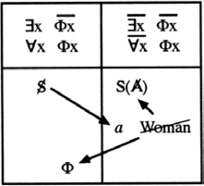
There are many extremely elaborate Lacanian readings of these formulas, providing and explaining their complex logical background, as well as interpreting their conceptual consequences.8 It is not my purpose here to engage in a discussion of this sort and scope. I will confine myself to some remarks that could link these formulas to the specific ontological inquiry into the sexual which I am pursuing in this book.
对这些公式,已经有大量极为精细的拉康派解读,它们给出并解释了这些公式复杂的逻辑背景,也阐释了其概念后果。3_8我在这里并不打算展开这样一类、这样范围的讨论。我只想限于几点评论,用它们把这些公式与我在本书中所做的、关于性的特定本体论探究联系起来。
The masculine (left) side posits that there exists One that is not castrated (and has access to full enjoyment: the primordial Father, the Woman): ∃x Φx. The exclusion of this One—that is, positing it as an exception, or exempting it—is the way in which the subject emerging on this side appropriates, frames, the minus involved in the signifying order. The exception (of a non-castrated One) functions as constitutive, that is, as the negative reference point, or the limit that permits everything else to be constituted as such, that is, to appear as everything else, or as a whole: all x are Φx, all x are subject to the function of castration (∀x Φx). The exception is inscribed here in the very appearing of all as all (as a determined totality): this is how one has to read together the two formulas in the upper-left corner of the scheme. The logic at stake here is nicely summed up by the following joke: “There are no cannibals here, we ate the last one yesterday”: the condition of “all of us” being “civilized” (non-cannibal) is the act of exemption that makes us “all.” This is also what is at stake in the Freudian myth of the killing of the primordial Father (as possessor of all women), followed by everyone giving up the claim to an “unlimited enjoyment” represented by the figure of the primordial Father. The exception (the “killing”) of the One frames the renunciation common to all. This basically means: everyone has to give up what they never had, and what is represented by the mythical figure of the primordial Father. The primordial Father is mythical in the precise sense that it is a necessary presupposition (and retrospective image) of the very notion of renunciation. Everyone has to give up what they never had—yet the form of giving it up is nonetheless essential. This is perhaps also the best definition of castration: to give up what one never had, that is to say, to transform the “minus one” which comes with the signifying order into something that we have renounced; to transform what we never had into something lost. In this kind of “framing” the negativity, the “negative quantity,” of the signifier order acquires a signifying form, a privileged signifier; the lack of the signifier gets a signifier, and this signifier is called Phallus. This brings us to the lower part of the left side of the formulas of sexuation. What we see here is precisely that man assumes castration by relying on its signifier (Φ or the master-signifier, S1—Lacan explicitly makes this connection) as the support of this subjective position, that is, as the support of “masculine” subjectivation.
男性侧(左侧)主张:存在一个不被阉割的“太一”(并且能通达完整享乐:原初父亲、女性大他者):3_9 ∃x Φx。对这个“太一”的排除——也就是把它设定为例外,或使它豁免——就是出现在这一侧的主体挪用并框定能指秩序中那个“负”的方式。这个(不被阉割的“太一”的)例外起着构成性作用,也就是作为否定性的参照点,或作为界限,让其余一切得以作为其余一切被构成,也就是让它们作为整体出现:所有x都是Φx,所有x都服从阉割功能(∀x Φx)。这里,例外被铭写在“全体作为全体(作为一个被规定的总体)出现”这件事本身之中:左上角的两个公式必须这样合起来读。这里的逻辑可由下面这个笑话很好地概括:“这里没有食人族,我们昨天把最后一个吃了”:我们“所有人”之所以是“文明”的(非食人的),条件正是那个使我们成为“所有人”的豁免行动。这也是弗洛伊德关于杀死原初父亲(作为占有所有女人的存在)的神话所涉及的东西:随后每个人都放弃了对“无限享乐”的要求,而这一享乐由原初父亲这个形象代表。“太一”的例外(“杀死”)框定了所有人共同的放弃。这基本上意味着:每个人都必须放弃自己从未拥有过的东西,以及由原初父亲这个神话形象所代表的东西。原初父亲是神话性的,确切地说,就因为它是“放弃”这一概念本身的必要预设(也是其回溯性形象)。每个人都必须放弃自己从未拥有过的东西——但放弃的形式仍然至关重要。这或许也是阉割最好的定义:放弃自己从未拥有过的东西;也就是说,把随能指秩序而来的“减一”转化为我们已放弃的东西,把我们从未拥有过的东西转化为失去的东西。在这种“框定”中,能指秩序的否定性、即“负量”,获得了一种能指形式,一个特权能指;能指的缺失获得了一个能指,而这个能指就叫菲勒斯。这就把我们带到性化公式左侧的下半部分。我们在这里看到的正是:男人依靠阉割的能指(Φ,或主人能指S1——拉康明确建立了这一联系)来承担阉割,把这个能指当作这一主体位置的支撑,也就是当作“男性”主体化的支撑。
This “assuming” it by means of the master-signifier—that is, by means of giving a signifying frame to the lack in the Other—equals assuming it by repressing it. One puts one’s faith in the hands of the signifier, but one does not want to know anything about what takes place in this swap (namely, “castration”). The subject thus relies on the signifying support of castration, Φ (we can say: he doesn’t need to know anything about castration because the signifier “knows” it for him), and establishes a relation to the Other in the guise of the small a on the right-hand side of the formulas. What does this mean, or imply? The mythical One of exception (the One which, by being “cut out,” so to speak, provides the signifying frame of the inaugural minus) also constitutes the frame or the “window of fantasy,” as Lacan puts it, through which the other can appear as desirable (as object-cause of desire). In other words: the “formal” structure that provides the signifying frame for the lack of the signifier, combined with the particular circumstances in which this “swap” takes place for a subject, determines the concrete conditions under which (and only under which) the Other appears desirable. Hence Lacan’s statement that man “never deals with anything by way of a partner but object a inscribed on the other side of the bar. He is unable to attain his sexual partner, who is the Other, except inasmuch as his partner is the cause of his desire” (Lacan 1999, 80). We have a nice illustration of this, to borrow one of Žižek’s examples, in Hitchcock’s movie Rear Window. James Stewart, immobilized by having his whole leg in plaster, is killing time by observing the people who live in the building opposite. A young nurse visits him every morning, and his fiancée (Grace Kelly) every evening. Grace Kelly is beautiful, rich, and crazy about Stewart. Yet he hardly seems to notice her, and is certainly in no hurry to marry her. Their relationship thus does not work too well, and they are on the verge of breaking it off. But this starts to change when they notice that strange things have been going on in one of the apartments across from Stewart’s—it looks as if the man who lives there has just killed his wife. The young couple start playing detective together, and a decisive change in their relationship takes place when Kelly enters the apartment under investigation, appearing in the window. The supposed murderer is out, and she is looking for clues to the crime. Stewart is observing this from his own window: he watches her searching the apartment, and being surprised by the unexpected return of the man who lives there. This short sequence changes everything: Stewart behaves as if he were seeing Grace Kelly for the first time; she captures his full attention, and, completely fascinated, he can no longer take his eyes off her. Without a word being exchanged between them, we—as spectators—can see it all: now he very much desires her. She has quite literally entered the “window of his fantasy,” and started to function as the object of his desire. …
借助主人能指来“承担”它——也就是说,给大他者的缺失套上一个能指框架——就等于通过压抑它来承担它。人们把信任交到能指手里,却不想知道在这场交换中发生了什么(也就是“阉割”)。于是,主体依靠阉割的能指性支撑Φ(我们可以说:他对阉割不需要知道任何东西,因为能指已经替他“知道”了)3_10,并以公式右侧那个小a的形态与大他者建立关系。这是什么意思,又意味着什么?神话性的例外的一(这个“太一”可以说通过被“切出”,为原初的“减”提供了能指框架)也构成了拉康所说的框架或“幻想的窗口”,他者通过它显现为可欲的(作为欲望的对象-原因)。换句话说,为能指的缺失提供能指框架的“形式”结构,连同这一“交换”在某个主体那里发生的特定情形,共同决定了大他者显现为可欲的具体条件(而且只在这些条件下才显现为可欲)。因此拉康说,人“从来不是和伴侣打交道,而只是和写在横杠另一侧的对象a打交道。他无法抵达作为大他者的性伴侣,除非他的伴侣就是他的欲望的原因”(Lacan 1999, 80)。借用齐泽克的一个例子,我们在希区柯克的电影《后窗》里有一个很好的说明。James Stewart整条腿打着石膏,动弹不得,只好靠观察对面楼里的住户来打发时间。一位年轻护士每天早上来看他,他的未婚妻Grace Kelly每天晚上来。Grace Kelly漂亮、富有,而且对Stewart爱得发狂。但他似乎几乎没注意到她,当然也不急着娶她。于是他们的关系并不太顺利,正处在分手的边缘。可当他们注意到Stewart住所对面的一间公寓里发生了怪事——住在那里的男人好像刚刚杀了妻子——事情开始起变化。这对年轻男女一起玩起侦探游戏,而当Kelly进入那间被调查的公寓、出现在窗口时,他们的关系发生了决定性的变化。那个被怀疑是凶手的人外出了,她在寻找犯罪线索。Stewart从自己的窗户观察这一切:他看着她搜查公寓,又被那个住户突然回来吓了一跳。这短短一段戏改变了一切:Stewart表现得好像第一次见到Grace Kelly;她完全抓住了他的注意力,他彻底着迷,再也无法把目光从她身上移开。他们之间一句话也没说,而我们——作为观众——却能看得很清楚:现在他对她充满欲望。她简直字面意义上走进了“他的幻想的窗口”,并开始作为他欲望的对象发挥作用。……
Let us now look on the other, feminine (right) side of the formulas of sexuation. Here the minus one that comes with the signifying order (constituting its real) configures differently: castration, as the signifying operator of the minus, does not rely for the feminine subject on the exclusion (exception) of the non-castrated Other. We start with negation of a possible exception, ∃x Φx: there is no x which does not fall under the phallic function (that is, under the function of castration). Castration allows for no exception. And it is precisely this that makes any universal statement impossible, as we read in the second line of the “feminine” formulas: not all x are Φx. We cannot speak of “all” women or, simply, of the woman. Why is the possibility of an exception excluded on this, the feminine side? What does it mean or imply? It is the logical writing of the juncture of the following two claims. First, woman is “the Other, in the most radical sense, in the sexual relationship” (Lacan 1999, 81). And second, “there is no Other of the Other.” If woman is the Other of man, man is not the Other of woman. There is no Other of the Other—the Other is included in the Other (as the Other sex). This is what is expressed by the following paradoxical formulation: “Being the Other …, woman is that which has a relationship to that Other” (ibid.). In other words, the relationship to the Other is, so to speak, included in the Other; it is “part” of the Other. Whereas a man can think of the Other as the exception to the rule, to his rule, on the basis of which he relates to women, a woman cannot think of the Other as the exception to her rule, but as part of the rule, as included in the rule. This affects significantly the nature of this rule, making it “not-all.” The nonexistence of the Other is itself inscribed into the Other. And this is precisely what the concept of the unconscious is about: the point where the nonexistence of the Other is itself inscribed into the Other. And, as suggested by the concept of the unconscious, this is not a point of self-reflective transparency, but that of a signifying gap constitutive of knowledge. This further implies that the infamous Lacanian “barred Other” is not simply an inconsistent, lacking Other, but the Other the inconsistency of which is inscribed in it, and has itself a marker in it: Lacan writes it as S(Ⱥ), signifier of the Other as barred. But what is this signifier? Here Lacan makes a most surprising connection: “by S(Ⱥ) I designate nothing other than woman’s jouissance” (Lacan 1999, 84). The signifier at stake is thus a most peculiar one. In order to understand what precisely is at stake here, we can relate it directly to the following crucial claim, made above: the emergence of the signifying order directly coincides with the non-emergence of one signifier, and at the place of this gap appears enjoyment as the heterogeneous element pertaining to the signifying structure, yet irreducible to it. In this precise sense, the enjoyment at stake essentially belongs to the unconscious (and to its “gap”): not as repressed, but as the very substance of the missing signifier which, as missing, gives its form to the unconscious. This also explains Lacan’s emphasis (in Seminar XX, where he discusses formulas of sexuation) on the question of knowledge and its “limits”: Can one know—and say—anything about this other, non-phallic enjoyment? The answer is no: one cannot say anything about this enjoyment, this other enjoyment cannot be an object of knowledge, because it is a placeholder for the knowledge which does not exist. This enjoyment appears at the place of the lack in knowledge, it appears because there is nothing to know there. In this precise sense, woman’s jouissance is the signifier of the lack of knowledge (in the Other). It marks the point where the Other does not know. If there was such a thing as “sexual relation,” this would amount to the existence of its signifier (knowledge) in the Other, but since there is no sexual relation, there is this other enjoyment. What this implies is that the infamous “feminine jouissance” is not an obstacle to the sexual relation, but a symptom (or marker) of its nonexistence. No wonder, then, that it has been subjected to such violent forms of exorcism in the course of history.
现在来看性化公式的另一边,也就是女性(右边)这一边。在这里,伴随能指秩序而来的那个减一(它构成能指秩序的实在界)有着不同的配置:阉割作为减一的能指操作符,对女性主体来说,并不依赖于把未阉割的大他者排除出去(作为例外)。我们从对一个可能例外的否定开始:不存在这样的x,它不落入菲勒斯函数(也就是阉割函数)之下。阉割不允许任何例外。正是这一点使任何全称陈述都不可能,正如我们在“女性”公式的第二行读到的:并非所有x都是Φx。我们不能谈论“所有”女人,也不能简单地谈论“女人”。为什么在女性这一边,例外的可能性被排除了?这意味着或暗示什么?这是以下两个主张之接合点的逻辑书写。第一,女人是“性关系中最彻底意义上的大他者”(Lacan 1999, 81)。第二,“没有大他者的大他者。”如果女人是男人的大他者,那么男人不是女人的大他者。没有大他者的大他者——大他者被包含在大他者之中(作为大他者性别)。下面这个悖论式表述说的就是这个:“作为大他者……女人就是与那个大他者有关系的东西”(同上)。换句话说,与大他者的关系可以说被包含在大他者之中;它是大他者的“一部分”。男人可以把大他者设想为规则的例外,也就是他的规则的例外,他正是依据这条规则与女人建立关系;女人却不能把大他者设想为她规则的例外,而只能把它设想为规则的一部分,被包含在规则之中。这显著改变了这条规则的性质,使它成为“非全”。大他者的不存在本身被铭写进大他者之中。而这正是无意识概念所关涉的:大他者的不存在本身被铭写进大他者之中的那个点。而且,正如无意识概念所提示的,这不是一个自我反思性透明的点,而是一个构成知识的能指裂隙。这进一步意味着,那个声名狼藉的拉康式“被划杠的大他者”并不只是一个不一致的、有所欠缺的大他者,而是其不一致性被铭写于自身之中、并在自身中拥有标记的大他者:拉康把它写作S(Ⱥ),即被划杠的大他者的能指。但这个能指是什么?在这里,拉康建立了一个最令人惊讶的联系:“我用S(Ⱥ)所指的,不是别的,正是女人的享乐”(Lacan 1999, 84)。因此,这里涉及的能指是一个极为特殊的能指。为了理解这里究竟涉及什么,我们可以把它直接联系到前面提出的一个关键主张:能指秩序的出现,直接伴随着一个能指的未出现;而在这个缺口的位置上,出现了享乐,它作为属于能指结构、却又不可还原为该结构的异质元素。正是在这个精确意义上,这里涉及的享乐本质上属于无意识(也属于它的“缺口”):它不是作为被压抑之物属于无意识,而是作为那个缺失能指本身的实体属于无意识;这个能指正因为缺失,才赋予无意识以形式。这也解释了拉康为什么(在讨论性化公式的《研讨班XX》中)强调知识与它的“界限”问题:人们能否知道——并说出——关于这种另一类、非菲勒斯的享乐的任何东西?答案是否定的:人们无法对这种享乐说出任何东西;这种另一种享乐不能成为知识的对象,因为它是为那种不存在的知识占位的东西。这种享乐出现在知识缺失的位置上;它出现,是因为那里没有什么可知道的。正是在这个精确意义上,女人的享乐是(大他者中)知识之缺失的能指。它标记出大他者不知道的那个点。如果真有“性关系”这回事,那就等于说它的能指(知识)存在于大他者之中;但既然没有性关系,就有这种另一种享乐。这意味着,那个声名狼藉的“女性享乐”并不是性关系的障碍,而是性关系不存在的症状(或标记)。因此,难怪它在历史进程中遭受了如此暴烈的驱魔式对待。
This S(Ⱥ), the other’s jouissance as the signifier of the “Other as barred,” is thus not to be confused with the signifier of castration (Φ, or the phallic function), with which a woman also has a relation: “woman has a relationship with S(Ⱥ), and it is already in that respect that she is doubled, that she is not-whole, since she can also have a relation with Φ” (Lacan 1999, 81). The relation with Φ—that is to say, the relation with the signifier—is the relation on which existence is founded (for any speaking being), whereas the relation with S(Ⱥ) puts us on the path of “ex-sistence.” But the point is not simply that a woman only partly falls under the phallic function, that she is not “whole” in it, and that part of her remains outside. No, “she is there in full” (ibid., 74). But there is something else (en plus), which comes with the position of being the Other in the sexual relation, and this supplement—the relation with S(Ⱥ)—not only detotalizes her, but also makes her relation with Φ different than in the case of a man.
这个S(Ⱥ),也就是作为“被划杠的大他者”之能指的大他者享乐,因此不能与阉割的能指(Φ,或菲勒斯功能)相混淆;女人与后者也有关系:“女人与S(Ⱥ)有关系,而且正是在这一点上,她被双重化,她不是全部,因为她也可以与Φ有关系”(Lacan 1999, 81)。与Φ的关系——也就是说,与能指的关系——是存在得以奠定的关系(对任何言说存在者而言),而与S(Ⱥ)的关系则把我们带上“外-存在”的道路。但要点并不只是:女人只部分地落入菲勒斯功能之下,她在其中不是“全部”,她有一部分留在外面。不,“她整个都在那里”(同上,74)。但还有别的东西(en plus),它伴随着在性关系中作为大他者这一位置而来;这个增补——与S(Ⱥ)的关系——不仅把她去总体化,也使她与Φ的关系不同于男人的情况。
note:因为没有例外,所以女人一定在菲勒斯功能下面,但是不存在x不受菲勒斯定义 -> 并非所有x都受菲勒斯定义的原因是:一个闭合的集合一定需要排除一些东西,如果不存在x不受菲勒斯定义,那么这个受菲勒斯定义的集合就无法闭合。
We could perhaps put it in the following way: Being the Other in the sexual relationship, a woman cannot rely (for her being) on a constitutive exception, but relies on a constitutive deception. This, at least, was the remarkable idea suggested by Joan Riviere in her essay “Womanliness as Masquerade,” where she suggests that femininity is essentially a masquerade, a putting on of femininity. Needless to say, this point was much appreciated by Lacan. Riviere proceeds in two steps. She starts from a case study of a woman who was extremely successful in what was then considered an intellectual “male” profession (involving public speaking and writing), who, particularly after a successful public performance, tended to react with an excessive display of femininity, by compulsive flirting and coquetry. What analysis revealed in this particular case, and in Riviere’s account, was the following:
[Her compulsive ogling and coquetting] was an unconscious attempt to ward off the anxiety which would ensue on account of the reprisals she anticipated from the father-figures after her intellectual performance. The exhibition in public of her intellectual proficiency, which was in itself carried through successfully, signified an exhibition of herself in possession of the father’s penis, having castrated him. The display once over, she was seized by horrible dread of the retribution the father would then exact. (Riviere 1929, 305)
也许我们可以这样表述:在性关系中作为大他者,女人(就她的存在而言)不能依靠一种构成性的例外,而只能依靠一种构成性的欺骗。至少,这是Joan Riviere在《女性特质作为假面舞会》一文中提出的一个引人注目的想法:她认为女性特质本质上是一场假面舞会,是把女性特质穿戴起来。不必说,拉康很欣赏这一点。Riviere分两步展开。她首先从一个个案研究出发:这位女性在当时被视为知识性的“男性”职业中极为成功(该职业涉及公开演讲和写作),而她尤其在一次成功的公开表现之后,往往会以过度展示女性特质来作出反应,表现为强迫性的调情和卖弄风情。分析在这个具体个案中、也在Riviere的叙述中揭示出的是:
[她那强迫性的抛媚眼和卖弄风情]是一种无意识的尝试,用来挡开一种焦虑:她预想自己智力表现之后会遭到父亲式人物的报复,而这种焦虑就会随之而来。公开展示自己的知识才能——这一展示本身是成功完成的——意味着展示她自己占有父亲的阴茎,并且已经阉割了他。展示一旦结束,她就被一种可怕的恐惧攫住:父亲随后会施加报复。
To ward off this anxiety she engaged in coquetting and a display of femininity, “‘disguising herself’ as merely a castrated woman, [so that] in that guise the man found no stolen property on her” (ibid., 306). This is not to say, of course, that while she was “disguising herself” as castrated, in truth she was not. Behind her disguise there was not something like a full non-castrated subjectivity, but a full-blown anxiety, on which I will comment later.
为了抵御这种焦虑,她卖弄风情,展示女性特质,“‘伪装自己’不过是个被阉割的女人,[于是]以这副模样,男人在她身上找不到任何被偷走的东西”(同上,306)。当然,这并不是说,她在“伪装”成被阉割者时,实际上她并没有被阉割。她的伪装背后并不是什么完整的、未被阉割的主体性,而是一种充分展开的焦虑;对此我后面会再谈。
It is only fair to say that Riviere’s account of the case in question often reads as an oversimplified application of psychoanalytic theory and its “ready-made” concepts, rather than as analysis proper. Yet crucial for our argument here is her next step, which brought the article its (deserved) fame, and in which she arrives at a more general conclusion, not necessarily related to this particular woman’s history and psyche: femininity (or womanliness) as such is nothing but this susceptibility to wear femininity as a mask (that is to say, to wear castration as a mask). There is no “true femininity” as opposed to femininity as masquerade:
The reader may now ask how I define womanliness or where I draw the line between genuine womanliness and the “masquerade.” My suggestion is not, however, that there is any such difference; whether radical or superficial. They are the same thing. (Riviere 1929, 306)
平心而论,Riviere 对所讨论个案的叙述,读起来常常像是对精神分析理论及其“现成”概念的过度简化应用,而不是严格意义上的分析。不过,对我们这里的论证来说,关键是她接下来的一步;正是这一步让这篇文章获得了(当之无愧的)名声,也让她得出一个更一般的结论,而这个结论未必与这位特定女性的历史和心灵有关:女性特质(或女人味)本身,无非就是这种倾向——把女性特质当作面具戴上(也就是说,把阉割当作面具戴上)。并不存在一种与作为假面的女性特质相对立的“真正女性特质”:
读者现在也许会问:我怎样定义女人味?我又在哪里划出真正女人味与“假面”之间的界线?不过,我想说的并不是存在任何这类差别——无论是根本差别还是表面差别。它们是一回事。(Riviere 1929, 306)
One can be a woman only if one is not “intrinsically so”—at its most genuine, femininity is masquerade. In this precise sense it is perhaps not enough to say that there is no essence of femininity; one could go a step further and say that the essence of femininity is to pretend to be a woman.
一个人只有不“本质上就是女人”,才能成为女人——女性特质在最本真的意义上就是伪装。正是在这个确切意义上,或许只说女性特质没有本质还不够;还可以再进一步说,女性特质的本质就是假装自己是个女人。
One is a woman if one carries castration as a mask. Castration is not repressed (or it is repressed, but to a lesser extent than in the case of men), neither is it assumed as something empirical. That emphasis is crucial, since this is not about revealing, disclosing, or “accepting” any kind of empirical fact—for example, that “she doesn’t have it”; it is not that she openly reveals that she is “castrated”: castration can only be enacted, the real of castration is not something that could be exposed or seen as such. Nobody has it (namely, the missing signifier), men no more so than women; what they both have is a way of dealing with this ontological minus by dealing with its marker (phallic function as the function of castration). And if using it as a mask defines the feminine position, this does not prevent men from using it as a mask as well: this is why an ostentatious display of virility (men meticulously dressing up in “masculine” clothes or, for example, in costumes of symbolic power) always has the curious effect of seeming feminine. The “phallic function” is not masculine: what we perceive as “masculinity” and “femininity” are different ways of its deployment. “Putting it on” suggests femininity. But “putting it on what?”
一个人若把阉割作为面具来承担,她就是女人。阉割不是被压抑的(或者说它也被压抑,但程度比男人的情况轻),它也不是作为某种经验性事实被承担。这个强调很关键,因为这里不是要揭示、披露或“接受”某种经验事实——比如“她没有它”;也不是说她公开表明自己被“阉割”了:阉割只能被实行,阉割的实在界不是可以被暴露出来的东西,也不是可以按其实在本身被看见的东西。没有人拥有它(也就是那个缺失的能指),男人并不比女人更有;男女双方共同拥有的,是一种通过处理它的标记(作为阉割功能的菲勒斯功能)来应对这一本体论缺失的方式。而如果把它当作面具来使用界定了女性位置,这并不妨碍男人也把它当作面具来使用:这就是为什么炫耀式地展示男子气概(男人一丝不苟地穿上“男性”衣服,或比如穿上象征权力的服装)总有一种奇特效果,显得女性化。“菲勒斯功能”并不属于男性:我们所感知为“男性特质”和“女性特质”的东西,是它不同的运作方式。“把它戴上”暗示着女性特质。但“把它戴在什么上?”
This question leads us back to the anxiety that Riviere emphasizes in her analysis and which, I will suggest, goes beyond the fear of reprisals (by father figures) which she underlines, and joins what could be seen as a more general “feminine anxiety”: anxiety pertaining to femininity as essentially a masquerade. This path is implicitly indicated by Riviere herself: she keeps repeating the same metaphor in her description of the dread that compels the woman from her analysis to “disguise herself as castrated” after every (public) achievement: the metaphor of “stolen goods” or “stolen property.” Her display of femininity, writes Riviere, was “much as a thief will turn out his pockets and ask to be searched to prove that he does not have the stolen goods.” What I would add to Riviere’s analysis at this point is simply the following: at stake here is not simply the dread of being punished for stealing the father’s property, but also, and more fundamentally, the anxiety of literally being nothing: if her intellectual performance was attributable to stolen property, then who, or what, or where, is “she”? In other words, the really troubling question here is: What if I’m not really anything, what if there is no “me” in any of this? This ontological anxiety doesn’t stop at “Am I that name?,” rather, it revolves around “Do I exist at all?” All that I have left at this point is a pretense, a mask. The subject hinges on this mask, and not perhaps the other way around. Under the mask there is nothing but sheer ontological anxiety.
这个问题把我们带回 Riviere 在其分析中强调的焦虑;我会提出,这种焦虑超出了她所强调的对(父亲式人物)报复的恐惧,并连接到一种可被视为更普遍的“女性焦虑”:这种焦虑关乎女性特质,而女性特质本质上是一种假面。Riviere 自己已经隐含地指出了这条路径:在描述那种迫使她分析里的那位女人在每一次(公开)成就之后“把自己装扮成被阉割者”的恐惧时,她不断重复同一个隐喻:“偷来的物品”或“偷来的财产”。Riviere 写道,她对女性特质的展示“很像一个小偷翻出自己口袋、要求被搜身,以证明自己并没有偷来的东西”。我在这一点上要给 Riviere 的分析补充的,只是下面这一点:这里涉及的并不只是因偷窃父亲的财产而受惩罚的恐惧,而且更根本地,是字面意义上“什么也不是”的焦虑:如果她的智识表现可以归因于偷来的财产,那么“她”是谁,或者是什么,或者在哪里?换句话说,这里真正令人不安的问题是:如果我其实什么也不是呢?如果在这一切之中根本没有“我”呢?这种本体论焦虑不会停在“我是那个名字吗?”上,而是围绕着“我究竟存在吗?”打转。到这一步,我所剩下的只有一种装样子、一张面具。主体系于这张面具,也许而不是反过来。面具底下别无他物,只有赤裸裸的本体论焦虑。
According to Lacan, this radical ontological anxiety is the prerogative of subjectivity as such; and precisely in this sense, the feminine position is the closest to subjectivity in its pure state. To be a man implies a step in a different direction—relying on the phallus as his signifying support (as “that which props him up,” as Lacan puts it)—he believes that he is (exists), which is why “male anxiety” usually stops at castration anxiety. Man is the subject who believes he is man. Masculinity is a question of belief (based on, and sustained by, the repression of castration).
拉康认为,这种根本的本体论焦虑是主体性本身的特权;也正是在这个意义上,女性位置最接近纯粹状态的主体性。做一个男人,意味着朝另一个方向迈一步——依靠菲勒斯作为自己的能指支撑(用拉康的话说,就是“那个把他撑起来的东西”)——他相信自己“是”(存在),所以“男性焦虑”通常止步于阉割焦虑。男人就是那个相信自己是个男人的主体。男性特质是一个信念问题(它基于对阉割的压抑,并由这种压抑维持)。
Of course, believing oneself to be a man does not exclude the painful anxiety about how much of a man one is; on the contrary: only those who fundamentally believe themselves to be men can have this kind of worry, or anxiety. … This, by the way, also sheds some light on why it often happens that apropos of women who excel in “male” professions, one asks whether they are “really women.” To conclude that they are not really women but “men” (“mannish” or homosexual) seems to result in relief—relief from what? From the anxiety (dread) that behind these accomplishments there is no substantial subjectivity and that, furthermore, this could be a general state of things, with masculinity being but a simulacrum of a substantial subjectivity. When men feel threatened by such women, it is not simply that they represent for them a “threat of castration”; rather, their presence makes it harder for men to sustain the repression of castration; it weakens the defense wall of anxiety. And this explains the often violent and affect-ridden reactions to these women.
当然,自认为是个男人,并不排除一种痛苦的焦虑:自己到底在多大程度上算个男人;恰恰相反:只有那些从根本上相信自己是个男人的人,才会产生这种担忧或焦虑。……顺便说,这也多少解释了为什么常常会出现这样一种情况:谈到那些在“男性”职业中表现出色的女人,人们会问她们是不是“真正的女人”。一旦断定她们其实不是女人,而是“男人”(“男人婆”或同性恋),似乎就会带来一种宽慰——从什么当中获得宽慰呢?从这样一种焦虑(恐惧)中获得宽慰:在这些成就背后并没有实体性的主体性;而且,这可能是一种普遍状态,男性特质不过是对实体性主体性的拟像。当男人感到被这样的女人所威胁时,并不只是因为这些女人对他们代表着“阉割的威胁”;更确切地说,她们的存在使男人更难维持对阉割的压抑;它削弱了抵御焦虑的防御墙。这也解释了人们常常对这类女人产生暴烈而情绪化的反应。
So this, then, is how sexual division could be formulated from the perspective of the question of the ontological minus: masculinity is a matter of belief, femininity is a matter of pretense. And one can (it is to be hoped) see from this formulation in what sense the psychoanalytic take on sexual difference is not about finding a pertinent feature differentiating men and women; it is about the parallax inscription of the constitutive minus of the signifying order in this order itself. This could well be why Lacan never actually uses the term sexual difference, but speaks of sexual “division.” This is also why, for him, language is not a neutral medium of communication between subjects, but produces subjects by implicating them in its inherent antagonism, its own inherent contradiction and impossibility. Subjects are not “constructed” by language; they are produced as a response to its inherent limit, and the unexpected plus appearing at this limit.
那么,这就是从本体论缺失问题的视角出发,可以如何表述性划分:男性特质关乎信念,女性特质关乎伪装。人们(但愿如此)可以从这一表述中看到,精神分析对待性别差异的方式,并不是去找某个能区分男女的相关特征;它关涉的是,把能指秩序的构成性缺失以视差性的方式铭写进这一秩序自身之中。这很可能正是为什么拉康实际上从不使用“性别差异”一词,而是说性“划分”。这也正是为什么,对他来说,语言并不是主体之间中性的交流媒介,而是通过把主体卷入语言自身固有的对抗、它自身固有的矛盾与不可能性之中来生产主体。主体不是由语言“建构”出来的;主体是作为对语言固有界限的回应、并且是在这一界限处出现的意外之“加”而被生产出来的。
Although it is formulated more explicitly much later, this fundamental insight is already implicit in the perspective from which Lacan, in his 1957 essay “The Instance of the Letter in the Unconscious,” criticizes the logic usually associated with structural linguistics, and particularly with the famous Saussurean algorithm (S/s—signifier over signified). The central theme of structural linguistics is the emphasis on pure differentiality (as Saussure famously puts it in his Course in General Linguistics: in language there are only differences without positive terms, and signifiers “make sense,” or produce meaning, only as parts of differential networks of places, binary oppositions, etc.), as well as the emphasis on the arbitrariness of the sign: the signifying chain is strictly separated from the signified, which is what the bar in the Saussurean algorithm indicates. This algorithm, argues Lacan, can sustain the illusion that the signifier serves the function of representing the signified, and that it has to justify its existence in terms of some signification. To illustrate this erroneous conception, Lacan first reproduces what he calls “the faulty illustration” (reproduced from Lacan 2006c):
这一根本洞见虽然很久以后才得到更明确的表述,但已经隐含在拉康1957年《无意识中文字的动因》所采取的视角中。拉康正是从这个视角出发,批判通常与结构语言学、尤其与著名的索绪尔式算法(S/s——能指在所指之上)联系在一起的逻辑。结构语言学的核心主题,是强调纯粹的差异性(正如索绪尔在《普通语言学教程》中的名言:语言中只有差异,没有积极项;能指只有在由位置、二元对立等构成的差异网络中,作为其中一部分,才“有意义”或产生意义),同时也强调符号的任意性:能指链与所指严格分离,而索绪尔式算法中的横杠正表示这一点。拉康认为,这一算法会维持一种幻觉:能指的功能就是代表所指,而且它必须依据某种意义来证明自身的存在。为了说明这种错误观念,拉康先复制了他所说的“有缺陷的图示”(复制自Lacan 2006c):
The signifier “tree” would serve (albeit arbitrarily) to represent some signification. This is the conception that Lacan refutes as erroneous. On the other hand, he is also well aware that it is not enough to simply assert that there is no connection whatsoever between the two levels of the algorithm, and to subtract from the algorithm S/s solely the notion of the parallelism of its upper and lower terms, because this way “it remains the enigmatic sign of a total mystery. Which, of course, is not the case” (Lacan 2007, 416).
能指“树”会(尽管是任意地)用来代表某种意指。拉康驳斥的正是这种看法,认为它错了。另一方面,他也很清楚:仅仅断言算法的两个层面之间根本没有联系,并且只从算法 S/s 中抽掉上下项平行这一观念,仍然不够;因为这样一来,“它仍然是某个完全神秘之物的谜样符号。当然,情况并非如此”(Lacan 2007, 416)。
For Lacan there is a connection between the two levels, but it is not that of representation, nor that of signification. So, what is it? How to think it without falling back into the (pre-Saussurean) position of seeing language as a collection of names for a collection of objects? Lacan’s answer is that “the signifier in fact enters the signified—namely, in a form which, since it is not immaterial, raises the question of its place in reality” (Lacan 2007, 417). This, then, is the connection we were looking for: the signifier “enters the signified,” and the bar between them does not exactly prevent that. But how can we understand this? I believe it is quite legitimate to understand the singular connection at stake in terms of “with-without” as discussed above. The signifier does not represent a signified, nor is it simply “an enigmatic sign of a total mystery”—it is with-without the signified (as the binary signifier). The lack of the relation symbolized by the bar between the two levels is itself inherent to the signifier (and the signifying order) as such. It should not be conceived simply as the incapacity of the signifier to find, attain (and relate to) its signified, but rather as language’s inherent minus and contradiction. This is the inherent twirl/loop of the symbolic order, the (same) minus implied and repeated by every word we utter. What links/relates one signifier to another (constituting the signifying chain) is precisely the negativity of with-without: this is the gap inherent to the signifying order where Lacan situates the subject (of the unconscious). And the beauty of it is, of course, that this with-without is already there in the signifier without: with-out—to be without something is to be with the lack of something. We could thus say that Lacan transposed the bar separating the signifier from the signified (S/s) into the bar inherent to the register of the signifier itself. “A signifier represents the subject for another signifier” is his formula that makes this binding negativity explicit. And this is also why, for Lacan, the theory of the signifier is inseparable from the theory of the unconscious—the “with-without” (or simply with-out) could also be taken as the very formula (the letter) of the unconscious; not of any unconscious content, but of the very form (topology, structure) of the unconscious. The signifier and the unconscious (or the subject of the unconscious) are inseparable concepts; the signifying order (emerging with-without one signifier) and the constitution (of the loop) of the unconscious are one and the same thing.
对拉康来说,这两个层面之间有联系,但不是再现的联系,也不是意指的联系。那么是什么?怎样才能思考它,而不退回到(前索绪尔式的)立场,把语言看成一组名称对应一组对象?拉康的回答是:“能指实际上进入了所指——也就是说,以一种形式进入,而这种形式既然不是非物质的,就提出了它在现实中的位置问题”(Lacan 2007, 417)。这就是我们要找的联系:能指“进入所指”,而两者之间的横杠并不真的阻止这一点。但我们怎么理解?我认为,用前面讨论的“有-无”(with-without)来理解这里独特的联系,是完全正当的。能指并不代表一个所指,也不只是“一个总体谜团的神秘符号”——它与所指是有-无的关系(作为二元能指)。两个层面之间的横杠所象征的那种关系的缺失,本身就是能指(以及能指秩序)所固有的。不应把它简单设想为能指无法找到、达到(并关联于)其所指,而应把它理解为语言自身固有的缺失和矛盾。这就是象征秩序固有的旋转/回环,是我们每说一个词都隐含并重复的(同一个)缺失。把一个能指与另一个能指连接/关联起来(构成能指链)的,正是“有-无”的否定性:这就是能指秩序固有的裂隙,拉康把(无意识的)主体定位于此。当然,妙处在于,这个“有-无”已经就在“without”这个能指里:with-out——没有某物,就是带着对某物的缺失。于是我们可以说,拉康把分隔能指与所指(S/s)的横杠,移置成了能指领域本身固有的横杠。“一个能指为另一个能指代表主体”,这是他让这种联结性的否定性变得明确的公式。也正因如此,对拉康来说,能指理论与无意识理论不可分——“有-无”(或干脆说 with-out)也可以被当作无意识本身的公式(字母);不是任何无意识内容的公式,而是无意识本身形式(拓扑、结构)的公式。能指与无意识(或无意识主体)是不可分的概念;能指秩序(伴随着一个能指的缺失而出现)与无意识的(回环的)构成,是同一回事。
For Saussure, language functions as a system of pure differentiality. Meaning emerges through relations of difference that a signifier maintains in relation to other signifiers (“tree” is tree because it is not “car,” “bush,” “train,” and so on). In language, everything is thus based on relations. Lacan’s point, however, which moves beyond Saussure and the classical structuralist approach, is that this pure relational differentiality, which he admits, can only be based on a non-relation or, if one prefers, on a different kind of difference. In order for the relational differentiality to exist and to function, the one (of the binary relation) has to be missing. And this makes all the difference (the possibility of differentiation can appear only on the basis of this fundamental difference). This is Lacan’s crucial addition which allows him to reintroduce the concept of the subject (of the unconscious) at the very highest point of the structuralist attacking of this notion.
对索绪尔来说,语言是一个纯粹差异性的系统。意义通过能指与其他能指保持的差异关系而产生(“树”之所以是树,是因为它不是“车”“灌木”“火车”,等等)。因此,在语言中,一切都建立在关系之上。然而,拉康的要点——也是他超越索绪尔和经典结构主义方法之处——在于:他承认这种纯粹的关系性差异性,但它只能建立在一个非关系之上,或者如果你愿意,也可以说建立在另一种差异之上。关系性差异性要存在并发挥作用,二元关系中的那个“一”就必须缺失。而这就造成了一切差异(区分的可能性只能在这种根本差异的基础上出现)。这是拉康的关键补充,使他能够在结构主义对这一概念攻击得最激烈的地方,重新引入(无意识的)主体概念。
And, as I have been arguing so far, the real of sexual division is linked to precisely this point of the “missing one.” I would further suggest that this is why Lacan uses as a key example of his general understanding of the functioning of the signifier the following, also quite famous, drawing (reproduced from Lacan 1999):
而且,正如我迄今一直在论证的,性的区分的实在界恰恰关联到“缺失的一”这一点。我还想进一步指出,正因如此,拉康才把下面这张同样相当著名的图(转引自拉康 1999)当作关键例子,用来说明他对能指运作的一般理解:
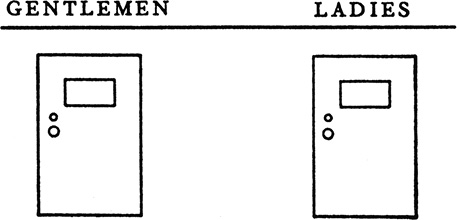
This is the drawing (illustration) with which he replaces the “faulty illustration” (the one involving the tree). What do we have here? Two different names written above (the repetition of) the same thing, a door. In other words, we have differentiality (two different signifiers), but there is nothing different in the realities to which they refer. And yet they are not one reality, but reality as split. Lacan is quick to add that his point is not merely to silence the nominalist debate with a low blow, “but to show how the signifier in fact enters the signified” (Lacan 2007, 417).
这就是他用来替换那个“有问题的图示”(也就是涉及树的那一幅)的图(图示)。这里有什么?两个不同的名称,写在同一个东西——一扇门——的重复之上。换句话说,我们得到的是差异性(两个不同的能指),但它们所指涉的现实并没有什么不同。然而,它们并不是同一个现实,而是分裂的现实。拉康马上补充说,他的要点不只是用一记阴招让唯名论争论闭嘴,“而是要表明能指实际上如何进入所指”(Lacan 2007, 417)。
There is nothing neutral in this example; on the contrary, it is highly biased. For it cannot be taken and understood outside Lacan’s persistent emphasis on how sexual difference is a singular kind of difference, which does not follow the basic signifying logic of binary oppositions and differentiations. We thus seem to be facing an obvious contradiction: how can Lacan use, as his showcase illustration of the functioning of the signifier, an example that, according to his own theory, does not fall under the usual rules of functioning of the signifier? The answer is that what Lacan is after here—in his debate with structural linguistics—is not simply an example of the functioning of the signifier, but also an example of the presuppositions of this functioning: presuppositions left out by linguistics, and brought into focus by psychoanalysis.
这个例子没有任何中立之处;相反,它高度有偏。因为不能脱离拉康反复强调的一点来理解它:性差异是一种独特的差异,它不遵循二元对立和区分的基本表意逻辑。3_11 于是我们似乎面对一个明显的矛盾:拉康怎么能用一个按他自己的理论并不属于能指通常运作规则的例子,来作为能指运作的示范性例证?答案是,拉康在这里——在与结构语言学的论辩中——所追求的,不只是一个能指运作的例子,也是一个能指运作之预设的例子:这些预设被语言学遗漏,而由精神分析带入焦点。
In other words, the “Ladies and Gentlemen” example is not so much an example of the logic of the signifier as the example “illustrating” the constitutive gap and contradiction at the very core of the signifying logic; it is not one of many possible examples, but rather an example which, in a sense, is implicit in any other example decomposed to the level of its presuppositions. The example used by Lacan at this crucial point of his theory of the signifier is thus by no means accidental, which becomes abundantly clear when he goes on to replace this “contrived example,” as he calls it (the above schema), with a “lived experience of truth,” namely, the following story:
A train arrives at a station. A little boy and a little girl, brother and sister, are seated across from each other in a compartment next to the outside window that provides a view of the station platform buildings going by as the train comes to a stop. “Look,” says the brother, “we’re at Ladies!” “Imbecile!” replies his sister, “don’t you see we’re at Gentlemen.”
换句话说,“Ladies and Gentlemen”这个例子,与其说是能指逻辑的一个例子,不如说是“说明”能指逻辑最核心处那个构成性裂隙与矛盾的那个例子。它不是众多可能例子中的一个,而是在某种意义上,隐含于任何其他例子之中的例子——只要把那个例子分解到它的预设层面。正因为如此,拉康在能指理论这个关键点上所用的例子绝非偶然;当他接着用一段“真理的活生生经验”来替换这个他所谓的“刻意构造的例子”(即上述图式)时,这一点就变得再清楚不过了。那段经验就是下面这个故事:
一列火车到站。一个小男孩和一个小女孩,兄妹俩,面对面坐在车厢里,旁边是靠外的车窗。火车停下时,从窗里可以看到站台建筑一一掠过。“看,”哥哥说,“我们到‘Ladies’了!”“白痴!”妹妹回答,“你没看见我们到‘Gentlemen’了吗。”
And he accompanies this story with a very precise, and beautiful, commentary:
one would have to be half-blind to be confused as to the respective places of the signifier and the signified here, and not to follow from what radiant center the signifier reflects its light into the darkness of incomplete significations.
For the signifier will raise Dissension that is merely animal in kind, and destined to the natural fog of forgetfulness, to the immeasurable power of ideological warfare, which is merciless to families and a torment to the gods. To these children, Gentlemen and Ladies will henceforth be two homelands toward which each of their souls will take flight on divergent wings, and regarding which it will be all the more impossible for them to reach an agreement since, being in fact the same homeland, neither can give ground regarding the one’s unsurpassed excellence without detracting from the other’s glory. (Lacan 2007, 417)
他给这个故事配了一段非常精确而优美的评论:
人得半瞎,才会搞不清这里能指和所指各自的位置,才会看不出能指是从怎样一个光芒四射的中心,把光反射进不完整意指的黑暗之中。
因为能指会把一种纯属动物性的、注定落入遗忘之自然迷雾的纷争,提升为意识形态战争那股无可估量的力量;这种战争对家庭毫不留情,对诸神则是折磨。对这些孩子来说,从今往后,“绅士”与“女士”将是两个故乡;他们每个人的灵魂都会展开彼此分岔的翅膀飞向它们。而他们也就更不可能就这些故乡达成一致,因为二者实际上是同一个故乡:任何一方要承认其中一个无可超越的卓越,都不可能不损害另一个的荣耀。(Lacan 2007, 417)
This passage is extremely valuable because we can clearly see how, for Lacan, two topics (the topic of the logic of the signifier and the topic of sexual division) coincide; he treats them as inseparable. Not because the signifier would already presuppose sexual difference, or construct it as such, but because sexual difference (and all the contrived dialectics of sexuality, desire, love) is the consequence—not simply of the signifying order, but of the fact that something is lacking in it (and that, at the same time, there is something excessive in it—surplus-enjoyment). As two perspectives within the same signifying configuration, the (not quite) two sexualized subjects mark a radical difference, or difference as such. This is the difference that has no ground: it does not spring from two different grounds, which would allow it to settle as difference between two “homelands” (which could then sign an agreement, and establish a “relation”). Their homeland is one and the same: yet this oneness and sameness is the oneness and sameness of pure difference.
这段文字非常有价值,因为我们可以清楚地看到,对拉康来说,两个论题——能指逻辑的论题和性的区分的论题——是如何重合的;他把它们视为不可分割。这并不是因为能指已经预设了性差异,或已经把性差异本身建构出来,而是因为性差异(以及性、欲望、爱那整套编造出来的辩证法)是一个结果——不只是能指秩序的结果,还是能指秩序中有某种东西缺失这一事实的结果(与此同时,能指秩序中又有某种过剩的东西——剩余享乐)。作为同一能指构型中的两个视角,两个(并不完全是两个)性化主体标出了一种根本差异,或者说差异本身。这是没有根据的差异:它并非来自两个不同的根据,否则它就能落定为两个“家园”之间的差异(而这两个家园随后可以签订协议,建立一种“关系”)。它们的家园是同一个:然而这种一体性与同一性,正是纯粹差异的一体性与同一性。3_12
note:性差异不是生物男女有别也不是社会/语言的规训的产物,而是副产物——语言本身漏洞的副产物,因此,男人来自火星、女人来自金星其实是一个很和谐的、各自为营的状态,但实际上,男女是同一个主体面对一种匮乏后不得不进行的防御姿态,他们在争夺一块地盘——菲勒斯空洞后不得不填补的块。
Lacan’s example is thus not simply an example of the functioning of the signifier, but also and above all an example of its negative ontological presuppositions; it is an example of what pins the dimension of language to the gap of the unconscious, to a “radical heteronomy … gaping within man” (Lacan 2007, 436), as he puts it. This heteronomy is thus not that between Ladies and Gentlemen, but between language as a system of differences and the object-like surplus (a) appearing at the place of the constitutive minus of this system, spoiling its pure differentiality. Sexual difference is difference in the configuration (logic) of this “spoiling.” This is the other point where psychoanalysis parts from structural linguistics. If we consider the phenomena of speech that psychoanalysis mostly deals with, it is simply not true that all meaning is produced according to the laws of pure differentiality, but also following two other mechanisms pointed out by Freud: sonorous similarities or homonyms, and associations that exist in the speaker’s memory. Slips of the tongue, jokes, dreams—in all these (and others) we find something very much like positive entities, with words functioning in a strangely similar fashion to objects. Lacan thought this Freudian point was crucial.
拉康的这个例子因此不只是能指运作的一个例子,而且尤其还是能指之否定性本体论预设的一个例子;它例示了究竟是什么把语言这一维度钉在无意识的裂隙上,钉在——如拉康本人所说——一种“根本他律……在人之中张裂开来”(Lacan 2007, 436)之上。因此,这种他律不是“女士”与“先生”之间的他律,而是作为差异系统的语言与对象般的剩余(a)之间的他律:后者出现在该系统构成性的减号/缺失之处,搅坏了它的纯粹差异性。性差异就是这种“搅坏”的构型(逻辑)中的差异。这是精神分析与结构语言学分道扬镳的另一点。如果我们考察精神分析主要处理的言语现象,那么“所有意义都按照纯粹差异性的法则被生产”这一说法根本不成立;意义还遵循弗洛伊德指出的另外两种机制:声音上的相似或同音词,以及存在于说话者记忆中的联想。口误、玩笑、梦——在所有这些(以及其他)现象中,我们都会发现某种很像肯定性实体的东西:词语以奇怪地类似于对象的方式运作。拉康认为弗洛伊德这一观点至关重要。3_13
Signifiers are never pure signifiers. They are ridden, from within, with unexpected surpluses that tend to ruin the logic of their pure differentiality. On the one side—the structuralist side that Lacan includes in his theory—they are separated from the signified in the sense that there is no inherent connection leading from the signifier to its meaning. Yet, if this were all, the signifying field would be a consistent system and, as the structuralist motto goes, a structure without a subject. Lacan subscribes to this view to the extent to which it convincingly does away with the notion of a “psychological subject,” of an intentional subjectivity using language for its purposes, mastering the field of speech or being its Cause and Source. Yet he goes a step further. If we focus on the signifying chain, precisely in its independence and autonomy, we are bound to notice that it constantly produces, from within itself, quite unexpected effects of meaning, a meaning which is, strictly speaking, a surplus meaning that stains the signifiers from within. This is the locus of the subject (of the unconscious). And it is precisely through this surplus meaning (bound up with surplus-enjoyment) that signifiers are irreducibly and intrinsically bound to the reality to which they refer; it is in this way that they “enter the signified.” We can thus supplement our thesis according to which this “entering the signified” could be understood in terms of with-without which marks an absence at the very heart of the signifying presence: supplement it by this dimension or element of surplus meaning/enjoyment as the other side (l’envers) of the negativity implied in the with-without. The signifier enters the signified (in a form “which is not immaterial,” as Lacan adds), and thus takes a place in reality, in the form of this surplus which creates, as well as complicates, the signifying relations, twisting and “driving” their logic.
能指从来不是纯粹的能指。它们从内部被种种意想不到的剩余所侵扰,这些剩余往往会破坏它们纯粹差异性的逻辑。在一边——也就是拉康纳入其理论的结构主义这一边——能指与所指是分离的,因为从能指到其意义并没有任何内在联系。然而,如果仅止于此,能指场就会是一个一致的系统,而且按结构主义的口号,就是一个无主体的结构。拉康赞同这一看法,只要它令人信服地取消了“心理主体”的观念:即一个有意向性的主体性,为自身目的使用语言,掌控言语场,或作为言语的原因和源头。但他更进一步。如果我们聚焦于能指链,恰恰在其独立性和自主性中,我们必然会注意到:它不断从自身内部产生相当意想不到的意义效果;严格说来,这是一种剩余意义,从内部沾染着能指。这就是(无意识)主体的场所。而恰恰通过这种剩余意义(与剩余享乐绑在一起),能指不可还原地、内在地与它们所指涉的现实绑定在一起;正是以这种方式,它们“进入所指”。因此,我们可以补充我们的论点:根据这一论点,“进入所指”可以按照“有-无”(with-without)来理解,而“有-无”在能指在场的最核心处标记出一种缺席;我们可以用剩余意义/享乐这一维度或要素来补充它,作为“有-无”所蕴含的否定性的另一面(l’envers)。能指进入所指(以拉康补充的“并非非物质”的形式),于是以这种剩余的形式在现实中占有一个位置;这种剩余既创造又复杂化能指关系,扭曲并“驱动”其逻辑。
note:很重的黑格尔的感觉,因为剩余在那里,能指的意义总是在扩张——能指的生产性源于能指自己的回溯性构建——God is God。
Minus one/plus enjoyment—this is the necessarily distorted structural topology where the subject of the unconscious dwells. This subject is never neuter; it is sexed, since sex(uality) is nothing but a configuring of the signifying minus and of the surplus-enjoyment: a configuring which cannot escape contradiction, the latter being the logical consequence of the one (the Other) that is not there.
“负一/剩余享乐”——无意识主体就栖居在这种必然被扭曲的结构拓扑之中。这个主体从来不是中性的;它总是被性化的,因为性(性特质)不过是对能指的负一与剩余享乐的一种配置:这种配置无法逃脱矛盾,而矛盾正是那个并不在场的一(大他者)的逻辑后果。
Je te m’athème … moi non plus
Alain Badiou and Barbara Cassin have a long history of an intriguing dissent regarding the role of sophistry in philosophy. To put it very simply: Badiou sees in the figure of the sophist the antiphilosopher par excellence, tempting the philosopher to discard the notion and pursuit of truth, and instead to embrace a playful gliding on the surface of language and sense, exposing and enjoying its contradictions and paradoxes. In other words, the sophist is the fatal double, the alter ego of a true philosopher; he is the Other which philosophy—even though it can indeed learn something from him—has to leave behind in the end. On the other hand, Barbara Cassin, who has written most compellingly on sophistry and the figure of the sophist, sees in this figure an irreducible and indispensable core of philosophy: something that one cannot eliminate from philosophy without losing philosophy itself. Sophistry is a genuine philosophy.
Alain Badiou 和 Barbara Cassin 围绕智术在哲学中的角色,有一段长久而耐人寻味的歧见。简单说:Badiou 在智者形象中看到典型的反哲学家,他引诱哲学家放弃关于真理的观念和追求,转而拥抱在语言与意义的表面上的嬉戏滑行,暴露并享受其中的矛盾与悖论。换句话说,智者就是那个宿命般的双重身,是真正哲学家的另一个自我;他是那个大他者,哲学——尽管确实能从他那里学到东西——最终不得不将其抛在身后。另一面,Barbara Cassin 曾就智术和智者形象写下极具说服力的论述,3_14 她在这个形象中看到哲学不可化约且不可或缺的内核:某种一旦从哲学中清除,哲学本身就会失去的东西。智术是真正的哲学。
And it is surely no coincidence that this polemic reaches its peak and crystallizes precisely around (the late work of) Lacan, in which we find proliferating side by side, and at the same time, the taste for “sophistry” (plays on words, equivocation, neologisms …) and formal rigorism (formulas, mathemes, topology). In 2010, Badiou and Cassin published a short book entitled Il n’y a pas de rapport sexuel, which features their respective commentaries on Lacan’s notoriously difficult text from 1972, “L’étourdit.” It is quite obvious that the title (“There is no sexual relation”) has not been chosen simply because they both discuss what is at stake in this Lacanian claim, and in his formulas of sexuation, but also because they believe that their discussion is itself a staging of this claim, its philosophical and embodied performance. In the introduction to the book, signed by both, we read:
These two studies, or readings, or ruptures, made by a woman and a man (this remark is important), turn around knowledge, contemplated by her from the perspective of its intimate relation to the matters of language, and by him from the perspective of what philosophy pretends to be able to say concerning the truth. And this is why in relation to Lacan’s “L’étourdit,” to the modern theory of sexuation, to the paradoxes of language and of the unconscious, the philosopher at least finds it possible to say that what follows is a new confrontation, or a new dividing up [partage], between the masculinity of Plato and the femininity of sophistry. (Badiou and Cassin 2010, 9)
这场论战达到顶点,并恰恰围绕拉康(晚期著作)而结晶,这肯定不是巧合:在拉康那里,我们看到对“诡辩”(文字游戏、歧义、新造词……)的趣味与形式严格主义(公式、数学型、拓扑)同时并行增殖。2010年,Badiou和Cassin出版了一本小书,题为Il n’y a pas de rapport sexuel,其中收录了他们各自对拉康1972年那篇出了名难懂的文本《L’étourdit》的评论。很明显,标题(“不存在性关系”)之所以被采用,不只是因为他们二人都讨论了这一拉康命题及其性化公式中的关键所在,也因为他们相信,他们的讨论本身就是对这一命题的一次上演,是它的哲学性和具身性表演。在该书由二人共同署名的导言中,我们读到:
这两项研究,或者说两种阅读、两种断裂,由一个女性和一个男性完成(这个说明很重要),它们围绕知识展开:她从知识与语言事务的亲密关系这一角度来考察知识,他则从哲学自称能够就真理说些什么这一角度来考察知识。也正因此,面对拉康的《L’étourdit》、现代性化理论、语言与无意识的悖论,哲学家至少可以认为,接下来的内容是一场新的对峙,或者说一种新的划分,即在柏拉图的男性特质与诡辩术的女性特质之间。(Badiou and Cassin 2010, 9)
Hm …
Upon reading the two essays, we are indeed immediately struck by the divergence in the fundamental perspective and conceptual wager of the two authors. Barbara Cassin puts at the center of her reading Lacan’s emphasis on equivocity, formulated most directly in the following claim from “L’étourdit”: “The interpretation which—if it is not to be directive, has to be ambiguous or equivocal—is here in order to bore a hole” (Lacan 1973, 48). Or, to quote a slightly more extensive version of the same claim:
Psychoanalytic intervention should in no way be theoretical, suggestive, that is to say imperative. It has to be equivocal. Analytical interpretation is not made in order for it to be understood; it is made in order to make waves … (Lacan 1976, 32)
嗯……
读完这两篇文章,我们确实会立刻感到,两位作者在根本视角和概念赌注上存在分歧。Barbara Cassin 把拉康对多义性的强调放在她解读的核心,这一点最直接地体现在《L’étourdit》的这句话里:“解释——如果它不是指导性的,就必须是含糊的或多义的——在这里就是为了打洞”(Lacan 1973, 48)。或者,引用同一说法稍完整一点的版本:
精神分析的干预绝不应当是理论性的、暗示性的,也就是说,不应当是命令性的。它必须是多义的。分析的解释不是为了被理解而作出的;它是为了掀起波澜而作出的……(Lacan 1976, 32)
Badiou, on the other hand, takes for his starting point another well-known claim by Lacan: “formalization is our goal, our ideal” (Lacan 1999, 119). Here, the emphasis is strikingly different: we are in the domain of formalization, formulas, mathemes, knots, and other topological models, and all this (including the clinical practice of la passe) is based upon the idea of an integral transmission, a transmission without any rest. What this implies, according to Badiou, is an absolute univocity. At the level of the matheme there is no equivocity—the matheme is only what it is.
另一方面,Badiou 以拉康另一个著名主张为出发点:“形式化是我们的目标,我们的理想”(Lacan 1999, 119)。这里重点明显不同:我们处在形式化、公式、数学型(matheme)、结以及其他拓扑模型的领域里;而这一切(包括 la passe 的临床实践)都基于一种完整传递、一种没有剩余的传递这一观念。按 Badiou 的说法,这意味着一种绝对的单义性。在数学型的层面上没有歧义——数学型是什么,就只是什么。
Many years ago, when Badiou first presented his theory of love, in which he made ample use of mathematical formalization, a journalist thought his approach was terribly reductive in relation to the rich lived experience of love. In an attempt to mock Badiou, he came up with a splendid formula, very much appreciated by Badiou. He said that when Badiou is making love to a woman, he probably doesn’t say to her: Je t’aime but, rather: Je te m’athème. And perhaps an interesting way of summarizing the debate between Badiou and Cassin on these questions of equivocity versus formalization, cast in terms of sexual difference, would be to paraphrase the famous song, and to say that this is their Je te m’athème … moi non plus.
许多年前,Badiou首次提出他的爱理论,其中大量运用了数学形式化。一位记者认为,相对于爱那种丰富鲜活的经验,他的进路太还原了。为了嘲弄Badiou,记者想出一个极妙的说法,Badiou本人非常欣赏。他说,当Badiou跟一个女人做爱时,他大概不会对她说“Je t’aime”(我爱你),而会说“Je te m’athème”。3_15 也许,要总结Badiou与Cassin围绕多义性与形式化这些问题的争论,并从性别差异的角度来表述,一个有趣的办法就是戏仿那首名歌,说这就是他们的“Je te m’athème … moi non plus”。
Yet is this view on sexual difference—as the divide “between the masculinity of Plato and the femininity of sophistry,” or between univocity and equivocity—really sustainable from a Lacanian perspective?
然而,这种关于性差异的看法——把它看作“柏拉图的男性特质与智术的女性特质”之间的区分,或单义性与歧义性之间的区分——从拉康派视角看,真的站得住脚吗?
Needless to say, both Cassin’s and Badiou’s readings are based on the appropriate passages from Lacan, and it might seem that they testify in this way to the inconsistency of Lacan’s thought, or at least to his being clearly divided between two opposite tendencies: the almost wordless mode of formalization, and the abundantly talkative mode of puns, playing with words, as well as of the labyrinthine path of mysterious- sounding formulations. It is true: in Lacan we find both.
不必说,Cassin 和 Badiou 的解读都基于拉康的相应段落,而这样一来,它们似乎就见证了拉康思想的不一致,或者至少见证了他明显分裂在两种对立倾向之间:一种是几乎无词的形式化方式,另一种是滔滔不绝的双关、文字游戏,以及听起来神秘的表述所构成的迷宫般的路径。确实如此:在拉康那里,这两者都能找到。
Yet this opposition or difference between equivocity and formalization (univocity) in the context of Lacan’s theory may actually be misleading, or simply false. It is based on the opposition and divergence between two philosophical orientations, defined by Badiou in terms of the pursuit of truth (and formalization) versus the “linguistic turn.” Yet it is crucial to see how the very notion of language that follows from psychoanalytic theory and practice is not the one implied in the “linguistic turn,” and does not allow for this kind of opposition, but rather makes it unsustainable. This at least is what I will be arguing in what follows, taking Badiou’s and Cassin’s commentaries on Lacan’s text only as a starting point, without presenting and doing justice to their complex, and in many ways most illuminating, arguments. The question that will guide us is simply this: how are equivocity and formalization configured in Lacan, and what is the position of truth in this configuration?
然而,在拉康理论的语境中,多义性与形式化(单义性)之间的这种对立或差异,实际上可能是误导性的,甚至干脆是错的。它建立在两种哲学取向的对立与分歧之上;Badiou 用追求真理(以及形式化)与“语言转向”的对立来界定这两种取向。但关键在于看到:从精神分析理论与实践中所引出的语言概念本身,并不是“语言转向”所暗示的那种语言概念;它并不容许这类对立,反而使这种对立站不住脚。至少,这就是我接下来要论证的。我会把 Badiou 和 Cassin 对拉康文本的评注只当作一个起点,不打算呈现他们那复杂且在許多方面极具启发性的论证,也无法充分公正地对待这些论证。引导我们的问题很简单:在拉康那里,多义性与形式化是如何被配置的?真理在这一配置中又处于什么位置?
Let us first briefly return to the quotes where Lacan rejects the imperative nature of interpretation in favor of equivocity. Psychoanalytic intervention and interpretation should not be “theoretical,” “suggestive,” “directive,” “imperative”—what does this mean in fact? It is important first to stress that what is at stake here is not some kind of antitheoretical orientation of psychoanalysis, as analysts sometimes like to understand from such claims—what Lacan critiques here is not psychoanalytic theory, but the kind of practice which brings theory into play at the wrong point or in the wrong way. Let us hear the words from Lacan himself, who this time spells out very clearly what is at stake:
If there is a principal law of psychoanalysis, it is that we shouldn’t blather, not even in the name of analytical categories. No wild analysis: one shouldn’t be using words that make sense only for the analyst. I learn everything from my analysands; it is from them that I learn what psychoanalysis is about. I borrow my interventions from them, and not from my teaching—except if I know that they know exactly what something means. I replaced the word “word” by the word “signifier”; and this means that it lends itself to equivocity, to several possible meanings. And if you choose your words well—the words that will haunt the analysand—you will find the elected signifier, the one which will work. (Lacan 1976, 34)
让我们先简短地回到那些引文:拉康在其中拒斥解释的命令性质,转而拥护多义性。精神分析的干预与解释不应是“理论性的”“暗示性的”“指导性的”“命令性的”——这实际上意味着什么?首先要强调,这里涉及的并不是精神分析的某种反理论取向,分析家有时喜欢从这类说法里听出这个意思——拉康在此批评的不是精神分析理论,而是那种在错误时点或以错误方式让理论登场的实践。让我们听听拉康自己的话,这次他非常清楚地说明了问题所在:
如果精神分析有一条首要法则,那就是我们不该胡扯,哪怕打着分析范畴的旗号也不行。不要野蛮分析:不该使用只对分析家有意义的词。我从我的分析者那里学到一切;正是从他们那里,我学到精神分析到底在讲什么。我的干预是从他们那里借来的,不是从我的教学里借来的——除非我知道他们确切地知道某个东西意味着什么。我把“词”这个词换成了“能指”;这意味着它允许多义,允许好几种可能的含义。如果你选词选得好——选那些会萦绕分析者的词——你就会找到那个被选中的能指,那个能起作用的能指。(Lacan 1976, 34)
It is not out of (false or sincere) modesty that Lacan says “I learn everything from my analysands,” “I borrow my interventions from them.” Rather, this is a procedure, a method that is carefully thought out, and actually recalls Hegel’s warning, in the Preface to the Phenomenology of Spirit, against the kind of (philosophical) proceeding which concerns itself only with aims and results, with differentiating and passing judgments on things. This kind of activity, says Hegel, instead of getting involved with the thing, is always-already beyond it; instead of tarrying with it, and being preoccupied with it, this kind of knowing remains essentially preoccupied with itself (Hegel 1977, 3). The proximity of “practicing analyst” Lacan and “speculative philosopher” Hegel on these questions of method should be enough to prevent any hasty conclusions drawn in terms of theory versus practice, philosophy versus antiphilosophy, or singular versus universal.
拉康说“我从我的分析者那里学到一切”,“我从他们那里借用我的干预”,这并不是出于(虚假或真诚的)谦虚。相反,这是一种经过仔细思考的程序、一种方法,而且实际上让人想起黑格尔在《精神现象学》序言中的警告:要警惕那种只关心目的和结果、只对事物作区分和判断的(哲学)做法。黑格尔说,这种活动不是介入事情本身,而是总已经超出它;不是与它逗留、专注于它,这种认识本质上仍然专注于自身(Hegel 1977, 3)。“实践分析家”拉康和“思辨哲学家”黑格尔在方法问题上的这种相近,足以防止任何草率结论——无论这些结论是以理论对实践、哲学对反哲学,还是单一对普遍的名义作出的。
A psychoanalyst is not an expert treating patients with her expertise, which she would apply to symptoms of a given concrete case. If one wants to shift something in the thing (in the unconscious structure), one has to allow it to speak, for it alone can come up with, produce, the word that eventually “works,” moves things. But one—in this case the analyst—should of course be able to recognize the “right word.” And this is not simply a practical (clinical) stance, but also a theoretical one.
分析家不是专家:不是用自己的专业知识去治疗病人,再把这套知识套到某个具体个案的症状上。若想在事物(无意识结构)中挪动点什么,就得让它说话,因为只有它自己才能找到、生产出最终“起作用”、推动事物的那个词。但一个人——在这里就是分析家——当然应该能认出那个“对的词”。这不只是实践(临床)立场,也是理论立场。
To return to our central question: what does this emphasis on the equivocal imply in relation to the also clearly stated ideal of formalization, which is very much present in Lacan’s work?
回到我们的核心问题:这种对歧义的强调,相对于同样被明确表述的形式化理想——它在拉康的著作中十分突出——究竟意味着什么?
The answer may be surprising in its very simplicity: equivocity itself can function directly as a formula, as is clear already in the example of “Je te m’athème,” as well as, for instance, in how equivocal punch lines function in jokes. In the case of jokes, playing on equivocity, and introducing another meaning with its help, does not have the result of relativizing meaning; it is, rather, designed so that we get a very precise, isolated point. Let me repeat here a joke that I used in my book on comedy. It is worth repeating not only because it illustrates this point perfectly, but also because we will be able to reconfigure it and use it further on as an example of possible analytic intervention.
A man comes home from an exhausting day at work, plops down on the couch in front of the television, and tells his wife: “Get me a beer before it starts.”
The wife sighs and gets him a beer. Fifteen minutes later, he says: “Get me another beer before it starts.” She looks cross, but fetches another beer and slams it down next to him. He finishes that beer and a few minutes later says:
“Quick, get me another beer, it’s going to start any minute.” The wife is furious.
She yells at him: “Is that all you’re going to do tonight? Drink beer and sit in front of that TV? You’re nothing but a lazy, drunken, fat slob, and furthermore …”
The man sighs, and says: “It’s started …”
答案可能简单得令人意外:双关性本身就能直接充当公式;从“Je te m’athème”这个例子已经能看清这一点,也比如在笑话里,双关的包袱如何起作用。就笑话而言,玩弄双关性、借它引入另一个意义,并不会让意义变得相对;相反,它是被设计来让我们得到一个非常精确、孤立的点。这里我再讲一个我在论喜剧的书里用过的笑话。它值得重复,不仅因为它完美地说明了这一点,也因为我们之后能重新配置它,把它当作分析性干预之可能性的例子来用。
一个男人下班回家,精疲力尽,一屁股坐到电视机前的沙发上,对妻子说:“趁它还没开始,给我拿杯啤酒。”
妻子叹了口气,给他拿了杯啤酒。十五分钟后,他说:“趁它还没开始,再给我拿一杯。”她面露愠色,但还是拿了另一杯,重重地放在他旁边。他喝完那杯,几分钟后又说:“快点,再给我拿杯啤酒,它随时就要开始了。”妻子暴怒。
她冲他吼道:“你今晚就打算干这个?喝啤酒,坐在电视前面?你就是个又懒又醉又胖的邋遢鬼,而且……”
男人叹了口气,说:“它开始了……”
The final punch line is equivocal, yet the point it transmits is not. This kind of equivocal punch line does not open up a multiplicity of possible meanings; rather, it evokes and uses this multiplicity in order to efficiently pin down and transmit a singular point (or impasse); and to transmit it in a most economical way—not by fully and exhaustively describing it, but by directly naming it: that is, precisely, so that it functions somewhat like a formula. It is of course true that such “formulas” are “universally transmittable” only if one speaks the language “of which” they are made. Unlike mathematical formulas they depend on living languages, on people speaking them. But this is not so much a limitation as precisely that which makes it possible for these equivocities to work as formulas, and to work tout court: to “make waves,” to “bore a hole”—to have consequences for the reality which they formalize.
最后那句包袱是含混的,但它所传递的那个点并不含混。这种含混的包袱并不打开可能意义的多重性;相反,它唤起并利用这种多重性,只为高效地钉住并传递一个单一的点(或僵局);并且以最经济的方式传递它——不是完整而详尽地描述它,而是直接给它命名:也就是说,恰恰让它多少像公式一样运作。当然,这类“公式”只有在人们说“构成它们的”那门语言时,才是“可普遍传递的”。与数学公式不同,它们依赖活生生的语言,依赖说这些语言的人。但这与其说是限制,不如说正是这一点使这些含混能够作为公式起作用,并且干脆说,能够起作用:能“掀起波澜”、能“钻孔”——能对它们所形式化的现实产生后果。
What is a symptom that one “brings” to analysis? It is always a subjective solution to some contradiction or impasse. And it is a solution that usually makes one’s life very complicated; it comes with some degree of suffering. Yet it is a solution, and it involves serious subjective investment. The work of analysis consists in forcing out the contradiction “solved” by the symptom, in relating the symptom to the singular contradiction of which it is a solution. Psychoanalysis does not solve the contradiction; rather, it solves its solution (given by the symptom). It bores a hole where the symptom has built a dense net of significations. And the subject needs to “reconstruct” herself as part of this contradiction, as directly implied in it. (To be sure, this does not mean that here we are on the level of the particular/individual, as opposed to the general or communal. The contradiction that affects an individual is intrinsically social—others, and our relation to them, as well as social relations more generally, are already implied in it.)
一个人“带到”分析里的症状是什么?它总是对某个矛盾或僵局的主体解决办法。并且这种解决办法通常会让人的生活变得非常复杂,还伴随一定程度的痛苦。但它仍然是一种解决,而且包含严肃的主体投注。分析的工作,就是逼出症状所“解决”的那个矛盾,把症状与它所解决的那个独一矛盾联系起来。精神分析不解决矛盾;它解决的是矛盾的那个解决(由症状给出的解决)。它在症状已经织起密集意义网络的地方钻一个洞。主体则需要把自己“重构”为这个矛盾的一部分,直接卷入其中。(当然,这并不意味着这里我们处在特殊/个体的层面,而与普遍/共同体层面相对。影响个体的矛盾本质上是社会的——他人、我们与他人的关系,以及更一般的社会关系,已经内含于其中。)
The right (equivocal) word “bores a hole” because it repeats/names the enjoyment that holds (“glues”) different meanings together in a symptomatic way. It brings out the negativity (contradiction) which is shared, repeated, and obfuscated by the deployment of these different meanings, and it does so by spoiling/dissolving the enjoyment (surplus excitation) that emerges at the place of this negativity or contradiction (and associates these different meanings). The right word is not the right word by virtue of what it means, but by virtue of what it accomplishes.
恰当(含混)的词之所以“钻出一个洞”,是因为它重复/命名了那种以症状的方式把不同意义粘在一起的享乐。它带出被这些不同意义的部署所共享、重复和遮蔽的否定性(矛盾);而它这样做,靠的是败坏/消解在那个否定性或矛盾的位置上涌现出来的享乐(剩余兴奋),也正是这种享乐把这些不同意义关联起来。恰当的词之所以恰当,不在于它意味着什么,而在于它做成了什么。
What is at stake here is thus perhaps not best staged in terms of the relationship (or opposition) between equivocity and univocity. As Lacan himself suggests, univocity is, rather, a characteristic of the symbols of animal language.
All that appears-is (parest) in [language] of a semblant of communication is always dream, lapsus, or joke. Nothing to do then with what is imagined or confirmed in many points of animal language. The real there is not to be distanced from a univocal communication, from which the animals as well, in giving us the model, would make us their dolphins: a function of code exercises itself in it. … Even more, some vital conducts organize themselves there with symbols in every respect similar to ours (erection of an object to the rank of a master-signifier in the order of the flight of migration, symbolism of the parade as often amorous as of combat, signals of labor, marks of territory), except that these symbols are never equivocal. (Lacan 1973, 47)
因此,这里的关键也许最好不要放在多义性与单义性之间的关系(或对立)中来展开。正如拉康本人所提示的,单义性反倒是动物语言符号的一个特征。
在交流之假相的[语言]中,一切显现-存在(parest)都总是梦、口误或玩笑。因此,这与动物语言在诸多点位上被想象或被确认的东西毫无关系。那里的实在界并不远离一种单义交流;动物在给我们提供模型时,也会借此把我们变成它们的海豚:一种代码的功能就在其中运作。……更进一步说,某些生命行为在那里借助与我们各方面都相似的象征来组织自身(在迁徙飞行的秩序中,把对象提升至主人能指的地位;炫耀的象征化,它常常既关乎爱欲也关乎争斗;劳作信号;领地标记),只不过这些象征从来不是含混的。
Equivocity, on the other hand, is the very inherent condition of formalization, insofar as the formalization is not to be confused with symbols and codes as they seem to function between animals. In psychoanalysis, formalization is not a formalization of this or that content, of this or that meaning (as “the right meaning”)—it is the formalization of the very impasse/“hole” through which (and only through which) these meanings exist as bound together in a given configuration. Free associations produce piles of associated meanings. And the right word is the key to the twisted logic of this association. How do we know we have the right key? Because it works—it works in the direction of disassociation. The key in psychoanalysis is not simply a hermeneutical key, although hermeneutics is also important.
歧义性,另一方面,正是形式化本身固有的条件,只要形式化不该和象征与代码混为一谈——后者在动物之间似乎就是这样运作的。在精神分析中,形式化不是对某种内容、某种意义(比如“正确的意义”)的形式化;它是对那个僵局/“洞”本身的形式化,正是通过这个僵局/“洞”(而且只有通过它),这些意义才在某个既定构型中作为彼此联结在一起的东西而存在。自由联想会产生一堆堆相互关联的意义。而那个对的词,就是这种联想之扭曲逻辑的钥匙。我们怎么知道自己拿对了钥匙?因为它管用——它是在解除联想的方向上管用。精神分析中的钥匙并不只是一个解释学的钥匙,尽管解释学也很重要。
As Slavoj Žižek formulated this in relation to the Freudian theory of dreams and to his thesis that “dreams are nothing other than a particular form of thinking” (Freud 1988, 650):
First we must break the appearance according to which a dream is nothing but a simple and meaningless confusion, a disorder caused by physiological processes and as such having nothing whatsoever to do with signification. In other words, we must accomplish a crucial step towards a hermeneutical approach and conceive the dream as a meaningful phenomenon, as something transmitting a repressed message which has to be discovered by an interpretative procedure.
Then we must get rid of the fascination in this kernel of signification, in the “hidden meaning” of the dream—that is to say, in the content concealed behind the form of a dream—and center our attention on this form itself, on the dream-work to which the “latent dream-thoughts” were submitted. (Žižek 1989, 14)
正如斯拉沃热·齐泽克在联系弗洛伊德的梦理论,以及弗洛伊德“梦无非是一种特殊形式的思维”这一命题时所作出的表述:
首先,我们必须打破这样一种表象:梦不过是简单而无意义的混乱,是由生理过程造成的一种失序,因此与意指毫无干系。换句话说,我们必须迈出通向诠释学进路的关键一步,把梦设想为一种有意义的现象,设想为某种传递被压抑讯息的东西,而这个讯息必须通过解释程序才能被发现。
然后,我们必须摆脱对意指内核的迷恋,摆脱对梦的“隐藏意义”的迷恋——也就是说,摆脱对隐藏在梦的形式背后的内容的迷恋——并把注意力集中到这个形式本身,集中到潜隐梦思所经受的梦的工作上。(Žižek 1989, 14)
The unconscious desire is not the content of the hidden message, it is the active designer of the form that latent thoughts get in a dream.
无意识欲望不是隐藏信息的内容,而是潜隐思想在梦中所获形式的主动设计者。
This is why the key in psychoanalysis is not a key to a hidden meaning, but the key that “unlocks” this form itself (makes what has been associated to compose the hidden meaning dissociate). And this is what “the right word” does.
这就是为什么,精神分析里的钥匙,不是一把通向隐藏意义的钥匙,而是那把“打开”这个形式本身的钥匙(让那些经由联想而组合成隐藏意义的元素彼此解离)。而“恰当的词”所做的,正是这件事。
We could actually reconfigure the “It’s started …” joke as something that constitutes a possible psychoanalytic intervention. A patient is repeatedly complaining to his analyst how, when he comes home from work, all he wants is to lie on the couch, drink beer, and watch his favorite TV show. He insists, repeatedly, on how much he likes to have a few beers before the show starts, which is why he has the habit of asking his wife just this: to bring him a beer or two before it starts. Yet inevitably, he complains, his wife explodes and starts shouting insults at him.—“And so it starts,” intervenes the analyst. The point of this intervention is not simply that the true hidden meaning behind the husband’s repeating of the words “before it starts” is a reference to frequent domestic quarrels, but also to shift the focus to the form itself: this whole staging (the whole scene as acted out with his wife) IS his favorite show. And this point is made not simply so that the husband will understand what he is really saying, but also to spoil for him the symptomatic enjoyment invested in this scene of the domestic quarrel and its anticipation. In this precise sense we could say that the form of the symptom (the specific work of the unconscious) is “unlocked” by this intervention.
我们其实可以把“它开始了……”这个笑话重新配置成一种可能的精神分析干预。一个病人不断向他的分析家抱怨:下班回家后,他想要的就是躺在沙发上、喝啤酒、看自己最喜欢的电视节目。他反复强调自己多么喜欢在节目开始前喝上几瓶啤酒,所以他习惯只要求妻子做一件事:在节目开始前给他拿一两瓶啤酒。然而,他抱怨说,妻子每次都不可避免地爆发,开始对他破口大骂。——“于是它开始了,”分析家插话说。这个干预的要点不只是:丈夫反复说“在它开始前”这几个字,背后真正隐藏的含义是在指频繁的家庭争吵;同时还要把焦点转到形式本身:这一整套搬演(与妻子一起上演的整场戏)就是他的最爱节目。而且,点出这一点,不只是为了让丈夫明白他真正在说什么,也是为了搅坏他投注在家庭争吵场景及其预期中的症状性享乐。正是在这个确切意义上,我们可以说,症状的形式(无意识的特定工作)被这一干预“解锁”了。
The psychoanalytic key could thus be described precisely as fitting the point where “truth holds onto the real,” to use Lacan’s wording from Television: “I always speak the truth. Not the whole truth, because there is no way to say it all. Saying it all is materially impossible: words fail. Yet it is through this very impossibility that the truth holds onto the real” (Lacan 1990, 3). And this point where “truth holds onto the real” is precisely the point involved in formalization. Formalization is not a truth about the Real, but concerns the point of entanglement of speech (as sustaining the dimension of truth) with the Real.
因此,精神分析的钥匙或许可以准确地被描述为:它正好对准“真理紧抓住实在界”的那个点——借用拉康在《电视》中的说法:“我始终说真理。不是全部真理,因为没有办法把一切都说出来。把一切说出来在物质上是不可能的:词语会失效。然而,正是通过这种不可能性,真理才紧抓住实在界”(Lacan 1990, 3)。而“真理紧抓住实在界”的这个点,正是形式化所涉及的点。形式化并不是关于实在界的一种真理,而是关涉到言语(作为支撑真理维度者)与实在界相纠缠的那个点。
And here we come to the core of the difference between Lacan and Badiou, as Badiou sees it: what makes Lacan an antiphilosopher (or sophist) is his claim that we cannot speak about the Real (and that there is no truth about the real), and that the Real does not allow for metalanguage. However, on the basis of what has been said so far, we can already see the crucial difference that separates Lacan from, for example, the Wittgensteinian version of this claim. We cannot speak about the Real because speech is too close to it, because it can never fully escape the Real, but holds onto it. This is why, instead of the prohibition of the impossible, which we find in Wittgenstein (“whereof one cannot speak, thereof one must be silent”—the famous lines from his Tractatus Logico-Philosophicus), we have in Lacan its double reversal: go on, speak about anything whatsoever, and with a little luck and help (from the analyst) you will sooner or later stumble against the Real, and get to formalize (write) it. The Real is not some realm or substance to be talked about, it is the inherent contradiction of speech, twisting its tongue, so to speak. And this is precisely why there is truth, and why, at the same time, it is not possible to say it all.
… one needs to accept that we speak of truth as a fundamental position, even though we don’t know it all, since I define it with the fact that it is only possible to half say it. (Lacan 2011, 173)
在 Badiou 看来,拉康与他本人的差异,核心正在这里:使拉康成为反哲学家(或智者)的,是他主张我们不能谈论实在界(也不存在关于实在界的真理)3_16,并且实在界不允许元语言。不过,基于前文,我们已经能看出一个关键差异:拉康不同于例如维特根斯坦对这一主张的表述。我们不能谈论实在界,是因为言语离它太近,因为言语永远无法完全摆脱实在界,反而会黏着它。所以,维特根斯坦那里有对不可能之物的禁令(“凡不可说者,必须沉默”——他《逻辑哲学论》中的名句),拉康这里则是这一禁令的双重反转:继续说下去,随便说什么都行;只要有点运气,再得到(分析家的)帮助,你迟早会撞上实在界,并得以把它形式化(书写)出来。实在界不是某个可供谈论的领域或实体,它是言语内在的矛盾,可以说,它让言语的舌头打结。正因如此,才有真理;也正因如此,才不可能把它全部说出来。
……必须接受,我们把真理作为一个根本立场来谈论,即便我们并不全知道它,因为我正是根据“它只能被半说”这一事实来定义它。(Lacan 2011, 173)
This is a quote from 1972, testifying to the fact that truth remains a central category also in “late” Lacan. And, as I have also pointed out, it is through this impossibility of saying it all that the truth holds onto the Real. Paradox is another indicator of this impossibility; it indicates that language cannot be neatly separated from the Real (about which it would supposedly speak). And the place/position of truth is the point where speech “slips,” “lapses” into the Real that it tries to articulate. It is not simply that this Real can be “felt” (experienced or “monstrated”) only as the limit of the discourse—it is possible to formalize it. This is what Lacanian mathemes are all about. A matheme is not simply a formalization of some reality; rather—and as Lacan himself puts it—it is the formalization of the impasse of formalization.
这是1972年的一段引文,它证明:在“晚期”拉康那里,真理仍然是一个核心范畴。而且,正如我也指出的,正是通过这种不能全都说出来的不可能性,真理才依附于实在界。悖论是这种不可能性的另一个标志;它表明语言无法与实在界干干净净地分开(人们本以为语言说的就是实在界)。而真理的位置/场所,就是言语“滑开”、“失足”落入它试图言说的实在界的那个点。并不是说这个实在界只能作为话语的界限被“感到”(被经验或被“展示”)——它也是可以被形式化的。这正是拉康派数学素的关键所在。数学素并不只是对某种现实的形式化;更确切地说——正如拉康本人所说——它是对形式化之僵局的形式化。
What is thus crucially important to point out is that for Lacan, it is not simply formalization as such that is interesting. What is interesting are the impasses (paradoxes) it produces—as points of its own impossibility which can themselves be “formalized.” And this is precisely why logic (and especially modern mathematical logic) is such an important reference for him: because it makes this double move possible.
This examination of the logics is not simply interrogation of that which sets its limit to the speech in its apprehension of the Real. In the very structure of this effort to approach the Real, in the very handling of this structure, the latter shows that which of the Real has determined the speech. (Lacan 2011, 20)
因此,关键要指出的是:对拉康来说,有趣的并不只是形式化本身。真正有趣的是形式化所产生的僵局(悖论)——作为形式化自身不可能性的点,而这些点本身还可以被“形式化”。正因如此,逻辑学(尤其是现代数理逻辑)对他而言才是如此重要的参照:因为它使这种双重操作成为可能。
这种对诸逻辑的考察,并不只是去质询:在言语把握实在界时,是什么给言语设定了界限。在接近实在界的这一努力本身的结构中,在对这一结构本身的处理中,该结构就显示出:实在界的什么东西决定了言语。(Lacan 2011, 20)
It would be difficult to put it more precisely: the structure that attempts to articulate the Real is determined in its foundation by the Real it attempts to formulate. Yet this very determination, far from discrediting in advance all approaches to the Real by way of the structure, is precisely what can make them credible. It is this very determination that can eventually ground (or justify) the psychoanalytic claims to realism. This grounding of realism can take place only from a certain folding of the structure upon itself, and from a singular perspective (“looking awry”) on this folding. Psychoanalysis is what introduces this singular perspective.
很难说得更精确了:那个试图表述实在界的结构,在其根基上是由它试图表述的实在界所决定的。然而,这种决定关系非但不会预先取消一切经由结构接近实在界的路径,反而恰恰能让这些路径变得可信。正是这种决定关系,最终能够为精神分析关于实在论的主张奠基(或证明其正当性)。3_17 这种对实在论的奠基,只能从结构对自身的某种折叠中、并从针对这一折叠的一种独特视角(“斜目而视”)出发才可能发生。精神分析正是引入这一独特视角的东西。
From its very beginning, logic has advanced by articulating paradoxes. Lacan reminds us of this in “L’étourdit”: “I will simply recall that no logical development, this starting before Socrates and from elsewhere than in our tradition, ever proceeded except from a kernel of paradoxes” (Lacan 1973, 49). Yet he does not consider these paradoxes as the limit of rationalist endeavors, as proof of how the Real is inaccessible to discourse, or as proof of the uselessness and arbitrariness of the concept of truth; on the contrary, he takes them as that which can ground rationality, what testifies to the irreducible link between the discursive and the Real, and that which alone opens the space of truth as a fundamental position.
从一开始,逻辑学就是通过把悖论表述出来而向前推进的。拉康在《L’étourdit》中提醒我们这一点:“我只想提醒一句:任何逻辑发展——它始于苏格拉底之前,并且来自我们传统之外的别处——都只有从一个悖论的内核出发才得以展开”(Lacan 1973, 49)。然而,他并不把这些悖论看作理性主义努力的界限,不看作实在界无法被话语通达的证明,也不看作真理概念无用而任意的证明;相反,他把它们看作能够为理性奠定基础的东西,看作证明话语与实在界之间存在不可化约之联系的东西,并且看作唯有它们才开启真理作为根本立场之空间的东西。
Psychoanalysis does also not simply “side with” the scientific advances made by solving these paradoxes, but accompanies them by producing a singular perspective on them; it formalizes what makes these advances necessary, it formalizes the impasses of formalization. This is why “analytical discourse is not scientific discourse, it is a discourse to which science provides its material, and that is something considerably different” (Lacan 2011, 141).
精神分析也并不只是简单地“站在”那些通过解决这些悖论而取得的科学进步一边,而是伴随着这些进步,并对它们给出一种独特的视角;它把使这些进步成为必要的东西形式化,也把形式化自身的僵局形式化。正因如此,“分析话语不是科学话语,它是科学为其提供材料的话语,而这是相当不同的另一回事”(Lacan 2011, 141)。
The specificity of the Lacanian notion of formalization, which is not simply scientific formalization, should also be pointed out in response to a criticism of his method that one sometimes hears: if formalization actually writes something that cannot be said (better) in any other way, are the eventual explanations of these formulas and schemes, then, utterly misguided? If that which is “said” by a formula can be verbalized without loss, unraveled into simple prose, why use formulas at all? If, however, it is not possible to do this, then all “translations” of formulas into prose introduce, conceptually speaking, an irreversible loss.
还应指出拉康式形式化概念的特殊性——它并不只是科学意义上的形式化——以此回应人们有时听到的、对其方法的一种批评:如果形式化实际上写下了某种无法以任何其他方式(或更好地)说出的东西,那么后来对这些公式和图式所作的解释,难道就完全是误入歧途吗?如果公式所“说”的东西能够无损地用言语表达出来,能够拆解成简单平白的文字,那为什么还要用公式?可是,如果这件事做不到,那么所有把公式“翻译”成平白文字的做法,从概念上讲,都会引入一种不可逆的损失。
Just as in the case of the relationship between equivocity and formalization, the answer is that we should not oppose formulas and verbalization. Lacan does not resort to formulas in order to avoid the ambiguities of everyday speech and make sure that there is only one possible meaning to them, but sees the formulas as related to the very logic (and dialectic) of the verbal, insofar as the verbal is inherently inseparable from the negativity that generates it. That is why we can gain as much (or even more) by verbalization of the formal as by a formalization of the impasses of the verbal. There are legendary stories circulating about how Lacan, in his last seminars, almost stopped talking—instead he would make some of his famous knots, and simply throw them to the audience. This indeed conveys the image of a wise man who lost all confidence in words and opted for a “higher” and more reliable mode of communication. Or else, as suggested by Jean-Claude Milner, it conveys the image of a man who relied on topology as a means of destroying language. Yet both these images are somehow at odds with the following explicit statement, also belonging to the repertoire of Lacan’s late work (1975): “I do not use knots because they are non-verbal. On the contrary, I try to verbalize them” (Lacan 1976, 35). True, this verbalization could itself be seen as a destruction of language, or as a means of its destruction—or as a pathway to a fundamentally different kind of language. Lacan’s late hommage to Joyce could be seen as going in this direction. Yet I share the conviction of many of my friends (starting with Badiou) that Beckett is a more compelling, and probably more Lacanian, author than Joyce. We can get a much better idea of what “verbalizing the knots” may amount to by reading Beckett than by reading Joyce. We may also get a better idea of how “boring holes” in language relates to equivocity. Commenting on Beckett’s decision to write in French instead of in his mother tongue, Mladen Dolar wrote:
正如在歧义性与形式化之间的关系这一情形中一样,答案是我们不应把公式与言语化对立起来。拉康诉诸公式,并不是为了避免日常言语的歧义、确保它们只有一种可能含义,而是把公式看作与言语本身的逻辑(以及辩证法)相关,因为言语内在地离不开产生它的否定性。这就是为什么,把形式的东西言语化,和把言语的僵局形式化,能让我们获得同样多(甚至更多)的东西。有一些传奇故事流传:拉康在最后的研讨班上几乎不再讲话——相反,他会打一些他著名的结,然后直接扔给听众。这确实传达出一个智者的形象:他对词语失去了全部信心,转而选择一种“更高”也更可靠的交流方式。或者,如Jean-Claude Milner所提示的3_18,它传达出这样一个人的形象:他依靠拓扑学作为摧毁语言的手段。然而,这两种形象都与下面这个明确说法有些相抵触,而它同样属于拉康晚期作品(1975)的一部分:“我使用结,并不是因为它们是非言语的。相反,我试图把它们言语化”(Lacan 1976, 35)。确实,这种言语化本身可以被看作对语言的摧毁,或看作摧毁语言的手段——或看作通往一种根本不同的语言的道路。拉康晚期对Joyce的致敬可以被看作朝这个方向走。然而,我和许多朋友(从Badiou开始)抱有同样的确信:Beckett是比Joyce更有说服力、也可能更拉康派的作者。读Beckett比读Joyce更能让我们了解“把结言语化”可能意味着什么。我们也能更好地了解“在语言中打洞”如何与歧义性相关。在评论Beckett决定用法语而不是母语写作时,Mladen Dolar写道:
The first decision that followed from the revelation was to start writing in French and thus to escape the “Anglo-Irish exuberance and automatisms,” but this involved a lot more: to escape the tentacles of the mother tongue as the seemingly natural home ground of self-expression, of one’s cultural heritage, the territory of the spontaneous and the homely. The mother tongue is not an ally but a foe. But this only leads to this wider claim: language is not an ally but a foe. To write in a language where one is not at home is just a consequence of the fact that one is never at home in a language, so that mother tongue, and ultimately language as such, is but a refuge against what literature ought to do. To bore holes in language, as he famously put it in the letter to Axel Kaun.
那次启示之后作出的第一个决定,就是开始用法语写作,从而逃离“盎格鲁-爱尔兰式的丰溢与自动机制”;但这牵涉的远不止于此:要逃离母语的触手——母语看似是自我表达的自然家园,是文化传承的自然家园,是自发之物与熟悉之物的领地。母语不是盟友,而是敌人。但这只引出一个更宽的论断:语言不是盟友,而是敌人。用一门自己并不安身其中的语言写作,不过是一个事实的后果:人从来就不在任何语言中安身;因此母语,最终说语言本身,不过是用来躲避文学本应去做之事的避难所。在语言中钻孔,正如他在给 Axel Kaun 的信中那句名言所说。3_19
As we have seen, the Beckettian formulation “to bore holes in language” does indeed resonate strongly with, and in, (the late work of) Lacan. It is also directly related to the issue of equivocity: Dolar also reminds us how, in a wonderful pun, Beckett once said: “En français on est si mal armé”: one is so poorly equipped in French as a foreign speaker, but there is Mallarmé lurking behind even the simplest expressions.
正如我们所见,Beckett式的说法“在语言中打洞”,确实与拉康(晚期工作)强烈共鸣,也在拉康那里回响。它还直接关系到歧义性问题:Dolar 也提醒我们,Beckett曾用一个绝妙双关说过:“En français on est si mal armé”:作为外语者,人在法语中如此“装备不良”,可即便最简单的表达背后,也潜伏着 Mallarmé。
This is indeed a perfect example of equivocity that can function as a formula. It could even be considered as the formula of the very inseparability of equivocity and formalization. This Beckettian pun is also exactly of the kind used, or practiced, by Lacan. For there are puns and puns, and there are different ways of “using” them. Lacan tends to use them as “formulas,” and there is actually a very interesting proximity between his and Beckett’s usage of puns.
这确实是一个绝佳例子,说明“多义性”可以充当公式。甚至可以把它看作多义性与形式化本身不可分离的公式。这个Beckett式双关,也恰恰是拉康所使用、或所实践的那类双关。因为双关也分很多种,而“使用”双关的方式也各不相同。拉康倾向于把双关当作“公式”来用;实际上,他使用双关的方式和Beckett使用双关的方式之间,有一种非常有趣的接近性。
Earlier on I suggested that psychoanalysis does not resolve the contradiction but, rather, its (symptomatic) solution. It is now time to ask if this is simply a kind of practical bottom line of psychoanalysis? That is: is there a fundamental (structural) impossibility or contradiction which is irreducible, and all we can do is circumscribe or recognize it as such and accept it, in order to prevent it from secretly feeding our pathological fantasies? This is indeed the bottom line in a certain (“liberal”) understanding of psychoanalysis. However, I do not think one should endorse this perspective, but rather insist that, no, this is not the bottom line. On the contrary: it is not about accepting the contradiction, but about taking one’s place in it. This is what the “position of truth” could be understood to amount to. (And let us not forget that in analysis, formalization relates to a shift in our position—otherwise it does not work, and is not “the right formalization,” as Lacan also puts it.) Yet this shift of perspective does not occur in the movement that would go from the surface toward the foundation (contradiction as foundation). Rather, the foundation appears (takes place) as a splitting of the surface itself. That is to say: the fundamental contradiction appears to be inherent to the terms involved in it. This, for example, is precisely what the Lacanian formulas of sexuation force us to think: not the contradiction between “opposite” sexes, but the contradiction inherent to both, “barring” them both from within.
前面我提过,精神分析并不解决矛盾,而倒是矛盾的(症状性)解决。现在该问:这是否只是精神分析的一种实践底线?也就是说:是否存在一种根本的(结构性的)不可能性或矛盾,它是不可化约的,而我们所能做的只是圈定它、承认它如此并接受它,以免它暗中滋养我们的病理性幻想?在某种(“自由主义式”)的精神分析理解里,这确实是底线。不过,我不认为应该赞同这种视角,反而要坚持:不,这不是底线。恰恰相反:问题不在于接受矛盾,而在于在矛盾中占据自己的位置。所谓“真理的位置”,或许正可作此理解。(也别忘记,在分析中,形式化关系到我们位置的转变——否则它就不起作用,也不是拉康所说的“对的形式化”。)然而,这种视角的转变并不是发生在从表面走向基础(把矛盾当作基础)的运动中。相反,基础是作为表面自身的分裂而显现(发生)的。也就是说:根本矛盾似乎内在于它所涉及的各项之中。例如,拉康的性化公式恰恰迫使我们思考的正是这一点:不是“对立”两性之间的矛盾,而是二者各自固有的矛盾,从内部把二者都“划杠”。
note:男性一边维护规则,一边又认同“例外”而痛苦;女人一边被象征化,另一边又总是无法闭合而无法获得“完全认同”而痛苦。
When I talk about a “fundamental contradiction” I am not referring to some contradiction buried deep down in the foundation of things, and influencing them from there. Contradiction is “fundamental” in the sense that it is persistent, and repeating—yet always in concrete situations, on the surface of things and in the present. It is by engaging with it in these concrete situations that we work with the “fundamental contradiction.”
当我谈“根本矛盾”时,我指的不是某种埋在事物根基深处、并从那里影响事物的矛盾。说矛盾是“根本的”,意思是它持续存在、不断重复——但总是出现在具体情境中,在事物的表面上,在当下。正是在这些具体情境中与它打交道,我们才是在和“根本矛盾”一起工作。
Contradiction is not something that we simply have to accept and “make do with”; it can become, and be “used” as, the source of emancipation from the very logic dictated by this contradiction. This is what analysis ideally leads to: contradiction does not simply disappear, but the way it functions in the discourse structuring our reality changes radically. And this happens as a result of our fully and actively engaging in the contradiction, taking our place in it.
3_1. 关于这一点,更多内容参见拉康 1987,151。 ↩
3_2. 这里我不讨论:康德式的姿态究竟只是在本体论身后把门关上,还是为一种崭新且相当不同的本体论奠定了基础。 ↩
3_3. 例如,参见 Butler 1990。 ↩
3_4. 必须清楚地认识到:“男性”和“女性”这两个概念,在普通人看来含义似乎毫无歧义,实际上却是科学中最混乱的概念之一。 ↩
3_5. 参见祖潘契奇 2008,59–60。 ↩
3_6. 当然,这也是齐泽克解读这两者的关键点之一。例如,参见齐泽克 2012。 ↩
3_7. 关于这一点,更多内容参见 Dolar 2010。 ↩
3_8. Copjec 1994,Žižek 2012,Le Gaufey 2006,Chiesa 2016——这里只举几个例子。 ↩
3_9. 拉康坚持认为,“女性大他者”是父之名中的一个名字。 ↩
3_10. 当然,恋物癖这里的关键也正在于此。 ↩
3_11. Mladen Dolar 曾极为简洁地总结道:“性差异恰恰提出了‘二’的问题,因为它无法被化约为二元对立,也不能用二元数字式的‘二’来说明。它不是一种能指差异,不是那种界定结构元素的差异。不能用彼此对立的特征来描述它,也不能把它说成先于差异而存在的既定实体之间的关系……我们要追索的‘二’,不是相等者或相异者组成的二元之二,而是太一与大他者之二。可以说:身体可被计数,性不可被计数。性给身体的计数设下界限,它从内部切分身体,而不是按共同名目把它们归并起来”(Dolar 2010, 88)。 ↩
3_12. 两种差异——一种是关系性的,一种是非关系性的——之间的这一差异,正是拉康在其晚期研讨班中结合集合论详细展开的内容;我将在下文第四章讨论它。 ↩
3_13. Mladen Dolar 在 Dolar 2010 中对此作了较为详细的展开。 ↩
3_14. 先从她的代表作《诡辩的效果》(L’effet sophistique,Paris: Gallimard,1995)谈起。 ↩
3_15. Badiou 在《二人场景》中讲述了这则轶事(参见 Badiou 2003, 43)。 ↩
3_16. 参见 Badiou 与 Cassin,2010,第109页。 ↩
3_17. 拉康一再重复,他是一个“实在论者”,而不是唯名论者或观念论者。 ↩
3_18. 在2016年2月于卢布尔雅那所作的一次讲座中。 ↩
3_19. Mladen Dolar,《两种灰色》,在Beckett会议上发表的讲座,柏林自由大学,2016年2月1日。强调为引者所加。 ↩