LACAN ON MADNESS: MADNESS, YES YOU CAN'T
LACAN ON MADNESS: MADNESS, YES YOU CAN'T
Ivoripuion半题页
This new collection of essays by distinguished international scholars and clinicians will revolutionize your understanding of madness. Essential for those on both sides of the couch eager to make sense of the plethora of theories about madness available today, Lacan on Madness: Madness, yes you can’t provides compelling and original perspectives following the work of Jacques Lacan.
这部由国际知名学者与临床工作者撰写的全新论文集,将彻底颠覆你对疯狂的理解。对于躺椅两侧(无论是分析家还是分析者)的在当下纷繁芜杂的疯狂理论中寻得意义的人而言,此书不可或缺。《拉康论疯狂:疯狂,是的,你不能》一书循着雅克·拉康的思想轨迹,提供了极具说服力且原创性的视角。
Patricia Gherovici and Manya Steinkoler suggest new ways of working with phenomena often considered impermeable to clinical intervention or discarded as meaningless. This book offers a fresh view on a wide variety of manifestations and presentations of madness, featuring clinical case studies, new theoretical developments in psychosis, and critical appraisal of artistic expressions of insanity.
帕特里夏·格罗维奇与玛妮娅·斯坦科勒提出了一些新的临床路径,用以处理那些通常被视为无法穿透临床干预、或被斥为无意义的现象。本书对疯狂的多种表现形式与呈现方式提供了崭新的视角,其中既包含临床个案研究,亦涵盖精神病领域的新理论进展,并对疯狂之艺术表达进行了批判性重估。
Lacan on Madness uncovers the logics of insanity while opening new possibilities of treatment and cure. Intervening in current debates about normalcy and pathology, causation and prognosis, the authors propose effective modalities of treatment, and challenge popular ideas of what constitutes a cure by offering a reassessment of the positive and creative potential of madness. Gherovici and Steinkoler’s book makes Lacanian ideas accessible by showing how they are both clinically and critically useful. It is invaluable reading for psychoanalysts, clinicians, academics, graduate students, and lay persons.
《拉康论疯狂》揭示了疯狂的逻辑,并开辟了治疗和治愈的新途径。作者介入当下关于常态与病理、病因与预后的诸多争论,提出了切实有效的治疗模式,并通过重新评估疯狂蕴含的积极和创造性潜能,挑战了关于“治愈”的流行观念。格罗维奇和斯坦科勒的著作使拉康的思想变得可及,展现了它们在临床和批判层面的双重效用。本书对于精神分析家、临床医生、学者、研究生和普通读者来说都极具价值。
Patricia Gherovici is a psychoanalyst and analytic supervisor. Her books include The Puerto Rican Syndrome (Other Press, 2003) winner of the Gradiva Award and the Boyer Prize, and Please Select Your Gender: From the Invention of Hysteria to the Democratizing of Transgenderism (Routledge, 2010).
帕特里夏·格罗维奇是一位精神分析家和分析督导。她的著作包括《波多黎各综合症》(Other Press,2003),该书荣获格拉迪瓦奖(Gradiva Award)和博耶奖(Boyer Prize);以及《请选择您的性别:从癔症的发明到跨性别主义的民主化》(Routledge,2010)。
Manya Steinkoler is a psychoanalyst in formation at Après-Coup in New York and a professor in the Department of English at Borough of Manhattan Community College.
玛妮娅·斯坦科勒是纽约 Après-Coup 的一名精神分析家,同时也是曼哈顿社区学院英语系的教授。
撰稿人简介
Jean Allouch is one of the founders and directors of the review Littoral and the École lacanienne de psychanalyse (Paris). His study of Lacan’s patient, Marguerite, ou L’Aimée de Lacan (1990/1994) is known as a masterpiece of scholarly research. Allouch has introduced significant feminist, gay, lesbian, and queer theory works to a French audience. Author of over twenty books, including Lettre pour lettre (1984), Érotique du deuil au temps de la mort sèche (1995/1997), Le sexe du maître (2001), L’amour Lacan, (2009), his most recent work is the trilogy L’Ingérence divine: Prisonniers du grand Autre (2012), Schreber théologien (2013), and Une femme sans au-delà (2014).
让·阿卢什(Jean Allouch)是期刊《滨海地带》(Littoral)及巴黎拉康学派精神分析学院(École lacanienne de psychanalyse, Paris)的创始人与负责人之一。他对拉康个案“玛格丽特”(Marguerite)的研究——即《拉康所爱者:玛格丽特,或被爱者》(Marguerite, ou L’Aimée de Lacan, 1990/1994)——被公认为学术研究的典范之作。阿卢什将重要的女性主义、男同性恋、女同性恋及酷儿理论著作引介至法语世界。他著有二十余部著作,包括《字对字》(Lettre pour lettre, 1984)、《干枯死亡时代的哀悼之爱欲》(Érotique du deuil au temps de la mort sèche, 1995/1997)、《主人的性》(Le sexe du maître, 2001)、《拉康之爱》(L’amour Lacan, 2009);其最新著作为三部曲《神圣干预》(L’Ingérence divine):《大他者的囚徒》(Prisonniers du grand Autre, 2012)、《神学家施雷伯》(Schreber théologien, 2013)以及《无彼岸之女人》(Une femme sans au-delà, 2014)。
Richard Boothby is Professor in the Philosophy Department at Loyola University Maryland. His research has focused on the intersection of psychoanalytic theory and contemporary continental philosophy. He is author of Death and Desire: Psychoanalytic Theory in Lacan’s Return to Freud (1991), Freud as Philosopher: Metapsychology after Lacan (2001) and Sex on the Couch: What Freud Still Has to Teach Us about Sex and Gender (2005).
理查德·布思比(Richard Boothby)系马里兰洛约拉大学哲学系教授。其研究聚焦于精神分析理论与当代欧陆哲学的交汇之处。他著有《死亡与欲望:拉康重返弗洛伊德中的精神分析理论》(1991)、《作为哲学家的弗洛伊德:拉康之后的元心理学》(2001)以及《躺椅上的性:弗洛伊德关于性与性别仍需教给我们的》(2005)。
Nestor Braunstein is a psychiatrist and psychoanalyst whose work has been paramount in the reception of Lacanian psychoanalysis in Mexico and Latin America. Recent books include Por el camino de Freud (2001), Ficcionario de Psicoanálisis (2001), Depuis Freud, Après Lacan. Déconstruction dans la psychanalyse (2008), Memoria y espanto o el recuerdo de infancia (2008), La memoria, la inventora (2008), Memory and Dread: or the Memory of Childhood (2010), El inconsciente, la técnica y el discurso capitalista (2012). His best-known work, Goce (Jouissance: A Lacanian Concept, 1990, 2006) has been translated into many languages. Other books include Clasificar en psiquiatría, published simultaneously in México, Madrid, and Buenos Aires, and a volume co-edited with Betty Fuks and Carina Basualdo published in French, Spanish and Portuguese: A cien años de Tótem y Tabú 1913–2013 (2013) and Le malaise dans la technique. L’inconscient, la technique et le discours capitaliste (2014).
内斯托尔·布朗斯坦是一位精神病学家与精神分析家,其工作在拉康派精神分析于墨西哥及拉丁美洲的接受过程中具有决定性意义。他近期的著作包括:《沿着弗洛伊德的道路》(Por el camino de Freud,2001)、《精神分析辞典》(Ficcionario de Psicoanálisis,2001)、《自弗洛伊德以来,经拉康之后:精神分析中的解构》(Depuis Freud, Après Lacan. Déconstruction dans la psychanalyse,2008)、《记忆与惊怖:或童年的回忆》(Memoria y espanto o el recuerdo de infancia,2008)、《记忆,那发明者》(La memoria, la inventora,2008)、《记忆与惊怖:童年的记忆》(Memory and Dread: or the Memory of Childhood,2010),以及《无意识、技术与资本主义话语》(El inconsciente, la técnica y el discurso capitalista,2012)。他最为人所知的著作《享乐》(Goce: Un concepto lacaniano,1990;2006年再版)已被译为多种语言。其他著作还包括《精神病学中的分类》(Clasificar en psiquiatría),该书同时在墨西哥、马德里和布宜诺斯艾利斯出版;此外,他还与贝蒂·富克斯(Betty Fuks)及卡丽娜·巴苏阿尔多(Carina Basualdo)共同主编了《〈图腾与禁忌〉百年纪念(1913–2013)》(A cien años de Tótem y Tabú 1913–2013,2013),该书以法语、西班牙语和葡萄牙语出版;以及《技术中的不适:无意识、技术与资本主义话语》(Le malaise dans la technique. L’inconscient, la technique et le discours capitaliste,2014)。
Olga Cox Cameron has been a practicing psychoanalyst in Dublin for the past twenty-five years. She lectures in psychoanalytic theory and in psychoanalysis and literature at St. Vincent’s University Hospital and has published numerous articles on these topics in national and international journals. She is on the editorial board of Lacunae, The Irish Journal of Psychoanalysis and she is the founder of the Irish Psychoanalytic Film Festival.
奥尔加·考克斯·卡梅伦(Olga Cox Cameron)过去二十五年来一直在都柏林从事精神分析临床实践。她在圣文森特大学医院讲授精神分析理论以及精神分析与文学,并在国内外期刊上发表了大量相关主题的文章。她是《空缺》(Lacunae)——《爱尔兰精神分析期刊》的编委会成员,亦为爱尔兰精神分析电影节的创始人。
Guy Dana is a psychiatrist and psychoanalyst in Paris and clinical director of the psychiatric hospital and treatment facilities at Longjumeau, part of the Bartélémy Durand Administration (France). Past president of the Cercle Freudien, he has authored numerous articles, participated in radio and television programs about his innovative psychoanalytic treatment of psychotic patients. In Quelle politique pour la folie? Le suspense de Freud (2010) he describes the theoretical and practical aspects of the treatment he has put into place. Le hasard, les mots et la psychanalyse will appear in 2015. Involved in conflict resolution in the Middle East, he organized a meeting for psychoanalysts, including Israeli and Palestinian colleagues, at the French Senate (2003).
居伊·达纳(Guy Dana)是巴黎的一位精神病学家与精神分析家,现任法国巴尔泰莱米·杜兰德行政体系(Administration Bartélémy Durand)下属隆瑞莫(Longjumeau)精神病院及治疗机构的临床主任。他曾任弗洛伊德学圈(Cercle Freudien)主席,撰写了大量文章,并多次参与广播与电视节目,介绍其在精神病患者精神分析治疗方面的创新实践。在其著作《疯狂需要怎样的政治?——弗洛伊德的悬置》(Quelle politique pour la folie? Le suspense de Freud,2010)中,他系统阐述了其所实施之治疗的理论与实践面向。其新著《偶然、词语与精神分析》(Le hasard, les mots et la psychanalyse)将于2015年出版。此外,他亦积极参与中东冲突调解工作,并于2003年在法国参议院组织了一场汇聚以色列与巴勒斯坦同行的精神分析家会议。
Guy Dana is a psychiatrist and psychoanalyst in Paris and clinical director of the psychiatric hospital and treatment facilities at Longjumeau, part of the Bartélémy Durand Administration (France). Past president of the Cercle Freudien, he has authored numerous articles, participated in radio and television programs about his innovative psychoanalytic treatment of psychotic patients. In Quelle politique pour la folie? Le suspense de Freud (2010) he describes the theoretical and practical aspects of the treatment he has put into place. Le hasard, les mots et la psychanalyse will appear in 2015. Involved in conflict resolution in the Middle East, he organized a meeting for psychoanalysts, including Israeli and Palestinian colleagues, at the French Senate (2003).
居伊·达纳(Guy Dana)是巴黎的一位精神病学家与精神分析家,现任法国巴尔泰莱米·杜兰医院管理局(Administration Barthélemy Durand)下属隆瑞莫(Longjumeau)精神病院及治疗机构的临床主任。他曾任弗洛伊德学圈(Cercle Freudien)主席,撰写了大量文章,并多次参与广播与电视节目,介绍其在精神病患者精神分析治疗方面的创新实践。在其著作《疯狂需要怎样的政治?——弗洛伊德的悬置》(Quelle politique pour la folie? Le suspense de Freud,2010)中,他系统阐述了其所实施之治疗的理论与实践面向。其新著《偶然、言词与精神分析》(Le hasard, les mots et la psychanalyse)将于2015年出版。此外,他亦积极参与中东冲突调解工作,并于2003年在法国参议院组织了一场汇聚以色列与巴勒斯坦同行的精神分析家会议。
Jasper Feyaerts (Msc Psychology) is a PhD student in the Department of Psychoanalysis at Ghent University. He specializes in the philosophical cross-reading and critical reappraisal of psychoanalytic and phenomenological perspectives on subjectivity and modern science, with attention to the work of Husserl, Merleau-Ponty and Lacan.
贾斯珀·费亚茨(心理学硕士)系根特大学精神分析系博士生。其研究专长在于对精神分析与现象学关于主体性及现代科学之视角进行哲学性的互文阅读与批判性重估,尤其关注胡塞尔、梅洛-庞蒂与拉康的著作。
Rolf Flor is a psychoanalyst in private practice in Boston. He is co-curator of the Boston Lacan Study Group and the clinical director of the Eliot Community Human Services in Lynn, Massachusetts. He is a faculty member of the Massachussetts Institute for Psychoanalysis.
罗尔夫·弗洛尔(Rolf Flor)是波士顿的一名执业精神分析家。他是波士顿拉康研究小组的联合策展人,同时也是马萨诸塞州林恩市埃利奥特社区人类服务(Eliot Community Human Services)的临床主任。此外,他还是马萨诸塞精神分析研究所(Massachusetts Institute for Psychoanalysis)的教员。
Patricia Gherovici is a psychoanalyst, analytic supervisor, co-founder and curator of Philadelphia Lacan Group (Philadelphia) and member of Après-Coup (New York). Her books include The Puerto Rican Syndrome (2003), winner of the Gradiva Award and the Boyer Prize, and Please Select Your Gender: From the Invention of Hysteria to the Democratizing of Transgenderism (2010). Recent contributions include The Literary Lacan: From Literature to ‘Lituraterre’ and Beyond (2013) and A Concise Companion to Psychoanalysis, Literature and Culture (2014). Psychoanalysis Needs a Sex Change: Lacanian Approaches to Sexual and Social Difference is forthcoming.
帕特里夏·格罗维奇(Patricia Gherovici)是一位精神分析家、分析督导,费城拉康小组(Philadelphia Lacan Group)的联合创始人兼策展人,同时也是纽约“事后”(Après-Coup)团体的成员。她的著作包括《波多黎各症候群》(The Puerto Rican Syndrome, 2003),该书荣获格拉迪瓦奖(Gradiva Award)与博耶奖(Boyer Prize);以及《请选择您的性别:从癔症的发明到跨性别主义的民主化》(Please Select Your Gender: From the Invention of Hysteria to the Democratizing of Transgenderism, 2010)。她近期的贡献包括《文学中的拉康:从文学到“字土”及其超越》(The Literary Lacan: From Literature to ‘Lituraterre’ and Beyond, 2013)和《精神分析、文学与文化简明指南》(A Concise Companion to Psychoanalysis, Literature and Culture, 2014)。其新著《精神分析需要一次性别转换:拉康派对性与社会差异的探讨》(Psychoanalysis Needs a Sex Change: Lacanian Approaches to Sexual and Social Difference)即将出版。
Russell Grigg practices psychoanalysis in Melbourne and teaches philosophy at Deakin University. He has been a major influence in introducing Lacanian psychoanalysis in Australia. A member of the École de la cause freudienne (Paris) and the Lacan Circle of Melbourne (Melbourne), he has been closely involved in the translation of Lacan into English, having translated Lacan’s Seminar III The Psychoses and Seminar XVII: The Other Side of Psychoanalysis and collaborated with Bruce Fink on the translation of Écrits. His books include Female Sexuality (1999), Lacan, Language and Philosophy (2009), and with Justin Clemens, Jacques Lacan and the Other Side of Psychoanalysis: Reading Seminar XVII (2006). He has published on questions of logic, language, and ethics, as well as on clinical issues concerning psychosis and neurosis.
拉塞尔·格里格(Russell Grigg)在墨尔本从事精神分析实践,并在迪肯大学(Deakin University)教授哲学。他是将拉康派精神分析引入澳大利亚的重要推动者之一。作为巴黎弗洛伊德事业学派(École de la cause freudienne)及墨尔本拉康圈(Lacan Circle of Melbourne)的成员,他深度参与了拉康著作的英译工作,曾翻译《拉康研讨班III:精神病》(Seminar III: The Psychoses)与《拉康研讨班XVII:精神分析的另一面》(Seminar XV VII: The Other Side of Psychoanalysis),并与布鲁斯·芬克(Bruce Fink)合作翻译了《文集》(Écrits)。他的著作包括《女性性欲》(Female Sexuality, 1999)、《拉康、语言与哲学》(Lacan, Language and Philosophy, 2009),以及与贾斯汀·克莱门斯(Justin Clemens)合著的《雅克·拉康与精神分析的另一面:〈研讨班XVII〉解读》(Jacques Lacan and the Other Side of Psychoanalysis: Reading Seminar XVII, 2006)。他的研究涉及逻辑、语言与伦理问题,亦涵盖精神病与神经症等临床议题。
Darian Leader is a psychoanalyst practicing in London. Founding member of the Centre for Freudian Analysis and Research, he is President of The College of Psychoanalysts-UK and Visiting Professor at the School of Human and Life Sciences, Roehampton University. He is the author of many essays on art and a frequent contributor to The Guardian. His books include Why Do Women Write More Letters than They Post? (1986), Promises Lovers Make When It Gets Late (1997), Freud’s Footnotes (2000), Stealing the Mona Lisa: What Art Stops Us from Seeing (2002), Why Do people Get Ill? (with David Corfield, 2007), The New Black: Mourning, Melancholia and Depression (2008), What Is Madness? (2011), and Strictly Bipolar (2013).
达里安·利德(Darian Leader)是一位在伦敦执业的精神分析家。他是弗洛伊德分析与研究中心(Centre for Freudian Analysis and Research)的创始成员,现任英国精神分析学院(The College of Psychoanalysts-UK)主席,并担任罗汉普顿大学(Roehampton University)人文与生命科学学院客座教授。他撰写了大量关于艺术的论文,亦为《卫报》(The Guardian)的常驻撰稿人。其著作包括:《为何女性所写的信件多于寄出的?》(1986)、《夜深时恋人许下的诺言》(1997)、《弗洛伊德的脚注》(2000)、《偷走蒙娜丽莎:艺术使我们无法看见之物》(2002)、《人为何生病?》(与大卫·科菲尔德合著,2007)、《新黑色:哀悼、忧郁与抑郁》(2008)、《何谓疯狂?》(2011)以及《严格意义上的双相障碍》(2013)。
Juliet Flower MacCannell is Professor Emerita of Comparative Literature and English at UC Irvine. She is currently co-chair of the California Psychoanalytic Circle and co-editor of (a): the journal of culture and the unconscious. An Honorary Fellow of the Institute for Advanced Study, University of London, she is the author of several books on psychoanalysis and philosophy in a social and political frame, including Figuring Lacan: Criticism & the Cultural Unconscious (1986; reissued by Routledge, 2014), The Regime of the Brother: After the Patriarchy (1991), The Hysteric’s Guide to the Future Female Subject (2000), and over ninety articles. Her work has been translated into Spanish, German, Slovenian and French. She is also an artist.
朱丽叶·弗劳尔·麦坎内尔(Juliet Flower MacCannell)系加州大学欧文分校比较文学与英语系荣休教授。她现任加州精神分析圈联合主席,以及文化与无意识期刊《(a)》的联合主编。作为伦敦大学高等研究院荣誉院士,她著有多部将精神分析与哲学置于社会政治框架中探讨的著作,包括《构形拉康:批评与文化无意识》(Figuring Lacan: Criticism & the Cultural Unconscious,1986年;2014年由Routledge再版)、《兄弟的体制:父权之后》(The Regime of the Brother: After the Patriarchy,1991年)、《癔症者通往未来女性主体之指南》(The Hysteric’s Guide to the Future Female Subject,2000年),并发表论文九十余篇。其作品已被译为西班牙语、德语、斯洛文尼亚语及法语。此外,她亦是一位艺术家。
Jean-Claude Maleval is a psychiatrist, psychoanalyst, and professor of clinical psychology at Rennes University, France. He is a Member of École de la cause freudienne and World Association of Psychoanalysis. His voluminous scholarly publications on schizophrenia, paranoid psychosis, and autism are considered to be at the cutting edge of research and theory in the field. His books have become standard for studying psychosis in a psychoanalytic framework. They include Folies hystériques et psychoses dissociatives (1981, 1985, 1991, 2007), Logique du délire (1997, 2011), La forclusion du Nom-du-Père (2000), L’autiste et sa voix (2009), Etonnantes mystifications de la psychothérapie autoritaire (2012).
让-克洛德·马勒瓦尔(Jean-Claude Maleval)系法国雷恩大学临床心理学教授、精神科医生及精神分析家,为弗洛伊德事业学派(École de la cause freudienne)及世界精神分析协会(World Association of Psychoanalysis)成员。他在精神分裂症、偏执型精神病及自闭症领域的大量学术著述,被公认为该领域研究与理论的前沿成果。其著作已成为在精神分析框架下研习精神病的标准文献,其中包括:《癔症性疯狂与解离性精神病》(Folies hystériques et psychoses dissociatives,1981、1985、1991、2007年版)、《妄想的逻辑》(Logique du délire,1997、2011年版)、《父之名的排除》(La forclusion du Nom-du-Père,2000年)、《自闭者及其声音》(L’autiste et sa voix,2009年)以及《威权心理治疗令人惊异的蒙蔽术》(Étonnantes mystifications de la psychothérapie autoritaire,2012年)。
Paola Mieli is a psychoanalyst in New York City. Instrumental in bringing a Lacanian clinical presence to the US, Dr Mieli is the founder and president of Après-Coup Psychoanalytic Association and member of Le Cercle Freudien (Paris), Insistance (Paris), and The European Federation of Psychoanalysis (Strasbourg). She has published numerous articles on psychoanalysis and culture in Europe and America. A correspondent editor of the psychoanalytic journal Che Vuoi (Paris) and a contributing editor of the journal Insistance. Art, psychanalyse et politique (Paris), she teaches in the Department of Photography and Related Media of The School of Visual Arts in New York City. Her books include Sobre as manipulações irreversíveis do corpo (2002), and Being Human: The Technological Extensions of the Body (co-editor, 1999).
葆拉·米埃利(Paola Mieli)是纽约市的一位精神分析家。作为将拉康派临床实践引入美国的关键人物,米埃利博士是“事后”(Après-Coup)精神分析协会的创始人兼主席,并为巴黎弗洛伊德学圈(Le Cercle Freudien)、巴黎《坚持》(Insistance)团体以及斯特拉斯堡欧洲精神分析联合会(The European Federation of Psychoanalysis)的成员。她在欧洲与美洲发表了大量关于精神分析与文化的研究文章。她担任巴黎精神分析期刊《Che Vuoi?》的通讯编辑,亦为巴黎期刊《坚持:艺术、精神分析与政治》(Insistance. Art, psychanalyse et politique)的特约编辑。此外,她还在纽约视觉艺术学院(School of Visual Arts)摄影及相关媒体系任教。其著作包括《论身体不可逆的操弄》(Sobre as manipulações irreversíveis do corpo,2002年)以及合编作品《何以为人:身体的技术性延展》(Being Human: The Technological Extensions of the Body,1999年)。
Geneviève Morel is a psychoanalyst in Paris and Lille whose numerous works have been translated into many languages. She is the president of Savoirs et Clinique, Association pour la Formation Permanente en Psychanalyse (Paris), director of their journal, a member of CFAR and president of the Collège de Psychanalystes d’A.l.e.p.h (Association pour l’étude de la psychanalyse et de son histoire). She has written extensively on art, culture, film and psycho-analysis. Her books include Sexual Ambiguity (2011), Clinique du suicide (2002; 2010), L’œuvre de Freud. L’invention de la psychanalyse (2006), La loi de la mère. Essai sur le sinthome sexuel (2008), Pantallas y sueños. Ensayos psicoanalíticos sobre la imagen en movimiento (2011).
热纳维耶芙·莫雷尔(Geneviève Morel)是巴黎与里尔的精神分析家,其大量著作已被译为多种语言。她是“知识与临床”(Savoirs et Clinique)——巴黎精神分析持续培训协会的主席,该协会同名期刊的主编,CFAR成员,并担任A.L.E.P.H.(精神分析及其历史研究协会)精神分析学院院长。她广泛撰述艺术、文化、电影与精神分析领域的议题。其著作包括《性别的模糊性》(Sexual Ambiguity,2011)、《自杀的临床》(Clinique du suicide,2002;2010)、《弗洛伊德的著作:精神分析的发明》(L’œuvre de Freud. L’invention de la psychanalyse,2006)、《母亲的律法:论性化症候》(La loi de la mère. Essai sur le sinthome sexuel,2008),以及《银幕与梦:关于运动影像的精神分析文集》(Pantallas y sueños. Ensayos psicoanalíticos sobre la imagen en movimiento,2011)。
Claude-Noële Pickmann is a psychoanalyst in Paris and a member of Espace Analytique, and The Fondation Européenne pour la Psychanalyse. She is the founder of the research group Asphère, dedicated to the question of psycho-analysis and the feminine. Her work focuses on hysteria and the feminine question in clinic and theory. She has published widely in psychoanalytic journals.
克洛德-诺埃勒·皮克曼(Claude-Noële Pickmann)是巴黎的精神分析家,欧洲精神分析基金会(Fondation Européenne pour la Psychanalyse)及分析空间(Espace Analytique)的成员。她创立了名为“Asphère”的研究小组,致力于精神分析与女性性(le féminin)问题的研究。她的工作聚焦于临床与理论中的癔症(hystérie)及女性性问题。她已在诸多精神分析期刊上广泛发表文章。
Manya Steinkoler is a psychoanalyst in New York. She is a member of Après Coup (New York) and Espace Analytique (Paris). She is film editor of The Candidate Journal and has published articles on psychoanalysis and film, literature, opera and financial fraud. She is assistant professor and teaches literature and film at Borough of Manhattan Community College. She is co-editor, with Patricia Gherovici, of Lacan, Psychoanalysis and Comedy (forthcoming).
玛妮娅·斯坦科勒(Manya Steinkoler)是纽约的一位精神分析家,系纽约“事后”(Après Coup)学派及巴黎“分析空间”(Espace Analytique)的成员。她担任《候选人期刊》(The Candidate Journal)的电影编辑,并已发表多篇关于精神分析与电影、文学、歌剧及金融欺诈的文章。她现任曼哈顿社区学院(Borough of Manhattan Community College)助理教授,讲授文学与电影课程。她与帕特里夏·格罗维奇(Patricia Gherovici)共同主编了即将出版的《拉康、精神分析与喜剧》(Lacan, Psychoanalysis and Comedy)。
声明
This book would not be in your hands if it were not for the help of many remarkable people. Our heartfelt thanks to the following:
若非诸多杰出之士的襄助,此书便不会呈于诸位手中。我们谨向以下人士致以诚挚谢忱:
Jennifer (Rivky) Mondal for her promptness, reliability, and discerning attention to detail in the editing of the manuscript.
Jean Michel Rabaté for his kind support and invaluable assistance with style and translation.
Guy le Gaufey for his painstakingly careful proofreading of our translation, his attentive reading of several chapters in this volume, and his helpful editorial suggestions.
Dan Collins and Todd Dean who helped organize conferences on madness and psychosis that inspired our book project.
Vanessa Sinclair and Michael Garfinkle for their support and friendship.
Sofía Rabaté for her good cheer.
Luis Calderón Alvarado for his fantastically good sense of humor and support of the “Locaniana Picapiedra project.”
The members of the Smedley Writers Group: Justine Gudenas, Randall Couch, Mona Doyle, Larry MacKenzie Carolyn Kipnis Raskin, Ave Maria Merritt, and Bernard Stehle for their support, adroit criticism, and love of words.
Kate Hawes and Kirsten Buchanan at Routledge for their trust in our endeavor, which made this book possible.
感谢珍妮弗(里夫基)·蒙达尔(Jennifer [Rivky] Mondal)在文稿编辑过程中所展现的迅捷、可靠以及对细节敏锐而精准的关注。
感谢让-米歇尔·拉巴泰(Jean-Michel Rabaté)给予我们的善意支持,及其在文体与翻译方面所提供的无价协助。
感谢居伊·勒戈费(Guy Le Gaufey)对我们译文所做的极为审慎细致的校订,他对本书若干章节的专注阅读,以及所提出的富有洞见的编辑建议。
感谢丹·柯林斯(Dan Collins)与托德·迪恩(Todd Dean)协助组织了关于疯狂与精神病的系列会议,这些会议启发了我们的著作计划。
感谢瓦内萨·辛克莱(Vanessa Sinclair)与迈克尔·加芬克尔(Michael Garfinkle)的支持与友谊。
感谢索菲娅·拉巴泰(Sofía Rabaté)始终如一的乐观精神。
感谢路易斯·卡尔德龙·阿尔瓦拉多(Luis Calderón Alvarado)以其非凡的幽默感及对“洛康尼亚·皮卡丘项目”(Locaniana Picapiedra project)的鼎力支持。
感谢斯梅德利写作小组(Smedley Writers Group)全体成员——贾斯汀·古德纳斯(Justine Gudenas)、兰德尔·库奇(Randall Couch)、莫娜·多伊尔(Mona Doyle)、拉里·麦肯齐(Larry MacKenzie)、卡罗琳·基普尼斯·拉斯金(Carolyn Kipnis Raskin)、阿韦·玛丽亚·梅里特(Ave Maria Merritt)与伯纳德·施泰勒(Bernard Stehle)——给予我们的支持、精到的批评以及对语言文字的热爱。
最后,感谢劳特利奇出版社(Routledge)的凯特·霍斯(Kate Hawes)与克里斯滕·布坎南(Kirsten Buchanan)对我们这项事业的信任,正是这份信任使本书得以问世。
We are very grateful to all the people whose combined support has given us the very power of the “yes” that buoyed up the “can’t” so that something new could be born.
我们深深感激所有人士的共同支持,正是这种支持赋予了我们“是”的力量,使这一“是”得以托举起“不能”,从而让某种新的东西得以诞生。
引言
Patricia Gherovici and Manya Steinkoler
帕特里夏·格罗维奇 & 玛妮娅·斯坦科勒
The aim of this book is to change our perception of madness. Is madness a disease? Does it have a cure? We interrogate the meanings of these words and the assumptions they involve. The essays in this book show how fear can be replaced by thought, how impasse can be resolved by informed clinical inter vention, and how a threatening emptiness can be lessened by the invention of a shared word. We will learn that there is a way to work with senselessness, with those patients on the brink of a precipice, or those trapped in a gaping void. We will be able to better intervene with subjects who suffer seemingly inexplicable aggressive explosions as well as with those whose normalcy and extreme ration ality may conceal a dormant psychosis. The essays in this collection uncover the hidden logics of insanity to take a first step towards new possibilities of treatment and cure.
本书旨在改变我们对疯狂的感知。疯狂是一种疾病吗?它是否可被治愈?我们在此对这些词语的意涵及其所预设的前提提出质询。本书所收录的论文表明,恐惧可以被思想所取代,临床僵局可通过具备知识的临床介入得以化解,而那令人不安的空无则可借由共同能指的创制而有所缓解。我们将认识到,存在一种与无意义共事的方式——无论是面对那些立于悬崖边缘的主体,还是困于裂隙之中的主体。我们亦将能够更有效地介入那些看似无法解释地爆发攻击性的主体,以及那些以表面的“正常”与极端理性掩盖着潜在精神病的主体。本论文集揭示了精神病背后隐匿的逻辑,从而迈出朝向治疗与治愈之新可能性的第一步。
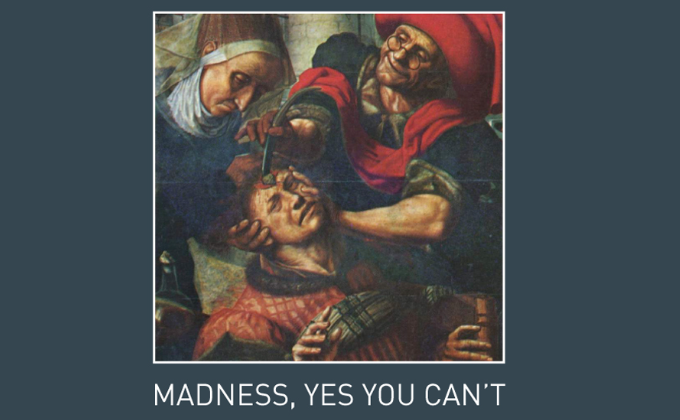
Why madness? The term itself, like the vicissitudes of the clinic devoted to it, has protean qualities. It is a shape-shifting oracular monster that only answers to those capable of discerning its wiles. Medical historian Roy Porter called it “the mystery of mysteries” (Porter 2002: 1). When does the question of madness begin? Apparently with humanity itself. As far back as 10,000 years ago, we find archaeological evidence of skulls with holes drilled into them. Medical historians hypothesize that the trepanations were early treatments for those who today we would call mentally ill. Later medieval iconography suggests that the holes in the head were made in the attempt to remove “the stone of madness.” Evidently, from the beginning of the history of madness, there has been a hole, and the hole persists.
为何是疯狂?这一术语本身,如同围绕它展开的临床实践之命运一般,具有普罗透斯般的多变特质。它是一个不断变形的神谕式怪物,仅向那些能够识破其诡计之人作出回应。医学史家罗伊·波特称其为“诸谜之谜”(Porter 2002: 1)。那么,关于疯狂的问题始于何时?显然,它与人类自身的历史同步开启。早在一万年前,考古学便已发现带有钻孔颅骨的证据。医学史家推测,这些颅骨穿孔术乃是针对今日我们称之为精神疾患者的早期治疗手段。中世纪晚期的图像志进一步表明,人们曾试图通过在头颅上钻孔以取出“疯狂之石”。显而易见,自疯狂之历史肇始,便已存在一个空洞,而此空洞始终持存。
Literature and myth have wrestled with madness: from a raving Heracles’s foaming mouth, rolling eyes, contorted body, to Medea’s vengeful frenzy, taking the life of her own children, to Ajax’s unrighteous wrath, to Dido’s suicidal despair, to Orestes’s feverish hounding by the untamable furies, to Lear’s stub-born demise, howling on the heath, to Hamlet’s real or feigned delusions, to Ophelia’s florid musings while losing her mind; all these cultural icons illustrate a continued questioning of the pathos of madness, a plight that exceeds our comprehension and elicits our pity, our fear, and our awe. Yet while the pathos of madness has inspired classics of the Western canon, the mystery of insanity resists explanation.
文学与神话始终与疯狂角力:从赫拉克勒斯狂怒时口吐白沫、双目翻白、身躯扭曲,到美狄亚复仇的癫狂——亲手扼杀自己的子女;从埃阿斯不义的暴怒,到狄多自杀式的绝望;从俄瑞斯忒斯被不可驯服的复仇女神(厄里倪厄斯)疯狂追猎而高烧谵妄,到李尔王在荒原上咆哮着走向顽固的毁灭;再到哈姆雷特真实或佯装的妄念,以及奥菲莉娅在神志失常之际所吟咏的繁花般呓语——所有这些文化意象皆持续叩问着疯狂的激情,此种困境超越了我们的理解,并唤起我们的怜悯、恐惧与敬畏。然而,尽管疯狂的激情激发了西方正典中的诸多经典,精神病之谜却始终抗拒阐释。
Nowadays, despite the innovations in pharmacology, diagnosis, and brain research and imaging, madness continues to haunt the layman as well as the specialist. Researchers, scientists, psychologists and therapists in charge of its treatment and management, as well as the discovery of its causes, are repeatedly confronted with the inability to fully account for its opaque and troubling reality while endlessly churning out new diagnostic labels. Since the Enlightenment, the machine model of the human being has continued to enjoy considerable popularity: contemporary psychiatry tries to reduce any form of bizarre or disruptive behavior to a defectively wired brain. When today we talk about “wiring of the brain,” or “genetic,” rather than familial inheritance, we should not forget that these are metaphors. The “wiring” and “chemical” models have become a new craze of the mental health and pharmaceutical industries that purport to circumvent metaphor and treat the body as if madness itself could be reduced to an affair of the flesh, and the entire human being to a malfunctioning apparatus.
如今,尽管药理学、诊断学以及脑科学研究与成像技术不断推陈出新,疯狂依然萦绕于外行与专家心头。负责其治疗、管控及病因探求的研究者、科学家、心理学家与治疗师,一再遭遇自身无法充分阐明疯狂那晦暗而扰人的实在界之困境,却仍源源不断地炮制出新的诊断标签。自启蒙时代以降,将人视为机器的模型始终广受欢迎:当代精神病学试图将一切怪异或扰乱性的行为归结为大脑“线路”接错所致。当我们今日谈论大脑的“线路”或“基因”而非家族性遗传时,切不可忘记这些皆为隐喻。所谓“线路”模型与“化学”模型,已然成为心理健康产业与制药工业的新狂热,它们声称可绕过隐喻,径直处理身体,仿佛疯狂本身可被简化为纯粹肉体之事,而整个人类存在亦不过是一台失灵的装置。
After endless rewritings of the many editions of the bible of psychiatric diagnosis, the Diagnostic and Statistical Manual of the American Psychiatric Association, the boundary between madness and sanity remains undefined, permeable, and constantly contested, as several essays in this book argue. Nestor Braunstein, Jean-Claude Maleval, Darian Leader, Paul Verhaeghe, and Russell Grigg rethink the classic taxonomy. They challenge the limitations of the DSM and offer alternative approaches to bring back to the clinic a precision that was lost with the new-fangled psychiatric terminology. Grigg’s meditation on clinical impasses and Richard Boothby’s analysis of suicide bombing also invite us to rethink classical psychoanalytic notions used in diagnosis such as the Freudian con ception of melancholia. Darian Leader’s precise exploration of manic depression also provides a welcome clarification of a tricky and seemingly ubiquitous manifestation, restoring its clinical specificity. His contribution has a poignant urgency given the current cultural trend of rebranding classical diagnoses as lifestyle choices applying to almost everyone.
在《美国精神病学会诊断与统计手册》(DSM)——这部精神病诊断的“圣经”——历经无数版本的反复改写之后,疯狂与理智之间的边界依然未被界定,具有渗透性,并持续处于争议之中,本书中的多篇论文正是如此主张。内斯托尔·布朗斯坦(Nestor Braunstein)、让-克洛德·马勒瓦尔(Jean-Claude Maleval)、达里安·利德(Darian Leader)、保罗·韦尔黑格(Paul Verhaeghe)与拉塞尔·格里格(Russell Grigg)重新思考了经典的精神病理学分类。他们质疑DSM的局限性,并提出替代路径,以期在临床实践中恢复因新潮精神病学术语而丧失的精确性。格里格对临床僵局的沉思,以及理查德·布思比(Richard Boothby)对自杀式袭击的分析,亦促使我们重新审视用于诊断的经典精神分析概念,例如弗洛伊德关于忧郁症的构想。达里安·利德对躁郁症所作的精准探讨,亦为这一棘手且看似无处不在的临床表现提供了亟需的澄清,重申其临床特异性。鉴于当下文化潮流倾向于将经典诊断重新包装为适用于几乎所有人的一种“生活方式选择”,利德的贡献尤显迫切而切中要害。
We are aware of the political, social, medical and religious valences of the word madness. It has been used as a coercive instrument of oppression to police people for centuries. Our use of madness in the title is an attempt to de-stigmatize and revitalize the word. Madness may very well be a social creation, as Emile Durkheim maintains in On Suicide (2006). A strong critique of the social stigma attached to those deemed insane and a denunciation of the abuse they have been subjected to, has been raised by the eloquent voices of the anti-psychiatry movement. Thomas Szasz (1974) has persuaded us that madness should not be considered within the parameters of “myths” such as that of “mental illness.” While promoting the creation of alternative approaches to non-normative behavior, anti-psychiatry has revealed that notions of mental illness are misleading, erroneous, and ultimately aimed at persecuting, restraining, and imprisoning the alleged mad person—Szasz famously compared psychiatric care to a witch-hunt. R. D. Laing (1960) has shown that insanity is a derogatory label to scapegoat and segregate those who deviate from social norms. Whether madness is a social construct, a myth or a label, clinicians still have an ethical responsibility to treat those who are suffering and ask for help. Lacan’s idea that the subject’s unconscious is both “the discourse of the Other” and “structured like a language” blurs the distinction between the individual and the social, offering us a way out of the binary that has informed this controversy.
我们深知“疯狂”一词所承载的政治、社会、医学与宗教意涵。数个世纪以来,该词一直被用作一种强制性的压迫工具,以规训和管控个体。我们在标题中使用“疯狂”一词,正是试图去污名化并重新激活这一术语。正如埃米尔·涂尔干在《自杀论》(2006)中所主张的那样,疯狂很可能是一种社会建构。反精神病学运动以其雄辩之声,对加诸于所谓“疯人”身上的社会污名提出了有力批判,并强烈谴责了他们所遭受的种种虐待。托马斯·萨兹(1974)使我们确信,“疯狂”不应被纳入诸如“精神疾病”这类“神话”的范畴之中。反精神病学在倡导对非规范行为采取替代性路径的同时,揭示出“精神疾病”这一概念具有误导性、谬误性,其终极目的实则是为了迫害、拘束乃至监禁那些被指认为“疯癫”的主体——萨兹曾著名地将精神病治疗比作一场猎巫行动。R. D. 莱因(1960)则指出,“精神病”不过是一个贬损性的标签,用以将偏离社会规范者当作替罪羊并加以隔离。无论疯狂是一种社会建构、一种神话,抑或仅仅是一个标签,临床工作者仍负有伦理责任,去回应那些正在受苦并寻求帮助的主体。拉康提出,主体的无意识既是“大他者的话语”,又“像语言那样结构的”,这一观点模糊了个体与社会之间的界限,为我们提供了一条超越此争议所依赖之二元对立的出路。
Freud was already questioning the distinction between sanity and insanity when he claimed that everyone was insane in their dreams (Breuer & Freud 1893: 13) and developed a theory of dream interpretation based on the analogy between dreams and insanity (Freud 1900). Freud here indicated that he was echoing Kant’s assertion of 1764 that “[t]he madman is a waking dreamer” and Schopenhauer’s quip “that dreams are a brief madness and madness a long dream” (Freud 1900: 90). While objectors may see the dream as a “useless and disturbing process” or “the expression of a reduced activity of the mind” (Freud 1900: 91), the creator of psychoanalysis claimed that “we shall be working towards an explanation of the psychoses while we are endeavoring to throw some light on the mystery of dreams.”
弗洛伊德在宣称“每个人在梦中都是疯子”(Breuer & Freud, 1893: 13)时,已然开始质疑理智与疯狂之间的区分,并在此基础上发展出一种释梦理论,该理论建立在梦与疯狂之间的类比之上(Freud, 1900)。在此,弗洛伊德指出,他所呼应的是康德1764年的断言——“疯子乃醒着的做梦者”,以及叔本华的警句:“梦是短暂的疯狂,而疯狂是一个漫长的梦”(Freud, 1900: 90)。尽管反对者可能将梦视为“一种无用且扰人的过程”或“心智活动减弱之表达”(Freud, 1900: 91),但精神分析的创立者却宣称:“当我们致力于阐明梦之谜团时,我们亦是在为精神病(psychoses)的解释铺路。”
What light does madness shed on dreaming? Elsewhere, in “An Autobiographical Study,” Freud observed “that so many things that in the neuroses have to be laboriously fetched up from the depths are found in the psychoses on the surface, visible to every eye” (Freud 1925: 60). Since repression does not operate in psychosis, we are not talking about a divided subject as we would in neurosis; there is no “un”-conscious as such. Actually, the psychotic is spoken by the Other, as manifested in the delusions, usually experienced as thoughts coming from the exterior, imposing themselves from without. The psychotic is subjected to the Other without mediation through intruding ideas, hallucinations, voices, imposed thoughts and commands. Lacan says that the psychotic is the “martyr of the unconscious,” giving to “martyr” its meaning of “witness” (Lacan 1993: 132). If dreams are the via regia to a knowledge of the unconscious (Freud 1900: 33), in madness we have already arrived.
疯狂为梦提供了何种启示?弗洛伊德在别处的《自传研究》中曾指出:“在神经症中需费力从深处挖掘出来的诸多事物,在精神病中却浮于表面,人人可见”(Freud 1925: 60)。由于压抑机制在精神病中并不运作,我们在此所面对的并非如神经症中那样的分裂主体;严格意义上并不存在“无意识”这一结构。事实上,精神病主体是被大他者所言说的,这一点体现在妄想之中——这些妄想通常被体验为来自外部的思想,从外强加于主体。精神病主体未经中介便直接屈从于大他者,表现为侵入性观念、幻觉、声音、强加的思想与命令。拉康指出,精神病主体乃是“无意识的殉道者”,此处“殉道者”取其“见证者”之义(Lacan 1993: 132)。如果说梦是通往无意识知识的“王者之路”(via regia)(Freud 1900: 33),那么在疯狂之中,我们已然抵达目的地。
The delusion opens a direct access to the unconscious as the discourse of the Other, and it is a spontaneous attempt at a cure. Lacan considers the delusion a metaphor, highlighting its palliative function and its creative aspect. It is ironic that our wish to cure the delusions of the mad is in fact an attempt to cure their own cure. As torturing as it may be, a delusional system of thought can compensate for an experience of collapse, as it did for President Schreber. His elaborate delusion of rays, transformation into a woman, and final marriage with God to start a new race granted him not only freedom (he wrote a memoir about this and was released from confinement) but offered a system of ideas to compensate for his inner collapse. In Manya Steinkoler’s essay in this volume, we also see the invention of a delusion as the attempt on the part of a schizophrenic at self-cure. We note that what we call “symptoms” can be a mode of action, a form of reparation and a way of making sense of senselessness, even if it looks like senselessness to us. It is often said that hallucinations are unreal. Given the unmediated relation of the psychotic to the Other, hallucinations are actually the most real. As much as hallucinations are the reality for the delusional person, the scene of the dream becomes the reality for the dreamer but only while she is asleep. Deprived of a structuring prohibition, the psychotic is condemned to an unbearable, untethered freedom, as Nestor Braunstein develops in his essay in this collection, caught in the nightmare of living in a constant dream. Neurotics wake up from their dreams while psychotics do not. Since one third of our life is spent sleeping, it is a logical conclusion that we spend one third of our lives mad. Should the skeptical reader think we exaggerate, we will remind her that we are in good company. Let us recall Cervantes’ Don Quixote who warns us “[t]oo much sanity may be madness,” and Emily Dickinson’s “Poem 620,” “Madness is Divinest Sense and Sense the Starkest Madness.”
妄想为无意识——即大他者话语——开启了一条直接通路,它是一种自发的疗愈尝试。拉康将妄想视为一种隐喻,强调其姑息功能与创造性面向。颇具讽刺意味的是,我们试图治愈疯人之妄想的意愿,实则是在试图治愈他们自身的疗愈方式。尽管妄想性的思想体系可能令人痛苦不堪,但它却能补偿主体所经历的崩解经验,正如施雷伯法官(President Schreber)的案例所示。他那套精心构建的妄想——包括光线、变身为女性,以及最终与上帝结合以开创新人类种族——不仅为他赢得了自由(他为此撰写了回忆录并获释),更提供了一整套观念体系,用以弥补其内在的崩塌。在本卷中玛妮娅·斯坦科勒(Manya Steinkoler)的文章里,我们同样看到,妄想的发明乃是精神分裂者试图自我疗愈的一种努力。我们需注意到,所谓“症状”实际上可作为一种行动模式、一种修复形式,以及一种为无意义赋予意义的方式——即便在我们看来,它似乎毫无意义。人们常说幻觉是不真实的;然而,鉴于精神病主体与大他者之间缺乏中介的直接关系,幻觉恰恰是最为真实的。对妄想者而言,幻觉即是其现实,正如梦境场景对做梦者而言在其沉睡之际即为现实一般。由于缺失了结构性的禁令,精神病主体被抛入一种难以承受、无锚可依的自由之中——正如内斯托尔·布朗斯坦(Nestor Braunstein)在本辑文章中所阐发的那样——深陷于永不停歇的梦魇之中。神经症患者终会从梦中醒来,而精神病患者却无法醒来。既然我们一生中有三分之一的时间处于睡眠状态,那么逻辑上便可推断:我们一生中有三分之一的时间处于疯狂之中。若持怀疑态度的读者认为我们言过其实,我们不妨提醒她:我们并非孤例。不妨回想塞万提斯笔下的堂吉诃德,他曾警示我们:“过度的理智或许正是疯狂”;亦如艾米莉·狄金森《第620号诗》所言:“疯狂乃最神圣的理性,而理性则是最赤裸的疯狂。”
Madness is no longer a technical word in the current psychiatric jargon, although it was once widely used as such by medical practitioners. We nevertheless insist on the use of a commonsensical word in order to open a discussion of a non-specialized, non-nosological term, taking into account Michel Foucault’s critique of psychoanalysis. Foucault (1988) conducted a history of madness leading to an analysis of the institutions that secluded and imprisoned otherness. Our choice of the word “madness” pays homage to Foucault’s seminal contribution to the awareness of how social, political, and legal structures discipline and punish; they construct discourses that confine the insane, the morally degenerate, and the non-compliant. Let us reclaim madness not just by absorbing Foucault’s critique of psychoanalysis, but by thinking beyond it.
“疯狂”一词在当代精神病学行话中已不再作为技术性术语使用,尽管它曾一度被医学从业者广泛如此运用。然而,我们仍坚持采用这一日常用语,以开启对一个非专业化、非分类学术语的讨论,并充分考量米歇尔·福柯对精神分析的批判。福柯(1988)曾对疯狂进行谱系学考察,由此展开对那些将他异性隔离与监禁之制度的分析。我们选用“疯狂”一词,正是向福柯所作出的开创性贡献致敬——他揭示了社会、政治与法律结构如何通过规训与惩罚机制,建构出种种话语,将疯癫者、道德堕落者以及不服从者加以围禁。让我们不仅吸纳福柯对精神分析的批判,更在此基础上进一步思考,重新夺回“疯狂”之意义。
We live in a time when many uncertainties are covered up by salesperson-like assurance, a hallmark of today’s master discourses. Anyone curious enough to take a look at pharmaceutical companies’ explanatory inserts of their anti-psychotic drugs will quickly note that the efficacy of the psychiatric medication is always rendered in the hypothetical conditional tense. This is not the case only for side effects, but also for the mechanism of action of the specific “disorder” or “condition” the medication is prescribed to treat. Peter Breggin, in Your Drug May be Your Problem (1999), Talking Back to Prozac (1994), Toxic Psychiatry (1991), and Medication Madness: A Psychiatrist Exposes the Dangers of Mood-Altering Medications (2008), has denounced the risks of what he sees as the over-prescription of psychiatric drugs. He argues that psychiatric drugs have replaced religion. Marx’s opium of the masses is back with a twist—nowadays, psycho-pharmaceutical drugs are the opium of the masses, sustaining a colossal, extremely lucrative industry. As of March 2014, the antipsychotic drug aripiprazole or Abilify was the top selling prescription drug in dollar volume in the United States with sales reaching nearly $6.9 billion a year. How many psychotics are there in America? How could a drug initially approved for schizophrenia achieve blockbuster sales? Besides launching a very aggressive publicity campaign urging everyone to “Ask Your Doctor If It May Be Right For You—Abilify” and pushing illegal remuneration to physicians and other health care providers to entice sales (in 2007 Bristol-Myers Squibb was forced to pay more than $515 million to settle federal and state investigations into their drug marketing and pricing practices), Abilify was marketed as an atypical antipsychotic; it could be prescribed for all kinds of symptoms from bipolar disorder, to depression, to autism. Today, antipsychotic drugs like Abilify, which are acutely sedating and have dangerous and potentially irreversible side effects, are widely and casually prescribed off-label for people without diagnoses of psychosis and who suffer only moderate symptoms such as anxiety (Friedman: 2012).
我们生活在一个诸多不确定性被推销员式的笃定所掩盖的时代,而这正是当今主人话语的典型特征。任何稍具好奇心的人,只要翻阅一下制药公司为其抗精神病药物所附的说明书,便会迅速注意到:精神科药物的疗效始终是以虚拟条件式来表述的。这不仅适用于副作用,也适用于该药物所宣称治疗的特定“障碍”或“状况”的作用机制。彼得·布雷金(Peter Breggin)在其著作《你的药物可能就是你的问题》(1999)、《向百忧解回话》(1994)、《有毒的精神病学》(1991)以及《药物疯狂:一位精神科医生揭露情绪调节药物之危险》(2008)中,严厉谴责了他所认为的精神科药物过度处方所带来的风险。他指出,精神科药物已然取代了宗教的位置。马克思所说的“人民的鸦片”如今以一种新的形式卷土重来——今日的精神药物(psychotropes)成了大众的鸦片,维系着一个规模庞大且利润惊人的产业。截至2014年3月,抗精神病药物阿立哌唑(aripiprazole),即商品名阿碧芙(Abilify),已成为美国按销售额计算的最畅销处方药,年销售额近69亿美元。美国究竟有多少精神病患者?一种最初仅获批用于治疗精神分裂症的药物,何以取得如此“重磅炸弹”级别的销量?除了发起极具侵略性的宣传运动,鼓动所有人“向您的医生询问:阿碧芙是否适合您?”,以及通过非法向医生及其他医疗提供者支付回扣以刺激销售(2007年,百时美施贵宝公司被迫支付逾5.15亿美元,以了结联邦与各州对其药品营销及定价行为的调查),阿碧芙还被定位为“非典型抗精神病药”,从而得以广泛用于各类症状的治疗——从双相情感障碍、抑郁症到自闭症谱系障碍。如今,像阿碧芙这类具有强烈镇静作用、并伴随危险乃至潜在不可逆副作用的抗精神病药物,已被广泛且随意地用于“超适应症”处方,对象甚至包括那些并未被诊断为精神病、仅表现出轻度至中度症状(如焦虑)的个体(Friedman, 2012)。
Chris Lane (2008) in Shyness: How Normal Behavior Became a Sickness has widely documented the alarming consequences of the influence exercised by drug companies on psychiatric practice. Ordinary afflictions get transformed into mental disorders, everyday shyness gets turned into “social anxiety.” The astonishing rise of mental illness is simple to explain. Every time a new “disease” appears in the DSM, Big Pharma just happens to be marketing the profitable drug for its treatment. As Lane concludes, “before you sell a drug, you need to sell the disease.” Here, we use the word “madness” so that the “conditional condition” can remain an open question and not a commodity, refusing the obfuscation of the jargon of the psychopharmacological salesperson. Influential clinicians such as Darian Leader (2011) have already extolled the benefits of the use of this term in an attempt to make the divide that separates “normal” from “mad” flexible and open to discussion. This is an ethically important consideration that challenges the temptation to demonize, judge, and overmedicate the insane, opening up the possibility of listening properly.
克里斯·莱恩(Chris Lane,2008)在《羞怯:正常行为如何变成疾病》一书中广泛记录了制药公司对精神病学实践施加影响所引发的令人警觉的后果。日常的困扰被转化为精神障碍,普通的羞怯被转变为“社交焦虑症”。精神疾病数量的惊人增长其实很容易解释:每当《精神障碍诊断与统计手册》中出现一种新的“疾病”,大型制药公司(Big Pharma)恰好就在推销用于治疗该病的高利润药物。正如莱恩所总结的:“在你卖出药物之前,你必须先卖出疾病。”在此,我们使用“疯狂”一词,以使这种“条件性状态”保持为一个开放的问题,而非一种商品,从而拒斥精神药理学推销员行话所造成的遮蔽。具有影响力的临床家如达里安·利德(Darian Leader,2011)早已颂扬过使用这一术语的益处,试图使划分“正常”与“疯狂”的界线变得更具弹性,并向讨论敞开。这是一种伦理上至关重要的考量,它挑战了将疯癫者妖魔化、评判乃至过度药物化的诱惑,从而开启真正倾听的可能性。
The subtitle Madness, yes you can’t is a way to express the paradoxes of both neurosis and psychosis. This perplexing formulation refers back to the idea of the double-bind, a contradictory injunction that plays with rationality and twists it around, so widely discussed in the 1960s and considered the cause of psychosis at that time. Madness, yes you can’t also reminds us that in madness the law operates in a derailed manner. We hope to generate reflection and deliberation with our subtitle. It will send the reader to the heart of the issues addressed in this book. The phrase also evokes negation, both in terms of psychosis as the failure of a “no” at the origin of the law, and of neurotic repression, which is threatened in the dramatic crises we may find in non-psychotic madness.
副标题“疯狂,是的,你不能”旨在表达神经症与精神病二者所共有的悖论。这一令人困惑的表述回溯至“双重束缚”的概念——即一种自相矛盾的禁令,它戏弄理性并将其扭曲翻转;该概念在1960年代被广泛讨论,并一度被视为精神病的成因。“疯狂,是的,你不能”亦提醒我们,在疯狂之中,法则以一种脱轨的方式运作。我们期望借此副标题激发读者的反思与审思,将其引向本书所探讨问题的核心。此短语同时唤起否定的维度:一方面指向精神病,即作为法则之起源的那个“不”的失败;另一方面则关乎神经症性的压抑,这种压抑在非精神病性疯狂所遭遇的剧烈危机中受到威胁。
Indeed, if the term madness elicits inquiry and even controversy, we hope it will inspire the re-emergence of thought in the clinical setting. It is a reminder that in clinical practice it is efficacious to remain curious, open-minded, critical, ready to listen, not too rushed to “capture the disease” or tighten uncertainty with the lasso of a diagnostic label. While most of the time it is possible to make a clear distinction between neurosis, psychosis, and perversion, it is often clinically efficacious to make use of the diagnosis as a “working hypothesis” that is constantly tested and rethought. Occasionally, it may only be confirmed at the conclusion of a treatment. As Dany Nobus and Malcolm Quinn (2005) suggest, “knowing nothing” can be extremely productive. For Lacan, the role of the analyst is marked by docta ignorantia, “wise ignorance,” as systematized by the Renaissance philosopher Nicolas Cusanus (Lacan 1988: 278). The analyst operates from a place of ignorance, of not-knowing; if there is any knowledge, the analysand’s unconscious produces it. Jean Allouch further elaborates this idea in his chapter in this collection, noting that the relation to knowledge, on which transference is predicated, is reversed in psychotic patients: the analyst has to be willing to become a “secretary to the insane” (Lacan 1993: 206), reversing the place of the “subject-supposed-to-know.” Not-knowing is not a posture. It is the beginning of a learning and of a possibility of an effective clinical intervention. Ignorance, if it can inspire curiosity, may be the mother of thought.
的确,若“疯狂”一词引发探究乃至争议,我们希望它能激发临床场域中思想的重新涌现。它提醒我们,在临床实践中,保持好奇、开放、批判的态度,并随时准备倾听,而非急于以诊断标签之套索去“捕获疾病”或消弭不确定性,是富有成效的。尽管在多数情况下,神经症、精神病与倒错之间可作出清晰区分,但在临床上,将诊断视为一种不断接受检验与重思的“工作假说”往往更为有效。有时,这一诊断甚至只能在治疗结束时才得以确认。正如达尼·诺布斯(Dany Nobus)与马尔科姆·奎因(Malcolm Quinn)(2005)所指出的,“一无所知”可能极具生产性。对拉康而言,分析师的角色由“博学的无知”所标记——这一概念由文艺复兴时期哲学家尼古拉·库萨(Nicolas Cusanus)系统化(Lacan 1988: 278)。分析师从无知、从“不知”的位置出发运作;若有任何知识产生,那也是分析者无意识所生产的。让·阿卢什(Jean Allouch)在本论文集的章节中进一步阐发了这一观点,指出:在精神病患者那里,转移所赖以建立的知识关系发生了逆转——分析师必须愿意成为“疯子的秘书”(Lacan 1993: 206),从而颠倒“被假设知道的主体”的位置。“不知”并非一种姿态,而是学习的起点,亦是有效临床干预之可能性的开端。若此无知能激发好奇,它或许正是思想之母。
Indeed, the clinic of madness can serve to remind us once again of the Freudian discovery: the emergence of the unconscious is always surprising—for both the analysand and the analyst. We advocate keeping an openness to surprise and contingency, as grounds of fertile possibility not just in the individual cure of a patient, but to impact the general malaise affecting psychoanalysis itself, a malaise in which a will to tame the drives on the part of the analyst, however well-meaning it might seem, gives up on the work of the unconscious. It can concern a passion for interpretation or a theoretical certitude that amounts to the same. At times, psychoanalytic theory becomes not just a defense against thinking but a resistance to listening.
的确,精神病的临床实践可再次提醒我们弗洛伊德的发现:无意识的浮现总是令人惊异的——无论对分析者还是对分析家皆然。我们主张保持对惊异与偶然性的开放态度,这不仅是个体治疗中富有成效的可能性之根基,亦能作用于精神分析自身所罹患的普遍性不适。此种不适体现为分析师试图驯服冲动的意志——无论其初衷看似多么善意——却因此放弃了无意识的工作。这种放弃可能表现为对诠释的激情,抑或表现为一种理论上的确信,二者实则殊途同归。有时,精神分析理论不仅成为抵御思考的防御机制,更成为抗拒倾听的阻抗。
Our subtitle Madness, yes you can’t alerts us to a structural constraint: nobody goes mad by wanting to. One goes mad because of a disposition, or rather an indisposition: there is structural limitation to the triggering of psychosis. Someone becomes truly crazy only if it is structurally possible. We see this elaborated in Braunstein’s contribution to this volume, “You cannot choose to go crazy.” We follow a practice of “differential diagnosis.” A “mad” symptom does not necessarily mean a psychosis. This distinction concerns cases of neurosis even when they present excessive and outlandish behavior, as shown in Claude-Noële Pickmann’s contribution to this volume, “She’s raving mad: the hysteric, the woman, and the psychoanalyst” and Verhaeghe’s “Today’s madness does not make sense.” This does not mean that we believe in a continuum between psychic structures, as Melanie Klein proposed with her idea of a progression from a schizoparanoid position to a depressive position, nor does it mean that we consider madness a latent stage to which one can regress transitorily. Mental structural organization has to be dislodged from symptoms.
我们的副标题“疯狂,是的,你不能”提醒我们注意一种结构性的限制:没有人是通过想要而发疯的。人之所以发疯,乃是由于一种禀赋,更确切地说,是一种失序:精神病的触发存在结构性的限度。唯有当结构上具备可能性时,个体才会真正陷入疯狂。这一点在本卷中布朗斯坦(Braunstein)的文章《你无法选择发疯》中有详尽阐述。我们遵循一种“差异性诊断”的实践。“疯狂”的症状并不必然意味着精神病。这一区分甚至适用于那些表现出过度或怪诞行为的神经症个案,正如克洛德-诺埃尔·皮克曼(Claude-Noële Pickmann)在本卷中的文章《她疯得厉害:癔症、女人与精神分析家》以及韦尔黑格(Verhaeghe)的《今日之疯狂毫无意义》所展示的那样。这并不意味着我们相信心理结构之间存在连续统一体——如梅兰妮·克莱因所提出的从偏执—分裂位态向抑郁位态的渐进过程;也不意味着我们将疯狂视为一个可暂时退行至其中的潜在阶段。心理结构的组织必须与症状本身区分开来。
Madness, yes you can’t is also a formula for neurosis. A yes is premised on an interdiction of jouissance: “You can’t,” an interdiction that Lacan calls the Name-of-the-Father. The paternal metaphor separates the mother from the child and sets the child on an impossible quest to find the object of the mother’s desire, which henceforth is at the level of metaphor, forever exiled from the Thing itself: the divided subject is born. The resulting frustrations of this quest are unsatisfying and even enraging—indeed, they can be maddening. A further reading of this phrase in the context of neurosis and society points to the way the superego commands enjoyment while making it impossible at the same time. Here the cultural and ideological “dream” is posited as the good, and even at times as a moral injunction “to enjoy” (the American dream, the dream of thinness, of riches, of happiness), with its underside, you can’t, being the figure par excellence of political and social impotence and contemporary malaise. Our subtitle lets a recent and well known presidential campaign slogan ring slightly off key, allowing us to hear the limitations of willful and even well-meaning optimism.
“疯狂,是的,你不能”同样也是神经症的一个公式。“是的”以对享乐的禁令为前提:“你不能”——这一禁令被拉康称为“父之名”。父性隐喻将母亲与孩子分离开来,并将孩子置于一场不可能完成的追寻之中:去寻找母亲欲望的对象。自此,该对象便处于隐喻层面,永远被放逐于物(原质)本身之外:分裂主体由此诞生。这场追寻所引发的挫败令人无法满足,甚至令人愤怒——的确,足以令人发狂。若进一步在神经症与社会的语境中解读这一短语,则可揭示超我如何一方面命令主体去享乐,同时又使其享乐变得不可能。在此,文化与意识形态所建构的“梦想”被设定为善,甚至时常作为一种道德律令——“去享乐!”(例如美国梦、瘦身梦、财富梦、幸福梦),而其背面的“你不能”则恰恰构成了政治与社会无能以及当代不适的典范形象。我们的副标题让一句近期广为人知的总统竞选口号略显走调,从而让我们得以听出那种出于意志、甚至出于善意的乐观主义所固有的局限。
In the tilting of our subtitle towards the side of neurosis, the word madness relates to anger, as a consequence of something that is not allowed. The subject is frustrated. So while you cannot choose to go crazy, the particular ways in which you cannot choose vary, and can become infuriating. The demands and strictures of civilization are stultifying, driving us mad, if only for a brief period. Ira brevis furor est—anger is a brief madness. Anyone can go crazy for a moment. This is made explicit in the semantic proximity in English of “mad” and “angry.” Rage can lead to a momentary insanity. Doesn’t the standard equivalence of “angry” with “mad” already imply that anger can make us lose our heads? We recognize the difference between being angry and acting out murderous fury, but what matters here in the linguistic and psychological affinity between “mad” and “angry” is the stress on time: a “brief” madness—duration is key. Why do people sometimes go crazy, if just for a while? Moderate anger, in Aristotle’s perspective, arises from a situation of injustice that needs to be corrected and has a policing function (Aristotle 1980: 96). This naturally leads to a conception of anger as a handmaiden of justice. Yet, in Aristotle’s view, this rage for justice is within measure—never excessive; we are never really that mad.
在我们的副标题向神经症一侧倾斜之际,“疯狂”一词关联于愤怒,作为某种被禁止之物的后果。主体陷入挫折。因此,尽管你无法选择发疯,但你无法选择的具体方式却各不相同,并可能令人怒不可遏。文明的要求与禁令令人窒息,驱使我们陷入疯狂——哪怕仅是短暂一瞬。“Ira brevis furor est”(愤怒乃短暂之疯狂)。任何人都可能在某一刻发疯。这一点在英语中“mad”与“angry”的语义邻近性中已显而易见:暴怒(rage)可导向一时的精神病。难道“angry”与“mad”的惯常等同,不已然暗示着愤怒足以令我们丧失理智?我们固然能区分“愤怒”与“付诸行动的杀人狂怒”,但此处关键在于“mad”与“angry”在语言及心理层面的亲缘性所强调的时间维度:一种“短暂的”疯狂——持续时间至关重要。人为何有时会发疯,即便只是片刻?依亚里士多德之见,适度的愤怒源于一种有待纠正的不义情境,并具有规训功能(Aristotle 1980: 96)。这自然导向将愤怒视为正义之侍女的观念。然而,在亚里士多德看来,此种对正义的激愤始终处于尺度之内——从不过度;我们从未真正那般疯狂。
As we continue to helplessly witness senseless explosions of violence in our schools, parking lots, movie theaters, and shopping malls, we find ourselves more bewildered by the terrifying reality before us. And we are even more confounded by a rage for retaliation that is anything but temperate or rational. Wanting to protect our children, we look to science, especially to genetics, only to find ourselves at the mercy of a frightening essentialism increasingly jeopardizing the very rights and freedoms we are aiming to protect. Not all angers are created equal: the notion of foreclosure allows us to make a structural distinction between delusional rage and justified anger. The visibility of madness today makes us denounce the mental health system’s failures, the horror of the act, and the suffering of the victims. We wish to move away from the spectacular side of madness and turn our attention to its causes and treatment, to madness before it becomes visible.
当我们持续无助地目睹校园、停车场、电影院和购物中心中毫无意义的暴力爆炸事件时,我们愈发被眼前这一恐怖现实所困惑。而更令我们茫然失措的,是一种全然缺乏节制与理性的报复性愤怒。出于保护子女的愿望,我们求助于科学——尤其是遗传学——却发现自己竟沦为一种令人恐惧的本质主义的牺牲品,而这种本质主义正日益危及我们本欲捍卫的权利与自由。并非所有愤怒皆属同质:借由“除权”这一概念,我们得以在结构上区分妄想性的狂怒与正当的义愤。今日疯狂的可见性促使我们谴责精神卫生系统的失能、行动本身的恐怖以及受害者所承受的苦难。我们希望摆脱疯狂的奇观化面向,转而关注其成因与治疗——亦即关注疯狂尚未显现之前的样态。
Lacan never retreated in the face of madness. While Freud allowed us to hear the logic of neurosis behind its symptoms, uncovering their sense and learning to read the unconscious, he did not feel that psychoanalysis could treat insanity. Indeed, many psychoanalysts after Freud have considered that psychoanalysis has no contribution to make to its treatment. The specificity of structure has been lost for many clinicians who become intimidated by the often dramatic and inexplicable phenomena. More disquieting, some psychoses remain unrecognized by the practi tioner, often due to overly normal behavior, extreme rationality, superior intelli gence, and at times, apparent social success. Even when it may remain dormant, untriggered, with no visible signs, psychosis is nevertheless the correct diagnosis. Our collection of essays will alert us to the recognition of both forms—visible madness and the more subtle form that Darian Leader (2011) calls “quiet psychosis.”
拉康从未在疯狂面前让步。弗洛伊德使我们得以听见神经症症状背后的逻辑,揭示其意义,并学会阅读无意识;但他并不认为精神分析能够治疗精神病。事实上,弗洛伊德之后的许多精神分析家亦持此观点,认为精神分析对精神病的治疗并无贡献可言。对于诸多临床工作者而言,结构的特异性已然丧失,他们往往被精神病所呈现的剧烈而不可解的现象所震慑。更令人不安的是,某些精神病态甚至未被执业者识别出来,这常常是由于患者表现出过度正常的行为、极端理性、超常智力,乃至表面上的社会成功所致。即便精神病可能处于潜伏状态,未被触发,且毫无可见征兆,它仍应被正确诊断为精神病。本文集将提醒我们辨识这两种形式——显性的精神病,以及达里安·利德(Darian Leader, 2011)所称的“静默精神病”。
If Lacan did not hesitate before madness, it was because his encounter with psychosis made him a psychoanalyst. Not only was his doctoral thesis on paranoia the beginning of a lifelong development and refinement of his original understanding of madness, as Allouch’s essay in this volume shows, but Lacan turned to Freud to make sense of his encounter with Marguerite Anzieu, whom he called Aimée. She presented the full gamut of paranoid symptoms (erotomania, megalomania, prejudice, persecutory ideation, passionate jealousy) while her superior cognitive abilities remained intact. Aimée was committed to Saint-Anne Hospital after having spent one month incarcerated. An intelligent, well read, articulate young mother, she had tried her hand at fiction and poetry as a means of recognition, and ended up institutionalized after attempting to murder a famous actress, a gesture that Lacan would name “paranoiac self-punishment.” Studying Aimée and her writings, Lacan came to understand the origins of paranoiac crime, later unveiling the logic of the psychotic structure. The essays in this book continue to advance his theories regarding the various clinical realities he encountered. The texts by Verhaeghe, Pickman, and Yankelevich allow us to revisit what are often considered non-analyzable cases, inviting us to examine our assumptions and the conceptual challenges posed by patients whose clinical presentations do not fit into the classical clinical categories. Lacan’s clinical experience taught that psychosis needed psychoanalysis, and Freud’s that hysterical madness founded psychoanalysis. Together they show that madness indeed needs psychoanalysis.
倘若拉康对疯狂未曾犹豫,那是因为他与精神病的遭遇使他成为了一名精神分析家。正如本卷中阿卢什(Allouch)的文章所揭示的那样,不仅他的博士论文以偏执狂为题,开启了其对疯狂之原初理解的终生发展与精炼;而且,正是为了理解他与玛格丽特·安齐厄(Marguerite Anzieu)——他称之为艾梅(Aimée)——的相遇,拉康才转向弗洛伊德。艾梅呈现出偏执症状的完整谱系(钟情妄想、夸大妄想、偏见、被害观念、激情性嫉妒),而其高级认知能力却完好无损。在被监禁一个月后,她被送入圣安娜医院。这位聪慧、饱读诗书、善于言辞的年轻母亲曾尝试通过小说与诗歌寻求承认,却最终因试图谋杀一位著名女演员而被收容入院——拉康将这一举动命名为“偏执性自我惩罚”。通过对艾梅及其文字的研究,拉康逐步把握了偏执性犯罪的起源,并继而揭示了精神病结构的逻辑。本书所收录的诸篇论文持续推进着拉康针对其所遭遇的各类临床现实所提出的理论。韦尔黑赫(Verhaeghe)、皮克曼(Pickman)与扬凯列维奇(Yankelevich)的文本促使我们重新审视那些常被视为“不可分析”的个案,邀请我们质疑自身的预设,并直面那些临床表现无法纳入经典临床范畴的患者所提出的概念性挑战。拉康的临床经验表明:精神病需要精神分析;而弗洛伊德的经验则表明:癔症性的疯狂奠定了精神分析的基础。二者共同昭示:疯狂确实需要精神分析。
One of Lacan’s major contributions was the theorization of the mirror stage, which Feyaerts, Vanheule, Yankelevich, and Steinkoler revisit and elaborate on in this collection. This elaboration was directly influenced by his encounter with paranoid psychosis in the 1930s. His later thesis of the Name-of-the-Father and the primacy of the signifier, which he developed in the 1950s, can also be traced back to his reading of another case of paranoia, Schreber’s memoirs. For Lacan, foreclosure is a defining term. It concerns the fact that in psychosis the Name-of-the-Father failed, the mother’s desire was never metaphorized, that is, it was never replaced by a signifier. What is not inscribed in the Symbolic returns from the Real. With this thinking Lacan is able to make sense of the logic of Schreber’s madness. At this point, the primacy of the Imaginary, or mirror stage, which had dominated Lacan’s early thinking about psychosis, would be replaced by the deficit in the Symbolic. In the 1970s, in his reading of James Joyce, Lacan invented yet a new theory of madness. The writings of Joyce led him to the invention of the “sinthome,” a symptom that does not need to be cured but one that makes life livable and can spare someone a fate of madness. In this instance, using the topological model of the Borromean knot of Real, Imaginary, and Symbolic, Lacan effectively went beyond the classical diagnostic taxonomy. He replaced the Name-of-the-Father with the sinthome, a creation with the potential to make up for errors in the knotting of the three registers. The father becomes just a symptom like many others, and Oedipus, Freud’s symptom.
拉康的一项重要贡献在于对镜像阶段的理论化,而费亚尔茨(Feyaerts)、范赫勒(Vanheule)、扬克列维奇(Yankelevich)与斯坦科勒(Steinkoler)在本文集中对此进行了重访与阐发。这一阐发直接受到他在1930年代对偏执型精神病临床经验的影响。他于1950年代提出的“父之名”及其对能指优先性的强调,亦可追溯至他对另一例偏执症个案——施雷伯(Schreber)回忆录的阅读。对拉康而言,“除权”是一个界定性的概念:它意指在精神病中,“父之名”未能被纳入象征界,母亲的欲望从未被隐喻化,即从未被一个能指所取代。凡未被铭刻于象征界者,必从实在界中返回。凭借这一思路,拉康得以阐明施雷伯疯狂的逻辑。至此,原先主导拉康早期精神病思考的想象界优先性——亦即镜像阶段——便被象征界的缺损所取代。到了1970年代,在对詹姆斯·乔伊斯的阅读中,拉康又提出了一种全新的疯狂理论。乔伊斯的写作引导他发明了“圣状”这一概念:它并非一种需要被治愈的症状,而是一种使生命变得可居并能使人免于陷入疯狂命运的创造。在此,拉康借助实在界、想象界与象征界三者的博罗米结拓扑模型,有效地超越了经典的精神病诊断分类学。他以“圣状”取代了“父之名”——后者不过是一种能够弥补三界纽结中错位或断裂的创造物。“父亲”由此沦为众多症状之一,而俄狄浦斯则成为弗洛伊德的症状。
Our contributors invite us to tread the fine line where mad is not necessarily pathological but potentially creative. Madness does not only manifest in suffering or a maladjusted or aberrant response. The sinthome is another way for madness to be transformed into an individual and creative solution, an invention, which becomes another form of cure. In the third section, “Madness and creation: environs of the hole,” several essays reflect on the work of great writers to show how creation can avoid madness or make good use of it. Mieli with Primo Levi, MacCannell with Joyce and Woolf, Whitworth with Crashaw, Cox Cameron with Beckett and O’Brien, and finally, Steinkoler with the writings of a schizophrenic patient show that madness has the potential to give access to a profound form of knowing, and that creation is a savoir faire with that knowledge.
我们的撰稿人邀请我们行走在一条微妙的界限之上:在此,疯狂未必是病理性的,而可能具有创造性。疯狂并不仅仅表现为痛苦,或一种失调、异常的反应。圣状提供了另一种路径,使疯狂得以转化为一种个体化的、创造性的解决方案——一种发明,从而成为另一种形式的治愈。在第三部分“疯狂与创造:空洞的周遭”中,多篇论文通过反思伟大作家的作品,揭示了创造如何能够规避疯狂,或善加利用它。米埃利(Mieli)论普里莫·莱维(Primo Levi)、麦克坎内尔(MacCannell)论乔伊斯(Joyce)与伍尔夫(Woolf)、惠特沃斯(Whitworth)论克拉肖(Crashaw)、考克斯·卡梅伦(Cox Cameron)论贝克特(Beckett)与奥布莱恩(O’Brien),以及最后斯坦科勒(Steinkoler)对一位精神分裂症患者文本的分析,均表明:疯狂具有通向一种深刻认知的潜能,而创造正是对这种知识的“知道如何”。
This book is a timely collection of state-of-the-art essays by leading international scholars and clinicians responding to an urgency experienced in society today with regard to madness. It addresses a gap in Lacanian psychoanalytic literature in English. Offering new perspectives on a wide variety of manifestations and presentations of madness, this book condenses seminal and innovative work by international specialists spanning several continents. All contributions reflect the state of the art of Lacanian theory today.
本书乃一部应时之作,汇集了国际顶尖学者与临床家所撰写的前沿论文,回应了当代社会对疯狂所体验到的紧迫性。此书填补了英语世界拉康派精神分析文献中的一项空白。通过对疯狂之诸种表现形态与临床呈现提供崭新视角,本书凝练了来自各大洲国际专家所开展的奠基性且富于创新的研究成果。所有文章皆体现了当下拉康派理论的前沿状态。
This book is divided into three sections. The first: “Madness manifest: encountering madness” provides a combination of clinical case studies, institutional modalities of treatment, and social symptoms of madness such as suicide bombing that we hope will open discussion and debate. The second section: “The method in madness: thinking psychosis” is devoted to a rich variety of elaborations that help us rethink madness outside traditional categories and definitions while maintaining theoretical rigor. The common thread among these chapters is the idea that madness has a logic. The third: “Madness and creation: environs of the hole,” demonstrates how madness can be a solution rather than a problem to be “fixed.” It illustrates the creative, affirmative aspects of madness.
本书分为三个部分。第一部分:“疯狂的显象:遭遇疯狂”,结合临床个案、机构治疗模式以及诸如自杀式袭击等社会性疯狂症状,旨在开启讨论与争鸣。第二部分:“疯狂中的方法:思辨精神病”,致力于呈现丰富多样的理论阐述,以助我们在保持理论严谨性的同时,超越传统范畴与定义来重新思考疯狂。诸章节贯穿一共同线索:疯狂自有其逻辑。第三部分:“疯狂与创造:空洞的周遭”,则表明疯狂可作为一种解决方案,而非亟待“修复”的问题;它彰显了疯狂所蕴含的创造性与肯定性面向。
The section “Madness manifest: encountering madness” opens with Rolf Flor’s “The case of the baby diaper man,” which disproves the assumption that psycho-analysis cannot treat psychosis. The open-minded intervention of a clinician who is willing to listen to the logic and traumatic personal history behind seemingly senseless and disturbing symptoms, and who is not confined to ideals of “health” or “normalcy,” can assist a psychotic subject in leading a less precarious life where he can form meaningful attachments to others. Not concerned with moral correction, the ideology of norms or the indication of deviancy, but respecting the patient’s structure and giving dignity to symptom formation, such clinical work allows for change where before there had been only the invisible solitude of a lost social outcast.
“疯狂的显象:遭遇疯狂”一节以罗尔夫·弗洛尔(Rolf Flor)的《婴儿尿布男个案》开篇,该案例驳斥了精神分析无法治疗精神病的假设。一位临床工作者若能敞开心扉,倾听那些看似无意义且令人不安的症状背后所蕴含的逻辑及其创伤性的个人史,并不囿于“健康”或“常态”的理想化标准,便能够协助精神病主体过上一种不那么岌岌可危的生活,使其得以与他人建立有意义的联结。此种临床实践并不着眼于道德矫正、规范意识形态或对越轨行为的指认,而是尊重患者的结构,并赋予其症状形成以尊严;正是在此基础上,改变才成为可能——此前,患者仅陷于一名被社会遗弃者的不可见的孤独之中。
In “Ilse or the Law of the Mother,” Geneviève Morel relates a detailed clinical case that challenges the usual psychoanalytic paradigms of cure and of sexual difference, showing innovative ways in which the clinic can be re-invented. Lacanian psychoanalysis has been accused of being obsessed with the phallus, the father and, even more misleadingly, with “language games.” In Morel’s compelling clinical account, Lacanian psychoanalytic treatment is creative, deeply ethical, and concerned with subjective reality; it is a dynamic work where dramatic transformative effects become possible. Morel shows how, by having a child with her female life partner, Ilse was able to position herself in the family history to become a parent, and ultimately to avoid the destiny of madness. The outcome of the treatment places the subject in the family genealogy facing sexual difference without fully relying on the phallus. What is at stake in this case is the dignity of life and the invention of a future.
在《伊尔丝或母之律法》一文中,热纳维耶芙·莫雷尔(Geneviève Morel)详述了一则临床个案,此个案挑战了精神分析关于治愈与性差异的常规范式,展示了临床实践得以被重新发明的创新路径。拉康派精神分析常被指责执迷于阳具、父亲,甚至更误导性地被归结为“语言游戏”。然而,在莫雷尔这一极具说服力的临床叙述中,拉康派精神分析治疗展现出其创造性、深刻的伦理维度以及对主体现实的关注;它是一项动态的工作,在其中,戏剧性的转化效应成为可能。莫雷尔指出,伊尔丝通过与她的女性伴侣共同生育子女,得以在家族历史中为自己定位,从而成为一位家长,并最终规避了疯狂的命运。该治疗的结局使主体置身于家族谱系之中,直面性差异,却并未完全依赖于阳具能指。在此个案中,攸关的是生命之尊严与未来之发明。
In Chapter 3, “From psychotic illness to psychotic existence: on re-inventing the institution,” Guy Dana, creator of a pioneering clinic for the treatment of psychosis, explains how the Lacanian understanding of psychosis led to his creation of a new institutional treatment structure. Foucault had documented how society tries to control the abnormal, punishing by way of exclusion and seclusion. Dana shows that the seclusion of the psychotic subject is already present at the psychic level. He demonstrates how the clinical setting built on a multi-disciplinary treatment team and a multitude of treatment venues fosters a change in material space, allowing for the formation of a newfound social link. In Dana’s invention, influenced by Winnicott as well as Lacan, the institution itself is structurally modified in order to better treat and manage the psychic reality of psychosis. Stressing the move to “psychotic existence” from “psychotic illness,” Dana aims to make “madness” something livable and inventive for the patient, as well as for us.
第三章《从精神病性疾患到精神病性存在:论机构的再发明》中,精神病治疗先驱诊所的创立者居伊·达纳(Guy Dana)阐释了拉康对精神病的理解如何引导他创设一种全新的机构化治疗结构。福柯曾揭示社会如何试图规训异常者,通过排斥与隔离施以惩罚。达纳则指出,精神病主体的隔离早已内在于其心理层面。他展示了这样一个临床设置——基于多学科治疗团队及多元治疗场所——如何促成物质空间的转变,从而为一种崭新的社会纽带之形成提供可能。在达纳的发明中,既受温尼科特亦受拉康影响,机构本身在结构上被重新调整,以更恰切地介入并容纳精神病的心理现实。达纳强调从“精神病性疾患”向“精神病性存在”的转向,旨在使“疯狂”对患者乃至对我们而言,成为一种可居、可创的存在方式。
In the following chapter, “On the suicide bomber: anatomy of a political fantasy,” Richard Boothby discusses the phenomenon of the “madness” of the suicide bomber, testing Freud’s theory of melancholia in the analysis of a socio-political “case.” Boothby’s examination uncovers the metapsychology of the political mechanism at work in the ideology of the suicide bomber and the fantasy that motivates the suicide. He unpacks the dynamics of terror in terms not just of the act itself, but of the fantasies at play for the perpetrator and for the society in which these events occur. He reveals an intimate connection between the terrorist act and the society and culture it is perpetrated on. Without diminishing their outrageousness, he reveals the logic implied by the seemingly inexplicable and senseless acts of terror and the frenzy they elicit.
在接下来的章节《论自杀式袭击者:一种政治幻想的解剖》中,理查德·布思比(Richard Boothby)探讨了自杀式袭击者所呈现的“疯狂”现象,并以弗洛伊德的忧郁理论为参照,对这一社会政治“个案”展开分析。布思比的考察揭示了驱动自杀式袭击者意识形态及其自杀行为之幻想背后的元心理学机制。他不仅从行动本身,更从施动者与事件所发生之社会内部运作的幻想层面,剖析恐怖的动力结构。他揭示出恐怖行动与其所施加的社会文化之间存在一种内在的关联性。在不减损此类行径之骇人听闻的前提下,他揭示了那些看似不可理喻、毫无意义的恐怖行为及其所激起的狂乱背后所隐含的逻辑。
Exploring the clinical challenges we face today, Paul Verhaeghe, in Chapter 5, “Today’s madness does not make sense,” writes about the “difficult” patients we encounter today. These are patients who do not associate freely or seem to have transference to the analyst. They do not give any meaning or relevance to their past experiences in terms of their current suffering, nor do they express any curiosity about their symptoms, tending to act out by engaging in dangerous activities such as drug use, cutting, eating disorders, and putting their bodies at risk. These patients’ presentations question the armchair comforts of what Verhaeghe proves are antiquated ways of thinking about them and what they tell us. Challenging the contested notion of “borderline,” Verhaeghe proposes to bring back the quasi-forgotten Freudian notion of “actual-neurosis,” which can help us discern what looks like psychosis all the while remaining in the field of neurosis. Opening the dialogue with other psychoanalytic perspectives, such as attachment theory, he underlines the crucial role of a positive therapeutic relation while inviting the reader to address creatively the clinical challenges of seemingly senseless madness.
在探讨我们今日所面临的临床难题时,保罗·韦尔黑赫(Paul Verhaeghe)于第五章《今日之疯狂毫无意义》中论及我们当下遭遇的“困难”个案。这些主体既无法进行自由联想,亦似乎对分析师不产生任何转移。他们既不赋予自身过往经验以意义,亦不将其与当下的痛苦关联起来;他们对自己的症状毫无好奇,反而倾向于付诸行动,投身于诸如药物滥用、自残、进食障碍等危险行为,将身体置于风险之中。此类主体的临床呈现,质疑了那种安坐躺椅中的舒适姿态——韦尔黑赫揭示,此种姿态所依托的对这些主体及其言说的理解方式早已过时。韦尔黑赫挑战了备受争议的“边缘”概念,转而提出重拾弗洛伊德几近被遗忘的“现实性神经症”范畴。这一概念有助于我们在看似精神病的表象之下,辨识出其仍处于神经症场域之内的结构位置。他同时开启与其他精神分析视角(如依恋理论)的对话,强调积极治疗关系的关键作用,并邀请读者以创造性的方式回应那些看似无意义之疯狂所带来的临床挑战。
In the opening chapter to the second section, “The method in madness: thinking psychosis,” Nestor Braunstein both warns and reassures us: “You cannot choose to go crazy.” Braunstein shows that madness is not a matter of will or choice. Indeed, psychosis is the structure where choice is impossible. Lacan nevertheless asserted that the mad person is the only truly free human being. Braunstein explores this seeming contradiction, underlining the paradoxical “price” of that freedom in all its clinical resonance. He shows how the psychotic subject experiences jouissance as a devastating, limitless and painful invasion, not subjected to meaning or social norms. Without the barrier of fantasy, the very being of the psychotic is at stake. Braunstein returns to the question about diagnosis to tell us that since “there are no full time psychotics,” both “psychosis” and “psychotic” can become “schematic labels that steer the clinician and the reader off track, instead of orienting them.”
在第二部分的开篇章节《疯狂中的方法:思考精神病》中,内斯托尔·布朗斯坦(Néstor Braunstein)既向我们发出警示,又给予某种安抚:“你无法选择发疯。”布朗斯坦指出,疯狂并非意志或选择的问题。事实上,精神病正是一种选择不可能的结构。然而,拉康却断言,疯者乃是唯一真正自由的人。布朗斯坦深入探讨了这一表面矛盾,强调此种自由所蕴含的悖论性“代价”——其临床回响不容忽视。他揭示出,精神病主体所体验到的享乐乃是一种毁灭性的、无边无际且充满痛楚的侵入,它不受意义或社会规范的辖制。由于缺乏幻想屏障,精神病主体之存在本身便岌岌可危。布朗斯坦重返诊断问题,告诫我们:既然“并不存在全职的精神病患者”,那么“精神病”与“精神病性的”便可能沦为“图式化的标签”,非但无法为临床工作者与读者提供方向,反而将他们引入歧途。
Chapter 7, Jean-Claude Maleval’s “Psychosis and contemporary psycho-analysis,” provides a historical survey of the theorization of psychosis, situating Lacan’s development therein as a way of problematizing the contemporary DSM and the pharmacologically-influenced psychiatric clinic. Highlighting the originality of the Lacanian approach, he foregrounds the notion of the foreclosure of the Name-of-the-Father as playing a defining role in the origins of psychotic structure. Explaining the concept of suppléance, Maleval shows how invention plays an important part in the cure. Maleval reminds us that modern psychiatry has abandoned its own rich history and theoretical rigor and that it was Lacan’s gift to transmit this fruitful heritage via his teaching.
第七章,让-克洛德·马勒瓦尔(Jean-Claude Maleval)的《精神病与当代精神分析》,对精神病理论化的历史进行了梳理,并将拉康在此脉络中的发展置于其中,以此对当代《精神障碍诊断与统计手册》(DSM)及受药物影响的精神病临床实践提出质疑。马勒瓦尔凸显了拉康式进路的原创性,尤其强调“父之名”的除权在精神病结构起源中所起的决定性作用。通过对“增补”概念的阐释,他指出发明在治疗过程中扮演着关键角色。马勒瓦尔提醒我们,现代精神病学已然抛弃了自身丰厚的历史与理论严谨性,而正是拉康通过其教学,将这一富饶的遗产传递给了我们。
Chapter 8, Jean Allouch’s “Transference in psychosis,” historically situates the notion of transference in terms of Lacan’s encounter with Aimée. Recalling that Freud thought that without transference a psychoanalytic cure was impossible, Allouch explains why the existence of transference has been questioned in psychosis. If in neurosis, transference is an attribution of knowledge, in psychosis, it is not the analyst who is in the position of the so-called subject-supposed-to-know, but the psychotic subject himself. Allouch illustrates this reversal of positions by revisiting Lacan’s seminal case of Aimée. This chapter gives us the key to working successfully with psychotic patients who are considered by some clinicians to be unanalyzable precisely because they are incapable of developing transference in the traditional psychoanalytic sense. Alluding to Lacan’s own transformative encounter with psychosis, Allouch recommends that the clinician occupy the place of “secretary of the alienated,” a perplexing yet clinically astute maneuver. Allouch’s work situates the discussion of transference and of psychotic transference as a central aspect of the history of psychoanalysis. This chapter is taken from Allouch’s Marguerite ou L’Aimée de Lacan (1994), considered a classic in psychoanalytic scholarship, a detailed examination of Lacan’s seminal case study. We are proud to make this remarkable contribution finally available to an Anglophone audience.
第八章,让·阿卢什(Jean Allouch)的《精神病中的转移》,从历史角度出发,将转移这一概念置于拉康与艾梅(Aimée)相遇的语境之中加以定位。阿卢什回溯弗洛伊德的观点——若无转移,则精神分析的治愈便无从谈起——继而阐明为何在精神病中,转移的存在性一直备受质疑。在神经症中,转移体现为对知识的归赋;而在精神病中,占据所谓“被假设知道的主体”之位置的,并非分析师,恰恰是精神病主体自身。阿卢什通过重访拉康那项具有开创性的艾梅个案,生动地展示了这一位置的倒转。本章为我们提供了关键线索,使我们得以成功地与那些被某些临床工作者视为“不可分析”的精神病患者展开工作——他们之所以被认为不可分析,正是因为在传统精神分析意义上,他们被认为无法发展出转移。阿卢什援引拉康本人与精神病遭遇所引发的理论转向,建议临床工作者应占据“异化者的秘书”这一位置——此一姿态看似令人困惑,实则蕴含深刻的临床洞见。阿卢什的工作将转移问题、尤其是精神病中的转移问题,置于精神分析史的核心位置予以探讨。本章选自阿卢什1994年出版的经典著作《玛格丽特,或拉康的艾梅》(Marguerite ou L’Aimée de Lacan),该书是对拉康标志性个案研究的详尽考察,被公认为精神分析学术领域的典范之作。我们深感荣幸,终于能将这一卓越贡献首次呈现给英语世界的读者。
In Chapter 9, “The specificity of manic-depressive psychosis,” Darian Leader also critically reconsiders the use of clinical categories. Offering a thorough historical survey of the concept of manic depression, he draws a distinction between manic-depressive psychosis, mania and depression. Leader emphasizes that Lacanian studies of psychosis have tended to focus on three diagnostic categories: paranoia, schizophrenia and melancholia. Historically, however, the category of manic-depressive psychosis has been the subject of a vast amount of attention in mainstream psychiatry, and is often seen, with schizophrenia, as encompassing the whole field of psychosis. While Lacan’s references to manic-depressive psychosis are few and far between, in this chapter, Leader examines them to see what light they can shed on the phenomenon of manic-depressive states, posing the question of the legitimacy of the diagnostic category itself. Are mania and depressive states phenomena found in all forms of psychosis or is manic depression a distinct diagnostic entity unto itself? If it is, what are its links to other forms of psychosis and, in particular, to schizophrenia? He explores these questions using clinical vignettes, memoirs, and textual studies from psychoanalysis and psychiatry.
在第九章《躁郁性精神病的特异性》中,达里安·利德(Darian Leader)亦对临床范畴的使用进行了批判性重审。他通过对躁郁症概念的历史脉络进行详尽考察,区分了躁郁性精神病、躁狂与抑郁。利德强调,拉康派对精神病的研究历来聚焦于三种诊断范畴:偏执狂、精神分裂症与忧郁症。然而,在主流精神病学的历史发展中,“躁郁性精神病”这一范畴却获得了大量关注,并常与精神分裂症一道,被视为囊括整个精神病领域的两大基本形式。尽管拉康本人对躁郁性精神病的直接论述寥寥无几,利德在本章中仍细致检视这些零散的指涉,以探明其对理解躁郁状态现象所能提供的启示,并进而质疑该诊断范畴本身的合法性:躁狂与抑郁状态究竟是所有精神病形式中普遍存在的现象,抑或躁郁症本身构成一个独立的诊断实体?若其确为一独特实体,则它与其他精神病形式——尤其是与精神分裂症——之间存在何种关联?利德借助临床片段、患者回忆录以及精神分析与精神病学的文本研究,深入探讨上述问题。
In the tenth chapter in this collection, “Melancholia and the unabandoned object,” Russell Grigg explores another complex clinical phenomenon that raises treatment questions: the patient who enters analysis in good faith, works diligently during her analytic sessions, and yet continues to suffer and gets worse, as if the analysis itself were the cause of the deterioration. Grigg shows that this clinical stagnation or regression can be understood within the parameters of melancholia, as the consequence of an invasive presence of an object. Arguing that Freud’s comparison of mourning and melancholia is misleading, Grigg points out that, following Freud, the attack on the ego in melancholia is too devastating for it to be fully understood as internalized aggression against the object. Another explanation of the origins of melancholia needs to be found.
本论文集第十章《忧郁症与未被放弃的客体》中,拉塞尔·格里格(Russell Grigg)探讨了另一重复杂的临床现象,该现象引发了治疗上的疑难:患者以真诚的态度进入分析,在分析会谈中勤勉工作,却持续受苦,甚至病情恶化,仿佛分析本身正是其退行的根源。格里格指出,此种临床僵局或退行可在忧郁症的框架内加以理解,其成因在于某一客体之侵入性在场。他进一步论证,弗洛伊德对哀悼与忧郁症所作的类比具有误导性;依循弗洛伊德的思路,忧郁症中对自我的攻击过于毁灭性,以至于无法被充分理解为针对客体之内化攻击。因此,必须另寻忧郁症起源的解释路径。
Looking more closely at the origins of madness, in Chapter 11, “Madness, subjectivity, and the mirror stage: Lacan and Merleau-Ponty,” Jasper Feyaerts and Stijn Vanheule discuss the model of Lacan’s mirror stage to illuminate how madness touches on the essential structure of human subjectivity, effectively erasing the divide between normal and pathological. Feyaerts and Vanheule show how Lacan’s mirror stage, the formative developmental milestone in the creation of the ego, can be importantly distinguished from the mirror as theorized by Merleau-Ponty. Further, they develop and elucidate the Lacanian understanding of hallucination in terms of the mirror stage’s relation to the Symbolic order, lending theoretical sense to the very heart of madness’s opacity.
更深入地考察疯狂的起源,在第十一章《疯狂、主体性与镜像阶段:拉康与梅洛–庞蒂》中,贾斯珀·费亚尔茨(Jasper Feyaerts)与斯蒂恩·范厄勒(Stijn Vanheule)借助拉康的镜像阶段模型,阐明疯狂如何触及人类主体性的根本结构,从而有效地消解了正常与病态之间的界限。费亚尔茨与范厄勒指出,拉康所提出的镜像阶段——作为自我建构过程中的关键性发展节点——可与梅洛–庞蒂所理论化的“镜子”作出重要区分。此外,他们进一步阐发并澄清了拉康派对幻觉的理解:幻觉须置于镜像阶段与象征界(Symbolic order)的关系之中加以把握,由此为疯狂之晦暗核心赋予了理论上的可理解性。
In Chapter 12, “Narcissistic neurosis and non-sexual trauma,” Hector Yankelevich interrogates madness in terms of a discussion of narcissistic neurosis, providing further consideration of the mirror stage’s role in the development of subjectivity. Let us recall that, observing the retraction of the libido from the external world in psychosis, “narcissistic neurosis” was one of the names originally suggested for psychosis by Freud, following Abraham. Yankelevich delves into the construction of reality as an early work of the psyche. Developing the clinical consequences of Lacan’s theory of the mirror stage, he elaborates a Lacanian theory of narcissistic neurosis by considering Rilke as an example of a successful solution to the limitation of this form of narcissistic madness.
在第十二章《自恋性神经症与非性创伤》中,埃克托·扬克列维奇(Hector Yankelevich)通过对自恋性神经症的探讨,对疯狂展开质询,并进一步审视镜像阶段在主体性建构中的作用。让我们回溯一下:弗洛伊德继亚伯拉罕之后,曾观察到在精神病中力比多从外部世界撤回的现象,并据此最初将“自恋性神经症”作为精神病的一个命名。扬克列维奇深入探究了现实之建构——这一心灵早期的运作。他以里尔克(Rilke)为例,阐释了一种对自恋性疯狂之局限的成功应对方案,由此发展出拉康镜像阶段理论的临床后果,并在此基础上构建了一种拉康式的自恋性神经症理论。
In “She’s raving mad: the hysteric, the woman, and the psychoanalyst,” Claude-Noële Pickmann takes a close look at mad episodes in the treatment of women that often follow a crisis in their amorous lives. She develops Lacan’s concept of “ravage” or ravissement, a term taken from the writer Marguerite Duras, to show its use in understanding the differential clinic of hysteria and psychosis. By way of this concept, Pickmann proposes another way to think about madness in women, i.e. as a being stranded or as concerning a theft of the ego. She explains that such madness is not psychotic and can exist in neurotics, when they experience a significant loss of love or are deprived of their support systems. Probing Freud’s speculations regarding femininity while proposing a feminist Lacanian theory of women’s sexuality, Pickmann’s understanding of feminine madness is crucial in the treatment of women who are systematically misdiagnosed as borderline or psychotic, and, as a result, often suffer social stigma and clinical mistreatment. Once again, the puzzling quality of madness is lifted, inspiring new ways of considering clinical challenges.
在《她疯得厉害:癔症者、女人与精神分析家》一文中,克洛德-诺埃尔·皮克曼(Claude-Noële Pickmann)细致考察了女性在情爱生活遭遇危机之后常出现的疯狂发作,并以此切入临床。她援引拉康所发展的“劫掠”或“迷醉”这一概念——该术语借自作家玛格丽特·杜拉斯(Marguerite Duras)——用以阐明癔症与精神病之差异性临床的运作机制。通过此一概念,皮克曼提出了一种重新思考女性疯狂的方式:即疯狂可被理解为一种“搁浅”状态,或关乎“自我”的被盗取。她指出,此类疯狂并非精神病性的,而可能出现在神经症主体身上,尤其当其经历重大爱之失落或丧失支撑其存在的大他者支持系统之时。皮克曼一方面深入探询弗洛伊德关于女性气质的种种推测,另一方面则提出一种女性主义的拉康派女性性欲理论。她对女性疯狂的理解,对于那些被系统性误诊为边缘型人格障碍或精神病的女性而言至关重要——此类误诊往往导致她们承受社会污名与临床处置上的不当对待。在此,疯狂那令人困惑的谜团再次被揭开,从而激发出面对临床难题的新路径。
In Chapter 14, which opens the section “Madness and creation: environs of the hole,” Juliet Flower MacCannell’s “The open ego: Woolf, Joyce and the “mad” subject” shows how the writing egos of two of the most celebrated twentieth century modernist writers, James Joyce and Virginia Woolf, allowed them to overcome the social, familial and gendered conditions they struggled with. MacCannell compares Woolf to Joyce in terms of their “writing egos” to highlight Joyce’s unique know-how and Woolf’s tragic entrapment in the ideal of a unified ego she protested, but from which she could not finally free herself. She calls Joyce’s know-how an “open ego,” one that liberates the Imaginary from the confines of a body and situates it in a new and liberating relation to language—protecting him from the madness Woolf endured.
第十四章开启了题为“疯狂与创造:空洞的周遭”的章节,朱丽叶·弗劳尔·麦坎内尔(Juliet Flower MacCannell)在《开放的自我:伍尔夫、乔伊斯与“疯狂”的主体》一文中,揭示了二十世纪两位最受推崇的现代主义作家——詹姆斯·乔伊斯与弗吉尼亚·伍尔夫——如何通过其书写自我,克服他们所深陷其中的社会、家庭及性别化境况。麦坎内尔将伍尔夫与乔伊斯置于“书写自我”的维度加以比较,以突显乔伊斯所特有的“知道如何”与伍尔夫对统一自我理想的悲剧性困缚:她虽对此理想提出抗议,却终究未能从中彻底解脱。麦坎内尔将乔伊斯的这种“知道如何”称为一种“开放的自我”,它使想象界得以从身体的牢笼中解放出来,并将其置入一种崭新而解放性的语言关系之中——正是这一机制,使乔伊斯免于遭受伍尔夫所经历的那种疯狂。
In the next essay, chapter 15, “Normality and segregation in Primo Levi’s Sleeping Beauty in the Fridge,” Paola Mieli analyses one of the most eloquent writers of the holocaust experience, Primo Levi. In one of his less commented on works, the dystopian science-fiction short story, Sleeping Beauty in the Fridge, Levi tells the story of a woman who is kept in the refrigerator over hundreds of years and taken out only for important occasions, showing the strangeness and yet perfect comfort of madness in everyday life. In Mieli’s analysis of the story, she shows how the intrusion of the past into the present is a source of both life and death, of a sense-making and sense-destroying intrusion of a traumatic reality. She shows how Levi’s story illustrates how the uncanny can lose its status as uncanny and become simply banal. This paper not only offers a contribution to Holocaust-survivor literature by touching on the understanding of the madness of technology and the commodification of femininity (and, thus, of otherness), but allows us to consider our current reality in which the madness of consumerism has become commonplace.
在下一篇论文,即第十五章《普里莫·莱维〈冰箱中的睡美人〉中的常态与隔离》中,保拉·米埃利(Paola Mieli)分析了大屠杀经验最具雄辩力的书写者之一——普里莫·莱维。在莱维一部较少被评论的作品、反乌托邦式的科幻短篇小说《冰箱中的睡美人》中,他讲述了一位女性被置于冰箱中长达数百年之久,仅在重要场合才被取出;这一叙事揭示了疯狂在日常生活中的怪异之处,却又呈现出一种令人不安的完美安适。米埃利对这一故事的解析表明,过去对当下的侵入既构成生命亦导向死亡,它是一种创伤性实在界的闯入,既赋予意义又摧毁意义。她进一步指出,莱维的故事如何呈现了“诡异”如何丧失其诡异地位,而沦为纯粹的平庸。本文不仅通过对技术之疯狂与女性气质(从而亦即他异性)商品化的理解,为大屠杀幸存者文学作出贡献,更促使我们反思当下现实:消费主义的疯狂已然成为司空见惯之事。
In the following chapter, “Spell it wrong to read it right: Crashaw, psychosis, and Baroque poetics,” Stephen Whitworth examines the absence of the Name-of-the-Father in the poetry of the seventeenth century English Catholic mystic, Richard Crashaw. Crashaw’s solution to the failure of paternal metaphor is to “sing the Name which None can say,” suggesting that the Baroque poet had found a creative solution—a substitute for this lacking crucial function. While his art assists him in his work on and with the jouissance that traverses and exceeds him, in Whitworth’s reading, Crashaw is never completely sheltered from psychotic returns of the Real.
在接下来的章节《拼错以正读:克拉肖、精神病与巴洛克诗学》中,斯蒂芬·惠特沃思考察了十七世纪英格兰天主教神秘主义者理查德·克拉肖诗歌中父之名的缺席。面对父性隐喻的失败,克拉肖所采取的解决之道乃是“吟唱那无人能言之名”,这表明这位巴洛克诗人已然寻得一种创造性的应对方案——即对此一关键功能之缺失的增补。尽管其艺术助其对穿越并溢出自身的享乐进行加工与操演,然而依惠特沃思之解读,克拉肖始终未能完全免于实在界之精神病性回返。
Olga Cox Cameron’s essay “Madness or mimesis: narrative impasse in the novels of Samuel Beckett” discusses Lacan’s claim that our relationship to language is one of parasitic dependency. She shows how Beckett unmasks this relation of interdependency in all its alienating dimensions. The maddening effects of language pertain to all speaking beings, not only to the insane. Beckett’s tragicomic reduction of the “I” illuminates the darkness we like to deny by way of chatter that occludes a more permanent and abiding silence. By way of Beckett, Cox Cameron shows the Lacanian notion that we are all mad; madness is no longer designating illness but rather refers to what it means to be a being who speaks.
奥尔加·考克斯·卡梅伦(Olga Cox Cameron)在其文章《疯狂抑或拟仿:塞缪尔·贝克特小说中的叙事僵局》中探讨了拉康的论断——我们与语言的关系是一种寄生性的依赖。她揭示了贝克特如何将这种相互依存关系以其全部异化维度赤裸裸地呈现出来。语言所引发的疯狂效应,并非仅限于精神病患者,而是关乎所有言说主体。贝克特以悲喜剧的方式对“我”进行缩减,照亮了我们惯常借喋喋不休的闲谈所遮蔽的那一片更为恒久、更为根本的沉默之暗域。通过贝克特,考克斯·卡梅伦阐明了拉康式的观点:我们皆处于疯狂之中;此处的“疯狂”不再指涉一种病理状态,而恰恰指向作为言在的根本处境——即,一个言说的存在的意义本身。
The book closes with Manya Steinkoler’s “Reading mayhem: schizophrenic writing and the engine of madness,” a reading of a screenplay synopsis written by a psychotic patient. Le Jeu-Mémoire du Dieu Serpent Mehen offers a paradigmatic example of schizophrenic writing. Writing, in this case, while opaque and oppressive for a reader, since there is no access to metaphor, acquires sense when seen as an attempt to explain and find a logic to an existence that seems completely random, without fantasy and without the metaphor of the Name-of-the-Father to anchor meaning. In the text, Ixidor finds himself being played in a game the rules of which he doesn’t understand and he advances and regresses without understanding why or how. Steinkoler’s reading locates the function of the mirror stage in psychosis as illustrated in the story by the progression of the game. Despite the fact of being crazy, Le Jeu-Mémoire du Dieu Serpent Mehen is not mad insofar as it makes something legible and grants Ixidor a reader, if not exactly an addressee. This is a good example of the ingenious aspects of psychotic creation that find a creative way to reveal an absolute structural impasse, and can be called a work of art.
本书以玛妮娅·斯坦科勒(Manya Steinkoler)的《阅读混乱:精神分裂式书写与疯狂的引擎》作结,该文对一位精神病患者所撰写的电影剧本梗概进行了阐释。《蛇神梅亨的记忆游戏》为此提供了一个典范性的精神分裂式书写案例。在此情形下,书写对读者而言虽显晦暗而压抑——因其无法通达隐喻——但若将其视为一种试图解释并为看似全然随机之存在赋予逻辑的努力,则可获得其意义;此种存在既无幻想支撑,亦无“父之名”的隐喻作为锚定意义的能指。在文本中,伊克西多尔(Ixidor)发现自己被卷入一场规则莫测的游戏之中,他时而前进、时而后退,却始终不明其缘由与机制。斯坦科勒的解读将镜像阶段的功能置于精神病结构之中加以定位,正如故事中游戏进程所呈现的那样。尽管此文本出自疯狂之手,《蛇神梅亨的记忆游戏》却并非全然“疯狂”,因为它使某种东西变得可读,并为伊克西多尔赋予了一位读者——即便未必是一位确切的言说对象。这恰是精神病性创造之精巧面向的绝佳例证:它以富于创造力的方式揭示出一个绝对的结构性僵局,因而可被称作一件艺术作品。
Lacan on Madness: Madness, yes you can’t intervenes in current debates about normalcy and pathology, causation, effective modalities of treatment, prognosis, and currently popular ideas of what constitutes cure, while offering a reassessment of the positive and creative aspects and potential of madness. This book tries to show that those who dream of lassoing Proteus err, drunk with phallic hubris that the tragedies sought to purge us of. But that does not mean that we are ineffective with the gods. Sometimes, by showing our humility in just being mortals who lack the strength to subdue them, we can be far more effective. These essays show us that we can know a great deal about why Proteus takes the shapes he does and how his shapes, and tempests, and rages can be changed as he stages them for us. And in the event we are not recognized, where we are called to witness a terrible and frightening tempest, silent or deafening, staged for no one at all, the essays in this book show us the modest power to be had in simply witnessing the storm. Sometimes just knowing that the storm matters, that he has affected the mortal realm, that he was seen, is enough for Proteus to leave the seas in peace.
《拉康论疯狂:疯狂,是的,你不能》介入了当下关于常态与病理、病因、有效治疗模式、预后以及当前流行的“治愈”观念的争论之中,同时重新评估了疯狂所蕴含的积极、创造性面向及其潜能。本书试图表明,那些妄想以套索擒获普罗透斯之人,实则犯下谬误——他们沉醉于菲勒斯式的傲慢,而这正是古希腊悲剧力图为我们涤除之物。然而,这并不意味着我们在诸神面前束手无策。有时,恰恰通过展现我们作为凡人的谦卑——承认自身无力驯服诸神——我们反而能获得更为有效的力量。这些文章向我们揭示,我们能够深入理解普罗透斯何以采取其特定形态,以及当他在我们面前上演其形变、风暴与狂怒时,这些表现如何可能被转化。即便在无人认出我们、我们仅被召唤去见证一场可怖而骇人的风暴之际——无论那风暴寂静无声抑或震耳欲聋,且似乎并非为任何人而上演——本书中的论述亦向我们展示了仅仅作为见证者所拥有的那种谦逊之力。有时,仅需知晓这场风暴具有意义,知晓他已然扰动了凡人之域,知晓他曾被看见,便足以令普罗透斯平静地重返大海。
第一部分:疯狂的显象:遭遇疯狂
第一章:婴儿尿布男个案——罗尔夫·弗洛尔
Jay achieved only modest toilet training. At first, this was framed by his parents as a training issue. Thereafter it was framed as a health problem. Doctors were consulted; medications were tried; behavioral methods were laid out. However, the problem remained unsolved and unexplained. Extensive medical efforts to help Jay with enuresis continued into adulthood. Eventually Jay only feigned participation. He lost interest in solving what was no longer a problem. One might say, to the contrary, the problem had become its own solution.
杰伊仅实现了有限的如厕训练。起初,其父母将此问题框定为一项训练议题;随后,又将其重构为一种健康问题。他们求诊于医生,尝试了各类药物,并实施了行为干预方案。然而,该问题始终未获解决,亦未得到解释。针对杰伊遗尿症的广泛医学干预持续至其成年阶段。最终,杰伊仅佯装参与治疗;他对解决这一问题已然丧失兴趣——因为对他而言,这已不再构成一个问题。相反,人们或许可以说,该问题本身已然成为其自身的解决方案。
In a particular crisis, his diaper began to feel good to him. Over time he added ways to comfort himself. Jay collected pacifiers and discarded children’s clothing. By the time he reached late adolescence, Jay began to photograph himself wearing a diaper, clutching the paraphernalia of infancy. He could admire these pictures and eventually shared them with others in online communities. With these images and objects, he found himself able to develop a quasi-symbolic matrix that made it possible to negotiate the challenges of connecting to others.
在一次特定的危机中,他的尿布开始给他带来快感。随着时间推移,他逐渐增添了一系列自我安抚的方式。杰伊收集奶嘴与废弃的童装。及至青春期晚期,他开始拍摄自己身穿尿布、紧抱婴儿用具的照片。他能够凝视这些影像,并最终将之分享于线上社群。正是借由这些影像与物件,他得以构建出一种准象征性的矩阵,从而使其有可能应对与他人建立联结时所遭遇的种种挑战。
Now an adult, Jay sees himself as an “adult baby” and a “diaper lover.” His “solution” is not a flawless way of negotiating his connections; some people who know him closely, especially family members, object to his diapers. Despite their complaints, the only thing he wishes to change about himself is certain angry outbursts that punctuate his social experience. “I lose it and when I do I hurt people that I love very much.” Rage troubles him and for this he seeks help.
如今已成年的杰伊将自己视为一名“成人婴儿”与“尿布爱好者”。他的“解决方案”并非处理人际关系的完美方式;事实上,那些与他关系密切的人——尤其是家人——对其使用尿布的做法颇多异议。尽管如此,他唯一希望改变的,乃是那些在其社会经验中周期性爆发的愤怒发作。“我会失控,而一旦失控,就会深深伤害我所爱之人。”这种暴怒令他深感困扰,也正是为此,他前来寻求分析的帮助。
治疗的设置和开始(The setting and beginning of treatment)
I am a psychoanalyst in private practice. I am also the clinical director for a community behavioral health agency. The agency provides what is called “human services,” a description that I personally value more than the notion of “behavioral health,” because it emphasizes that we provide our services one person at a time, rather than for the benefit of maintaining a norm. The case I will discuss is from the clinic.
我是一名私人执业的精神分析家,同时也是一家社区行为健康机构的临床主任。该机构所提供的服务被称为“人类服务”——我个人更珍视这一表述,而非“行为健康”的概念,因为“人类服务”强调我们所提供的服务是面向一个个具体主体的,而非旨在维系某种规范。本文所要讨论的个案便来自该诊所。
A clinician with many years’ experience entered my office.
一位拥有多年临床经验的从业者走进了我的办公室。
She said, “We have to figure something else out. This one is not for me. Somebody else should see him.”
她说道:“我们得另想办法了。这个人不适合我来接待,应该由别人来看他。”
I responded, “Who is he?”
我回应道:“他是谁?”
“A guy sent over by the shelter specialist. At first he said he has urinary incontinence and needs to wear a diaper. Later in the interview he admitted he is registered as a level 3 sex-offender and he really wears diapers all the time because he likes them. Half way through the intake he started sucking on a binky!”
“是收容所专员转介过来的一个男人。一开始他说自己有尿失禁,必须穿纸尿裤;后来在访谈中却承认,自己是一名三级性犯罪者登记在案,而他之所以一直穿着纸尿裤,是因为他喜欢这样。更甚者,在入院评估进行到一半时,他竟开始吮吸一个奶嘴!”
I asked, “Why is he here?”
我问道:“他为什么来这里?”
“He said he comes ‘from an angry family’ and that it was ‘rough at the shelter’ and that he is anxious about staying there because it is ‘making him mad.’ God only knows what he really wants …”
“他说自己‘来自一个愤怒的家庭’,又说‘收容所里很艰难’,还声称待在那里让他焦虑,因为那‘快把他逼疯了’。天晓得他真正想要的究竟是什么……”
She interrupted herself with an apologetic tone and softened her demeanor.
她以一种歉疚的语调打断了自己,并缓和了自己的姿态。
“Look, I am sorry, but I am the wrong therapist for him. He needs someone that can work with his kind.” After a pause, she continued, “I bet he is here just for medications anyway … or maybe because of some parole officer.”
“听着,我很抱歉,但我并不是适合他的治疗师。他需要的是能够与他这类人工作的分析家。”稍作停顿后,她继续说道:“我敢打赌,他来这儿不过是为了拿药……或者,也许是因为某个假释官的缘故。”
“Did he ask for medications?”
“他是否要求开药?”
“No, not yet.”
“不,还没有。”
“Did he say he was mandated to treatment?”
“他说过他被强制接受治疗吗?”
“No.”
“不。”
“What did he say?”
“他说了什么?”
The volume of her voice rose steadily as she said: “He said he pleaded guilty to sexually assaulting a six-year-old girl when he was eighteen and that was why he was labeled as a sex-offender.” Pausing, she added, “He admitted that he offered to lick the girl’s vagina.”
她的声音逐渐升高,说道:“他说自己十八岁时曾对一名六岁女孩实施性侵,并因此认罪,这才被贴上了性犯罪者的标签。”稍作停顿后,她又补充道:“他承认自己曾提出要舔那女孩的阴道。”
She continued with an ironic tone, “But then of course he also said he is ‘not a pedophile’ and he was ‘misled to a guilty plea.’ I tell you, this guy is a creep.”
她继续以一种反讽的语调说道:“但当然啦,他还声称自己‘不是恋童癖’,并且是‘被误导而认罪的’。我跟你说,这家伙真是个令人作呕的家伙。”
I asked, “What did you say to him about next steps?”
我问道:“你对他说了些什么关于下一步的安排?”
“I told him that I was just doing an intake assessment and that I will not be his therapist. He is waiting outside. Should we tell him that someone will contact him when someone becomes available?”
我告诉他,我只是在做一次入院评估,不会成为他的分析家。他现在正在外面等候。我们是否该告知他,一旦有分析家空缺,自会有人与他联系?
“What is his name?”
“他的名字是什么?”
“Jay.”
“杰伊。”
和杰伊会谈(Meeting Jay)
Waiting outside my door was a slender young man with strawberry blond hair. He appeared younger than his twenty-eight years. Jay wore loose clothing: overalls and an oversized baseball cap. Since I was already aware of it, I could not fail to notice the evident padding from a diaper. He seemed to be carrying his worldly belongings in a large diaper bag.
在我门外等候的,是一位身形纤瘦的青年,草莓金色的发丝衬出他稚气未脱的面容——尽管他已二十八岁,却显得更为年少。杰伊身着宽松的衣装:工装背带裤配一顶过大的棒球帽。我早已有所耳闻,因此无法忽视那显而易见的尿布垫层。他似乎将全部家当都装进了一只硕大的尿布包中,随身携带。
I gestured for him to come in and I introduced myself. He smiled wanly as he looked at my outstretched hand. “I understand you are asking for treatment and I am available. When is it possible for you to come back?” I shook his hand again after we agreed to a time the next day.
我示意他进来,并作了自我介绍。他目光落在我的伸出手掌上,露出一抹虚弱的微笑。“我明白您是在寻求治疗,而我恰好有空。您什么时候能再来?”我们约定好次日的会面时间后,我又一次与他握了手。
I saw Jay in the clinic, twice a week, for less than year. I would describe our work as psychoanalytic psychotherapy. For my work in the clinic I need to modify the range of options for variable-length sessions and must develop treatment-planning language that can withstand the scrutiny of third-party payers. Nevertheless, the work that I asked of Jay began very much like the work I ask of any patient (say everything that comes to mind, complete unfinished sentences, associate to dreams, reflect on parapraxes, etc.).
我在诊所每周两次接待杰伊,历时不足一年。我会将我们的工作描述为精神分析式心理治疗。在诊所工作中,我不得不调整可变时长会谈的选项范围,并发展出一套能够经受第三方支付方审查的治疗计划话语。然而,我对杰伊所要求的工作,起初与我对任何分析者所要求的工作并无二致:言说一切浮现于脑海之物、完成未竟之句、对梦进行联想、反思过失行为等等。
In the course of treatment, we established that he was not mandated to see me, and I never had any contact with authorities on his behalf. I found him to be engaged in the process and reliable in attendance. He had complaints about the world and how he was treated. There was also at least one specific thing he wished would change: although the events had been infrequent, he had occasionally found himself in a blind rage during which “I lost control of my body.” Though he did not develop this point at the beginning of treatment, he described “rage coursing through [his] body.”
在治疗过程中,我们确认他并非受命前来见我,我也从未因其个案与任何权威机构有过接触。我发现他投入于分析进程,并且出勤可靠。他对世界及其所遭受的对待多有怨言。此外,至少存在一个他明确希望改变的具体事项:尽管此类事件并不频繁,但他偶尔会陷入一种盲目暴怒的状态,在此状态中,“我失去了对身体的控制”。尽管他在治疗初期并未深入展开这一点,但他曾描述过“暴怒贯穿[其]身体”的体验。
家庭历史(Family history)
Jay was born and raised in a large city in the southwest of the United States. He is the second of three children. He has a brother who is two years older and a sister who is three years younger.
杰伊出生于美国西南部的一座大城市,并在该地成长。他是家中三个孩子中的次子,有一位年长两岁的兄长和一位年幼三岁的妹妹。
Jay’s father, now disabled, was a long-distance truck driver. Early in the treatment, Jay told me that his father had recently been diagnosed with terminal cancer and that his siblings were encouraging Jay to go down and “make peace with him.” Jay refused because he thought he would not be able to control his rage in the presence of his father. He described his father as having been a “crazy asshole who beat the shit out of us.” He can “rot in hell for all I care.”
杰的父亲曾是一名长途卡车司机,如今已身患残疾。在治疗初期,杰告诉我,他父亲最近被诊断出罹患晚期癌症,他的兄弟姐妹们正劝说他回去“与父亲和解”。然而杰断然拒绝,因为他认为自己一旦面对父亲,将无法控制内心的暴怒。他形容父亲是个“疯狂的混蛋,把我们往死里打”。他甚至愤恨地表示:“我才不管他,就让他在地狱里烂掉好了。”
Jay’s mother held numerous unskilled jobs. He first described her as “pushy” and “controlling,” but in later sessions it becomes increasingly clear that he thinks he was at one point her favorite and he expressed nostalgia for better times with her. Sometimes he blames the change on the birth of his sister; at other times he blames the abusive father for having “ruined” things. In the arc of their relationship, his mother went from “loving to pissy.” His use of that phrase is interesting in the context of his life long struggle with enuresis. We can hear a unique significance in the phrase for Jay about the switch in valence in his relation to the (m)Other—from positive to negative—and about the emergence of a localized body symptom in a place of contestation between Jay as a subject and the Other.
杰伊的母亲曾从事过多种非技术性工作。他最初将她描述为“咄咄逼人”且“控制欲强”,但在后续的会谈中,愈发清晰地显露出他曾一度自认是母亲的宠儿,并对与母亲共度的“美好时光”流露出怀旧之情。有时,他将这种关系的转变归咎于妹妹的出生;另一些时候,则归因于施虐的父亲“毁掉了一切”。在他们关系的轨迹中,母亲从“充满爱意”变成了“满腹怨气”(loving to pissy)。这一表述在其长期与遗尿症抗争的生命史语境中尤为耐人寻味。我们可以从中听出,对杰伊而言,此短语承载着一种独特的意涵:它标示了他与(母性)大他者之间关系价值的逆转——从积极转向消极——同时也揭示了一种局部化的身体症状如何在主体与大他者之间的争执场域中浮现。
Growing up in relative poverty, the family lifestyle and income were greatly impacted by both parents’ abuse of drugs and alcohol. Their habits dominated Jay’s childhood. Jay and his brother were taken away by family services and placed into care with his paternal grandparents when he was two. After the parents finished a course of substance abuse rehabilitation treatment, Jay and his brother continued to live briefly with those grandparents while his parents struggled to find employment and housing. In contrast to Jay’s father, Jay said that he really respected his grandfather, emphasizing in particular that he was a “church-going man,” even while also acknowledging that his grandfather was tyrannical with his faith and quick to use corporal punishment. Jay’s grandfather functioned in a more symbolic father role, perhaps setting a limit to jouissance. But it seemed that his mother disapproved of this role. This left Jay eventually in the clutches of his real father, a father who did not recognize such limits and who probably could not facilitate for Jay a metaphorization of the desire of Jay’s (m)Other.
在相对贫困的环境中成长,其家庭的生活方式与经济状况深受父母滥用毒品与酒精的影响。这种习癖主宰了杰伊的童年。在他两岁时,儿童福利机构将他与其兄弟带离原生家庭,安置于父系祖父母家中照料。待父母完成药物滥用康复治疗后,杰伊兄弟二人仍短暂地继续与祖父母同住,而其父母则艰难地寻求就业与住所。与杰伊的父亲形成鲜明对照的是,杰伊表示自己极为敬重祖父,尤其强调祖父乃“虔诚赴教堂之人”;与此同时,他也承认祖父对其信仰施行专横统治,并惯于施加体罚。在此意义上,祖父扮演了一种更具象征父亲的角色,或许为享乐设定了某种界限。然而,似乎其母对此角色持否定态度。这一情势最终使杰伊落入其生父之掌控——此一父亲既不承认此类界限,亦很可能无法为杰伊促成对其(母性)大他者欲望的隐喻化。
Jay’s mother became pregnant while Jay was in the care of his grandparents. After the birth of a sister, Jay and his brother returned to live with his parents. The parents stayed close to the grandparents at first, his father making a show of remaining sober and attending church. Jay’s mother did not “buy into” his grandfather’s piety and expressed frustration with what she perceived as self-righteousness. When Jay’s father returned to work they moved again, and his father also gravitated back to a life filled with deadly pleasures. Jay’s father frightened everyone in their house with alcohol-fueled rages, magnified sometimes by cocaine abuse. His parents’ fights were quite violent, according to Jay’s report.
杰伊的母亲在杰伊由祖父母照看期间怀上了孩子。妹妹出生后,杰伊与其兄长便回到父母身边生活。起初,父母仍与祖父母保持亲近,父亲刻意表现出戒酒的姿态,并定期去教堂礼拜。然而,杰伊的母亲并不“买账”于祖父所展现的虔敬,反而对其自以为义的态度深感挫败。待杰伊的父亲重返工作岗位后,全家再度搬迁,而父亲亦重新沉溺于那些致命的快感之中。在酒精(有时还叠加可卡因滥用)的催化下,父亲的暴怒令家中人人胆寒。据杰伊所述,其父母之间的争斗极具暴力性。
After several courses of rehabilitation, Jay’s mother began to avoid street drugs and alcohol and described herself as “in sobriety.” She managed her version of sobriety by complaining of pain and obtaining prescription pain relievers. At the same time she began to rely more on Jay. She asked Jay to help care for his sister even when he was quite young, which he says he was happy to do because she really was a “good little baby.” But his mother’s moods ran, in his words, “hot and cold.” This greatly confused him, because his very earliest memories are of a loving mother. When his sister was asleep and his father was away she favored him by waking him up and taking him to bed with her.
经过数轮康复治疗后,杰伊的母亲开始回避街头毒品与酒精,并自称为“处于戒断状态”。她通过抱怨身体疼痛、获取处方止痛药的方式来维系其所谓“戒断”的状态。与此同时,她愈发依赖杰伊。即便在他尚且年幼之时,她便要求他协助照看妹妹;对此,杰伊表示自己乐于承担,因为妹妹确实是个“乖巧的小婴儿”。然而,用他自己的话说,母亲的情绪“忽冷忽热”,这令他深感困惑——因其最早期的记忆中,母亲是充满爱意的。当妹妹熟睡、父亲不在家时,母亲会特意将他唤醒,带他同床共眠,以此给予他特殊的偏爱。
After a certain age he changed his own diapers. In sessions, Jay related several charged moments, long after infancy, when she changed his diapers. When his mother helped, it was often because she wanted to hurry him along; but he also suggested that helping to change his diaper was her “wanting to make up with me,” a phrase that suggests the patching up of a romantic relationship.
在某个年龄之后,他开始自己更换尿布。在分析会谈中,杰伊讲述了若干充满张力的时刻——这些时刻远在其婴儿期之后——当时她为他更换尿布。当母亲施以援手时,往往是为了催促他快些;但他同时也暗示,母亲帮忙换尿布乃是“想与我和好”之举,这一表述令人联想到对一段浪漫关系的修补。
When Jay was six, it was decided that his younger sister should live with the grandparents. He does not understand exactly why that happened. Perhaps the mother did not have the time to take care of a pre-school child anymore. Perhaps the father’s doubt about Jay’s sister’s paternity reached some sort of head. Perhaps the father’s rages forced his mother to find a refuge for the girl. Jay raises all of these as options but seems unsure that any of them explains what happened, especially since his mother did not like the grandfather. But Jay is nevertheless certain that the decision to send his sister away came from his mother. It seemed odd to him that she could just “flush her away like that.”
杰六岁时,家人决定将他年幼的妹妹送去与祖父母同住。他并不确切知晓此事缘何发生。或许是母亲再也无暇照料一个学龄前儿童;或许父亲对妹妹是否亲生的疑虑终于达到了某种临界点;又或许父亲的暴怒迫使母亲为女儿另寻一处庇护之所。杰将这些可能性一一提出,却似乎无法确信其中任何一种足以解释所发生之事——尤其是考虑到母亲素来并不喜欢祖父。然而,杰仍确信将妹妹送走的决定出自母亲之手。这在他看来颇为怪异:她竟能如此轻易地“将她冲入下水道一般弃之不顾”。
Clearly the un-metaphorized desire of the mother remains enigmatic, but not one that leads to formulate this as a question; instead, it is only “odd” that she can “flush” Jay’s sister away. His diaper may be a way to hold her back from doing the same to him.
显然,母亲那未经隐喻化的欲望依然晦暗难解,但这种晦暗并非导向将其表述为一个问题;相反,真正“怪异”的是,她竟能将杰伊的妹妹“冲走”。他的尿布或许正是一种手段,用以阻止她对他做出同样的事。
遗尿症与“婴儿东西”(Enuresis and the “baby thing”)
Jay had only ever achieved a modest toilet training. Nighttime enuresis forced him to remain in diapers when he went to bed. Daytime accidents led to many embarrassing moments. Until he turned five, the enuresis was framed as a training issue, and thereafter it was framed increasingly as a medical problem. His mother was most troubled that accidents also happened during the day.
杰伊仅曾达成一种极为有限的如厕训练。夜间遗尿迫使他在就寝时仍需穿着尿布;而日间失禁则屡屡引发诸多尴尬时刻。五岁之前,其遗尿问题尚被框定为一项训练议题;此后,则日益被建构为一种医学问题。其母尤为困扰的是,意外竟亦发生于白昼之时。
After the family reunified, and without the presence of grandparents, Jay’s father first ridiculed Jay and then grew ever more frustrated over time. Jay was a target for his father’s anger because of the constant washing of sheets and the expense of unsuccessful treatment. The fact that his accidents were more frequent when Jay was upset did not change his father’s responses. Jay’s accidents became a lightning rod for family problems as his mother protected him by her own acts of violence towards his father.
家庭重聚之后,在祖父母缺席的情境下,杰伊的父亲起初对杰伊加以嘲弄,继而随着时间推移愈发陷入挫败。杰伊之所以成为其父愤怒的靶标,乃因其不断清洗床单所引发的烦扰,以及屡次治疗无效所带来的经济负担。尽管杰伊在情绪困扰时失禁发作更为频繁这一事实显而易见,却丝毫未能改变其父的反应方式。杰伊的失禁症状遂成为家庭冲突的导火索,而其母则通过针对父亲的暴力行为,以自身之暴力姿态对杰伊施以保护。
A few weeks into treatment Jay told me the following story. His father frequently complained about the smell of urine. Jay lived in fear of the days when he was at home alone with the father (Jay’s brother would find ways to not be home). Shortly before his eighth birthday, home alone with his father, after his sister had been sent to live with the grandparents, Jay’s father sat in the kitchen drinking and smoking. When his father went to the bathroom Jay heard him bellow in anger as he passed Jay’s bedroom. “What the fuck is wrong with you? You stupid fucking thing, this room smells like piss!” Associating to these words, Jay remarked that his father often called him a “fucking baby” and he did not fail to notice that his father was equating a “baby” with a “thing.”3 As his father sat on the toilet, he kept yelling out to Jay about the smell of the urine in the house. Jay feared where this was going. He slipped out of his own room and moved anxiously from corner to corner of the house, unsure where to find refuge, desperate to not let his father see him. His anxiety mounted as Jay thought about “how he was going to beat me.” Finally Jay slipped through his parents’ bedroom and to the small room beyond, a room originally intended for his sister. As his father intermittently bellowed from the toilet, Jay hid himself behind boxes and luggage, wondering how long it would be before his father got up from the toilet and found him.
治疗开始数周后,杰伊向我讲述了如下故事。他的父亲时常抱怨屋内有尿骚味。杰伊生活在恐惧之中,尤其害怕那些他独自与父亲在家的日子(他的兄弟总会设法避开待在家里)。就在他八岁生日前不久,在妹妹被送去与祖父母同住之后,有一次他独自与父亲在家。父亲坐在厨房里喝酒、抽烟。当父亲去上厕所时,经过杰伊的卧室,突然愤怒地咆哮起来:“你他妈到底怎么了?你这个蠢到极点的玩意儿,这房间臭得像尿坑!”杰伊在联想这些话语时指出,父亲经常骂他“该死的婴儿”(fucking baby),并且他敏锐地注意到,父亲在此将“婴儿”等同于“东西”。父亲坐在马桶上,仍不断朝杰伊吼叫,指责整栋房子里弥漫着尿味。杰伊预感到事态不妙,心中充满恐惧。他悄悄溜出自己的房间,在屋内焦虑地从一个角落躲到另一个角落,不知何处可寻庇护,只求别让父亲看见自己。随着他不断思忖“他要怎么打我”,焦虑愈演愈烈。最终,杰伊穿过父母的卧室,躲进后面那间原本为妹妹准备的小房间。父亲在厕所里断断续续地怒吼着,而杰伊则藏身于箱子与行李之后,惶惶不安地揣测:父亲究竟还要多久才会起身,继而发现自己?
“I rocked myself to stay calm—I thought my heart was going to jump out of my chest when I realized I had just had another accident—piss got onto the rug—I took off my clothes to try to soak it up—to rub it dry—I could still smell it—I don’t know why I but—I was cold?—anyway I reached into a box—then I was putting on my sister’s clothes—I don’t know why—I crawled into a ball and hid in the corner—rocking—then I—felt—good—and … and …”
“我摇晃着自己以保持镇定——当我意识到自己又出了一次意外时,心脏几乎要从胸腔里跳出来——尿液溅到了地毯上——我脱下衣服试图吸干它——用力擦拭让它变干——但我仍能闻到那气味——我不知道为何会这样——是因为冷吗?——总之我伸手进了一个盒子——然后穿上了我妹妹的衣服——我不知道为什么——我蜷缩成一团,躲进角落——不停地摇晃——接着我……感到……好……而且……而且……”
He stopped at this point in his story. After a pause, I asked, “And …?” He said the calmness he “discovered” while sitting rocking and wearing his baby sister’s clothes faded when he suddenly worried that his mother might find him. I was surprised that his worry was about her. At that moment in his story an enraged father was stewing on the toilet or perhaps even already looking for Jay to beat him. When I repeated his words, “mother might find me,” he said, with irritation in his voice, “Yes, well, she didn’t.”
他在此处停下了自己的叙述。片刻沉默之后,我问道:“然后呢……?”他说,当他坐在躺椅上、穿着妹妹的婴儿衣物时所“发现”的那份平静,却在他突然担心母亲可能会发现他时消散了。令我惊讶的是,他的忧虑竟指向了母亲。彼时在他的故事中,愤怒的父亲正坐在马桶上酝酿怒火,或许甚至已经开始四处寻找杰伊,准备痛打他一顿。当我复述他的话——“母亲可能会发现我”——他带着一丝恼怒说道:“是啊,可她并没有。”
From that day on, Jay had something he could use to “baby” himself literally. His very own diaper felt good to him. He could also wear things in addition to a diaper that helped him feel okay. Over time he collected discarded children’s clothing and other comforting clothes. He hid pacifiers in several places and he would suck on these when he was alone. He preferred to wear nothing but the diaper when he did this. He took pictures of himself, which he would look at later.
自彼日起,杰伊便拥有了某种可资利用之物,用以字面意义上地“婴儿化”自身。他自己的尿布令他感到惬意。此外,除尿布之外,他亦能穿戴其他衣物,以助其获得一种安然之感。日积月累,他搜集了被弃置的童装及其他具有抚慰作用的衣物。他在多处藏匿了安抚奶嘴,独处时便会吮吸它们。在此类时刻,他偏好仅着尿布,别无他物。他还为自己拍摄照片,并于事后反复凝视这些影像。
The next years involved continued medical efforts to help Jay with his enuresis. He wore special clothing and took precautions at night. His father continued to belittle him. Publicly, his mother defended Jay against the father, deflecting the father’s abusiveness. When they were alone, however, she reproached Jay, saying that he should “try harder.” Jay says he lost interest in solving what was “not anybody’s problem.”
接下来的几年里,围绕杰伊的遗尿症持续展开了医学干预。他穿着特制的衣物,并在夜间采取种种预防措施。他的父亲则一如既往地贬损他。在公开场合,母亲会为杰伊辩护,抵挡父亲的虐待性言行;然而,当两人独处时,她却责备杰伊,说他应当“再努力一点”。杰伊表示,他逐渐对解决这个“根本不是任何人的问题”失去了兴趣。
Jay’s parents separated when he was ten. When the father moved out, the sister returned to live with them. Jay changed school several times, since they moved often, but he appreciated the ability to start over and learn new ways to hide his practices from kids at school. He said nighttime enuresis abated during this time but he still wore a diaper day and night to control “accidents.”
杰伊的父母在他十岁时分居。父亲搬离后,姐姐返回与他们同住。由于频繁搬家,杰伊多次转学,但他颇为欣赏这种重新开始的机会,并借此习得新的方式,以向学校里的孩子们隐藏自己的行为。他提到,夜间的遗尿症在此期间有所缓解,但他仍日夜穿着纸尿裤,以控制“意外”。
“AB世界”中的“娘娘腔”(A “sissy” in “AB world”)
Early in his treatment, as he was relating his family history, Jay casually asked if I had “heard about the adult baby world?” I asked him to tell me about it. He picked up my pen and wrote the address of a website on my notepad. “Check it out. You’ll see.” His eyes brightened as he excitedly told me what I could expect there. Jay described how an internet search in his early teens unexpectedly brought him to the realization that “there are millions of us.” “There are adult babies everywhere. Places you would never even suspect. There are cops who are adult babies and diaper lovers—I have met some online—I even know an FBI agent who is a diaper lover.” He explained to me how the community of adult babies and the diaper lovers who admire them “are a family” and how they “stay connected and protect each other.” Pointing at his phone he said, “I have at least three numbers that I can call there and get help to almost anyone anywhere.”
在其治疗初期,当杰伊讲述其家族史时,他漫不经心地问我是否“听说过成人婴儿(Adult Baby)的世界?”我请他向我说明。他拿起我的笔,在我的记事本上写下了一个网站地址:“去看看吧,你会明白的。”他的双眼因兴奋而发亮,急切地向我描述我在那里会看到什么。杰伊解释说,他在少年早期的一次网络搜索中意外地意识到——“我们有数百万人之多”。“成人婴儿无处不在,有些地方你根本想象不到。有警察是成人婴儿,也有尿布爱好者——我在网上见过一些——我甚至认识一位FBI探员也是尿布爱好者(diaper lover)。”他向我说明,成人婴儿及其所吸引的尿布爱好者群体如何构成一个“家庭”,他们如何“彼此保持联结并相互保护”。他指着自己的手机说道:“我至少存了三个号码,无论何时何地,只要拨打就能几乎立刻获得帮助。”
Social media websites are frequently part of his dreams and were brought up in sessions. Jay had many profiles on social media websites. He belonged to several online communities that he believed were closely monitored to minimize exploitation and harassment. Additionally, he described himself as helping to police the sites, “reporting users who seemed to be a danger to others.” After he first mentioned his internet experience in a session, Jay would refer to ABs and DLs, sometimes saying “AB/DL” (much the way one hears people now use the abbrevi ation “LGBT” as a standard term for the lesbian, gay, bisexual and transgender community). Usually Jay would refer to this as the “AB world.”
社交媒体网站频繁地出现在他的梦境中,并在分析会谈中被反复提及。杰伊在多个社交媒体平台上拥有诸多个人资料。他隶属于若干个线上社群,坚信这些社群受到严密监控,以最大限度地减少剥削与骚扰。此外,他将自己描述为协助监管这些网站的“治安员”,“举报那些看似对他人构成威胁的用户”。在他首次于会谈中谈及自己的网络经历之后,杰伊便开始频繁使用“AB”与“DL”这两个缩写,有时甚至合称为“AB/DL”(即成人婴儿/尿布爱好者,其用法类似于当下人们将“LGBT”作为女同性恋、男同性恋、双性恋与跨性别群体的标准简称)。通常,杰伊会将这一领域称作“AB世界”。
The ecstasy of his discovery of the adult baby world when he was around thirteen years old was mitigated by another experience near the same time. An older cousin found Jay in bed dressed in an outfit that made him look like a “sissy.” This was the word used by the cousin, who took Jay’s diaper as an excuse to force Jay to perform fellatio on him. By Jay’s report he did not enjoy performing fellatio, but there was something complex about this moment of traumatism. The word “sissy” struck a chord with him and performing fellatio made him feel “gross,” but he genuinely liked this cousin and felt close to him. While Jay was discovering the world of “adult babies” and “diaper lovers” on fetishistic websites, he found that the term “sissy” had a generally understood meaning in this context. In the AB world, a “sissy” is a male who identifies as an adult baby but wants to dress and be experienced by others specifically as a baby girl. Jay’s cousin privately called him “sissy” in a way that suggested attraction or affection of some kind. So the sexual assault left Jay both anxious and ashamed but also stimulated in other ways. Jay became overwhelmed by the abuse heaped on him by that same cousin in front of others. Jay’s cousin had been using the word “sissy” and “faggot” inter changeably in public, “so I tried for a while not to wear diapers and got rid of things” (pacifiers, pictures, baby clothes).
他十三岁左右初次发现“成人婴儿”世界时所体验到的狂喜,很快便被另一段几乎同时发生的经历所冲淡。一位年长的表兄撞见杰伊躺在床上,穿着一套使他看起来像个“娘娘腔”的装束——这正是那位表兄使用的字眼;他以杰伊穿着尿布为借口,强迫杰伊为其口交。据杰伊所述,他并不享受口交行为本身,但这一创伤时刻却呈现出某种复杂的结构。表兄所用的“娘娘腔”一词在他心中激起回响,而口交则令他感到“恶心”;然而,他确实对这位表兄怀有真挚的好感,并感到与之亲近。当杰伊在恋物癖网站上探索“成人婴儿”与“尿布爱好者”的世界时,他发现“娘娘腔”在此语境中具有某种普遍可理解的意涵:在AB圈内,“娘娘腔”指的是一名认同为成人婴儿的男性,但他希望以女婴的形象着装,并被他人如此体验。值得注意的是,这位表兄私下称呼他为“娘娘腔”的方式,暗示了一种带有吸引或亲昵意味的姿态。因此,这场性侵事件既令杰伊陷入焦虑与羞耻,又在其他层面上激起了他的兴奋。随后,当这位表兄在众人面前反复羞辱他时,杰伊更被压垮了——表兄在公开场合将“娘娘腔”与“基佬”交替使用,“所以我一度试图不再穿尿布,并扔掉了那些东西”(奶嘴、照片、婴儿服饰)。
Soon after the sexual assault, feeling stripped of the ability to enjoy or comfort himself, Jay swallowed a bottle of the tri-cyclic antidepressants prescribed for his enuresis. “When I woke up [in the hospital after the suicide attempt], my father was speaking to me. I began screaming for him to go away, and I told them that I only wanted to talk to my grandfather.” In the way Jay tells this story, he relished the rejection he was able to express by asking for his grandfather. With the others present, his father was not able to react with his customary rage. The father needed to swallow that rage. “I know that pissed him off,” Jay explained; it was a necessary punishment of his father. The use of the expression “pissed off” evokes a theoretical network of connections between urination, anger, and paternity. One might wonder whether the diaper was not a kind of proxy device for containing his subjective dissolution, preventing his getting pissed away in the presence of this all-too-Real father.
性侵事件发生不久之后,杰伊感到自己丧失了享乐与自我抚慰的能力,遂吞下了一整瓶为其遗尿症所开具的三环类抗抑郁药。“当我醒来时(在自杀未遂后住院期间),父亲正在对我说话。我开始尖叫着让他走开,并告诉他们,我只想和祖父说话。” 在杰伊讲述这个故事的方式中,他显然享受着通过要求见祖父而得以表达出的那种拒绝。在场的他人使得父亲无法如往常那般暴怒;父亲不得不将那份怒火吞咽下去。“我知道这让他火冒三丈(pissed him off),”杰伊解释道——这正是对父亲必要的一种惩罚。此处“pissed off”这一表达唤起了一整套理论性的关联网络:排尿、愤怒与父性之间彼此缠绕。人们或许会思忖,那尿布是否并非一种代理装置,用以容纳其主体性的消解,防止他在那个过于真实的父亲面前彻底“被尿冲散”(getting pissed away)。
The rest of his middle and high school years, from age thirteen to eighteen, “had ups and downs.” The “ups” were largely in the form of increasing associations in the AB/DL world. He developed social media skills, profiles, and associations. On the “down” side, there was increasing isolation from his family. His suicide attempt first garnered him sympathy and then later ridicule in his family. During his teen years, his immediate family also made discoveries about his online life.
他十三至十八岁间的中学岁月可谓“起伏不定”。“上升”之处主要体现为他在AB/DL世界中日益扩大的关联网络:他发展出社交媒体技能,建立了个人资料,并编织起种种联结。而“下行”的一面,则表现为与家庭日益加剧的疏离。他的自杀未遂起初为其赢得了家人的同情,但随后却招致了嘲弄。在其青少年时期,其核心家庭亦逐步揭开了他线上生活的面纱。
寻得一道“浓黑之线”(Finding a “thick black line”)
After the sexual assault and the suicide attempt, after years of tolerating the shame quietly, Jay found himself increasingly unable to contain himself when “pissed off.” Jay became aware of what he called a “growing problem”: his temper. He found himself fighting more regularly, first with his brother, then with ever more people. These arguments were not “just fights,” they were “black-outs of rage … hissy-fits where I lose control and hurt anyone who got in the way.” He was arrested several times as a teenager for fighting.
在遭受性侵与自杀未遂之后,杰伊多年来默默忍受着羞耻,却发现自己在“被激怒”(pissed off)时越来越难以自持。他逐渐意识到自己所谓的“日益严重的问题”:他的脾气。他开始更频繁地与人发生冲突,起初是与自己的兄弟,继而扩展至越来越多的人。这些争执并非“普通的打斗”,而是“暴怒的失神状态……一种歇斯底里的发作,在其中我完全失控,伤害任何挡在我面前的人”。青少年时期,他曾因斗殴数度被捕。
The phrase “growing problem” seemingly referred to a problem that had been small but was becoming unmanageable. It could also however refer to the experience of becoming physically bigger and the frustration of seeing himself as no longer quite physically baby-ish. Jay recognized that an adult baby has something awkward about it. With the onset of puberty, he seemed to have to reinforce some sort of fundamental balance of what he knows and what he denies, and this did not come without discomfort for him.
“日益增长的问题”这一短语,表面上指涉一个曾微不足道、如今却渐趋失控的难题;然而,它亦可被切分为对身体日渐膨胀之经验的指认——即目睹自身不再全然“婴态”所激起的挫败。杰伊已然意识到,“成年婴儿”这一能指组合本身便携带着某种尴尬的剩余。随着青春期的到来,他似乎不得不加强某种关于他所知道的和他所否认的事物之间的基本平衡,而这给他带来了诸多不适。
These “explosions” became increasingly intrusive events for Jay just as he was starting to have real world contact with self-identified AB/DLs. Some of the people he met online would want to meet for sexual encounters; from Jay’s perspective they were predators who were “looking at the AB/DL world in the wrong way.” Asked what he meant, Jay explained that he saw a fundamental difference between ABs and DLs. Adult babies may or may not be sexually active, but the AB world is not “really a part of sex.” More often than not, AB events are enjoyed “for themselves.” Jay said, “Adult babies and their adult baby mommies [were] coming together just to be together,” emphasizing the word “be” in order to express the non-sexualness of coming together. In session Jay emphasized that even while sexual relations do happen in the AB world, for him there is a “thick black line” between the things he does in the AB world and ordinary sexual relations between himself and his partners. His sexual partners, usually female, are part of his adult baby world because he does not want to “always hide that,” but these partners also know that there is this “thick black line.”
这些“爆发”对杰伊而言变得愈发侵扰性,恰逢他开始在现实中接触那些自我认同为AB/DL的人群。他在网上结识的一些人希望安排性邂逅;而在杰伊看来,这些人是掠食者,他们“以错误的方式看待AB/DL世界”。当被问及此话何意时,杰伊解释道,他眼中AB与DL之间存在根本差异:成人婴儿或许涉入性活动,或许不涉入,但AB世界“本质上并不属于性之域”。更常见的是,AB活动是“为其自身”而被享受的。杰伊说道:“成人婴儿和他们的成人婴儿妈妈们[只是]聚在一起——为了‘在’一起”,并特意强调了“在”一词,以传达这种相聚的非性化的性质。在分析会谈中,杰伊进一步强调,即便AB世界中确实会发生性关系,但对他而言,自己在AB世界所做之事与他和伴侣之间的常规性关系之间,始终横亘着一道“浓黑之线”。他的性伴侣(通常为女性)之所以被纳入其成人婴儿世界,是因为他不愿“总是隐藏这一点”;但这些伴侣也清楚地知晓这条“浓黑之线”的存在。
Diaper lovers, on the other hand, have to be considered more cautiously according to Jay. Some really are just adult baby mommies and occasionally adult baby daddies. But diaper lovers also include some, usually males, who are “unable or unwilling” to maintain that thick black line. “Things get ugly when they [the diaper lovers] get confused.” Jay has many doubts about the role and prevalence of real adult baby daddies in the AB world.
另一方面,杰伊认为,对尿布爱好者需持更为审慎的态度。其中确有部分人不过是成年婴儿的“妈咪”,偶尔也有成年婴儿的“爹地”。然而,尿布爱好者亦包含某些——通常为男性——“无法或不愿”维系那道浓黑界线者。“一旦他们[尿布爱好者]陷入混淆,事态便趋于丑陋。”杰伊对AB世界中所谓真正的成年婴儿“爹地”之角色与普遍性深怀疑虑。
穿过“浓黑之线”(Crossing the “thick black line”)
When Jay finished high school at eighteen, he had limited notions of what to do next. He played with the idea of raising money in various ways, including prostituting himself. The internet gave plenty of opportunities for “that kind of hook-up.” He said he found the idea distasteful and yet it was implied that he did make some money by allowing himself to meet with DLs. Jay insists he never enjoyed these as sexual activities. Jay preferred to ignore the financial aspects of these encounters. He said he saw this as people helping each other in the AB world (not as prostitution). Far more troubling to Jay was the fact that online fetishistic culture seemed to think everyone was interested in every other fetishistic culture. He was completely perplexed that internet search engines suggested any connection between adult babies and, say, bondage. And yet, a search on adult baby leads quickly from the AB world to shoe fetishes, bondage, bestiality, etc.
杰伊十八岁高中毕业时,对下一步该做什么仅有模糊的念头。他一度玩味过以各种方式筹钱的想法,包括卖身。互联网为“那种勾连”提供了大量机会。他说自己觉得这主意令人作呕,但又暗示自己确实曾通过允诺与DL人士见面而赚了些钱。杰伊坚称,他从未将这些活动视为性行为而从中获得快感。他更倾向于忽略这些遭遇中的金钱面向,声称自己视之为AB圈内人彼此互助(而非卖淫)。真正令杰深感困扰的是:网络上的恋物文化似乎认定人人都对其他所有恋物文化感兴趣。他完全困惑于搜索引擎竟会暗示成人婴儿与例如捆绑)之间存在某种关联。然而,一旦搜索“成人婴儿”,结果便迅速从AB世界滑向恋鞋癖、捆绑、兽交等等。
Unable to keep any other employment due to his temper, throughout his adolescence Jay primarily made extra money by babysitting, an activity even the very name of which he enjoyed. There was “something funny” in telling people that he was babysitting, because that had very idiosyncratic associations for him. He also got to handle baby clothes and baby toys. He thinks he was “very good” to the children.
由于脾气的缘故,杰伊在整个青春期都无法维持其他工作,主要靠当保姆赚取额外收入——就连“保姆”这个词本身,他也乐在其中。向人宣称自己在“看孩子”总让他觉得“有点好笑”,因为这个词对他而言携带着极为特异的联想。他还能经手婴儿衣物与玩具。他认为自己对孩子们“非常好”。
When Jay was eighteen he happened to be babysitting a neighbor’s six-year-old girl and her two-year-old brother. The six year old, whom he had babysat before, had an accident in which she wet herself. Away from home, in wet clothes, she was ashamed of going home and having to face her parents. Jay described her as becoming inconsolable. Her crying became screams. Her baby brother woke and also began crying, and Jay reports that he became “anxious and angry.” He took her to a public bathroom to help her clean up. The filthy bathroom had nothing that could help: a broken sink, an out-of-reach hand drier, and an empty toilet paper dispenser. He said, “I did the only thing I could think of—I offered to, eh, lick it clean.” He says, “I never really did it—but I did offer—I don’t know why, but it doesn’t matter, I might as well have done it—it was wrong.”
杰伊十八岁时,曾替邻居照看一名六岁女孩及其两岁的弟弟。这名六岁女孩此前他已照看过;此次她意外失禁,弄湿了自己。身处异处,衣衫尽湿,她羞于归家面对父母。杰伊描述她“悲恸欲绝”——啼哭渐成尖叫。她的幼弟被惊醒,也随之号啕。杰伊自述彼时“焦虑而愤怒”。他带她至公共卫生间,想要帮助她清理。然此厕污秽不堪:水龙头损坏、干手器高不可及、厕纸盒空空如也。他说道:“我所能想到的唯一办法——呃,就是用舌头舔干净。”又说:“我其实并未真做——但我确实提了——不知为何,但这无关紧要;我本就该做了——这是错的。”
Jay related a version of this story to the clinician who first saw him. He again related the story to me in a very early session. Certainly this description of his crime pushed my clinician, and would push many people, past the limits of empathy. But what was the description? A well-practiced lie? A self-deluding reconstruction? A deliberate effort to get a rise out of me? Immediately after telling me the story, he said, “I think that hurt her. I would never hurt someone like that again. I would kill myself if I even thought of it.” He then related a complex story in which, having uncovered situations online where an adult male was apparently trying to have sexual relations with an underage person, he successfully thwarted them, reported them, had others come to their rescue, etc. He relished descriptions of how his intercessions led to punishments for these “moldy perverts.” His family name has a certain similarity to the word “moldy.” He had previously used the phrase “moldy-old” to describe other people pejoratively when he wished to suggest they were too old for something. I raised a question by simply stating the word he elided: “Old?” His association was that his mother had often tried to encourage him around his enuresis by saying to him, “You’re too old to be wearing a diaper, you can lick this problem Jay, I know you can.”
杰伊曾向最初接诊他的临床工作者讲述过这个故事的一个版本。在与我的一次极早期会谈中,他再次讲述了这个故事。无疑,他对自身罪行的这一描述,令那位临床工作者——也令许多人——超出了共情的界限。但问题在于:这究竟是何种描述?是一套娴熟操演的谎言?一种自我欺瞒的重构?抑或是一次蓄意激起我反应的尝试?
就在向我讲述完该故事之后,他立即说道:“我想那伤害了她。我再也不会那样伤害任何人了。只要我一有那种念头,就会自杀。”随后,他又讲述了一个复杂的故事:他在网上发现某些成年男性似乎正试图与未成年人发生性关系,而他成功地挫败了这些企图,予以举报,并促使他人前去营救,等等。他津津乐道于描述自己的干预如何导致这些“发霉的变态”(moldy perverts)受到惩罚。他的姓氏与“发霉”(moldy)一词存在某种相似性。此前,当他想贬低他人、暗示其年纪过大而不合时宜时,曾使用过“发霉的老家伙”(moldy-old)这一短语。我仅以一个词点出他所省略之物:“老?”(Old?)他的联想随即浮现:母亲曾屡次试图鼓励他克服遗尿症,对他说:“你都这么大(old)了,不该再穿尿布了,杰伊,你能搞定这个问题的,我知道你能。”
Months later the young girl told a parent what Jay had done (what Jay says he only offered to do). The enraged parent confronted Jay and eventually pressed charges. Many of his practices and photos were brought to family and police attention, leaving Jay “feeling trapped.” Unable to deny or explain the experience, Jay’s lawyer recommended he plead guilty. Jay went to a prison for five years.
数月之后,那名少女向其父母道出了杰伊之所为(杰伊声称自己仅是“提出”要做)。盛怒的父母与杰伊对质,最终提起控告。诸多其行径与照片被呈至家庭及警方眼前,令杰伊“深陷囹圄”。既无法否认亦无法解释此番经验,杰伊的律师遂建议其认罪。杰伊入狱五年。
When he left prison he was ranked at the highest level for sex-offenders. That rank is reserved for offenders who pose the greatest risk to the community, those deemed by the sexual offender registry boards as most likely to re-offend if provided the opportunity. Most have prior sex crime convictions as well as other criminal convictions. Their lifestyles and choices may also be what place them in this classification. Some, but not all, have predatory characteristics (i.e. they may seek out and groom their victims). They may also simply have refused to participate in or complete approved treatment programs. In fact, Jay felt the conditions of his treatment were intolerable and onerous. He was offered counseling in which he was “forced into talking about things [he] did not want to talk about.” “All they ever wanted to talk about was what happened. They don’t care about me at all.” Jay felt threatened by forensic clinicians because they would introduce intrusive elements to test his sexual inclinations (penile devices, polygraph tests) and so he refused treatment. Jay sees his “perversion” as the opposite of sexual. This rejection of “treatment” and his legal history of assault charges added weight to the case against him.
出狱时,他被列为性犯罪者中的最高风险等级。此等级专为那些对社群构成最大威胁的犯罪者所设——即性犯罪者登记委员会判定为一旦获得机会便极可能再犯者。多数此类人员既有既往性犯罪定罪记录,亦有其他刑事犯罪前科。其生活方式与选择亦可能构成该分类之依据。其中部分(但非全部)具有掠食性特征(即会主动寻觅并诱骗受害者)。此外,他们也可能仅因拒绝参与或完成经批准的治疗项目而被归入此列。事实上,杰伊认为其治疗条件令人无法忍受且负担沉重。他曾接受过心理咨询,却“被迫谈论自己不愿谈及之事”。“他们唯一想谈的就是发生了什么。他们根本不在乎我。”杰伊感到法医临床工作者对其构成威胁,因其会引入侵入性手段以测试其性倾向(如阴茎体积描记仪、测谎仪),故他拒绝接受治疗。杰伊视其“倒错”为性的反面。此种对“治疗”的拒斥,加之其过往的暴力指控法律史,进一步加重了针对他的案情。
越过“浓黑之线”(Beyond the “thick black line”)
After his release, while trying to steer through the many social and legal challenges of being labeled a sex-offender, Jay intensified the practice of meeting adult babies and adult baby mommies through online “AB world” chat rooms. He met his future wife, an AB woman living in New England, in a chat room. They began speaking regularly on the phone. He didn’t need to tell her about the diapers, because that is not only accepted but is a core element of the AB world. He did tell her about the enuresis, a bodily issue that stayed with him and had in fact worsened while in prison. Although she herself was a self-described AB who preferred to be treated as a baby, his incontinence “makes me feel,” she said, “like I should be the one taking care of you.”
获释之后,杰伊在应对被贴上性犯罪者标签所引发的诸多社会与法律困境之际,愈发频繁地通过线上“AB世界”的聊天室,与成人婴儿及成人婴儿妈咪们会面。他正是在这样一个聊天室中结识了未来的妻子——一位居住于新英格兰地区的AB女性。两人随即开始定期通电话。他无需向她提及尿布之事,因为在AB世界中,这不仅被接纳,更是其核心要素之一。但他确实向她坦承了自己的遗尿症——这一身体问题始终伴随着他,且在狱中实际上已进一步恶化。尽管她本人亦自称为AB,并偏好被当作婴儿对待,然而他的失禁却令她坦言:“这让我觉得,我反倒该是你那个照料者。”
Jay reports that they met for a strictly platonic AB encounter. Quickly after their one and only offline meeting, he decided to move up from the southwest to the northeast because she had again offered to “mommy” him. Jay began the process of having his parole moved out of his home state. After months of planning and saving, they had this encounter:
杰伊报告称,他们有过一次严格柏拉图式的AB相遇。在唯一一次线下会面后不久,他便决定从西南迁往东北,因为她再次提出要“妈咪”他。杰伊随即启动了将其假释地从原籍州转移的程序。经过数月的筹划与积蓄,他们终于有了这次相遇:
“I got off the bus and walked into the station looking around for Kayla—at first I couldn’t find her—I went from nervous to angry—I started calling her cell phone and then I saw her! She was sitting on the floor wearing the cutest dress—her legs spread out—her dress spread out like a blanket—with a little teddy in her lap—and that was it!”
“我下了公交车,走进车站,四下张望寻找凯拉——起初我找不到她——从紧张转为愤怒——我开始拨打她的手机,然后我看见她了!她坐在地板上,穿着最可爱的裙子——双腿摊开——裙摆铺展如毯——怀里抱着一只小泰迪熊——就这样!”
Even though this was technically not their first encounter, Jay described their reunion in this way: “We just clicked … it was love at first sight!” The original agreement, that she would be his mommy, changed when they began having sex. That image of her sitting on the floor, with her dress spread and a teddy bear between her legs, had aroused him sexually. My interventions prompted him to talk about the shift. This is when he first spoke of the “thick black line.” Some of the time they would be like a couple, having sexual relations, and other times they were in an AB relationship. His wife apparently also understood there to be a “thick black line” separating sex from the AB world. By his report, they never AB role-play while having sex.
尽管这在技术上并非他们的初次相遇,杰伊却如此描述他们的重逢:“我们一拍即合……那是一见钟情!”最初约定由她扮演他的“妈咪”,但当他们开始发生性关系后,这一约定发生了转变。她坐在地板上、裙摆摊开、双腿间夹着一只泰迪熊的画面,曾激起他的性冲动。我的干预促使他谈及这一转变——正是在此刻,他首次提到了那条“浓黑之线”。有时,他们如同一对情侣般发生性关系;而另一些时候,他们则处于AB关系之中。据他所述,他的妻子显然也理解存在一条“浓黑之线”,将性与AB世界分隔开来。他们从不在性行为中进行AB角色扮演。
Living with Kayla and her family was “tense but okay” at first. Things changed quickly when Kayla’s family found out about Jay’s status as a registered sex-offender. Further research by her mother led to an angry confrontation between Kayla and the rest of her family. “I heard the whole thing so I started packing my bag—Kayla came in and saw what I was doing, so she pulled out a bag and started packing to come with me.” They spent that night sleeping behind a church dumpster. The next day “I forced her to go back home. I knew she should not be on the streets. I couldn’t let her do that. So I moved into a shelter.”
与凯拉及其家人同住起初是“紧张但尚可”的。然而,当凯拉的家人得知杰伊系登记在案的性犯罪者后,情势急转直下。其母进一步调查,旋即引发凯拉与家人之间一场愤怒的对质。“我听到了整场对质,于是开始收拾行李——凯拉进来,看见我在做什么,便也拽出一个包,开始打包要跟我走。”当晚,他们睡在教堂后方的垃圾箱旁。次日,“我逼她回了家。我知道她不该流落街头。我不能让她那样做。于是我搬进了收容所。”
Eventually Kayla also moved out and they lived together with friends from the AB/DL world. Jay says it was then that they secretly got married. “But we never told anyone—her family doesn’t even know—they know we still get together but they have no clue that we are married.” Because Jay failed to register at this address, he went back to prison (now in Massachusetts) for a year. During that time he maintained contact with his wife, his mother and some AB friends. Later Jay admitted that the immediate cause of his being sent back to jail was actually instances of domestic violence between him and his wife. He begins to tear up when he talks about how she stuck it out with him; one time he said tearfully, “my baby is my mommy and I will do anything for her and she will do anything for me.” On release from this second spell in prison, Jay moved into the shelter near my clinic.
最终,凯拉也搬了出来,他们与来自AB/DL圈的朋友们同住。杰伊称,正是在那时,他们秘密结了婚。“但我们从未告诉任何人——连她家人都不知道——他们只知道我们仍在一起,却完全不知我们已结婚。” 由于杰伊未能在此地址登记,他再度入狱(此次在马萨诸塞州),服刑一年。在此期间,他仍与妻子、母亲及一些AB朋友保持联系。后来,杰伊承认,导致他再次入狱的直接原因,实则是他与妻子之间的家庭暴力事件。谈及她如何始终陪伴自己时,他开始落泪;一次,他含泪说道:“我的宝贝就是我的妈咪,我愿为她做任何事,她也愿为我做任何事。” 在第二次服刑期满获释后,杰伊搬进了我诊所附近的一处收容所。
临床问题(Clinical questions)
Jay seems to have lacked a signifier for his mother’s desire. What controlled the faucet that made her run hot then cold? Why did she “flush away” his sister? Arguably, even without such a signifier, Jay may have experienced moments in his life when an interdiction was placed on the direct experience of jouissance from/with his mother. But was a prohibition actually imposed by his father? His father had a presence that makes this theoretically possible. But Jay’s mother also undermined his particular paternal function in countless ways, even with regard to the paternal grandfather. So with his mother, as he said, things went “pissy.” And with “pissy” we can mark some kind of encounter for Jay with the Other of language, yet as a signifier, “pissy” has a strangely fixed connection to the problems of his body.
杰伊似乎缺少一个能指,用以表征其母之欲望。究竟是什么操控着那水龙头,令她时而滚烫、时而冰冷?又为何她竟将他的妹妹“冲走”?可以争辩的是,即便缺乏这样一个能指,杰伊在其生命中或许仍曾遭遇过某种禁令——禁止他直接体验与/来自其母的享乐。然而,这一禁令果真由其父所施加吗?其父的存在使这种理论上的可能性成立。但杰伊之母却以无数方式削弱了父亲特有的功能,甚至涉及父系祖父亦不例外。因此,正如他所言,与母亲之间的事态变得“pissy”(尿骚/恼火)。“Pissy”在此标记了杰伊与语言之大他者的某种遭遇;然而作为能指,“pissy”却诡异地固着于其身体之诸种难题之上。
I tread lightly with these assertions because I cannot be certain whether or not there were moment(s) of alienation and/or separation from an object a that could bring Jay to his personal version of the endless hunt for satisfaction faced by a speaking subject. How could I? Given the early stage of his treatment, the only thing I would like to postulate is that, remarkably, Jay has already laid bare for us a kind of inversion of the primal scene. Jay seems to discover (maybe I should say rediscover) the object a with which he will identify, the talismanic diaper with which he first sops up his own urine and then incorporates into his AB world. I now find it easier to think of the diaper as a way of tightening Symbolic, Real, and Imaginary aspects of his experience.
我对此类断言须谨慎措辞,因我无法确知杰伊是否曾历过与对象a的异化时刻和/或分离时刻——这些时刻本可将他引向言在所面对的那种对满足永无止境的追猎。我又如何能确知?鉴于其治疗尚处初期,我仅愿提出如下假定:尤为引人注目的是,杰伊已然向我们袒露了一种原初场景的倒置。杰伊似乎发现了(或许我该说重新发现了)那个他将与之认同的对象a——那块护身符般的尿布,他先以之吸吮自身尿液,继而将其纳入其AB世界之中。如今,我更易于将此尿布视为一种对其经验中象征界、实在界与想象界诸面向加以收紧的方式。
From the moment in the closet when he was able to calm himself with children’s clothing, it seems to me, he knows where he stands. But this could certainly be read in other ways; perhaps with his own penis sheathed, the image of his entire body may represent the wholeness of a maternal phallus. As a baby, he himself may belie her castration. His role as a “sissy,” a female adult baby who happens to be male, underscores that relationship to the mother. This is obviously not a primal scene of parental coitus on which neurotic fantasies are built, but rather one where Jay secures the imaginary role the diaper will come to play for him.
自他在衣橱中那一刻竟能以孩童衣物安抚自身起,依我之见,他已经知晓自身所处的位置。然此亦可作他解:或当其阳具被裹覆的的时候,其全身之形象便象征着母性菲勒斯之整全。作为婴儿,他自身就可能证伪母亲的阉割。他所扮演的“娘娘腔”——一个恰为男性的成年婴儿——正凸显了其与母亲之间的此种关系。此景显然并非神经症幻想赖以建构的那种父母交媾的原初场景,而毋宁是杰伊在此确立了尿布日后将在其想象界中所扮演的角色。
But what happens now in treatment? What can he do?
但如今在治疗中发生了什么?他能做些什么?
和“浓黑之线”共舞(Playing with the “thick black line”)
Jay is an adult baby and he has no wish to change that mode of jouissance. And yet there are problems that seem to threaten the “thick black line” with which he tries to organize his romantic life. From adolescence on, there is the increasingly intrusive question of the diaper lover. With “diaper lover” we should hear not only that there may be love for the one who wears the diaper, but that the one who wears the diaper may be a lover. Jay is an AB, an adult baby, a miraculous identification that constricts dimensions of experience that threaten to be pissed away or pissed off. But “AB” is now also short for “AB/DL.” And like “LGBT,” it no longer seems enough to reference the “LG” without saying the whole acronym. So Jay is also AB/DL: adult baby and diaper lover. What, we could ask, happens when one subtracts AB from DL?
杰伊是个成人婴儿,且无意改变此种享乐模式。然而,某些问题却似乎威胁着他试图用以组织其情爱生活的那条“浓黑之线”。自青春期起,尿布爱好者这一问题便愈发侵扰性地浮现出来。在“尿布爱好者”一词中,我们不仅应听出对穿戴尿布者之爱的可能,亦应听出:穿戴尿布者本身即可能是爱人。杰伊是AB——成人婴儿,此乃一种奇迹般的认同,它收束了那些本有被“尿掉”或“激怒”之虞的经验维度。但如今,“AB”亦成了“AB/DL”之缩写。恰如“LGBT”一般,单提“LG”已显不足,必须道出全称。故而,杰伊亦为AB/DL:成人宝宝兼尿布爱好者。那么,我们不妨发问:当从DL中减去AB时,究竟会发生什么?
That very question came up in a session when Jay was rehashing the calculus of letters with which he spells out this story. He related the following dream:
正是这个问题,在杰伊重述他用以拼写此故事的字母演算的一次会谈中浮现出来。他讲述了如下梦境:
“I was at the shelter being teased for my diaper. Everybody was staring at me and pointing and saying mean things. I was getting mad, really mad, and yet somehow I didn’t care. I took the rest of my clothes off just to show them. I don’t care. Suddenly everybody was just looking. There I was with a boner sticking out of the top of my diaper. When I woke up I did have a boner and I was really scared that … somebody would see me.” Because he paused in a notable way before he said “somebody,” I repeated for him “Somebody?” He responded, “Well, you too were staying at the shelter in my dream.” My presence in his dream at least suggests a transferential investment. How would this investment bring returns?
“我在收容所里,因尿布被人取笑。所有人都盯着我、指指点点,说些刻薄话。我气得要命,真的气疯了,可不知怎的,我又不在乎。我把剩下的衣服全脱了,就为了给他们看——我才不在乎呢。突然间,所有人都只是看着。我就站在那儿,阴茎从尿布顶上翘出来。醒来时,我的确勃起了,而且真怕……有人看见我。”由于他在说出“有人”之前明显停顿了一下,我便替他重复道:“有人?” 他答道:“嗯,在梦里,你也住在那个收容所。” 我在他梦中的在场,至少暗示了一种转移性投注。此种投注将如何带来回报?
A number of considerations of how he sees me must be taken up given my appearance in his dream. A part of his own body that seems to have been overrun by jouissance has been bound by his diaper, perhaps preventing the need for more violent management. Yes, he has found a “thick black line” to ward off the “black-outs.” On one side of the line we find the unruly jouissance, on the other, the ordinary sexual satisfaction with his wife. Now something threatens to peek out from that containment.
鉴于我在其梦中现身,必须考量他如何看待我。他自身身体的某一部分似已被享乐所侵袭,却为其尿布所束缚,或许由此避免了更暴力的管控之需。是的,他已寻得一道“浓黑之线”,用以抵御“黑线-outs”(black-outs)。在线之一侧,是那桀骜不驯的享乐;另一侧,则是他与妻子之间寻常的性满足。而此刻,某种东西正威胁着要从这一享乐的遏制中窥探而出。
Should one speak of transference here? Perhaps it was possible for him to see me as some kind of subject-supposed-to-know in part because of the way in which his intake-worker made clear that he, Jay, presented some kind of problem for her. She came to see me in an obvious state of anxiety about him. Her demeanor and actions may have actually facilitated his being able to see me in a different light. He sensed her judgment and found my neutrality more inviting. Perhaps because he thinks of himself as being fundamentally innocent, my neutrality showed that I knew something.
此处是否应该谈及转移?或许,他之所以能将我视作某种被假设知道的主体,部分原因恰在于其接案工作者所采取的方式——她明确表示,杰伊对她而言构成了某种问题。她来找我时,显然处于对他的焦虑状态之中。她的举止与行动,实际上可能促成了他以另一种目光来看待我。他感知到了她的评判,因而觉得我的中立更具吸引力。或许正因为他自认根本上是无辜的,我的中立便显露出:我知晓某物。
When Jay came into treatment I asked him to tell me about his history. I also asked in as many ways as I could what questions he faced. One way of asking that is to ask what he wanted from treatment. Over time, the list, if we draw it from his own expressed complaints, included many things: sleep better, be less anxious, have more real-life encounters, be less depressed, have children of his own. But two things in particular stand out: firstly, he has never expressed any interest in changing with regard to diapers and the AB world. He does not complain even about the urinary incontinence that he says still happens at night. But he has most definitely complained about the need to control his temper. He describes what he calls “black-outs,” a phrase that is frequently heard in the context of alcohol abuse. During these “black-outs” he has “assaulted” others, “including people I very much love.”
杰伊进入治疗时,我请他向我讲述他的历史。我也尽可能以多种方式询问他所面对的问题——其中一种问法便是:他究竟想从治疗中获得什么?随着时间推移,若我们依据他本人所表达的抱怨来罗列清单,内容可谓繁多:睡得更好、焦虑减轻、拥有更多现实中的遭遇、抑郁缓解、拥有自己的孩子。然而,其中有两点尤为突出:其一,他从未表达过任何想要改变自己在尿布及AB世界中的状态的意愿;即便他提到夜间仍会发生尿失禁,对此他也毫无抱怨。但他确实明确抱怨过自己需要控制脾气。他描述了一种他称之为“黑线-outs”(black-outs)的状态——这一说法常出现在酒精滥用的情境中。在这些“黑线-outs”期间,他曾“袭击”他人,“包括那些我深爱的人”。
Many of his early sessions contained long sections of material in which he described his policing the virtual AB world and his acquaintances therein. He would insist that the web was a sort of “wild west” that had not yet been civilized; is Jay now propping up the Law that was needed to keep it safe for other ABs? Sometimes he would tell me that he knew I couldn’t talk about it to others because of confidentiality, but it would be “ok if [I] did.” This makes it a “win-win,” because he gets to talk about things and I get to help others stay safe as well.
他的诸多早期会谈中,常有大段材料描述他如何监管虚拟的AB世界及其其中的熟人。他坚称网络乃一片尚未被文明化的“狂野西部”;那么,杰伊如今是否正在支撑起那道律法——那道为其他AB们维系安全所必需的律法?有时他会告诉我,他知道由于保密原则,我无法向他人谈及此事,但“若[我]说了也无妨”。如此一来,便成了“双赢”:他得以言说,而我也能助他人保全安全。
Every now and then he would turn to me for help. He showed that he thought I was being helpful in that regard, because even if I did not offer advice, he thought it was “clear from the way [I] was listening that if [I] felt he was doing something inadequately [I] would surely speak up.” On another occasion, having learned that I had some authority with regard to the local emergency services, he called me between sessions and asked me to help hospitalize his wife when she had called him expressing suicidality. When I gave him the number for the Emergency Service System in her part of the state he said he “was 100% sure that [I] would know how to direct [him] to the right place.”
他时不时会转向我求助。他表明,他认为我在这一点上是乐于助人的——即便我并未给出建议,他也觉得“从[我]倾听的方式来看,倘若[我]认为他做得不够妥当,必定会开口指出”。另一次,当他得知我在当地紧急服务系统中具有一定权威后,竟在会谈间隙致电于我,请求协助将其妻子送医住院,因其妻曾致电向他表露自杀意念。当我将她所在州属区域的紧急服务系统电话号码告知他时,他却说:“[他]百分之百确信[我]知道该如何指引[他]找到正确的去处。”
His dream about being in the shelter gives us pause. How can we theorize the “boner” he dreams of and the “boner” he wakes up with? Have I been deputized to keep some kind of Law in place? And what will he do with his “boner” if the point of a diaper is to “prevent black-outs” by keeping things all tied together?
他那个身处庇护所的梦令我们驻足。我们该如何理论化他在梦中所梦见的“勃起”与醒来时所拥有的“勃起”?我是否已被委任去维系某种律法?而若尿布之要点在于通过将一切牢牢系缚以“防止 黑线-outs”(prevent black-outs),他又将如何处置自己的“勃起”?
第二章:伊尔丝,或母性律法——热纳维耶芙·莫雷尔(ILSE OR THE LAW OF THE MOTHER)
There is no universal signifier for sexual difference in the unconscious. The phallus, which might have played this role, works for both sexes in the dialectic of the castration complex as the signifier for sexual ambiguity, at least in neurosis. Indeed, the phallus authorizes the dialectic of “having” and “being” insofar as they are related to anatomy. The boy has the penis and thus resents the failure of his phallic power even more. The girl does not have this organ, but this does not stop her from being the phallus for her mother, and later on for a man, or even to have it in the form of a child. Thanks to this phallic dialectic of having and being, the neurotic subject positions him- or herself on one side or another, slipping towards the other side at times without too much trouble: the pre-adolescent girl has her “tomboy” period, and the boys playing at cross-dressing do not create any lasting confusion. Admittedly, this denotes the neurotic’s polarization around the phallic question, contributing to symptom formation.
在无意识中,并不存在一个关于性别差异的普遍能指。菲勒斯本可能承担这一角色,但在神经症中,它却作为性别模糊性的能指,在阉割情结的辩证法中同时作用于两性。的确,菲勒斯之所以能够授权“拥有”与“是”的辩证关系,正是因为它与解剖学结构相关联:男孩拥有阴茎,因而更强烈地怨恨其菲勒斯力量的失败;女孩虽不拥有此器官,但这并不妨碍她成为母亲的菲勒斯,继而成为某个男人的菲勒斯,甚至以孩子之形“拥有”它。正是凭借这种“拥有”与“是”的菲勒斯辩证法,神经症主体得以将自身定位在某一侧,同时又时常轻易地滑向另一侧:青春期前的女孩会经历一段“假小子”时期,而男孩玩弄异性装扮亦不会造成持久的混淆。诚然,这正表明了神经症主体围绕菲勒斯问题的极化,此种极化促成了症状的形成。
When a psychotic subject does not enter the phallic language games that constitute what Lacan calls “the sexual discourse,” she is confronted with the enigma of sexual difference without having a phallic signifier ready-made by the maternal discourse at her disposal. She therefore has to invent something else in order not to become perplexed. Some cases show that adolescents can suffer from a double difficulty in separating from their parents, in situating themselves in sexuation. This difficulty makes them experience all sexuality as “incestuous” and their own position as “homosexual”—terms that connote in a simple way a confusion between the sexes and the generations. The subject wants certain worlds to remain distinct from one another.
当一名精神病主体未能进入拉康所谓“性话语”所构成的菲勒斯语言游戏时,她便直面性差异之谜,却无法动用由母性话语预先为其准备好的菲勒斯能指。因此,她不得不发明某种他者之物,以免陷入困惑。某些个案表明,青少年在与父母分离、并在性化中定位自身时,可能遭遇双重困难。此种困难使其将一切性欲体验为“乱伦性的”,并将自身位置体验为“同性恋的”——此处的术语以一种简明方式指涉了性别与世代之间的混淆。主体渴望某些世界彼此保持区隔。
But this is not enough: another sort of difficulty arises once the subject has succeeded in “separating these worlds,” worlds that need to be separate, but in which the subject does not manage to find a place. One solution consists in putting a sinthome in place to create a new relation to sexual classification and filiation. The case of Ilse shows that one way of inventing such a sinthome is to make use of the new forms of parenthood taking shape in our societies today.
但这尚不足够:一旦主体成功地“分离了这些世界”——这些世界固然需要彼此分离,但主体却无法在其中找到自身的位置——另一种困难便随之浮现。一种解决之道在于安置一个圣状,以建立与性化分类及亲缘关系的新联结。伊尔丝的个案表明,发明此类圣状的一种方式,便是利用当今社会中正在成形的新型亲职形式。
I:被拆解的联结(I: Unraveled connections)
Ilse, a thirty-year-old woman, came to see me because she wanted to change analysts. She had lost confidence in her analyst, a man, C., because of his silence. Since incestuous memories of her father had come up in the session, she was distressed, anxious, and experienced somatic symptoms. The silence of the analyst, which she associated with her father’s silence, became unbearable for her.
伊尔丝,一位三十岁的女性,前来寻求分析,因为她希望更换分析家。她对原先的男性分析师C.失去了信任,原因在于他的沉默。在分析过程中,关于父亲的乱伦记忆浮现出来,使她陷入痛苦、焦虑,并出现躯体化症状。分析家的沉默——她将其与父亲的沉默相联结——对她而言变得难以承受。
She felt that C. would hinder a new relationship she had recently begun after a difficult break-up with her previous girlfriend. Ilse had begun her analysis with C. because she had had difficulties with love in the relations with her partners, who were always women, and because of her troubled family background. Her father, married for thirty years to her mother, had changed jobs and had had several affairs, which led to a divorce. Her mother, panicking at the prospect of this separation, tended to depend on her only daughter for help rather than her three sons. It was difficult for Ilse to find a response to this maternal demand and she felt overwhelmed by her mother’s anxiety. What is more, she had become her father’s confidante: he would recount his adventures in detail and, feeling like an accomplice, she felt guilty in relation to her mother.
她感到,C.会妨碍她在经历与前任女友艰难分手后刚刚开启的一段新关系。伊尔丝之所以开始与C.进行分析,是因为她在与伴侣(始终是女性)的爱的关系中遭遇困难,同时也源于其复杂的家庭背景。她的父亲在与母亲维持了三十年婚姻之后更换了工作,并有了数段婚外情,最终导致离婚。面对这场分离的前景,母亲陷入恐慌,转而依赖自己唯一的女儿寻求支持,而非倚靠她的三个儿子。伊尔丝难以回应这种母性的要求,被母亲的焦虑所淹没。更甚者,她还成了父亲的知己:父亲会详尽地向她讲述自己的风流韵事,使她感觉自己成了共谋,从而对母亲怀有罪疚感。
Our sessions, which focused on the fear of incest and rape, began with much anxiety. The “incest” at issue was, however, exceedingly allusive and remained as such—or, more precisely, it was quickly no longer spoken about. It involved a scene with three people: her father supposedly put his hand on Ilse’s knees, and her mother supposedly protested, provoking a row between her parents. Also associated with this was the theme of violence and the evocation of a scene in which her father had beaten one of her brothers, Eric. She had heard screaming behind the closed door without seeing anything. Two years older, Eric was, she said, her “incestuous brother,” because she had had experiences of sexual fondling with him between the ages of eight and fourteen, also the time of her first homosexual relationship. He was now a father but she interpreted some of his behavior towards her as equivocal and dreaded that he might carry out incestuous acts should he have a daughter.
我们的会谈聚焦于对乱伦与强奸的恐惧,初始阶段充满了强烈的焦虑。然而,此处所涉的“乱伦”却极为隐晦,并始终维持此种模糊状态——更确切地说,它很快便不再被言说。该场景涉及三人:据称,她的父亲曾将手置于伊尔丝的膝盖上,而母亲则对此提出抗议,由此引发父母间的一场激烈争执。与此相关联的还有暴力主题,以及对另一场景的唤起:父亲曾殴打她的兄弟埃里克(Eric)。当时她只听见紧闭的门后传来尖叫声,却未目睹任何具体情形。埃里克比她年长两岁,她称其为自己的“乱伦之兄”,因为在八至十四岁之间——亦即她首次同性关系发生的时期——她曾与他有过性抚触的经历。如今埃里克已为人父,但她却将其某些行为解读为暧昧不明,并深恐一旦他育有女儿,便会实施乱伦之举。
When Ilse came to sessions, she spoke of how she “felt her sexual organ was hollow,” attributing this painful sensation, as well as sensations of being “crushed in her back” and “hit on her back,” to what remained from the rape and the incestuous acts of violence. These were forgotten but registered in her body—revealed in this way through a process of remembering. Her preoccupation with the deportation of homosexuals and their massacre by the Nazis (“you could not escape with your life”) was associated in the session with other “things” that she herself had been unable to escape from: her menstrual periods, and her father’s “massacre” of Eric, which he accepted “passively.”
伊尔丝前来分析会谈时,谈及自己“感到性器官是空洞的”,并将这种痛苦的感受,以及“背部被压碎”和“背部遭击打”的感觉,归因于强奸与乱伦暴力行为所遗留之物。这些经历虽已被遗忘,却铭刻于其身体之中——正是通过此种回忆过程,它们才得以如此显现。她在会谈中对纳粹驱逐同性恋者并对其实施大屠杀(“你无法全身而退”)的执念,与她自身无法逃脱的其他“原质”相联结:她的月经周期,以及她父亲对埃里克所施行的“大屠杀”——对此,她以“被动”姿态予以接受。
In light of her emotional state, I feared the development of a delusion, all the more so given that she told me she was feeling “paranoid” at work and with those around her. I therefore made two interventions. I remarked that on the one hand these supposed “memories” of incest (I insisted on this qualifier to loosen her conviction) had occurred after a face-to-face encounter with a man, C., the analyst that she had now left. On the other hand, referring to her recent comments in the session, I revived her historical interest in the massacres of homosexuals and highlighted the link of these to her more personal fears (I was thinking of her menstrual periods, of the idea of “massacre” and “rape” by the father).
鉴于她的情绪状态,我担忧妄想的形成,尤其因为她向我坦言自己在工作场合及与周遭之人相处时感到“偏执”。因此,我进行了两次干预。一方面,我指出那些所谓乱伦的“记忆”(我特意强调这一限定词,以松动其确信)是在她与分析家C.——一位男性、她如今已中断分析关系的对象——面对面相遇之后才出现的;另一方面,我援引她在本次会谈中最近的言说,重新唤起她对同性恋大屠杀的历史性关注,并凸显这一关注与其更为私密的恐惧之间的关联(我所思及的是她的月经周期,以及由父亲所施行的“大屠杀”与“强奸”之观念)。
These interventions offered her relief by separating her from what was confirmation of a catastrophic paternal transference and refocused her on her history. Indeed, for a few sessions she continued to feel “penetrable,” to have the idea that she had “foreign bodies in her vagina,” and to feel threatened by men, while evoking a desire tinged with fear, particularly in her dreams. Her position in these dreams was one of silent paralysis when confronted with men. She experienced a sexual excitement that seemed obscene to her and that made her feel shame when there were demonstrations against Le Pen and when reading news items about incest. These fantasies soon disappeared to be replaced by a somewhat laconic reconstruction of the stages in her history.
这些干预通过将她从一种灾难性的父性转移的确认中分离出来,为她提供了缓解,并重新将她的注意力引向其历史。事实上,在接下来的几次会谈中,她仍持续感到自己“可被穿透”,怀有“阴道内存在异物”的念头,并在面对男性时感到威胁,同时唤起一种掺杂着恐惧的欲望——尤其体现在她的梦境之中。在这些梦中,当遭遇男性时,她的位置表现为一种沉默的瘫痪状态。她体验到一种对她而言似乎淫秽不堪的性兴奋,这种兴奋在她参与反对勒庞(Le Pen)的示威活动或阅读有关乱伦的新闻报道时,会引发强烈的羞耻感。然而,这些幻想很快消退,取而代之的是对其历史诸阶段的一种略显简略(laconic)的重构。
II:两个彼此隔绝的世界(Two compartmentalized worlds)
Until the day when, at the age of six, her mother had had Ilse’s long hair cut, Ilse had no particular memories. That day, when she returned home and her brother Eric didn’t recognize her, she broke down. On that day, she felt she had lost her femininity. But what was this femininity before the age of six? She said nothing about it other than to mention her long hair.
直至六岁那年,母亲为伊尔丝剪去长发之前,她并无特别的记忆。就在那天,当她回到家中,哥哥埃里克竟认不出她,她顿时崩溃了。就在那一天,她感到自己失去了女性气质。然而,这种在六岁之前的女性气质究竟为何物?对此,她未置一词,仅提及了自己的长发。
男人的封闭世界(The closed world of men)
After this event, she entered definitively into a world of boys: she had three older brothers, was “her father’s daughter” and “a tomboy.” Between eight and fourteen years of age, there was some sexual fondling, initiated by her brother Eric, which she would describe as incestuous a long time afterwards, and which she stopped engaging in when she had her first same-sex relationship at the age of fourteen.
在此事件之后,她彻底进入了男孩的世界:她有三个年长的兄弟,是“父亲的女儿”,亦即一个“假小子”。在八岁至十四岁之间,其兄埃里克率先对她进行了若干带有性意味的抚弄行为;对此,她在很久之后才将其描述为乱伦性的。而当她在十四岁时首次进入同性关系时,便终止了此类行为。
At around nine or ten years of age, after a clash with her schoolteacher, she strongly felt the support and silent sympathy of her father. She had planned to run away, but she gave up on this because her brother had discovered what she was up to. The death of her paternal grandmother when she was twelve left her in despair.
大约在九岁或十岁时,她在与学校教师发生冲突之后,强烈地感受到父亲的支持与沉默的共情。她曾计划离家出走,但因哥哥察觉了她的意图而作罢。十二岁时,父系祖母的去世使她陷入绝望。
At thirteen, in an essay she wrote, she expressed her wish to change her sex. At fourteen, after her first relationship with a girlfriend, she knew that she was homosexual, but she did not tell her parents until she was twenty.
十三岁时,在一篇习作中,她表达了变更性别的愿望。十四岁,在与一位女友的初次关系之后,她确认了自身的同性恋取向,但直至二十岁才向父母言明。
We note very few events in a past apparently without much neurotic disturbance. In six years of analysis, however, numerous dreams enabled her to reconstitute what had been played out behind the smooth façade of a problem-free childhood. Two worlds confronted each other.
我们注意到,在其过往中鲜有事件发生,表面上似乎并无显著的神经症性扰动。然而,在长达六年的分析过程中,诸多梦境使她得以重构那看似无忧无虑的童年表象背后所上演之物。两个世界彼此对峙。
The world of men was characterized by cruelty. The father, “a mad, monstrous king,” incarnated absolute power in the home. In a dream, he is sitting in front of Ilse on a throne, exhibiting an enormous, “disproportionate” sexual organ, which she finds ridiculous. She evoked times when he would hit her brothers; she could hear these “massacres” even though she was not present. On one occasion, her mother got a black eye. She remembered her grandfather who used to cruelly kill rabbits on their farm. However, her father also had a protective role, as the episode with the schoolteacher indicated. He transmitted a certain professional ambition that was however damaged by the contradiction between the esteem he demonstrated towards his daughter and the scorn he showed for her mother. It was a silent, speechless transmission. Ilse chose the same profession as her father.
男人的世界以残酷为特征。父亲——“一个疯狂而 monstrous 的君王”——在家中化身了绝对权力。在一场梦中,他端坐于伊尔丝丝面前的宝座之上,展示着一个巨大而“不成比例”的性器官,令她觉得荒谬可笑。她忆起父亲殴打兄弟们的时刻;即便当时不在场,她仍能听见那些“大屠杀”之声。有一次,母亲被打得眼眶乌青。她还记得祖父曾在自家农场上残忍地宰杀兔子。然而,父亲亦扮演着保护者的角色,正如与学校教师那一幕所揭示的那样。他传递了一种特定的职业抱负,但这种传递却被他对女儿所表现出的尊重与其对母亲所流露的轻蔑之间的矛盾所损毁。这是一种沉默的、无言的传递。伊尔丝最终选择了与父亲相同的职业。
女人的封闭世界(The closed world of women)
Opposed to this, the world of women was essentially represented by her mother and her paternal grandmother. As a young girl, her mother had been “abandoned” by her fiancé “because of her refusal of sex.” So, she threw herself onto Ilse’s father and, in order not to lose him, became pregnant. The paternal grandmother was opposed to this marriage and looked down on her daughter-in-law, an attitude that she shared with her son. The father would systematically interrupt his wife and would never let her express her ideas. Ilse’s mother confided in her that she did not feel respected and constantly spoke badly to her of her father and of men. From this Ilse got the idea that the feminine sexual organ was “mutilated.”
与此相对,女性的世界本质上由她的母亲与父系祖母所代表。少女时期的母亲曾因其“拒绝性交”而被未婚夫“抛弃”,于是她转而扑向伊尔丝的父亲,并为免于失去他而怀上了身孕。父系祖母反对这桩婚姻,并鄙视这位儿媳——这一态度亦为其子所共有。父亲会系统性地打断妻子的言说,从不允许她表达自己的想法。伊尔丝的母亲向她吐露,自己从未感到被尊重,并不断向她诋毁其父亲及男性整体。由此,伊尔丝形成了这样一种观念:女性的性器官是“被阉割的”。
If she experienced compassion for her mother, her mother’s submission to her husband revolted her. She remembered one occasion when the family was leaving to go on holiday and her mother had insisted that Ilse not disturb her father who was preparing the trailer: her mother’s meekness troubled her deeply. As a consequence, she refused the feminine model that her mother incarnated, the model of a woman who “only” had children, who had remained dependent on her own mother for a long time, who could do nothing on her own, and who found herself, despite all her sacrifices, once again rejected by the divorce.
倘若她曾对母亲怀有怜悯,那么母亲对其丈夫的屈从便令她深感愤懑。她忆起一次全家准备启程度假的情景:母亲执意不让伊尔丝打扰正在整备拖车的父亲——母亲那副温顺怯懦的姿态令她内心深受搅扰。由此,她拒斥了母亲所化身的女性范式:那是一种“仅仅”生育子女的女性形象,一个长期依附于自身母亲、无法独立行事的女人;即便付出种种牺牲,最终仍遭离异之弃。此一拒斥,正是对大他者所铭刻之女性位置的拒绝,亦是对菲勒斯能指所规约之性别认同的抵抗。
The paternal grandmother was “a strong woman” who could have presented the little girl with another dimension of femininity, but she died too early. Her death, when Ilse was twelve, felt like “a catastrophe.” In short, Ilse rejected the model of the “mutilated” sexual organ and attempted to side with the boys. But there was an obstacle: the masculine sexual organ as an emblem of violence.
父系祖母本可为小女孩呈现女性气质的另一维度——她是个“强势的女人”,却过早离世。伊尔丝十二岁时,祖母之死对她而言宛如“一场灾难”。简言之,伊尔丝拒斥了“残缺”性器官的典范,并试图与男孩一方结盟。然而,此处横亘着一道障碍:男性性器官作为暴力之能指的象征。
想象界的女性认同与男性认同(Imaginary feminine and virile identifications)
Ilse succeeded all the same in siding with the world of boys by using an imaginary identification with her brothers when, at six years of age and with short hair, she was admitted into their world and recognized as one of them. She continued all the same to look for a place for femininity. Around the age of ten, she recounted having felt inexplicably good when the daughter of friends of her parents had joined her, without saying a word, in the bathroom. It was as if she then had a place, but only momentarily. We can deduce that she had to constantly rely on imaginary identification to find an evidently fragile identity. Suddenly, we understand why the relationship with Eric did not seem sexual to her: her “incestuous brother” was used mostly as a virile support for her. In an analogous way, from the age of fourteen, she tried to constitute a feminine identity for herself, though unsuccessfully, with same-sex, often platonic, relationships. She had a name for these relationships of support, calling them “imitation-couple” relationships, contrasting them with relationships as couples, which were more difficult to sustain, as we shall see.
尽管如此,伊尔丝仍通过与兄弟们的想象性认同成功地站在了男孩世界的一边:六岁时,她剪着短发,被接纳进他们的世界,并被承认为其中一员。然而,她始终继续寻找一个属于女性的位置。大约十岁左右,她曾讲述过这样一段经历:父母朋友的女儿一言不发地走进浴室与她待在一起,那一刻她感到一种难以言喻的愉悦。仿佛就在那时,她获得了一个位置——尽管只是转瞬即逝。由此我们可以推断,她不得不持续依赖想象性认同,以维系一种显然脆弱不堪的身份认同。骤然之间,我们便理解了为何她与埃里克的关系在她看来并不具有性意味:她的“乱伦性的兄弟”主要被用作一种阳刚的支撑。同样地,自十四岁起,她试图通过同性之间的关系(常常是柏拉图式的)来建构自身的女性身份,却始终未能成功。她为这类支撑性的关系赋予了一个名称,称之为“仿拟伴侣”,以区别于真正的伴侣关系——后者,正如我们将要看到的那样,对她而言更难以维系。
强奸与被残损的性器官(Rape and the mutilated sexual organ)
We can see what begins to emerge as a possible relation of complementarity between the two closed and separate worlds of men and women; on one side, the mutilated sexual organ, and on the other, masculine power—rape. Something bordering on delusion suddenly appeared, in the manner of the return in the Real of a long foreclosed idea. This was what had precipitated her leaving her male analyst C., whose silence evoked her father. Ilse, as we have seen, felt in her body that “her sexual organ was hollow” and “mutilated,” she experienced her body as “dismembered,” and she “remembered” being raped by her father. This worrying emergence was contemporaneous with her parents’ separation, when each of them had solicited her attention more than usual. Her father was looking for her approval, and her mother for her pity and company. She then had some dreams in which she found herself with a married couple. In one dream, the woman asked her to make love, but the man arrived and she felt paralyzed. She interpreted it as an Oedipal dream, which evoked a childhood memory, a scene in which her father had rejected her mother and Ilse had remained mute. Indeed, she was scared of remaining voiceless and paralyzed when confronted with violent men like her father, as she had been during “the massacre of her brother.” In an analogous way, she dreamt that one of her girlfriends was raped but that she herself remained mute and paralyzed. Afterwards, the girlfriend reproached her for not having intervened.
我们可以看到,在男性与女性这两个封闭而分离的世界之间,一种可能的互补关系开始浮现:一边是被残损的性器官,另一边则是男性权力——即强奸。某种近乎妄想的东西骤然显现,其方式恰如一个长期被除权的观念在实在界中的回返。正是这一令人不安的涌现,促使她离开了她的男性分析家C.,后者的沉默唤起了她对父亲的记忆。正如我们所见,伊尔丝在身体中感受到“她的性器官是空洞的”且“被残损的”,她体验到自己的身体是“被肢解的”,并“回忆起”曾遭父亲强奸。这一令人忧虑的涌现,恰与其父母分居同时发生;彼时,父母双方都比往常更迫切地向她索求关注:父亲寻求她的认可,母亲则渴求她的怜悯与陪伴。随后,她做了一些梦,在梦中她置身于一对已婚夫妇之间。其中一个梦里,那位女性邀她做爱,但男人突然出现,令她感到瘫痪无力。她将此梦诠释为一个俄狄浦斯式梦境,唤起了一段童年记忆:在那场场景中,父亲拒绝了母亲,而伊尔丝则保持沉默。事实上,她害怕自己在面对像父亲那样暴力的男人时,会再度陷入失语与瘫痪的状态——正如她在“兄弟的屠杀”事件中所经历的那样。与此类似,她还梦见一位女性朋友遭到强奸,而她自己却依旧沉默且瘫痪。事后,那位朋友责备她未曾出手干预。
Her mother had transmitted the fear of men and the idea that “one” could not defend oneself against them: all these dreams were therefore attributed to the mother—negatively, obviously. Ilse longed to free herself from this maternal suffering and, due to this, her place in the feminine world was unsustainable. She recalled holidays during which she was the only little girl among nine boys playing a stripping game (le pouilleux déshabilleur). When she lost, she had to do a striptease in front of the boys and couldn’t get out of it. Fortunately, the unexpected appearance of her mother—still without any words—saved her from the shame of being exhibited. This confirms that femininity for Ilse was reduced to a mutilated sexual organ, to be exhibited to boys without being able to say no.
她的母亲传递了对男性的恐惧,以及“人”无法抵御他们的观念:因此,所有这些梦都被归因于母亲——当然是以否定的方式。伊尔丝渴望从这种母性之苦中解脱出来,正因如此,她在女性世界中的位置变得不可维系。她回忆起一次假期,当时她是九个男孩中唯一的小女孩,他们玩着一种脱衣游戏。当她输掉时,不得不在男孩们面前跳脱衣舞,且无法拒绝。幸运的是,母亲出乎意料地现身——依旧一言不发——将她从被展示的羞耻中解救出来。这证实了对伊尔丝而言,女性特质被缩减为一个残缺的性器官,注定要在无法说“不”的情况下向男孩们展示自身。
女性的关系(Feminine relationships)
As soon as she had sexual partners, Ilse’s position was compromised, given the rigid framework of these two separate worlds. The imaginary identification with her brothers was no longer sufficient to ensure a relationship with a woman.
在伊尔丝拥有了性伴侣的同时,她在这一僵化的二元世界结构中的位置便遭到了动摇。她与兄弟们的想象性认同已不再足以维系其与女性的关系。
At the beginning of her analysis, Ilse had a tendency to put herself in the place of her father. She had already confronted her mother who had reproached her, when she was an adolescent, for being as nasty as he was. Stricken with nausea, she then felt invaded, inhabited by him: “I am my father,” she used to state with anxiety. She dreamt several times: that her father was making love with his wife, and that she was taking his place. The woman now in front of her was her “dismembered” mother, whom she wanted to satisfy, and to whom she wanted to give what her father had deprived her of. Transposed into reality, this produced relationships that were intolerable and given to fusion.
在分析之初,伊尔丝倾向于将自己置于其父亲的位置上。她早已与母亲对质过——后者在她青春期时曾责备她“和他一样刻薄”。当时她感到一阵恶心,继而觉得自己被父亲侵入、占据:“我就是我父亲”,她曾焦虑地如此宣称。她多次梦见:父亲正与妻子做爱,而她则取代了他的位置。此刻站在她面前的女人,成了她那“肢解了的”母亲,她渴望满足她,并给予她父亲所剥夺于她的东西。一旦这种幻想被移置到现实中,便催生出无法忍受且趋向融合的关系。
In another dream, she could neither stay with her partner, nor leave her side at all, because something terrifying threatened them. This terror was associated with her mother, whom she described at the time as a manipulator. She remembered having pretended to be asleep one morning as a child so that her mother would come and give her a cuddle. Her mother, who had not been fooled, left her alone and spoke to her in “a sardonic tone.” This demand for love from her mother was—without any possible dialectic—associated with the fear of being dropped and with archaic anxieties about dismemberment. When she had to leave her companion each day to go to work, it was “a tearing away from herself,” “a loss of identity” and “a roaming,” all of which were unbearable.
在另一个梦中,她既无法与伴侣共处,又完全无法离开其身边,因为某种可怖之物正威胁着她们。此种恐怖与她的母亲相关联——彼时她将母亲描述为一名操纵者。她忆起童年某日清晨曾佯装熟睡,只为诱使母亲前来给予她一个拥抱。然而母亲并未被蒙骗,反而将她独自留下,并以“一种讥讽的语调”对她说话。她对母亲所发出的爱之要求——毫无任何辩证可能地——与被抛弃的恐惧以及关于肢解的原始焦虑紧密相连。每当她不得不每日离开伴侣去工作时,便体验到“一种自我的撕裂”、“身份的丧失”以及“漫无目的的游荡”,这一切皆令人难以承受。
Her transference dreams were of the same basic structure: either she drove me in the car, she made me scared, and I felt bad, “directed” by her this way, or I was given blows to the back at the moment when she spoke to me in the dream about her mother, at the precise place where she felt pain. “So I was in the humiliated place that women are assigned to in this rigid sexual bipartition of the world.”
她的转移之梦具有相同的基本结构:要么是她开车载我,使我感到恐惧,而我则处于一种被她如此“引导”的糟糕状态;要么是在梦中她向我谈及她母亲的那一刻,我的背部遭到击打——恰恰击中了她所感受到疼痛的那个确切位置。“因此,我便置身于女性在这个僵硬的性别二分世界中被指派的屈辱位置。”
There was therefore barely any alternative between these two worlds that were mirrors of each other. Confronted with men, Ilse was plunged, speechless, into the world of raped women. And, confronted with the women, and against her will, she could easily inhabit the world of rapists.
因此,在这两个互为镜像的世界之间,几乎不存在任何替代性的可能。面对男性时,伊尔丝便陷入失语状态,被抛入遭强暴女性的世界之中;而面对女性时,尽管违背其意愿,她却轻易地栖居于施暴者的世界之内。
After her troubled start in analysis and my two interventions, which had distanced her from the “remembering” of paternal incest, her somatic symptoms and preoccupations with diverse massacres gradually stopped. The cure reoriented her towards the preceding construction. That is to say, she set up these two worlds, as well as the impasse where she found herself without a place. She got the measure of this impossibility and was able to break off the difficult relationship she found herself in with her partner, before finding her new girlfriend, Marie, with whom relations were different. Ilse let herself be talked into it and, appeased, did not expect anything in particular. The relationship took a more sexual turn, in a reci procal mode, which displaced the confrontation between these two worlds that were mirrors of each other. Marie liked Ilse’s body, and she accepted reciprocal penetration with a finger, which Ilse’s former partner refused—as, moreover, did most lesbians, Ilse told me.
在她分析之初经历的困境以及我所做的两次干预——这两次干预使她远离了对父性乱伦的“回忆”——之后,她的躯体症状以及对各类大屠杀事件的执念逐渐消退。治疗重新将她引向先前的建构。也就是说,她确立了这两个世界,以及她自身所处的僵局:在其中,她找不到自己的位置。她把握住了这种不可能性,并得以终结与前任伴侣之间那段艰难的关系,继而遇见了新女友玛丽,与后者的关系呈现出不同的样态。伊尔丝任由自己被言说所带动,内心趋于平和,不再对关系抱持任何特定的期待。这段关系转向更具性的维度,以一种相互性的方式展开,从而移置了那两个彼此映照的世界之间的对峙。玛丽喜爱伊尔丝的身体,且愿意接受相互的手指插入——而伊尔丝的前任伴侣拒绝如此,伊尔丝告诉我,大多数女同性恋者亦然。
In a dream, she was bathing with an amorous young man and her mother’s voice told her to be wary. She interpreted the dream as a sexual inhibition issuing from her mother, to which she was no longer obliged to conform. “I can feel an opening,” she said, still very close to language of the organ. In any case, she seemed to have found a place, which some new transference dreams confirmed. In one of them, her family consulted me, each one for themselves, separately, in turns: like her, each of them had found their place in the analysis. She took up the previous material again retrospectively in the analysis and re-elaborated it, returning again to “the two separate worlds” and their signification. Ilse thought she had gotten out of it.
在一场梦中,她正与一位充满爱欲的年轻男子共浴,此时母亲的声音告诫她要小心谨慎。她将此梦诠释为源自母亲的性抑制,而她已不再有义务顺从这一禁令。“我能感受到一种开启,”她说道,其言辞仍极为贴近器官的语言。无论如何,她似乎已然寻得一处位置,这一点亦由若干新的转移之梦所确证。其中一个梦中,她的家人逐一前来向我咨询,各自为己,轮番而至:正如她自己一般,他们每个人都在分析中找到了自己的位置。她在分析中回溯性地重拾先前的材料,并予以再阐述,再度返回“两个分离的世界”及其意指。伊尔丝以为自己已然从中脱身。
III: 授精之父(The inseminating father)
Marie, however, wanted a child. After some thought, consultation with various lesbian groups, and an in-depth study of the question, Ilse and Marie opted for artificial insemination for Marie in a European country that authorized AID (Artificial Insemination by Donor) for lesbians in a relationship (which is not the case in France). Ilse did not at all envisage becoming the biological mother of a child herself, but the plan and then the decision, taken together, of the insemination of Marie suited her. “I want to make a choice that connects me definitively,” she said, without clarifying any further the coordinates of this connection. However, even if she consented to it, this decision destabilized her a great deal, as was shown in two dreams about “conception” that she raised just before their trip for their first consultation at the specialist at the fertility clinic.
然而,玛丽却渴望拥有一个孩子。经过一番思索、与多个女同性恋团体的磋商,以及对该问题的深入研究之后,伊尔丝与玛丽最终决定:在某个允许处于伴侣关系中的女同性恋者接受供精人工授精(AID)的欧洲国家(这在法国并不被允许),由玛丽接受人工授精。伊尔丝本人完全未曾设想自己成为孩子的生物学母亲,但这一共同筹划并最终共同作出的、关于对玛丽实施授精的决定,却令她感到契合。“我想做出一个能将我彻底连结起来的选择,”她如此说道,却并未进一步阐明此种连结的具体坐标。然而,即便她对此表示了同意,这一决定仍极大地动摇了她的主体位置——这一点在她们前往生育诊所进行首次专家咨询前夕,伊尔丝所报告的两个关于“受孕”的梦中清晰地显现出来。
The first dream was a variant of a recurrent dream. Her father was having a sexual relationship with an unknown woman and Ilse took over from him, with the same woman. “It could have been my mother, but it was another woman” (in fact, in a previous dream, it had been with her mother).
第一个梦是某种反复出现之梦的变体。她的父亲正与一位陌生女性发生性关系,而伊尔丝接替了父亲的位置,与同一位女性继续这一关系。“那本可能是我母亲,但却是另一个女人”(事实上,在先前的一个梦中,对象正是她的母亲)。
We could have deduced from this that Ilse’s father was taking the place of the anonymous inseminator, of the real father of the child to come. But Ilse’s associations did not go in this direction. She found this dream pacifying, as it effaced the “memory” of the raping father and introduced a new, more idealized image of him: she “constructed herself as a homosexual” by now taking the place of the father “who loves women.”
由此本可推断,伊尔丝的父亲在此取代了匿名授精者的位置,即未来孩子的实在界父亲。然而,伊尔丝的联想并未朝此方向展开。她发现这一梦境具有安抚作用,因其抹除了对“强奸者父亲”的“记忆”,并引入了一个更为理想化的父亲形象:她如今通过占据那位“爱女人的父亲”之位,而“将自己建构为同性恋者”。
In the second dream, Ilse found herself with a naked man whose sexual organ she could see, and over which she vomited after they made love: I had to explain to him that I loved women. It probably concerned a dream linked to the announcement to her father of her decision to become a homosexual parent. This incestuous dream also shows that she, too, receives a child from the father (which she gives birth to by vomiting), at the moment of Marie’s insemination, which she was required to attend.
在第二个梦中,伊尔丝发现自己与一名赤身裸体的男子在一起,她能清楚看见他的性器官;二人交合之后,她竟在其上呕吐,并不得不向他解释:“我爱的是女人。”此梦很可能关联于她向父亲宣告自己决定以同性身份成为母亲一事。这一乱伦性的梦境亦揭示:就在玛丽接受人工授精、而她被要求在场见证的那一刻,她自身亦从父亲那里“接收”了一个孩子——并通过呕吐将其“诞出”。
If we read these two dreams together, it emerges from the first that the father gives Marie a child on Ilse’s behalf (since she substitutes herself for the father with the woman), and from the second, that he also gives a child to his own daughter. He therefore takes the place of the real father (the anonymous donor) and he impregnates the two women simultaneously with just one and the same child. The father therefore intervenes in this affair as a third party, like a hyphen between the two women, a Deus ex machina, an agent of liaison, to give the same child to both of them.
若我们将这两个梦并置阅读,便可见:在第一个梦中,父亲以伊尔丝之名赠予玛丽一个孩子(因她以自身取代了父亲与该女性的位置);而在第二个梦中,父亲亦将一个孩子给予自己的女儿。由此,父亲在此事中占据了真实父亲(即匿名捐赠者)的位置,并以同一个孩子同时使两位女性受孕。因此,父亲作为第三方介入此一情势,犹如连结两位女性的连字符,宛若机械降神,充当着联结的代理者,将同一个孩子同时赠予她们二人。
We remember how the encounter of Ilse with analyst C. had caused the sudden appearance of ideas of paternal incest, which could evoke the triggering of a psychosis. Now, curiously, the father was summoned, as a third party, to a symbolic place, in order to give in an imaginary way a real child to a female couple, without bringing with it the least delusion. On the contrary, the present situation was accompanied by a certain stabilization for Ilse because it was the sign of the end of an anguishing sexual bipartition of the world from which she had been excluded.
我们记得,伊尔丝与分析家C.的相遇曾骤然引发关于父系乱伦的念头,这可能唤起一种精神病的触发。如今,耐人寻味的是,父亲被作为第三方召唤至一个象征性位置,以便以想象的方式向一对女性伴侣赋予一个实在界的孩子,却并未伴随丝毫妄想。恰恰相反,当下这一情境为伊尔丝带来了一定程度的稳定化,因为它标志着她曾被排除于外的那种令人焦虑的世界之性二分法的终结。
结构之问:癔症的厌恶抑或菲勒斯的除权?(Questions of structure: hysterical disgust or phallic foreclosure?)
We could deduce from this that foreclosure, in the case of Ilse, is concerned more with the phallus (and the link between the masculine sexual organ and the phallus) than the Name-of-the-Father as a symbolic instance.
由此我们可以推断,在伊尔丝的个案中,除权所涉及的与其说是作为象征性实例的父之名,不如说更关乎菲勒斯(以及男性性器官与菲勒斯之间的联结)。
菲勒斯的除权与身体现象……(Foreclosure of the phallus and body phenomena …)
The rejected signifier is indeed the phallus, as an imaginary emblem of rape and massacre. It is the phallus in its capacity as signifier of an evil power that Ilse’s feminist culture links firmly to the masculine sexual organ. However, this idea, borrowed from the current cultural climate, is not tempered by a neurotic dialectic. Henceforth there was for her, on the one side, “women plus children,” and on the other side, “fathers plus the phallus.” Just before the “insemination dreams,” a previous dream had indeed represented this kind of separation exactly: Some men were sitting down around a giant phallus. It was the world of her childhood, while in another room, a widow, a colleague of her father’s, she was alone with her children.
被拒斥的能指确乎是菲勒斯,作为强暴与屠杀的想象性徽记。此一菲勒斯,以其作为邪恶权力之能指的功能,被伊尔丝的女性主义文化牢牢地锚定于男性性器官之上。然而,这一观念——借自当下文化氛围——并未经由神经症式的辩证法予以调和。自此,对她而言,一边是“女人加孩子”,另一边则是“父亲加菲勒斯”。就在那些“授精之梦”之前,一个先前的梦恰恰精确地呈现了此种分裂:一些男人围坐于一根巨型菲勒斯四周;那是她童年的世界;而在另一间房中,一位寡妇——她父亲的同事——则独自与她的孩子们在一起。
This dream seems to go in the direction of rejection of the phallus. I never noticed in our sessions any elementary phenomena at the level of language, and therefore no decomposition in the Symbolic register. Only bodily phenomena, “events of the body,” denoted a problem at the level of the body’s imaginary. These disturbances are undeniable; they have been repeated with much clarity and cannot be confused with conversion symptoms, which always rest on unconscious repressed metaphors. Only analytic deciphering can bring to light and undo them (like the vermögend in the case of Dora). Far from the complexity of the condensation and displacement that characterizes Freudian repression, it concerns bodily synesthetic sensations that Ilse immediately translates into the idea of receiving blows. In turn, these blows take on the signification of an idea, already there, of a rape, or are interpreted as maternal persecutions. In fact, Ilse confided to me on more than one occasion that she had “received blows” when coming to the session: “Someone was leaning on her back and Someone was making her sit down in the road.”
此梦似乎朝向对菲勒斯的拒斥。在我们的会谈中,我从未观察到任何语言层面的原初现象,因而也未见象征界中的解体。唯有身体现象——即“身体事件”——标示出身体想象界层面的问题。这些扰动无可否认;它们以极高的清晰度反复出现,且绝不能与转换症状相混淆——后者始终奠基于无意识中被压抑的隐喻。唯有分析性的破译方能将其揭示并予以消解(正如多拉个案中的vermögend所展现的那样)。这远非弗洛伊德式压抑所特有的凝缩与移置之复杂机制,而涉及的是身体性的联觉感受,伊尔丝即将其转译为遭受击打的意念。继而,这些击打又获得了一种已然存在的观念性意涵——即强奸的意念,或被诠释为来自母亲的迫害。事实上,伊尔丝曾不止一次向我吐露,她在前来会谈途中“遭到了击打”:“有人压在她的背上,有人强迫她坐在马路中央。”
This “Someone,” supposedly the agent of the bad treatments she was subjected to, was the sign of the existence of a mental automatism. This “Someone” is mute, as the father and mother are when they are the agent of torment. If this “Someone” begins to speak, the mental automatism worsens to become a verbal hallucination, which, fortunately, has never happened, but is not to be excluded as a possibility.
这个“某人”——据称是她所遭受之恶劣对待的施动者——乃是精神自动机制存在的征兆。此“某人”是缄默的,正如当父亲与母亲作为折磨之施动者时那般沉默。倘若这一“某人”开始言说,精神自动机制便会恶化为言语性幻觉;所幸此种情形迄今尚未发生,然其可能性却不可排除。
Ilse had associated the ill treatment with a traumatic anesthesia she had undergone at the age of five at the dentist, and for which her mother, who hadn’t warned her about it beforehand, appeared to be the person really responsible. I also received blows in one of Ilse’s dreams, just because she had spoken to me of her mother. This denotes a transitivist mechanism of projection and an imaginary identification in the transference. These elementary phenomena confirm Ilse’s psychotic structure.
伊尔丝将所遭受的虐待与五岁时在牙医处经历的一次创伤性麻醉联系起来,而其母亲因事先未予告知,被她视为真正应对此负责之人。在我这里,亦曾在伊尔丝的一个梦中挨了打——仅仅因为她向我谈及了她的母亲。这表明了一种投射性的过境主义机制以及在转移中的想象性认同。这些原初现象确证了伊尔丝的精神病结构。
……抑或癔症的转换(障碍)?(… or hysterical conversion?)
I had hesitated from the beginning of the cure. Was it a question, triggered by her entry into analysis with C., which had unfortunately evoked the phallus and the paternal silence—a revival of an incestuous fantasy incarnated in hysterical conversion symptoms? We could indeed have interpreted these corporal phenomena as a hysterical disgust for the masculine sexual organ. The connection of paternal incest with the veiled scene of the blows delivered by the father to the “incestuous brother” could, in this interpretation, evoke the Freudian fantasy “A child is being beaten.” The blows “received” in the street would then be the expression of a fantasy of being beaten (but why this curious way of presenting it as the initiative of the Other?). The analysis with C. would have provoked this strong return of the repressed. This is what I was inclined to believe at first. But, if this was the case, how to explain that in six years of analysis the castration complex never emerged? Why has no construction of the fantasy of flagellation ever been elaborated?
自治疗伊始,我便踌躇不决。这是否源于她进入与C.的分析所引发的问题?那次分析不幸地唤起了菲勒斯与父性沉默——一种以癔症性转换症状具身化的乱伦幻想之复现?我们确实可以将这些躯体现象诠释为对男性性器官的癔症性厌恶。在此诠释框架下,父性乱伦与父亲施加于“乱伦之兄”的隐匿殴打场景之间的关联,或可唤起弗洛伊德式的幻想“一个孩子正被鞭打”。那么,街头“遭受”的殴打便成了被鞭打幻想的表达(但为何以如此奇特的方式将其呈现为大他者的主动行为?)。与C.的分析或许触发了这一被压抑之物的强烈回返。起初,我倾向于如此理解。然而,倘若果真如此,又该如何解释:在长达六年的分析中,阉割情结竟从未浮现?为何始终未能建构出任何关于鞭笞幻想的阐述?
Is it not rather a question, in this difficult analytic beginning, of the outline of a delusion provoked by the appeal to the Name-of-the-Father in the transference towards C.? It is not easy to be categorical in a case in which there are no disturbances of language and the subject has a perfectly “normal” life. All the same, I opted for a psychotic structure, on account of the character of mental automatism of the somatic phenomena that repeated themselves (“someone” acted on her body, “someone” made her carry out an action) and because of a total absence of a phallic dialectic, which would be difficult to conceive in a neurotic context. Indeed, we do not find in Ilse any problematic around Penisneid as we do in the cases of neurotic homosexuality. Moreover, I have never glimpsed the least phallic demand in her. Nor do we find any possible passage between the separate worlds of men and women, marked by fixed and rigid traits, in which the subject only manages to integrate herself with the men, and only in an imaginary and fragile way.
在这一艰难的分析开端,难道问题不更应被理解为:在向C.的转移中,对父之名的召唤所引发的一种妄想轮廓吗?在一个既无语言紊乱、主体又过着完全“正常”生活的情境中,要作出明确判断实非易事。尽管如此,我仍倾向于将其结构判定为精神病性,理由在于其躯体现象所呈现的精神自动症特征(“某人”作用于她的身体,“某人”迫使她执行某个动作),以及菲勒斯辩证法的彻底缺席——这在神经症语境中是难以设想的。事实上,在伊尔丝身上,我们并未发现如神经症性同性恋案例中常见的那种围绕“阴茎羡嫉”的问题化;我也从未在她身上瞥见丝毫菲勒斯性的要求。此外,在她那里,也不存在任何可能穿越由固定而僵硬特征所标记的男女两个分离世界之间的通道;主体仅能以想象界的方式、且极为脆弱地将自身整合进男性一方。
两位分裂的父亲:女性之爱者与强奸犯(Two divided fathers: the lover of women and the rapist)
The foreclosure of the phallus as the signifier of generation emerges in the dream of “conception,” when Ilse vomits on the man’s sexual organ, even after her fertilization. The father as agent of generation is idealized as “the one who loves women,” at the moment when he is summoned to unconsciously “explain” the conception of the child. The father is then completely dissociated from all the allusions to castration that we would inevitably find in a case of neurosis: here, as soon as it concerns the father or a man, the foreclosed symbolic castration returns in the Real in the form of the idea of rape.
在“受孕”之梦中,当伊尔丝即便已然受孕,却仍向那男人的性器官呕吐时,作为生殖能指的菲勒斯之除权便显现出来。当父亲被无意识地召唤去“解释”孩子的受孕之际,他作为生殖之代理者便被理想化为“那个爱女人的人”。在此情形下,父亲彻底与所有指向阉割的隐喻割裂开来——而在神经症个案中,此类阉割隐喻本是不可避免的。此处,一旦涉及父亲或男性,被除权的象征性阉割便以强奸之观念的形式,在实在界中复返。
There are therefore two paternal images that remain disjointed and independent of each other: the rapist and the lover of women, as if we could turn the page between these two paternal figures without any remainder, as if a cut materializes what is not of the order of repression but of foreclosure.
因此,存在着两个彼此割裂且相互独立的父性形象:强奸犯与女性的情人。仿佛我们能在两个父性形象之间翻过一页而毫无剩余,仿佛一道切口所具现的并非压抑之序,而是除权之域。
On the side of the women, castration is realized and non-symbolized, and is confused (in a manner similar to the confusion in the idea of rape) with the horrifying idea of a mutilated sexual organ and a massacre of women. The mother is the center of gravity of this sinister field, into which she is likely to continually drag her daughter with her.
就女性一方而言,阉割是被实现的却未被象征化的,并且(类似于强奸观念中的混淆)与一种骇人的意象相混淆——即性器官遭受残害以及对女性的大屠杀。母亲构成了这一阴森场域的重心,她极有可能持续不断地将女儿拖入其中。
In a certain way, the relation to the child of the other woman seems more “simple” for Ilse than for a neurotic woman. Owing to this disjunction between the father of love and the gift and the father as the agent of the foreclosed castration (i.e. the rape), this solution avoids conflicts and gives Ilse greater social liberty
在某种意义上,相较于神经症女性而言,伊尔丝与“另一女人”之子的关系显得更为“单纯”。这一单纯性源于爱与赠礼之父同作为被除权的阉割之代理者之父(即施暴者)之间的断裂。此种解决方式规避了冲突,并赋予伊尔丝更大的社会自由。
In a later dream, Ilse sees “a sun father.” She associated on “the paternal shining light” in her present life, all the while saying that she had had to leave her father in order to find him.
在之后的一个梦中,伊尔丝看见了“一位太阳父亲”。她围绕着自己当下生活中“父性的光辉”展开联想,同时又说道,她不得不离开自己的父亲,才能真正找到他。
IV:作为“家长”(Being “the parent”)
What place is Ilse going to occupy, then, in relation to her partner, the future biological and legal mother? After the successful insemination of Marie, now pregnant, some dreams presented Ilse and her mother in the same scene, and Ilse had to reconsider her bipartition of the world. How was she going to situate herself? She announced to me that she was going to be “the parent” of Marie’s child. The parent, she explained to me, was neither the mother (this was Marie) nor the father, who was an anonymous donor. She considered this term “parent” as a sort of neologism, a new concept that would perfectly name, in its neutrality, her role with the child about to be born, a place that “linked her definitively” to Marie and the child. She didn’t want to be “a second mother”—a designation that often prevails in analogous situations. Nor did she want to take the place of a “father.”
那么,伊尔丝将在其伴侣——这位未来的生物学与法律意义上的母亲——面前占据何种位置呢?在玛丽成功受孕之后,伊尔丝梦见自己与母亲同处一景,这迫使她不得不重新审视自己对世界的二分划分。她将如何定位自身?她向我宣告,她将成为玛丽之子的“家长”。她向我解释道,“家长”既非母亲(此位已由玛丽占据),亦非父亲(后者仅为匿名捐精者)。她视“家长”一词为某种新造词,一个崭新的能指,以其特有的中立性,恰如其分地命名了她与即将降生之孩童的关系——这一位置“将她最终地”与玛丽及孩子联结在一起。她不愿成为“第二位母亲”——这一称谓在类似情境中往往占据主导;亦不愿占据“父亲”之位。
The couple would therefore not be based on the man-woman bipartition that up until then had governed the world order, but would be that of “a parent” and “a mother.” The parent would have moral authority, which corresponded well with her character and qualities, she thought. She would have no legal bond with the child, to her great regret, because an adoption turned out to be impossible. But she envisaged all the same, with Marie’s agreement, initiating steps in order to secure legal guardianship of the child.
因此,这对伴侣将不再奠基于此前一直支配着世界秩序的男女二分法,而将是“一位家长”与“一位母亲”的组合。她认为,这位家长将拥有道德权威,这与她的性格和品质十分契合。然而,令她深感遗憾的是,她与孩子之间并无法律上的纽带,因为收养被证明是不可能的。尽管如此,在玛丽的同意下,她仍设想启动相关程序,以期获得对孩子的法定监护权。
Ilse’s parents took the news calmly, all the while pointing out to her that her legal bond with the child would be fragile; they would have hoped for a little girl from her. On this occasion, when the theme of the law emerged, particularly in the discussion with her parents, it did not awaken anything terrible in Ilse: no specter of a commander arose, and there were no serious upheavals. Ilse was serene. Fundamentally, the neurotic and guilt-inducing debate concerning rights and duties simply did not take place. Ilse had found a solution to make do without the permission and blessing of the moral majority, all the while remaining within the limits of legality. She was not outside-the-law; she respected the law, but she exploited the loopholes in the system. The fact that there wasn’t the least psychotic emergence at that particular point again confirms the sinthomatic value of the solution Ilse found to the problems of generation and sexual difference.
伊尔丝的父母平静地接受了这一消息,同时却向她指出,她与孩子之间的法律纽带将是脆弱的;他们本希望她能带来一个小女孩。在这一场合,当“法”的主题浮现——尤其是在与父母的交谈中——并未在伊尔丝身上激起任何可怖之物:既未唤起指挥官的幽灵,亦未引发任何剧烈的动荡。伊尔丝显得安然自若。从根本上说,那种神经症式的、充满罪疚感的关于权利与义务的争辩根本未曾发生。伊尔丝已然找到一种解决方案,使她无需道德多数派的许可与祝福亦能行事,同时仍保持在合法性的界限之内。她并非处于法之外;她尊重法,却巧妙地利用了制度中的罅隙。在这一特定时刻,丝毫未见精神病性的显现,这再次确证了伊尔丝丝针对世代传递与性差异问题所寻得之方案所具有的圣状价值。
Marie’s labor, which they spent much time preparing for together, returned Ilse to the circumstances of her own birth, which she spoke about in the session. Her mother had tried to abort her, she had confided to Ilse when she was twenty, because she did not want a fourth child. After Ilse’s birth, her mother, exhausted by the labor, supposedly did not have the strength to breastfeed her baby, nor to receive her adequately. Listening to this sad account, Ilse had felt guilty for what she had inflicted on her mother by being born and she knew that it was through the willingness of Marie “to agree to have herself inseminated that she herself avoided the terror of labor.” Labor, like her periods, was associated with “massacre” and “the mutilated sexual organ,” and even with “a murderous maternal wish” towards the fetus that she compared to Nazism. The labor, at least in terms of the possibility of her own family, therefore also referred to a foreclosed castration. Moreover, Ilse was worried about Marie’s labor, which she “was supposed to attend.” I pointed out to her that it was not an obligation, which gave her some relief. But she insisted on being there and participating in (almost) everything. She lived “all the physical details” of this pregnancy; the child “slept by her side” and she spent a lot of time touching it on the mother’s stomach; this concerned a sort of “communication” and “recognition.” Maternity was unacceptable via her mother and she had to “appropriate it for herself” in another way through the intermediary of Marie, breaking away, at the same time, from her “murderous” mother. Before the labor, Marie had to take to her bed and Ilse spent some difficult moments looking after her. She dreamt that she had to seduce a young woman and at the moment of sleeping with her they found themselves in two separate beds, with the young woman dressed in a wedding gown.
玛丽的分娩——她们曾共同为此耗费大量时间做准备——将伊尔丝重新带回到她自身出生的情境之中,她在分析会谈中谈及了这一点。她母亲曾在她二十岁时向她吐露,当年曾试图堕胎,因为她并不想要第四个孩子。伊尔丝出生后,其母因分娩耗尽体力,据说既无力哺乳婴儿,也无法恰当地接纳她。听闻这一悲惨叙述,伊尔丝便因自己的降生给母亲带来的苦难而深感内疚;她深知,正是玛丽“同意接受人工授精”的意愿,才使自己免于陷入分娩的恐怖之中。对她而言,分娩——如同她的月经一般——与“大屠杀”、“被残害的性器官”相联结,甚至与一种“针对胎儿的杀戮性母性欲望”相关,她将此比作纳粹主义。因此,至少就其自身家庭的可能性而言,这一分娩亦指向了一种被除权的阉割。此外,伊尔丝对玛丽的分娩忧心忡忡,因为她“理应到场”。我向她指出,这并非一项义务,这令她稍感宽慰。但她仍坚持要亲临现场,并参与(几乎)全部过程。她“体验着这次怀孕的所有身体细节”;孩子“睡在她身旁”,她花大量时间抚摸母亲腹中的胎儿;这构成了一种“交流”与“承认”。经由其生母,母性对她而言是不可接受的,她必须借由玛丽这一中介,以另一种方式“将母性据为己有”,同时亦与她那“杀戮性的”母亲决裂。分娩前,玛丽不得不卧床休养,伊尔丝则度过了一段艰难的照料时光。她梦见自己必须去引诱一位年轻女子,而当两人即将同寝之际,却发现自己分处两张床,那年轻女子身着婚纱。
If the mother was offering herself, the woman remained forbidden. Ilse was tempted by infidelity while Marie and she did not have sexual relations and slept apart, but she resisted. One summer morning, during the holidays, she called me at last to tell me that a child, a boy, had been born and that all had gone well. I congratulated her soberly.
倘若母亲献身于己,女人却依然被禁止。伊尔丝曾受不忠之诱惑——彼时她与玛丽并无性关系,亦分床而眠——但她终究抵抗住了。某个夏日清晨,在假期之中,她终于致电于我,告知一子已诞,一切顺利。我以克制之辞向她致贺。
V: 圣状的发明(The invention of a sinthome)
In her analysis, Ilse put in place a sinthome, “the parent,” an invention of a new relation to woman and to filiation. At the outset, the sexes were distributed between two worlds, which were rigidly separated. Ilse had no place among them: the imaginary identification with her brothers was not sufficient to sustain her in the confrontation with women, except to form an “imitation-couple,” and it was out of the question for her to join the clan of feminine victims, of which her mother was a terrifying emblem. Following an intense elaboration in the analysis, and a minor delusional transferential episode accompanied by “events of the body,” the encounter with a new partner who wanted a baby transformed the initial given situation by allowing Ilse to construct a “couple.” Now, confronted with the “mothers with children,” it was not a question of placing herself on the side of “the men with the phallus”; such was the new sexual dichotomy that her unconscious was offering her. And this was all the more the case since the phallus turned out to be a foreclosed symbol for her, as it always had been. By leaning on the discourse of homosexual parenthood that the gay and lesbian movements offered her and to which she referred, Ilse invented—confronted with the future mother—“the parent.” This term has a neologistic value: it is full of what it avoids while alluding to it—the father and the mother.
在她的分析中,伊尔丝建构了一个圣状——“家长”,这是一种与女性及血缘关系的全新发明。起初,两性被严格地划分为两个彼此隔绝的世界,而伊尔丝在其中并无位置:她对兄弟们的想象性认同不足以支撑她在面对女性时的立场,除非形成一种“仿拟伴侣”;而加入以母亲为恐怖象征的女性受害者族群,则更是不可想象之事。经过分析中一段密集的阐述,并伴随一次轻微的妄想性转移插曲以及随之而来的“身体事件”,伊尔丝与一位渴望拥有孩子的伴侣相遇,这一遭遇彻底改变了初始的情境,使她得以建构出一个“伴侣”。如今,当她面对“携子之母”时,问题不再是要将自己置于“持菲勒斯之男性”的一侧;这正是她的无意识向她呈现的新型性别二分法。尤其如此,是因为菲勒斯对她而言始终是一个被除权的符号。借助同性恋亲职话语——这一由女同性恋与男同性恋运动提供并为其所援引的话语资源——伊尔丝在面对未来母亲之际,发明了“家长”这一能指。该词具有新语的价值:它充盈着其所回避却又暗指之物——父亲与母亲。
The rapist father became “the paternal shining light” as a result of an unconscious process that symbolically installed him as a third party between the two women. The process also effaced his initial value of phallic rapist to make of him both the real father—in the place of the anonymous sperm donor—and the imaginary father of the same child given conjointly to the two women.
强奸犯父亲经由一种无意识过程,被象征性地安置为两位女性之间的第三方,从而化身为“父性的光辉”。这一过程同时抹除了他最初作为菲勒斯式强奸者的能指价值,使其既成为实在界意义上的父亲——取代了匿名精子捐赠者的位置——又成为共同赋予两位女性的同一孩子的想象界父亲。
The mother, victim of the man but a potential murderer of the child, was effaced thanks to the advent of this new being. Furthermore, “being a parent” abolished Ilse’s sad arrival into the world by “repairing” the poor welcome her mother gave her when she was born.
母亲,作为男性的受害者却又是潜在的弑子者,因这一新存在的降临而被抹除。此外,“成为一个家长”这一身份通过“修复”伊尔丝出生时其母所给予她的苦难,从而废除了她悲惨降世的创伤性原初场景。
The new given situation is as follows: a “parent” faced with “a mother plus child,” with whom a definitive bond has been made; the disappearance of the “men plus phallus”; and, in one corner, “the paternal light” who guides the subject as her guardian angel. Such is the way the sinthome “being a parent” is written and it is thanks to this sinthome that Ilse is able to invent a new mode of filiation without the phallus, but not without a support taken from the father. We can observe the “quadripartite structure” (Lacan 2006a: 653; Lacan 2006b: 460–1) in which the sinthome is included, holding together the mother (the Real), the child (the Imaginary), and the father (the Symbolic) by confirming the exclusion of the phallus. Furthermore, the sinthome inscribes a possible sexual relation with a woman by using the social symptoms of the era. In this case too, as in Joyce’s case, we note that the father is an essential element for the sinthome, without however there having been any paternal metaphor. This confirms the interest of Lacan’s late teaching.
新的既定情境如下:“一位‘家长’面对着‘母亲加孩子’这一对组合,其间已缔结了确定性的纽带;‘男人加菲勒斯’的消失;以及,在一隅,作为主体守护天使而引导她的‘父性之光’。”这正是圣状“身为父母”被书写的方式,也正是凭借这一圣状,伊尔丝得以发明一种无菲勒斯却非无父性支撑的新型亲缘关系模式。我们可以在此观察到一种“四元结构”(Lacan 2006a: 653;Lacan 2006b: 460–1),圣状正内嵌于其中:它通过确认菲勒斯的除权,将母亲(实在界)、孩子(想象界)与父亲(象征界)维系在一起。此外,该圣状还借助时代所赋予的社会症状,铭刻出一种与女性发生性关系的可能性。在此情形中,正如在乔伊斯的案例中一样,我们注意到父亲乃是圣状的一个关键要素,尽管此处并未发生任何父性隐喻。这一点恰恰印证了拉康晚期教学的重要性所在。
The case of Ilse, if my diagnosis of structure is correct, demonstrates something further: there are cases in which the phallus is foreclosed. This provokes disturbances in the Imaginary register, producing body events. Yet the father as a signifier of creation and generation, as Name-of-the-Father, still functions. Speaking in the terms of “The preliminary question” (Lacan 2006b: 571), there are cases where we note the foreclosure of the phallus (Φ zero) without a foreclosure of the Name-of-the-Father (P zero).
倘若我对伊尔丝个案的结构诊断无误,此案例便进一步揭示了如下事实:存在某些情形,其中菲勒斯遭到了除权。此种除权扰动了想象界,从而引发身体事件。然而,作为创生与繁衍之能指的父亲——即父之名——仍发挥其功能。借用《论精神病的一切可能治疗之前提问题》(Lacan 2006b: 571)中的术语而言,我们在此类个案中观察到的是菲勒斯的除权(Φ zero),而非父之名的除权(P zero)。
The sinthome “being a parent” focuses Ilse’s sexual ambiguity and stabilizes her. Ilse is no longer neither on one side nor the other, she no longer needs to define herself in the “old” categories of man and woman that have tormented her to such an extent. She has taken on a new identity, sexual but not sexuated, and she has given it a name. From this point of view, “the parent” plays an analogous role to the phallus in neurosis—it is valid for both sexes. Its difference from the phallus is that “the parent” does not belong to the universal dialectic of Oedipus; it is Ilse’s singular invention using a minority discourse.
圣状“作为一个家长”聚焦了伊尔丝的性暧昧,并使其得以稳定。伊尔丝不再处于非此即彼的困境之中,亦不再需要借助那些曾令她备受折磨的“旧有”男女范畴来界定自身。她已然承担起一种新的身份——此身份关乎性,却不归属于性化的秩序;并且,她已为其命名。就此而言,“家长”所扮演的角色,与神经症中菲勒斯的功能具有类比性——它对两性均有效力。然而,其与菲勒斯之区别在于:“家长”并不隶属于俄狄浦斯情结的普遍辩证法;它是伊尔丝借由一种少数话语所作出的独特发明。
But who knows what the future holds? Nothing can guarantee that the signifier of the phallus as emblem of sexual discourse will not be taken over by a multitude of individual sinthomatic solutions. There are signs of precursors. In order to console those with a nostalgic bent, we will say that the phallus has been a universal signifier for a very long period of history.
但谁又能预知未来呢?没有任何东西能够担保,作为性话语之能指的菲勒斯符号不会被无数个体的圣状式解决方案所接管。已有先兆显现。为抚慰那些怀旧者,我们不妨说:菲勒斯在漫长的历史时期中,始终充当着一个普遍能指。
第三章:从精神病到精神病性存在:论机构的再发明——居伊·达纳(FROM PSYCHOTIC ILLNESS TO PSYCHOTIC EXISTENCE:On re-inventing the institution)
Let us begin with a simple question: Is psychosis curable? We have learned that delusions and other disturbing psychotic phenomena are almost always curable. In psychosis, we are concerned with what remains recalcitrant, resistant to treatment. These include psychic fortification, taciturn reclusiveness or what we call psychotic solitude, a solitude where social isolation is substantially marked. Interestingly, it is precisely the radical solitude of psychosis and the difficulty of constructing social ties that will provide the key; by understanding it, we will be able to discern the trajectory of a cure that would allow for a solitude more open to chance events and alterity, and distinguishable from agonizing solitude. Of course, we can generalize and say that all analytic encounters entail encounters with solitude. However, the particular solitude of psychosis is one that can never be shared. Here, the issue of the social link to others remains of primary concern.
让我们从一个简单的问题开始:精神病可被治愈吗?我们已然知晓,妄想及其他令人困扰的精神病性现象几乎总是可被治愈的。在精神病中,我们所关切的乃是那些顽固不化、抗拒治疗之物——诸如心理防御工事、缄默的隐遁,抑或我们称之为“精神病性孤独”的状态,此种孤独以显著的社会隔离为其根本特征。耐人寻味的是,恰恰是精神病所特有的激进孤独,以及建构社会纽带的困难,将为我们提供关键线索;通过对此的理解,我们方能辨识出一条治愈的轨迹——它允诺一种更向偶然事件与他异性敞开的孤独,并使之区别于那种令人煎熬的孤独。当然,我们可以泛而言之:一切分析性相遇皆涉及与孤独的遭遇。然而,精神病所特有的孤独却是一种永不可共享的孤独。在此,与他者建立社会联结的问题始终居于首要地位。
Even in “successful” cases where social ties have been established, one may still ask the question whether the patient has actually been cured. Looking for meaning or signification to resolve problems of a psychotic individual is not as efficacious as it often is with neurotic patients. In psychosis one must introduce other therapeutic parameters. That is why I have found the idea of perspective, as developed in the visual arts, useful within the structure of the clinical encounter. The notion of perspective insofar as it concerns the creation of space pertains to clinical work under transference, as the fundamental therapeutic position of “being with.” I shall return to this point and it will be part of the key to transforming psychotic solitude.
即便在那些“成功”的案例中——即患者已建立起社会纽带的情形下,我们仍可提出如下问题:该主体是否真正获得了治愈?对于精神病主体而言,试图通过寻求意义或意指来解决其困境,远不如在神经症患者身上那般有效。在精神病的临床工作中,必须引入其他治疗参数。正因如此,我发现视觉艺术中所发展的“透视”这一观念,在临床遭遇的结构中具有启发性。“透视”之概念,就其关乎空间之创生而言,与转移关系下的临床工作密切相关,它构成了“共在”这一根本治疗立场。我将重返此点,而它将成为转化精神病性孤独的关键之一。
The notion of solitude permits us to make distinctions in psychoses. One type of psychosis is that of the well-known case of Antonin Artaud, for whom the presence of someone, of anyone—not necessarily that of an analyst—was helpful. This proximate other helped Artaud’s ability to think and to tolerate the void. In Artaud’s statement in a letter addressed to George Soulié de Morant, this idea is made palpable; he writes: “My thought grabs what is alive and reacts to the ideas that someone emits alone” (Artaud 1996: 201). Here we see him intimately reacting to the other. When he is alone, however, it is quite a different matter. “I am mortally bored. I am nowhere. The nothingness and the void: that is what represents me.” When Artaud says “grabs on to what is alive” (Artaud 1996: 201), in his words we can hear the resonance of Gaetano Benedetti’s statement, “To be with: that is our answer to negative existence” (Faugueras 2011).
孤独这一概念使我们得以在精神病内部作出区分。其中一种精神病的范例,便是众所周知的安托南·阿尔托的个案:对他而言,任何人的在场——未必非得是分析家——都具有助益。这一邻近的大他者协助阿尔托维系其思考能力,并使其得以耐受空无。在阿尔托致乔治·苏利·德·莫朗的一封信中,这一观点被清晰地呈现出来;他写道:“我的思想攫取鲜活之物,并对某人独自发出的思想作出回应”。在此,我们看到他与大他者之间一种切身的回应关系。然而,当他独处之时,情形则截然不同:“我陷入致命的厌倦。我不在任何地方。虚无与空无:这正是我的表征。”当阿尔托言及“攫取鲜活之物”(Artaud 1996: 201)时,其话语中已然回响着盖塔诺·贝内代蒂所言:“与之共在:这便是我们对否定性存在的回应”。
Unlike the first modality of psychosis Artaud presented, one in which the other is necessary, in a second modality of psychosis, we see the exact contrary. In this form of psychosis, any other person is an unwelcome excess. Here, the experience of what Benedetti calls “negative existence” is so powerful that therapeutic attempts are almost always futile. The subject is alone, and comfortable with this aloneness. He may manifest social withdrawal by his own volition, looking for and at times even finding the way to spontaneously cure himself. This is possible when the patient’s search is not interrupted by pressure from the analyst that would cut short the time necessary for understanding, or by an authoritative decision coming from another person that would preclude the patient’s own search for a cure.
与阿尔托所呈现的精神病第一种样态——其中大他者是必要的——不同,在精神病的第二种样态中,我们看到的恰恰是其反面。在此种精神病形式中,任何他者皆被视为一种令人不适的过剩。此处,主体所体验到的贝内代蒂所谓“否定性存在”是如此强烈,以至于治疗尝试几乎总是徒劳无功。主体孑然一身,并且安于这种孤独。他可能出于自身意愿而表现出社会退缩,甚至主动寻求、有时亦能自发地找到治愈之道。此种可能性唯有在以下条件下方能实现:分析家施加的压力未强行打断主体理解所必需的时间,亦无来自他者的权威性决断预先阻断患者自身对治愈的探寻。
Finally, the third modality of psychosis is one in which transference is possible—with all its tumultuous, unexpected rebounds and ruptures that require years of engagement by both parties. In this instance, something, but mostly someone, wants to wrest the patient from solitude. Even though transference may occur, solitude remains an issue. Many authors have discussed the notion of “opaque compactness” (compacité) with regard to the psychoses, a term that pertains to this solitude. Here we witness a surprising adhesiveness to words, a lack of psychic space, and a quasi-impossibility of reflexive thought. In addition, we note the impossibility of considering what is said and detaching from it. This is illustrated in the words of a patient as they were reported to his analyst, Franco De Masi: “Unfortunately, the unconscious can only listen without seeing, just as the eyes can only see without hearing, and since the unconscious doesn’t have eyes to look within, it hallucinates internal images by way of its eyes that it lacks within” (De Masi 2011: 85). In other words, this patient can hallucinate or hear voices outside of himself. One may say then that from the moment he can hear himself speak and therefore consider himself engaged in social ties, it is probable that the relation to his hallucinations (hearing voices) will change.
最后,精神病的第三种样态乃是转移得以可能的样态——伴随着其全部汹涌不定、出人意料的反弹与断裂,这要求分析双方投入经年累月的介入。在此情形中,某种东西,但更确切地说是某个人,试图将患者从孤绝中拽出。即便转移已然发生,孤绝仍构成一个核心问题。诸多作者曾就精神病讨论过“不透明的致密性”这一概念,该术语正指向此种孤绝状态。在此,我们目睹了一种对言词的惊人黏着性、心理空间的匮乏,以及反思性思维几近不可能的状态。此外,我们亦注意到主体无法对所言之物加以考量并从中抽离。这一点可由一位患者对其分析家弗朗科·德·马西所述之话语得以阐明:“不幸的是,无意识只能倾听而无法观看,正如眼睛只能观看而无法倾听;既然无意识没有内在之眼以向内凝视,它便通过其内在所缺的眼睛,幻化出内在的影像”。换言之,此患者可在自身之外产生幻觉或听见声音。由此或可断言:一旦他能够听见自己言说,并因此将自身视为处于社会纽带之中,那么他与幻觉(即幻听)的关系便极有可能发生转变。
One comment on the handling of the psychotic transference: we cannot take for granted that we can occupy the position of analyst or therapist for psychotic patients. Transference in psychosis requires attention, presence, and composure. What is at stake is the presence of someone rather than the specific person of a given analyst. At times, we are called on to establish a limit, changing positions from a place of submission, and this intervention is often tumultuous and dramatic. The stakes for the analyst are to know at what moment one should wait for an elaboration, be it minimal, and at what moment one should interrupt the patient and cut into the jouissance. This delicate work is therefore like a dance step; one must know how to adjust in an encounter that is far from being assured. What the patient makes of what we think of him is important to consider, and yet risks becoming the slippery slope of an erotomanic transference where the analytic relation could intensify or end. Neurosis does not allow the same approach, or the same direction of treatment.
关于精神病性转移的处理,有一点评述:我们不能理所当然地认为自己能够占据分析家或治疗师的位置来面对精神病患者。精神病中的转移要求专注、在场与镇定。关键在于“某人”的在场,而非特定分析家之具体人格。有时,我们被召唤去设立一个界限,从服从的位置转换立场,而此类干预往往充满动荡与戏剧性。对分析家而言,关键在于知晓何时应等待主体作出(哪怕是最微小的)阐述,又在何时必须打断患者,切入其享乐。因此,这项精微的工作犹如舞步;必须懂得如何在一场远非确定的相遇中调整自身。患者对我们如何看待他所作的理解,值得重视,却也潜藏着滑入钟情妄想式转移的风险——在此情形下,分析关系可能骤然加剧,亦可能戛然而止。神经症则不允许采取同样的进路,亦不导向相同的治疗方向。
精神病者的栖居之所(The psychotic’s stabitat)
Starting with Lacan’s notion of the “stabitat,” a neologism condensing stability and habitat1 in my therapeutic approach to the cure of psychosis, psychic space and language form parallel roads. This “stabitat” is something the analyst can offer, but so can the institutional space as well. Gisela Pankow proposed this notion when she spoke of “backups.” Jean Oury added that “to see someone, even daily, if there are no back-up supports for living the rest of the time, for example, public transportation: on the metro, the bus, or in the street, amounts ultimately, to dishonesty” (Oury 2008: 138). The institution as a “back-up” is key in this regard.
从拉康所提出的“stabitat”(稳居)这一新词出发——该词凝缩了“稳定性”与“居所”——在我对精神病之治疗的临床实践中,心理空间与语言构成了两条平行的道路。这一“稳居”乃是分析家所能提供的,但制度性空间亦可提供此种功能。吉泽拉·潘科在谈及“增补”时曾提出此一观念。让·乌里(Jean Oury)进而指出:“若无日常生活的支撑性增补——譬如公共交通:地铁、公交车或街道上的日常经验——即便每日面见某人,最终也不过是一种不诚实”(Oury 2008: 138)。在此意义上,作为“增补”的制度性空间至关重要。
Conscious of this necessity, I am in agreement with the implementation of an unconditional welcome. This first step assures the preconditions of psychic security. The next step concerns a choice in the modalities of the work. An example of this can be found in Winnicott’s remark regarding this choice to Herbert Rosenfeld in 1953: “If an analyst or a psychiatric service is capable of curing a schizophrenic patient, a mother should certainly be capable of doing the same even though the child is only at the beginning of life, and the logical conclusion is that the mother prevents schizophrenia in driving things along well and in an utterly ordinary way” (Winnicott 1953: 98). In this remark, Winnicott makes us hear the disposition that I follow in my own practice. I find a good deal of clinical know-how in the alternation between the analytic setting and the psychiatric service. It is not for naught that Winnicott remarks, and not without some humor, that this strategy is like that of a mother!
意识到这一必要性,我赞同实施一种无条件的接纳。这第一步确保了心理安全的前提条件。下一步则关乎工作模态的选择。温尼科特1953年对赫伯特·罗森菲尔德(Herbert Rosenfeld)所作的一番评论便为此提供了一个例证:“倘若一位分析家或一项精神科服务能够治愈一名精神分裂症患者,那么一位母亲当然也应具备同样的能力——尽管她的孩子尚处于生命之初;由此得出的逻辑结论便是:母亲通过以一种全然平常的方式推动事情顺利进行,从而预防了精神分裂症”(Winnicott 1953: 98)。在这一评论中,温尼科特让我们听到了我在自身实践中所遵循的那种取向。我在分析设置与精神科服务之间的交替运用中,发现了大量临床的技艺。温尼科特以不乏幽默的口吻指出,此种策略恰如一位母亲之所为——此言绝非徒然!
Given the considerable challenges in the treatment work with psychotics, we are concerned with putting psychoanalytic tools into play in a variety of ways. These are often not decided in advance but are invented, and they constitute what I will call analytic invention or analytic know-how, or in this case we could call it “analytic engineering” put into practice. This engineering has its own internal intelligence, with modalities of operation respecting analytic methodology while adapting it. I define this engineering as a secular, material know-how, one that includes constructing bridges, tunnels, links, and walkways. This is why I make use of multiple treatment venues, where different therapeutic facilities are housed. They constitute the “tangibles,” what Foucault called “heterotopias.” They become the stage where at least one alternative to psychotic solitude is played out.
鉴于精神病性结构治疗工作所面临的巨大挑战,我们关切的是以多种方式调动精神分析的工具。这些方式往往并非预先决定,而是被发明出来的,并构成了我所谓的精神分析发明或精神分析技艺;在此情境下,我们亦可称之为付诸实践的“精神分析工程”。此一工程自有其内在的智性,其运作模态既尊重精神分析的方法论,又对其进行调适。我将此种工程界定为一种世俗的、物质性的技艺,它包含着桥梁、隧道、联结与通道的建构。正因如此,我运用多重治疗场所——不同的治疗设施即寓于其中。这些场所构成了“可触之物”,亦即福柯所称的“异托邦”。它们遂成为舞台,在其上至少上演着一种对精神病性孤独的替代方案。
I make use of the multi-venue treatment layout, and I place my bets on this multiplicity’s ability to bring forth a grammar that will allow perspective to come into play. The multi-venue treatment facilities welcome a language proper to subjectivity, however extravagant it may be. Finally, the various venues will allow the subject to be represented by a narrative account or a story, or even a multiplicity of stories.
我运用多场所治疗的布局,并将赌注押在这多重性所具有的能力之上——它能催生出一种语法,使视角得以介入。多场所治疗装置接纳一种专属于主体性的语言,无论其多么离奇乖张。最终,诸种场所将使主体得以通过一种叙事性陈述、一则故事,甚或多重故事而被表征。
The narrative will at once be the environment and the condition for the constitution of a new imaginary. Many psychotic patients lack an early childhood narrative; this seems increasingly the case today. There is often a lack of a discourse regarding what the “infans” felt or did. In short, this lack of stories told about the child results in a lack of psychic continuity between the child and his immediate environment. In such cases we have the conditions for the worst kinds of traumas since they cannot even be remembered. Here the subject molds himself precisely around this lack of narrative history.
该叙事将同时构成一种新想象界的场域与条件。许多精神病患者缺乏早期童年的叙事;在当今时代,此种情形似乎愈发普遍。关于“婴孩”曾有何感受或行为,往往阙如任何话语。简言之,围绕儿童所讲述的故事之匮乏,导致了儿童与其直接环境之间心理连续性的缺失。在此类情形中,我们便具备了最恶劣类型创伤的条件——因其甚至无法被回忆。在此,主体恰恰围绕着这一叙事历史的匮乏而自我塑形。
At times a traumatic past can be filtered through a transferential space and can therefore be worked with, allowing the re-establishment of a signifying chain. But, alas, this happens rarely. Small archaic traumas that could not be verbalized or transmitted, and therefore repressed, must be taken into consideration. In such circumstances, the ego folds back onto itself, building more or less indestructible walls. Winnicott’s contributions are relevant here, since his thesis is not incompatible with the Lacanian notion of the failure of the paternal metaphor. These failures may have occurred during times of psychic suffering, to have taken place completely unnoticed. They could be qualified as “soul murders,” as Schreber called them, the never-constituted psychic massacres unavailable to memory. Unable to remember them, the psychotic’s isolation deepens and may produce a more radical solitude.
有时,创伤性的过往可通过转移的空间加以过滤,从而得以被处理,使能指链得以重建。然而,唉,此种情形实属罕见。那些无法被言说、亦无法被传递的微小而古老的创伤,因而被压抑,必须被纳入考量。在此类情境中,自我折返自身,构筑起或多或少坚不可摧的壁垒。温尼科特(Winnicott)的贡献在此颇具相关性,因其论点与拉康所提出的父性隐喻之失败并非不相容。此类失败可能发生在精神痛苦的时刻,却全然未被察觉。它们可被称作“灵魂谋杀”——此乃施雷伯(Schreber)之语——即那些从未构成的精神大屠杀,无法进入记忆。精神病主体因无法忆起这些事件,其孤独遂愈发深重,并可能导向一种更为激进的孤独。
This solitude is only exacerbated by the regrettable changes taking place today in psychiatric hospitals, which give priority to action rather than to relationships. In socially marginalized areas, looks trump words, rendering the therapeutic effect of language ineffectual. Yet language plays a fundamental role in the treatment of psychosis. In my approach, the Lacanian concepts of the Other, the body, and jouissance guide the therapeutic work, both in the psychoanalytic and in the institutional dimension.
此种孤独感,因当今精神病院中令人遗憾的变革而愈发加剧——这些变革优先考虑行动而非关系。在社会边缘化的场域中,目光压倒了言词,致使语言的治疗效力失效。然而,语言在精神病的治疗中扮演着根本性的角色。在我的临床取径中,拉康关于大他者、身体与享乐的概念,引导着治疗工作,无论是在精神分析维度还是在机构维度皆然。
“Syntonia” is a term I take from the clinic of psychosis to introduce the connection between the Other and the body. We note this connection in the following clinical vignette of a neurotic patient and mark the distinction from what we will see in psychosis. The neurotic patient tells a story of an armchair (fauteuil) that he carried around in his car for several weeks without being able to find a place for it. The armchair (fauteuil) was a sort of blind spot (faut à l’oeil).3 This signifying equivocation illustrates the over-determination one sees in neurosis of the interplay between the Other and the body. We see that the fact that he keeps carrying the armchair around, not knowing why, betrays that jouissance is implicated and put into words possessed by the Other. Stemming from a bodily source of jouissance, it allows us to realize not just that the Other is the body (Lacan 1967), but that we are spoken unbeknownst to ourselves, always a source of surprise.
“谐调”一词,我借自精神病临床,用以引入大他者与身体之间的联结。我们在下述神经症个案的临床片段中可观察到此种联结,并由此标划出其与精神病中所见之差异。该神经症患者讲述了一则关于一把扶手椅的故事:他将这把椅子在汽车里携带数周之久,却始终无法为其找到安放之处。此扶手椅构成了一种视觉盲点。这一能指的歧义性恰恰揭示了神经症中大他者与身体之间互动的过度决定。我们注意到,他持续携带着这把扶手椅却不知其故,这一事实暴露了享乐的卷入——此种享乐被大他者所言说、所占有。它源自身体性的享乐之源,使我们得以领悟:不仅“大他者即身体”(拉康,1967),而且我们总是在无意识中被言说,而这始终是一切惊奇的源头。
For neurotics, the end of analysis allows the emergence of a novel relationship with jouissance and an increase in knowledge made possible due to a relation of speech with meaning. It is precisely this change that psychotic patients will never experience. In psychosis, when this jouissance is displaced, or when it falls, we can speak of a fall of “syntonia,” which implies a missing appeasing relation, a lack of stability between the Other and the body. We find this in psychosis where “syntonia” is notably absent. Let us posit a few hypotheses about this absence. Does this disharmony stem from a lack of ballast or anchoring point, seen in the difficulty in handling semblance4 and sexual drifting? Since in psychosis the paternal metaphor has failed, and there is a rapport, there is a sexual relation between the Other and the body. But this connection is fusional and does not work as a representational counting system, what in mathematics is called a base or radix. This disharmony stems from a “non-place” that makes counting impossible. The psychotic can approach this disharmony by way of irony, which is common and expresses the “out of sync” and “out of play” of the psychotic subject. From this de-regulation of jouissance, a spontaneous solution, what we may call suppléance, may emerge.
对于神经症主体而言,分析的终结使得其与享乐之间形成一种全新的关系,并促成知识的增长——这种增长之所以可能,乃因主体通过言语与意义建立起某种关联。而精神病患者恰恰无法经历此种转变。在精神病中,当此种享乐发生移位或崩塌时,我们可称之为“谐调”的坠落,这意味着大他者与身体之间缺乏一种安抚性的关系,亦即二者之间稳定性的缺失。我们在精神病中确实观察到“谐调”的显著缺席。对此缺席,不妨提出若干假设:此种失谐是否源于压舱物或锚定点的匮乏?此种匮乏体现为处理拟像的困难以及性之漂移。由于在精神病中父性隐喻已然失效,大他者与身体之间便直接建立起一种性关系。然而,此种联结是融合性的,无法发挥表征性计数系统的作用——数学中称之为“基底”者即是。此种失谐源自一个“无地”,正是它使得计数成为不可能。精神病主体常借由反讽来接近此种失谐状态;反讽在此极为常见,它表达了精神病主体的“脱节”与“出局”。正由此种享乐的失调,一种自发性的解决方案——我们可称之为增补——便可能浮现。
Let’s consider two clinical situations involving psychosis where such disharmony exists. Julien constantly fiddles with his Adam’s apple. He couldn’t tell you why he is obsessed with it, but this obsessive touching follows a recent state of depersonalization during which he mutilated his leg, wanting to cut it off completely. We can hypothesize that what is at stake is an impossible negativation, which is then followed by a failed symbolization. Cutting the leg is an unimaginable act in which reality is called forth. But this reality is a visible material reality, a “live” castration the subject cannot do without because it cannot be symbolized. While I am stunned, faced with the scope of this disaster, I tell Julien that maybe he is afraid of losing his voice, as he seems to be invaded by the influence of the voices.
让我们考察两种涉及精神病的临床情境,其中此种不谐和已然显现。朱利安不断摆弄自己的喉结。他无法向你说明自己为何对此如此着迷,但这种强迫性的触摸紧随其后于一种近期的去人格化状态——在此状态中,他曾自残其腿部,意图将其彻底截断。我们可以假设,此处所涉乃一种不可能的否定化,继之以一次失败的象征化。截断腿部是一种不可想象的行动,其中实在界被强行召唤而出。然而,此一实在界乃一种可见的物质性实在界,一种“活生生的”阉割,主体无法舍弃它,因为它无法被象征化。当我面对这场灾难的广度而深感震惊之际,我对朱利安说,或许他害怕失去自己的声音,因为他似乎正被那些声音的侵扰所占据。
The words of the analyst are never forgotten as the patient hears them. As they often do, the effects of words resonate elsewhere. While not inhibiting his curious tic, my remark at least calmed his anxiety because a subject was re-introduced into the game. This effect is only possible on the condition that the patient is able to re-appropriate in some manner what is suggested to him. The Other and the body are thus conditionally reconciled, allowing for some narrative. For Julien, the Adam’s apple is stranded without a signifying anchoring. With the psychoses we are without the resource of signification; we are forced to invent something else where signification works for neurotics.
分析家的话语,一旦被主体听见,便永不会被遗忘。正如话语常常如此,其效应总在别处回响。我的那句评述虽未能抑制他那好奇的抽动,至少平息了他的焦虑——因为一个主体重新被引入了这场游戏。此种效应唯有在患者能够以某种方式重新占有向他所暗示之物的条件下才可能发生。由此,大他者与身体得以有条件地达成和解,从而容许某种叙事的可能。对朱利安而言,喉结漂浮无依,缺乏能指的锚定点。在精神病中,我们无法诉诸于意指作用这一资源;我们被迫发明某种别样的东西——而对神经症主体而言,意指作用恰恰在此运作。
Let’s look at another case. Jerome repeats a soccer corner kick maneuver all day long. Does he actually enjoy playing ball? No one knows, yet he repeats the word “corner,” a signifier which insists, haunting him. Is he calling to others to come and play with him? If he was, he would surely have found them a long time ago. Perhaps it might be a call to another player who would strike the ball with his head and conclude the maneuver of the corner which usually requires one other person. Is Jerome’s “sick head” part of this repetition? Or is it a movement of admiration or even envy towards another head that does not leave him alone? Who knows? What is clear is that this “corner” for the time being, works as a signifier in the Real, as an ultimate signifier that paradoxically could open the road towards a form of supplementation (suppléance). All these conjectures can only be confirmed by the subjective response of the patient. Progress is when disharmony or “a-synthonia” resolves by a supplementation that affects the patient’s signifying chain. In other words, it allows the unconscious, even through secondary pathways, to reduce jouissance and liberate emotions and effects that have been fixated, in some cases, for years. In a psychotic situation one must reduce the Other’s alienating presence that is persecutory and insistent since, in psychosis, we find either a body not related to the Other, or a body suffering from too much Other.
让我们再审视一个案例。杰罗姆整日重复着足球角球的战术动作。他是否真的享受踢球?无人知晓,但他不断重复“角球”一词——这一能指固执地萦绕着他,挥之不去。他是在召唤他人前来与他一同游戏吗?倘若如此,他早该觅得同伴了。或许,这声呼唤是朝向另一位球员的:那位球员会以头球完成通常需要另一人参与的角球配合。杰罗姆那“病态的头颅”是否也卷入了这种重复之中?抑或,这是一种对另一个始终纠缠不休的“头颅”的钦羡,甚至嫉妒?谁又能断言?唯一清晰的是,这个“角球”眼下作为实在界中的一个能指运作着,作为一个终极能指,悖论性地开启了一条通往某种增补形式的道路。所有这些推测,唯有通过主体自身的回应方能得到确证。所谓进展,即在于那种不谐或“失谐”经由一种增补而得以化解,此种增补作用于主体的能指链。换言之,它使得无意识——即便经由次级路径——得以削减享乐,并释放那些被固着的情感与效应,而这些情感与效应在某些情形下已被禁锢多年。在精神病的情境中,必须削弱大他者那迫害性的、固执的异化在场;因为在精神病中,我们所遭遇的要么是一个与大他者毫无关联的身体,要么是一个承受着过多大他者的身体。
We can further observe “a-syntonia” in Antonin Artaud’s letter to Georges Soulié de Morant. Artaud speaks of his suffering as “troubles” occurring in his thoughts. Artaud writes that he is “at the mercy of a kind of terrifying crushing and tearing of consciousness, truly baffled with respect to my most elementary perceptions, unable to connect anything, to assemble anything in my mind or still less to express anything, since nothing could be retained…. It seems to me that I have forgotten how to think” (Artaud 1988: 289–90). Like Jerome, Artaud indicates that what we consider the potential for association, which allows for the fundamental rule of psychoanalysis to work, in his case does not function. Artaud suffers “a lack of continuity, a lack of development, a lack of persistence in my thoughts” (Artaud 1988: 294). To attempt to resolve this, he produces an invention. Artaud’s solution tries to avoid the Real as the winner.
我们还可进一步在安托南·阿尔托致乔治·苏利耶·德·莫朗的信中观察到一种“失谐”。阿尔托将其痛苦描述为思想中发生的“困扰”。他写道:“我任由一种可怕的意识碾压与撕裂所摆布,对于自己最基础的知觉也彻底茫然无措,无法将任何事物联系起来,无法在头脑中整合任何东西,更遑论表达什么,因为什么都无法留存……我仿佛已忘却了如何思考”(Artaud 1988: 289–90)。与热罗姆类似,阿尔托亦指出,在他身上,那种通常被视为联想之潜能——即精神分析基本规则得以运作的前提——已然失效。阿尔托承受着“思想中缺乏连续性、缺乏展开、缺乏持存”(Artaud 1988: 294)之苦。为应对这一困境,他发明了一种解决之道。阿尔托的这一方案试图规避作为胜利者的实在界。
精神病的发明(The psychotic’s invention)
Freud gives us directions that help us further understand the psychotic’s invention. One direction was actually set by Freud the pessimist, the proverbial doubter, who thought that analysis was not suitable for psychotic patients. Freud’s remarks to Lou Andréas Salomé in 1915, however, shed light on the issue of symbolization in psychosis. He wrote: “What interests me is the separation (Scheidung) and the breaking up into its component parts (Gliederung) of what otherwise would revert to an inchoate mass” (Freud and Salomé 1966: 32). Freud suggests that any act of symbolization supposes separating and creating distinct parts. This fails in psychosis: in psychosis, to organize would be the equivalent of symbolizing since this logical trajectory between separating and organizing does not function; it is blocked by the Real due to the attraction, or the weight, of the original inchoate mass.
弗洛伊德为我们提供了若干路标,有助于我们进一步理解精神病的发明。其中一条路径实际上出自作为悲观主义者、惯常怀疑者的弗洛伊德——他一度认为精神分析并不适用于精神病患者。然而,弗洛伊德于1915年致露·安德烈亚斯-莎乐美的信件却为精神病中的象征化问题投下了一道光亮。他写道:“令我感兴趣的是那种分离以及将原本会退回到混沌未分状态之物拆解为其构成部分的过程”(Freud and Salomé 1966: 32)。弗洛伊德在此暗示,任何象征化行为都预设了分离与区分的操作。而在精神病中,这一操作恰恰失败了:在精神病中,“组织”即等同于“象征化”,因为分离与组织之间的逻辑轨迹无法运作——它被实在界所阻断,其原因在于原初混沌团块所具有的吸引力或重量。
There is a kinship between the original inchoate mass evoked by Freud and the notion of lalangue theorized by Lacan. The baby’s playful gurgling denotes an enjoyment of the word, of its musicality, of its nonsensical sound. This enjoyment is erased so that words can become intelligible, establishing meaning and a social tie. This erasure of jouissance is far more difficult in psychosis. At the same time, the direction towards meaning is important since it gives us a signpost as to how to direct the cure. We must invent a detour for that enjoyment, for that jouissance, in order to distract it and even repress it. That is the space where the therapeutic work between the individual and the collective meet. While Freud makes distinctions, Lacan’s lalangue introduces excess, lalangue says more than shared common language can—it is there that its Real value lies.
弗洛伊德所唤起的原初混沌团块与拉康所理论化的“呀呀儿语”之间存在着亲缘关系。婴儿嬉戏般的咕哝声,标示出对词语本身的享乐——对其音乐性、对其无意义之声的享乐。此种享乐必须被抹除,词语方能变得可理解,从而建立意义与社会纽带。然而,在精神病中,这种对享乐的抹除要困难得多。与此同时,朝向意义的方向至关重要,因其为我们提供了路标,指示着如何引导治疗。我们必须为那种享乐、为那种原乐发明一条迂回之路,以转移它,甚至压抑它。这正是个体与集体之间的治疗工作相交汇的空间。如果说弗洛伊德作出区分,那么拉康的“呀呀儿语”则引入了过剩——“呀呀儿语”言说的总是比共享的共同语言更多;其实在界的价值正存于此。
To summarize, to convert jouissance into knowledge requires a shared language. This means creating a shared language out of solitary mad distortions, out of internal limitations, from which we can invent a place of awakening, a third place, namely, a place of transference. Jouissance thus serves as a compass in our practice, regulating it. For this conversion to occur we must tolerate the discontinuity or the void will reveal itself as soon as the analyst introduces regulation. This essential question inspired me to construct a multi-faceted institutional treatment plan in order to help with symbolization, to measure, organize, and tolerate the void.
简言之,将享乐转化为知识,需仰赖一种共通的语言。这意味着,我们必须从孤独的疯狂畸变与内在的局限之中,创生出一种共通语言,由此发明一处觉醒之所——即第三位置,亦即转移的位置。享乐因而成为我们临床实践中的罗盘,对其加以调节。为使此种转化得以发生,我们必须耐受不连续性;否则,一旦分析家引入调节,空无便会即刻显现。正是这一根本性问题促使我构建了一套多维度的机构化治疗方案,以助于象征化,并借此度量、组织且耐受此一空无。
Practically speaking, the jouissance triggered by psychotic transference puts into play one or several separations or cuts: considering that jouissance is a substance made of words and body, the trajectory of the analytic cure must allow for this jouissance to be worked on, reducing it and molding it in such a way that the interdictions of thought are lifted. The analyst intervenes to welcome, reorient, enlarge, and solicit an awakening that stems from the work of separation. This is key to the treatment of psychosis. If the jouissance is too strong, as is seen in logorrhea or mutism, a separation is called on between the Other (words) and the body. We are reminded of Freud, the pessimist, the very one who in 1904 affirmed, “Psychoses, states of confusion, and deeply-rooted (I might say toxic) depression are therefore not suitable for psycho-analysis; at least not for the method as it has been practiced up to the present. I do not regard it as by any means impossible that by suitable changes in the method we may succeed in overcoming this contra indication—and so be able to initiate a psychotherapy of the psychoses” (Freud 1905: 253).
从实践层面而言,精神病性转移所触发的享乐牵涉到一种或多种分离或切割:鉴于享乐乃由言语与身体构成的实体,分析治疗的轨迹必须容许对此享乐加以处理,将其缩减并塑形,从而解除思想的禁令。分析家介入其中,以接纳、重定向、拓展并激发源自分离之工作的觉醒。此乃精神病治疗之关键所在。若享乐过于强烈——如见于言语奔涌或缄默之中——则需在大他者(即言语)与身体之间施行一种分离。这令人忆起弗洛伊德这位悲观主义者,正是他在1904年断言:“精神病、意识混乱状态以及根深蒂固的(我甚至可称之为中毒性的)抑郁,因此并不适合精神分析;至少就迄今为止所践行的方法而言是如此。但我绝不认为,通过方法上的适当调整,我们便无法克服这一禁忌——从而得以开启对精神病的精神分析治疗。”(Freud 1905: 253)
I am not dissuaded by Freud’s pessimism and interpret it rather as a challenge to adjust our method. The psychoanalysis of psychosis may be considered a conquest of jouissance, a conquering of the substructure of language, all the while ensuring language’s value, and even its pleasure. For the psychotic, language says much more than the word can connote, inviting a private and particular jouissance. Creation grants the aptitude for tolerating the erratic and discontinuous. It allows for a means to extricate oneself from the quicksand of the original inchoate mass. How can the analyst best act to solicit creation, and enable the regulation of jouissance?
弗洛伊德的悲观主义并未使我却步,我反倒将其视为一种挑战,敦促我们调整自身的方法。精神病的精神分析可被视作对享乐的一种征服——即对语言之底层结构的征服,同时维系语言的价值,甚至其快感。对精神病主体而言,语言所言说的远超词语所能意指,它召唤着一种私密而独特的享乐。创造赋予主体以承受那飘忽不定、断裂不连之物的能力;它提供了一条路径,使人得以从原初混沌无序的泥沼中脱身。分析家当如何行动,方能最有效地激发此种创造,并促成享乐的调节?
With the taming of disruptive jouissance in mind, I have constructed a series of institutional treatment venues that are all very distinct from one another, and I have tried using the analytic method to confront the deregulation of jouissance as we experience it with psychotic patients. Between the treatment venues, a notion of space-time is introduced, attempting the connection between signifiers, thus very literally creating psychic space. This connection attempts to introduce a third term to exit the binary of outside/inside as well as the repetition of the couple hospital/home. The grammar of place, a grammar that is built up in terms of material space through hospitality, allows for ways of working with psychosis by breaking up jouissance. The experience of places and transfers, of space and time, allows for a new conjugation. This traversal affects the void, which can slowly become introjected and supported. A new grammar is thereby created. This grammar seeks, by way of differentiating between venues, to treat the linguistic difficulties associated with psychosis.
鉴于对扰乱性享乐的驯服,我构建了一系列彼此迥异的制度性治疗场所,并尝试运用分析方法,直面我们在精神病患者身上所遭遇的享乐失序。在这些治疗场所之间,引入了一种时空观念,试图联结能指,从而字面意义上创造出心理空间。此种联结旨在引入一个第三项,以摆脱“外部/内部”的二元对立,以及“医院/家庭”这一对子的重复。场所的语法——一种通过好客在物质空间中建构起来的语法——为处理精神病提供了路径,其方式在于拆解享乐。场所与转移、空间与时间的经验,促成了一种新的变位。此种穿越作用于空无,使之得以逐渐被内摄并获得支撑。由此,一种新的语法得以生成。该语法通过区分不同场所,力图处理与精神病相关的语言困难。
One of the problems of psychosis is the inability to inscribe history diachronically. The therapeutic aim here would be to support a discontinuity that “stops not being written,” as Lacan would say. This could explain why certain patients find writing a way to structure their relation to the world, sometimes to the point of “graphorrhea.” In reality, the Symbolic, but also the Imaginary are deficient in psychosis, and finding a way into a story is an important element of a coming to grips with the Real, and being able to sustain social ties.
精神病的一个问题在于无法以历时性的方式铭刻历史。此处的治疗目标,正如拉康所言,乃是支撑一种“不停止被书写”的断裂。这或许可以解释为何某些患者将书写视为建构其与世界之关系的一种方式,有时甚至达到“书写狂”的程度。事实上,在精神病中,象征界乃至想象界均存在匮乏;而寻得进入叙事的路径,乃是把握实在界并维系社会纽带的关键要素。
I propose a change of paradigm; I compare it to the invention of perspective in the Renaissance. My aim is to offer a more tolerable experience of discontinuity of space and time as enacted and emerging between the treatment venues. This allows an encounter with other treatment teams, and the formation of multidimensional transference. The subject’s history is created or re-created. What a particular staff member had not been able to hear, another will be able to welcome. Over time, a sort of supplement is thus constructed, making up for the lack of narration that insists in psychosis.
我提议一种范式的转换;我将其比作文艺复兴时期透视法的发明。我的目标在于提供一种更为可承受的空间与时间断裂体验——此种断裂在治疗场所之间被实施并浮现。这使得主体得以遭遇其他治疗团队,并形成多维度的转移。主体的历史由此被创造或重新创造。某位工作人员未能听见之物,另一位则能够予以接纳。久而久之,一种增补便由此建构起来,以弥补精神病中固执存在的叙述之匮乏。
Finally, this narrative construction is a buffer against excitation; it appeases the subject. One can see a modification of the Imaginary that goes from the specular to a more constructive Imaginary; continuity occurs between past and future. The venues, the frames, the gaps, the vacation breaks, help make up the experience of grammar of presence and absence. The experience of continuity and the gaps in between all make up this “analytic engineering.” All serve to regulate jouissance and take hold of the Real.
最终,这一叙事建构乃是对兴奋的一种缓冲;它安抚了主体。我们可以观察到一种想象界的修正:从镜像性的想象界转向更具建构性的想象界;过去与未来之间由此获得连续性。场所、框架、间隙、假期中断,皆有助于构成在场与缺席之语法的经验。这种连续性体验及其间的空隙,共同构成了所谓的“分析工程”。这一切皆服务于对享乐的调节,并对实在界加以把握。
Within this context, Kurt Lewin enlightens us with a verifiable formula: “Fixity of procedure, liberty of content.” This relates to institutional work where continuity is a way of working with the patients’ radical discontinuity. It is another way of looking at madness, albeit one less defined by medical aspects and where the social tie is able to act as a compass providing an additional gauge for our work.
在此语境中,库尔特·勒温以一个可验证的公式为我们带来启示:“程序之固定性,内容之自由性。”此公式关涉制度性工作,在其中,连续性恰恰成为与患者之激进非连续性共事的方式。这构成了对疯狂的另一种观照——此种观照较少由医学面向所界定,而更使社会纽带得以作为罗盘,为我们的工作提供一重额外的度量尺度。
第四章:论自杀式袭击者:一种政治幻想的解剖——理查德·布思比(ON THE SUICIDE BOMBER:Anatomy of a political fantasy)
It is a virtual axiom about madness, the sort of truism that offers a reliable fulcrum for jokes, that the madman never regards himself as mad. Madness appears to be fundamentally incapable of perceiving itself accurately, so much so that the lacking of the capacity for an objective perception of oneself can serve as a shorthand definition of the condition. Madness is always and essentially someone else’s problem, which means, among other things, that we can reasonably expect interesting political effects to cluster around assertions of madness. The post-9/11 world is routinely charged with low-grade, “code orange” paranoia about security issues, a paranoia not infrequently re-inflamed by the apparent madness of suicide attackers. It would seem particularly important to reflect not only on the psychical states that drive people to such extreme acts of violence but also the ways we perceive such actors. This paper is devoted to a brief exploration of the place suicide bombers occupy in our collective imagination.
关于疯狂,存在着一条近乎公理的虚拟命题——一种常被用作笑谈之可靠支点的陈词滥调:疯子从不自认其疯。疯狂似乎从根本上无法准确地自我觉察,以至于缺乏对自身进行客观感知的能力,几乎可被简约为对该状态的定义本身。疯狂始终且本质上是他者的问题;这意味着,除其他意涵外,我们有充分理由预期,围绕“疯狂”之宣称将聚集起一系列饶富兴味的政治效应。在“9·11”事件后的世界中,人们惯常处于一种低强度、“橙色警戒”级别的安全偏执之中,而这种偏执又屡屡因自杀式袭击者所显现出的明显疯狂而再度被点燃。因此,不仅反思驱使个体走向此类极端暴力行为的心理状态至关重要,同样关键的是审视我们如何感知这些行动者。本文旨在简要探讨自杀式袭击者在我们集体想象中所占据的位置。
The title’s reference to fantasy is in no way intended to deny the brutal reality of suicide bombing, a prime signature of political violence in our time. My intention is rather to pursue an inquiry into the psychic means by which we protect ourselves from the traumatic effects of such attacks and the collective uses to which those means are put. In the larger scheme of things, the number of casualties caused by most suicide attacks is relatively low. The attacks’ wider psychological and political impact, however, is immensely greater, often powerfully influencing public opinion and driving far-reaching national security measures and policy decisions. Such disparity between actual body counts and larger political effects is itself a central feature and generally an explicit aim of terrorist activity. All the more important, therefore, is the task of better understanding our own reactions to terror, reactions that are rightly called fantasmatic to the extent that they not only play on but also positively produce exceptionally powerful fears and prejudices. How, then, to grasp the structure and function of that fantasmatic dimension?
标题中对幻想的指涉,绝非意在否认自杀式袭击之残酷现实——此种袭击乃我们时代政治暴力的典型印记。我的意图毋宁在于探究:我们借以抵御此类袭击所引发之创伤效应的心理机制为何,以及这些机制如何被集体性地加以运用。就更宏大的格局而言,多数自杀式袭击所造成的伤亡人数相对有限;然而,其广泛的心理与政治影响却远为巨大,往往强力左右公众舆论,并驱动深远的国家安全措施与政策决策。实际伤亡数字与更大规模政治效应之间的这种悬殊,本身即是恐怖活动的一个核心特征,且通常为其明确目标。因此,更需着力理解我们自身对恐怖的反应——这些反应恰如其分地可被称为幻想性的,因其不仅操弄,更积极地生产出异常强烈的恐惧与偏见。那么,我们该如何把握这一幻想维度的结构与功能?
As a first approach to the topic, it is worth noting the ways in which a suicide attack appears to violate some of the basic patterns of human struggle. There is, for example, the way that the suicide bomber, most often striking out across a lopsided asymmetry of power, short-circuits the standoff described by Hegel between master and slave (Hegel 1977: 111–19). Suddenly and unexpectedly, the suicide attacker proves spectacularly willing to pay the price of death, defined by Hegel as the escape from serfdom and oppression.
作为对这一议题的初步切入,值得指出的是,自杀式袭击似乎以某种方式逾越了人类斗争的一些基本模式。例如,自杀袭击者往往在一种极端不对称的权力格局中发动攻击,从而短路了黑格尔所描述的主奴对峙(Hegel 1977: 111–19)。在猝然且出人意料的瞬间,自杀袭击者展现出一种惊人的意愿——甘愿付出死亡的代价;而对黑格尔而言,死亡恰恰被界定为摆脱奴役与压迫的逃逸之径。
Suicide bombing upends other conceptions of violent conflict as well. Think, for instance, of Hannah Arendt’s perspicacious definition of violence as requiring implements (Arendt 1970: 4). The point is that the reliable wielding of violence in direct combat over another human being necessitates augmenting one’s own bodily powers with supplementary tools, preferably specially made for the purpose, and the bigger the better. The suicide bomber comes close to inverting this logic of the implement, returning in the most grisly way to the materiality of the body. He or she dons an explosive vest, which will function less as a violent implement than as a mere propellant, so that the body itself assumes the role of the weapon. When the explosive vest is detonated in a crowded café, pieces of the attacker’s very body—limbs, bone, teeth—become lethal projectiles. In the most brutally literal way, suicide bombers kill by throwing their own bodies at their victims.
自杀式袭击亦颠覆了其他关于暴力冲突的构想。试以汉娜·阿伦特对暴力之敏锐界定为例:暴力需依赖器具(Arendt 1970: 4)。其要点在于,若要在直接对抗中可靠地施加暴力于另一具身体之上,就必须借助增补性的工具来强化自身肉体的力量——这些工具最好专为此目的而制,且愈大愈佳。然而,自杀式袭击者近乎颠倒了这一器具逻辑,以最为骇人的方式重返身体的物质性。他或她所穿戴的爆炸背心,并非作为暴力之器具发挥作用,而更像一种单纯的推进装置,使身体本身承担起武器的角色。当爆炸背心在拥挤的咖啡馆引爆时,袭击者自身的身体碎片——肢体、骨骼、牙齿——遂化为致命的投射物。以最赤裸而残酷的字面意义而言,自杀式袭击者正是通过将自身之身体掷向受害者而实施杀戮。
How can such an atavistic recourse to the pure corporeality of the body fail to be experienced as anything but a primitive insult to a culture that prides itself on technological advance, and that has invested itself so elaborately in implements of violence, particularly those that succeed in killing at a distance? It is as if the suicide bomber is breaking the rules of a game that we have long struggled to establish. What utter contrast there is, for example, between the grisly immediacy of suicide bombing and the near-perfect virtuality of assassination by drone attack.
此种对身体之纯粹肉体性的返祖式回溯,又怎能不被体验为对一种以技术进步为荣、并如此精巧地将自身投注于暴力器械(尤其是那些能远距离致死的器械)的文化所施加的原始侮辱?仿佛自杀式袭击者正在打破我们长久以来奋力确立的游戏规则。试想,自杀式爆炸那令人毛骨悚然的直接性,与无人机刺杀近乎完美的虚拟性之间,构成了何等彻底的对照!
Maybe it is not accidental that the bludgeon-like violence of suicide bombings and the abstract unreality and “surgical” character of our now-preferred means of pre-empting terrorist attack form such a striking asymmetry. The two tactics comprise a kind of binary couple, as if based on the necessity of a structural opposition. Aside from the technological abyss that separates the relative crudity of the suicide vest from the computerized aerial drone and its remotely guided missiles, the binary opposition at stake is also one of psychic impact. In the public eye, the one is as traumatically spectacular and mesmerizing as the other is deceptively invisible.
自杀式爆炸袭击所呈现的棍棒般的暴力,与我们当下偏好的、以“外科手术式”精准打击为特征的反恐手段所具有的抽象非现实性,二者之间形成了一种惊人的不对称——这或许并非偶然。这两种战术构成了一对二元组合,仿佛根植于某种结构性对立的必然性。且不论技术鸿沟如何将相对粗陋的自杀背心与电脑操控的空中无人机及其远程制导导弹分隔开来,此处所涉的二元对立亦关乎心理层面的冲击效应。在公众视野中,一方以其创伤性的奇观与魅惑力令人震颤,另一方则以欺骗性的不可见性悄然运作。
Suicide attack also turns on their heads other aspects of conventionally established power relations. One thinks of the underlying logic of sovereignty identified by Giorgio Agamben with the figure of homo sacer, the human being reduced to “bare life,” whose abject body furnishes the medium of exception that defines the sovereign authority (Agamben 1998). According to its origin in Roman law, Agamben reminds us, homo sacer is the condemned man who can be killed but not sacrificed. The suicide bomber appears to be the perfect opposite, a human being who is sacrificed, indeed sacrifices him- or herself, but who cannot be killed.
自杀式袭击亦将既定权力关系的其他面向彻底颠倒。我们不妨回想一下吉奥乔·阿甘本所揭示的主权逻辑,其核心形象即“神圣人”——此一存在被贬抑为“赤裸生命”,其卑贱之躯恰恰构成了例外状态的媒介,而正是这一例外状态界定了主权权威(Agamben 1998)。阿甘本提醒我们,依据其在罗马法中的起源,“神圣人”乃一被判决者,可被杀戮却不可被献祭。而自杀袭击者则看似其完美的反面:此一存在被献祭——确切而言,乃是自我献祭——却无法被杀戮。
To this neat opposition between homo sacer and the suicide bomber, it is crucial to append a further note about their deeper linkage, if not identity. Agamben’s intention in highlighting the concept of bare life in the figure of homo sacer—a figure most directly embodied in the contemporary world by the concentration camp prisoner—is to suggest that a greater and greater proportion of the world’s population finds itself approaching this very position. The virtual prisoners of refugee camps, for example, cannot be eliminated outright (such was the method employed by the Nazis and our laws raise a few more obstacles to such indiscriminate murderousness) but they also cannot be sacrificed (which we can take to mean that such persons are deemed to fall outside the bounds of established community and as such are deeply compromised in their ability to call on our protection or even our recognition). From this point of view, suicide bombing can readily appear as a last-ditch revolt of homo sacer, utilizing bare life itself as if it were the only resource still available to him (or her) in order to insist on being taken into account. The suicide bomber says, in effect, “I’ll make you pay attention to me, even at the cost of detonating my own body.”
在神圣人与自杀式袭击者之间这一看似清晰的对立之上,必须附加一个更为关键的注记:二者之间存在着某种深层的联结,甚至可说是同一性。阿甘本之所以强调神圣人形象中的赤裸生命——这一形象在当代世界最直接地体现为集中营囚徒——其意图正在于指出,全球人口中愈来愈多的人正趋近于这一位置。例如,难民营中的“虚拟囚徒”既无法被彻底消灭(纳粹曾采用此种手段,而今日之法律对这种无差别杀戮设置了更多障碍),亦无法被献祭(此处“献祭”可理解为:此类个体被判定处于既定共同体边界之外,因而其诉求保护、乃至获得承认的能力已遭根本性削弱)。从这一视角观之,自杀式袭击便极易显现为神圣人所发动的最后一搏之反抗——他(或她)将赤裸生命本身当作仅存的资源加以动用,以此强行要求被纳入考量。自杀式袭击者实际上是在言说:“即便以引爆自身躯体为代价,我也要迫使你注视我。”
To cite a last and very significant moment of inversion: the terrorist suicide bomber overturns, at least on an individual scale, the implicit logic of avoidance of suicide that formed the indispensable underlying premise of the classic doctrine of nuclear deterrence as MAD, or “mutually assured destruction.” In the Cold War confrontation between nuclear powers, a tense peace seemed guaranteed so long as each adversary could assume that the other would avoid the virtually self-destructive option of a first strike. Triggering the inevitable retaliation would be tantamount to suicide. Yet recent experience has presented a new kind of deadly proliferation, that in which the certainty that no one would willingly embrace self-destruction proves to be alarmingly false.
援引最后一个且极具意义的倒错时刻:恐怖主义自杀式袭击者至少在个体层面上颠覆了经典核威慑学说——即“相互确保毁灭”(MAD)——所赖以成立的那个不可或缺的隐含前提,亦即对自杀的规避逻辑。在冷战时期核大国之间的对峙中,只要每一方都能假定对方会回避那种近乎自我毁灭的首发动武选项,一种紧张的和平便似乎得以维系;因为一旦触发必然的报复,无异于自杀。然而,晚近的经验却呈现出一种新型的致命性增殖,在此情境中,“无人会自愿拥抱自我毁灭”这一确定性被证明是令人警觉地失效了。
In this way, the menace of the suicidal terrorist is internally connected to the most fearsome prospect of future terror: the willingness of attackers to use a nuclear bomb, without regard to consequences for themselves. With the suicide bomber, the Cold War specter of annihilation overspills any promise of containment in nuclear monopoly and threatens to break out anywhere, anytime. Nor does such renewed nuclear anxiety seem limited to non-state actors. Was not an assumption of this sort of suicidal willingness part of the implicit logic that informed the American attack on Saddam Hussein? To fear that Iraq possessed weapons of mass destruction and was prepared to use them was to assume that Saddam might become a suicide bomber on a national scale. It should be clear that the current debate about Iranian nuclear ambitions relies implicitly on a parallel assumption.
由此,自杀式恐怖分子所构成的威胁,内在地关联于未来恐怖最令人恐惧的前景:袭击者甘愿使用核弹,全然不顾自身后果。在自杀式袭击者身上,冷战时期那种毁灭的幽灵溢出了核垄断所承诺的任何遏制机制,并随时可能在任何地点爆发。此种重新燃起的核焦虑似乎亦不限于非国家行为体。难道美国对萨达姆·侯赛因发动攻击的隐含逻辑中,不就预设了此类自杀式意愿的可能性吗?担忧伊拉克拥有大规模杀伤性武器并准备加以使用,即意味着假定萨达姆有可能成为一个国家级别的自杀式袭击者。显而易见,当前围绕伊朗核野心的争论,亦隐含着一种平行的预设。
Already in these ways, the act of the suicide bomber is rightly said to constitute a special source of political anxiety, yet we have not exhausted the traumatic potential posed by suicide bombing. In a recent book, titled On Suicide Bombing, Talal Asad puzzles over the meaning of the particular horror provoked by the suicide attacker, a horror that presents a striking contrast, for example, to our often blithe acceptance of massively greater civilian slaughter by aerial bombardment. How is it possible that a suicide bomber can, and often does, produce a more atrocious-sounding headline than a B-52? The question is a provocative one, of course, because the casualties in the latter case are routinely many times greater. Among the first hypotheses Asad considers is that put forward by the psychoanalyst Jacqueline Rose, who focuses on the way in which suicide bombing uncannily closes the gap between perpetrator and victim. In the familiar scenario in which a bomber mingles in the thick of the crowd at a wedding, a funeral, or a marketplace, victims are drawn for a horrendous instant into a peculiar intimacy with their destroyer. The tender proximity of Eros has unbeknownst been joined by utter lethality. Suicide attack in Rose’s apt formulation is a “deadly embrace.” “Suicide bombing,” she says, “is an act of passionate identification—you take your enemy with you” (Rose 2004: 21).
即便仅就上述层面而言,自杀式袭击者的行动便已恰如其分地构成了一种特殊的政治性焦虑之源;然而,我们尚未穷尽自杀式袭击所蕴含的创伤潜能。塔拉勒·阿萨德在其近著《论自杀式袭击》中,对自杀袭击者所激起的那种独特恐怖感深感困惑——此种恐怖与我们对空袭造成的大规模平民伤亡往往抱持的漠然态度形成了鲜明对照。何以一名自杀式袭击者竟能、且常常确实比一架B-52轰炸机制造出更为骇人听闻的头条?这一问题无疑具有挑衅性,毕竟后者造成的伤亡人数通常远超前者数倍乃至数十倍。阿萨德首先考量的假说之一,便是精神分析家杰奎琳·罗斯所提出的观点:她聚焦于自杀式袭击如何诡异地弥合了施害者与受害者之间的距离。在那种司空见惯的情境中——袭击者混迹于婚礼、葬礼或市集的人群之中——受害者在恐怖的一瞬被强行拽入与其毁灭者之间一种怪异的亲密关系。爱神厄洛斯那温柔的邻近性,在不知不觉间已然与彻底的致命性交织在一起。正如罗斯精辟地表述的那样,自杀式袭击是一种“致命的拥抱”。“自杀式袭击”,她指出,“乃是一种充满激情的认同行为——你将敌人一同带走”。
A further reference to assassination by aerial drones seems irresistible at this point. By contrast to the horrifying erotic proximity of the suicide bomber, the drone attack, directed by remote control from bases a hemisphere away and quite literally striking out of thin air, appears as an embodiment of pure lethality from which every trace of messy erotic connection has been meticulously eliminated. In the aerial drone, the abstract essence of death, like a pure tincture of the Freudian Todestrieb, appears to have been perfectly distilled from all admixture with Eros.
在此处,似乎难以抗拒进一步援引空中无人机实施的暗杀行动。与自杀式袭击者所携带的那种令人惊骇的爱欲性临近形成鲜明对照的是,无人机攻击由远在半个地球之外的基地通过遥控发动,其打击仿佛凭空而降,俨然成为一种纯粹致死性的化身——其中一切混乱而纠缠的爱欲性联结皆被精心剔除殆尽。在无人机这一装置中,死亡的抽象本质,恰如弗洛伊德所谓死亡冲动之纯粹酊剂,似乎已从与爱欲的一切混杂中被完美地蒸馏而出。
Asad embroiders Rose’s approach, illuminating the paradoxes of suicide attack, particularly around the way that it effects a coincidence of the act of murder and its own punishment. The suicide bomber achieves both in the same instant. Yet Asad is ultimately unsatisfied with Rose’s analysis and proposes an alternative that highlights the way the suicide bomber achieves a kind of primitive ontological rupture. By its very nature the most successful suicide attack occurs wholly unexpectedly in the midst of the most mundane social intercourse, the frame of which is blasted into unrecognizability. The suicide bomb effects an instantaneous destruction of the reassuring existential horizon of the mundane life-space that Heidegger called “everydayness.” It is not just that one or more people are killed but rather that some local stage of existence is torn utterly asunder. In this way, Asad suggests, suicide bombing embodies Stanley Cavell’s definition of horror as “the perception of the precariousness of human identity … the perception that it may be lost or invaded, that we may be, or may become, something other than we are, or take ourselves for: that our origins as human beings need accounting for, and are unaccountable” (Asad 2007: 68).
阿萨德对罗斯的进路进行了增补,揭示了自杀式袭击所蕴含的悖论,尤其聚焦于谋杀行为与其自身惩罚如何在其中达成一种重合:自杀袭击者在同一瞬间同时完成了谋杀与自我惩罚。然而,阿萨德最终对罗斯的分析并不满意,并提出了一种替代性阐释,强调自杀袭击者由此达成了一种原初性的本体论断裂。就其本质而言,最成功的自杀袭击恰恰发生于最平凡的社会交往之中,全然出人意料,而这一日常交往的框架随即被炸裂至无法辨识的地步。自杀炸弹瞬间摧毁了海德格尔所谓“日常性”——即那种维系着平凡生活空间的、令人安心的存在论视域。问题并不仅仅在于一人或数人的死亡,而在于某种局部性的存在舞台被彻底撕裂。就此而言,阿萨德指出,自杀式袭击正体现了斯坦利·卡维尔对恐怖的界定:“对人类身份之脆弱性的感知……即感知到这种身份可能丧失或被侵入,我们可能成为、或变成某种异于我们自身、或异于我们自以为之所是的东西;人类存在的起源亟需解释,却终究不可解释”(Asad 2007: 68)。
And yet, we are prompted to ask a pesky question: wouldn’t any sudden outbreak of catastrophic violence produce such a “perception of precariousness”? What is so horrible about suicide attack in particular?
然而,这却促使我们提出一个棘手的问题:难道任何突发的灾难性暴力事件不都会引发这样一种“脆弱性的感知”吗?自杀式袭击究竟有何特别可怖之处?
Asad anticipates the question and answers it by supplying a crucial additional dimension to his argument. He notes first how suicide attack, as a strategy of killing others by means of voluntarily sacrificing oneself, resonates uncannily with religious traditions. Asad rightly notes that all three monotheisms found themselves on the willingness to sacrifice. Christianity is particularly striking in this respect, as it so clearly elevates virtually suicidal sacrifice to the status of divinity. Even more crucial, however, is the way in which the act of the suicide bomber intensifies the central contradiction that underlies the moral and political foundations of secular liberal society. The social contract that undergirds liberalism must continually resolve the tension between the maintenance of order in the community and the exercise of individual freedom. What the suicide bomber ultimately detonates is precisely that unstable tension. Asad thus concludes that “what horrifies is not just dying and killing (or killing and dying) but the violent appearance of something that is normally disregarded in secular modernity: the limitless pursuit of freedom” (Asad 2007: 91). By an act of spectacularly unrestrained and violent freedom, the suicide bomber explodes the balance between freedom and its disciplinary regulation for the good of the community that forms the very basis of liberal culture.
阿萨德预见到这一诘问,并通过为其论点增添一个关键维度予以回应。他首先指出,自杀式袭击作为一种通过自愿牺牲自身以杀伤他人的策略,与宗教传统之间存在着一种令人不安的共鸣。阿萨德正确地强调,三大一神教皆奠基于某种献祭意愿之上。其中,基督教在此方面尤为突出,因其明确地将近乎自杀式的牺牲提升至神性地位。然而,更为关键的是,自杀袭击者之行动加剧了世俗自由主义社会道德与政治根基中所内嵌的核心矛盾。支撑自由主义的社会契约,必须持续调和共同体秩序之维系与个体自由之行使之间的张力。而自杀袭击者最终引爆的,恰恰正是这一不稳定的张力。因此,阿萨德得出结论:“令人惊骇的并非仅仅是死亡与杀戮(或杀戮与死亡)本身,而是某种在世俗现代性中通常被除权之物的暴力性显现:即对自由的无限度追求”(Asad 2007: 91)。通过一场壮观而毫无节制的暴力性自由行动,自杀袭击者炸毁了自由与其为共同体之善所施行的规训性调节之间的平衡——而这一平衡,恰恰构成了自由主义文化的根本基础。
Though a good deal more could be said here to elucidate Asad’s point, which is a complex and interesting one, it is difficult not to feel that his account misses an enormously important dimension of the problem he has set for himself. It is a dimension forcefully indicated by a psychoanalytic perspective. Approaching the matter in psychoanalytic terms, we are led to wonder whether the most important psychical function of the horror aroused by suicide bombing resides less in the way that it triggers a recognition (about the precariousness of the human life, about our fragile stability, etc.) than in the way that it effects in us a failure of recognition. To put the question in other terms, what if the primary effect of the suicide attack is less to introduce a traumatizing new knowledge than to violently establish an especially impenetrable zone of not-knowing? On this view, the really salient thing about the horror of suicide attack consists in the way that it stuns cognition somewhat in the way we may be blinded by a brilliant flash.
尽管在此处尚可进一步展开以阐明阿萨德所提出的观点——这一观点本身既复杂又饶富兴味——但我们仍难以摆脱这样一种感受:他的论述恰恰遗漏了其所设定问题中一个极为关键的维度。而这一维度,恰恰为精神分析视角所强力揭示。若以精神分析的术语切入此一议题,我们便不得不追问:自杀式爆炸所激起的恐怖,其最为重要的心理功能,是否与其说在于触发某种认知(譬如对人类生命之脆弱性、我们自身稳定性的岌岌可危等等的认识),不如说在于它在我们身上造成了一种“认知”的失败?换言之,倘若我们将问题重新表述:自杀式袭击的首要效应,是否与其说是引入了一种创伤性的新知识,不如说是暴力地确立了一个尤为不可穿透的“不知”区域?依此视点,自杀式袭击之恐怖真正凸显之处,恰在于它以某种方式令认知陷入眩晕——正如一道耀眼强光使我们瞬间失明一般。
At stake, then, is the production of a selective unknowing that might also and more appropriately be compared to the psychoanalytic conception of the phobic object. Freud’s teaching insists that the object of phobic horror is not itself the issue. In fact, the particularly intense terror that is stimulated by the confrontation with the dreaded object, or better, the mere anticipation of that confrontation, effectively furnishes a screen behind which certain other things can remain hidden. In being terrified by spiders or insects, there’s something else at stake that remains concealed behind the fear of little bugs. The business of psychoanalysis is then to find and name that something else. Following a parallel approach in the present case, we need to ask whether, in the grip of the visceral horror aroused by suicide bombing, we are not likewise blinded to important aspects of its larger meaning? And doesn’t the production of that blindness have to be recognized as part of the very function of the horror that grips us in the face of suicide bombing?
因此,此处所涉乃是一种选择性的不知之生产,此种不知更恰切地可与精神分析对恐惧症对象的构想相类比。弗洛伊德的教诲强调,恐惧症所惧怕的对象本身并非问题所在。事实上,当主体直面其所惧之物——或更准确地说,仅是预想到此种遭遇——便激发出一种格外强烈的恐怖,而这种恐怖恰恰构成了一道屏幕,使某些他者之物得以在其背后隐匿。当人因蜘蛛或昆虫而陷入恐惧时,真正攸关之事却隐藏于对这些微小虫豸的恐惧之后。精神分析的任务,正是要寻获并命名那另外的东西。循此平行路径,在当前情境下,我们必须追问:当我们被自杀式爆炸所激起的内脏性的恐怖攫住之时,是否同样被蒙蔽,从而无法看清其更广义意涵中的关键面向?并且,此种盲目状态的生产,难道不正应被认作是我们面对自杀式爆炸时所体验之恐怖本身的功能之一吗?
Asad is right to focus on the special horror evoked by the suicide bomber. What he cannot clarify, however, is how that horror, produced by the spectacle of a violent exercise of freedom, also provides the means by which we may succeed in obscuring from ourselves the meaning of that very exercise. The resources of psychoanalytic theory are useful here because such a contradiction is exactly what Freud meant by the bi-fold structure of the symptom. The symptom is a paradoxical, double-sided process: it successfully denies the very thing that it compulsively reproduces. The symptom repeats the traumatic impact, indeed insistently forces it upon us, precisely as it represses its potential effect on us. The classic instance is that of sexual repression, which obsesses itself with the very substance of sex that it otherwise cannot tolerate. Is this not a similar mechanism operating in the present case? If we accept Asad’s claim that what horrifies about suicide bombing is a traumatizing excess of freedom, then should we not add that it is precisely this freedom that our horror most decisively covers and renders invisible?
阿萨德聚焦于自杀式袭击者所激起的特殊恐怖,此一取向无疑是正确的。然而,他未能阐明的是:此种由暴力行使自由之奇观所生产的恐怖,恰恰同时构成了我们用以遮蔽自身、使之无法直面该自由行使之意义的手段。在此,精神分析理论的资源尤为有用,因为这种矛盾正是弗洛伊德所谓症状之双重结构的确切内涵。症状乃一悖论性的、双面的过程:它在强迫性地重复某物的同时,亦成功地否认了该物本身。症状不断重演创伤性冲击,甚至固执地将其强加于我们,恰是在压抑其对我们可能产生的效应之际。经典例证便是性压抑——它痴迷于性之实质,而此实质却正是它所无法容忍之物。难道当前情境中运作的不正是类似的机制吗?倘若我们接受阿萨德的论断,即自杀式袭击之所以令人惊骇,正在于其所展现的自由之创伤性过剩,那么我们是否更应补充道:恰恰是此种自由,被我们的恐怖最为决绝地遮蔽,并使之不可见?
To grasp this interpretation requires squarely facing its paradoxical implication. The detonation of a suicide bomb understandably elicits an immediate reaction of profound horror, even in people not directly present at the site of detonation. Moreover, the incitement of that force of horror is presumably a key part of the attacker’s intention. What I am suggesting, however, is that that very reaction of horror submits almost immediately to a kind of psychical reprocessing, virtually automatically and without conscious effort, that redeploys it as the means by which the potential meaning of the horrific act can be more easily contained and dismissed. In this way, the sense of horror is enlisted in a process that prevents further reaction to or reflection on its cause. The real effect of the horror response is to produce a powerful blind spot in the consciousness of those horrified by it.
要把握这一阐释,就必须直面其悖论性的意涵。自杀式炸弹的引爆理所当然地激起一种深沉的恐怖反应,即便那些并未亲临爆炸现场的人亦不例外。此外,激发此种恐怖之力,很可能正是袭击者意图之关键所在。然而,我所提出的观点是:这种恐怖反应几乎立即便屈从于一种心理上的再加工——此过程近乎自动发生,无需意识层面的努力——并将该恐怖重新部署为一种手段,借以更轻易地框限并驱逐那恐怖行径所可能蕴含的意义。由此,恐怖感被征召进一个过程之中,该过程恰恰阻断了人们对恐怖之因的进一步反应或反思。恐怖反应的真实效应,乃是在那些深受其震慑者的意识中制造出一个强有力的盲点。
If this view of the matter is valid, it means that suicide bombing tends, by its very nature, to miss its real target. The aim of most suicide bombers is to bring attention to some desperate cause, to call attention to the plight of aggrieved people by engaging in the most desperate form of violence. The suicide attacker is most often a martyr in a struggle for recognition. Yet the psychic dynamics that are set in motion by suicide attacks tend to obscure the stakes of that very struggle for recognition. One might even find in this paradox of self-produced failure a limited cause for optimism. Perhaps the recent vogue of suicide attack will quickly fade, deflated by the realization that its desired effect, that of bringing desperately needed recognition to desperate causes, is finally self-defeating.
倘若此一观点成立,则意味着自杀式袭击就其本质而言,往往错失其真正目标。绝大多数自杀袭击者的目的在于唤起世人对其所投身之绝望事业的关注,通过采取最为极端的暴力形式,以凸显受难群体的悲惨处境。在此情境中,自杀袭击者通常乃为一场承认斗争而献身的殉道者。然而,此类袭击所激发的心理动力机制,却恰恰遮蔽了这场承认斗争本身所涉之根本赌注。人们甚至可在此种自我制造之失败的悖论中,寻得一丝有限的乐观理由:或许,近来盛行的自杀式袭击风潮将迅速消退——一旦人们意识到,其所欲达成的效果,即为那些亟需关注的绝望事业赢得承认,最终却自毁其目的。
But let us go on to specify more precisely the most common means by which this failure of recognition is accomplished. The suicidal gesture is taken to be either, first, completely irrational or, second, mindlessly robotic. In the first option, the suicide bomber is thoughtlessly dismissed as simply insane. The calculated willingness to die strikes most people as almost unimaginable. Suicidal attack appears cavalierly to reject the self-preservative impulse that underlies everything we do. This apparent rejection seems immediately unthinkable, yet more measured reflection after the fact confronts us with an insurmountable opacity. All suicide compels us to confront an ultimately unanswerable question. Absent the testimony of the one who has taken their own life, or sometimes even in the presence of such testimony, it is impossible to settle once and for all the question as to why they did it. In both of these senses—for its apparently crazy rejection of self-regard and for its intrinsic opacity of motive—the act of the suicide bomber, amplified atrociously by its spectacular consequences, readily announces itself as an irrational and gratuitous outburst.
不过,让我们更精确地说明这种“不被承认”最常通过哪些方式实现。自杀式行为通常被归为两类:其一,被视为彻底非理性的;其二,则被看作一种无意识的、机械式的举动。在第一种理解中,自杀袭击者被草率地斥为“疯狂”。那种经过计算、甘愿赴死的意愿,对大多数人而言几乎难以想象。自杀式攻击看似轻率地否定了支撑我们一切行动的自我保存冲动。这种表面上的否定立刻显得不可理喻;然而,事后若稍加反思,我们却会遭遇一种无法穿透的晦暗。所有自杀行为都迫使我们面对一个终究无法回答的问题:为什么?即便有时留有遗书或证词,也往往无法一劳永逸地解答这一疑问——因为死者本人已无法再言说。正是在这双重意义上——既因其看似疯狂地抛弃了对自身的关照,又因其动机本质上不可通约——自杀袭击者的行动,经由其骇人听闻的后果被极度放大后,便轻易地被宣判为一种非理性且毫无理由的爆发。
The second option construes the bomber’s intention not as a product of individual irrationality but of collective brainwashing. Here, the assumption is that only psychological manipulation by maniacal “handlers” could induce someone to blow themselves up. For the purpose of erasing awareness of the bomber’s own free will, however, this second course of interpretation is no doubt just as effective as the first, though by reliance on even more dangerous means, as it invites even more sweeping judgments about whole cultures, presumed to be mired in irrationality, that do not or cannot value life. In the wake of 9/11 attacks, Islam itself was referred to as a “culture of death.”
第二种解释路径,并非将自杀式袭击者的意图归因于个体的非理性,而是视为集体洗脑的产物。在此观点下,人们假定唯有狂热“操控者”的心理操纵,才能驱使某人引爆炸弹、与己同归于尽。然而,就抹除袭击者自身自由意志这一目的而言,这种解释路径无疑与第一种同样有效——甚至采用了更为危险的手段:它诱使人们做出更笼统的判断,将整个文化视为深陷非理性泥沼、无法或不愿珍视生命。在“9·11”袭击之后,伊斯兰本身竟被称作一种“死亡文化”。
In either case—dismissed as irrational acting out or as robotic automatism—the real freedom of the suicide attacker, that is to say, his or her subjective intentionality, is obscured. It remains a closed question. And we can immediately understand the reason for this closure. The immensely convenient thing about ascribing complete irrationality to the suicidal gesture is that it allows us to side-step consideration of any more comprehensible motive. Gone is any cognizance of the point made by Robert Pape and others that the majority of suicide attacks around the world are undertaken by members of communities suffering under foreign occupation or oppression (Pape 2006). The apparent craziness and essential opacity of suicide thus combines with our own need for political obtuseness to produce a self-serving blind spot. It is a blind spot that was already perfectly displayed by the response of Secretary of State George Shultz, fully twenty years before 9/11, when asked by the Yugoslav foreign minister about the causes of Palestinian terrorism. Reddening in the face, Shultz pounded the table and bellowed, “There is no connection with any cause. Period” (Ahmad 2003: 49).
无论将自杀式袭击者的行为斥为非理性的付诸行动,还是贬为机械式的自动行为,其真正的自由——亦即他或她作为主体的意向性——都被遮蔽了。这个问题始终悬而未决。而我们立刻就能明白这种封闭的缘由:把自杀姿态彻底归为非理性,实在太过方便;这样一来,我们就无需再去面对任何更可理解的动机。于是,罗伯特·佩普等人所指出的关键事实便被抹去:全球绝大多数自杀式袭击,皆出自那些正遭受外国占领或压迫的社群成员之手(Pape 2006)。自杀表象上的疯狂与本质上的不可解,恰好与我们自身对政治现实的刻意迟钝相耦合,共同制造出一个利己的盲点。早在“9·11”事件整整二十年前,这一盲点就已淋漓尽致地体现在美国国务卿乔治·舒尔茨(George Shultz)的回应中:当时南斯拉夫外长问他巴勒斯坦恐怖主义的根源何在,舒尔茨顿时面红耳赤,猛拍桌子吼道:“这跟任何原因都毫无关联。句号。”(Ahmad 2003: 49)
We have so far taken our clue from the Freudian perspective but are now in a position to benefit from the contributions of Freud’s most innovative follower, Jacques Lacan. The question of unknowable intention at stake here touches directly on the central concern of Lacan’s entire outlook on the unconscious: the enigma of the desire of the Other. According to Lacan, it is in relation to that enigma that the most inaccessible kernel of subjectivity is constructed and around it that the play of fantasy is spun. It is a point of immediate relevance to our discussion because it is the unanswerable question of the Other’s desire that energizes the obsessive search for traces of the Other’s enjoyment, a search that is inevitably driven to merely suppose what it cannot certify. It is in this light that we ought to interpret the apocalyptic dream of the seventy virgins attributed to the 9/11 attackers. This supposed dream of the martyrs’ heaven, conspicuously more sexualized than the Islamic tradition behind it actually warrants, says much more about the victims of the attacks than it does about the attackers themselves. The conclusion to be drawn is that this image of an anticipated sexual enjoyment is inserted at precisely the point at which the question of other motives for violent acts has been eliminated from consideration.
到目前为止,我们的线索来自弗洛伊德的视角,但现在我们已能借助弗洛伊德最具开创性的继承者——雅克·拉康的贡献。此处所涉的“不可知意图”问题,直接触及拉康整个无意识理论的核心关切:大他者欲望之谜。拉康指出,主体性最不可触及的内核正是围绕这一谜题构建起来的,而幻想的运作也正是以此为中心展开。这一点与我们的讨论密切相关,因为正是大他者欲望这个无法回答的问题,驱动着一种强迫性的搜寻——试图在大他者身上找到享乐的痕迹;而这种搜寻注定只能去“假设”它无法确证的东西。从这一视角出发,我们才能恰当地解读9·11袭击者所声称的那个“七十处女”的末日之梦。这个所谓殉道者天堂的梦境,其性化程度明显超出了伊斯兰传统本身所能支持的范围。它所揭示的,与其说是袭击者自身,不如说更多地折射出袭击受害者(或更广泛而言,西方想象)的欲望结构。由此得出的结论是:这一对性享乐的预期形象,恰恰被插入到一个位置上——在那里,对暴力行为其他动机的追问已被彻底排除。
Of course, the entirety of my analysis here takes as its object the immediate and relatively thoughtless reaction of ordinary people, and as such it is an exercise in reconstructing the background of unexamined assumptions and opinions that inform everyday perceptions and judgments. The point is to excavate some of the reasons why the drift of public doxa after 9/11 was decisively turned away from serious questions about the real motives of the attackers. The huge quantity of scholarly writing over the decade following 9/11 devoted to fathoming the motives of suicide bombers—a veritable flood of books and articles—poses less a counter-argument to this point than additional proof, as that volume of university discourse seems posed as a corrective to the sense of the majority of people on the street that suicide bombing is essentially something opaque and unimaginable.
当然,我这里的全部分析,其对象都是普通人那种直接而相对不经思索的反应。因此,这项工作本质上是在重构那些未经审视的预设与意见——正是这些构成了日常感知与判断的背景。关键在于挖掘出某些原因:为何在9·11之后,公众舆论的走向迅速偏离了对袭击者真实动机的严肃追问。事实上,在9·11之后的十年间,学界涌现出大量试图探究自杀式袭击者动机的著述——书籍与文章如潮水般涌现。但这种学术生产的规模,并非对此论点的反驳,反而进一步印证了它。因为这种学院话语的泛滥,恰恰像是要纠正街头大众普遍持有的那种感觉:即自杀式袭击本质上是某种晦暗不明、难以想象之物。
That opacity and unimaginability, in fact the entire complex of denial that I have been pointing to, was massively and elementally summed up and sealed by George Bush’s description of the 9/11 attackers as consummate “evil-doers.” Repeated like a drumbeat, the rhetoric of evil served ever more completely to communicate the pointlessness of any inquiry into comprehensible motives. Indeed, is not “evil” a prime figure, perhaps the prime figure, of the incomprehensible? One of the stranger things about evil is that, aside from understanding that it is something very, very bad, we know almost nothing about it, a circumstance, one might recall, that gave St Augustine plenty to think about.
事实上,我一直在指出的那种晦暗与不可想象性——即整套否认机制——被乔治·布什将9/11袭击者称为彻头彻尾的“作恶者”这一表述,以一种巨大而原初的方式加以总结并封印了。这种关于“邪恶”的修辞如鼓点般反复回响,愈发彻底地传达出:任何试图探究其可理解动机的努力都是徒劳的。的确,“邪恶”难道不正是不可理解之物的首要形象,甚至或许就是其最典型的化身吗?关于“邪恶”,有一件颇为怪异的事:除了知道它是一种极其、极其糟糕的东西之外,我们对它几乎一无所知——这一处境,人们或许会想起,曾让圣奥古斯丁绞尽脑汁。
A final series of questions might be considered, all clustered around the use of the term “fantasy” to describe the psychical residue of the horrified apprehension of suicide attack, a usage that may sound strange when compared to the more ordinary meaning of fantasy. I’ve argued that the most important thing about the idea of the suicide bomber, the real meaning of our horror in the face of that idea, is a fundamental opacity or even emptiness. The central feature of this “fantasy” seems to be a vacant and indeterminate lack. At this point, the resources of Lacanian theory are again indispensable, insofar as Lacan defines the luring power of fantasy in relation to an obscure core that remains completely unspecified. This core of lack he calls, famously if enigmatically, “objet petit a,” the “little object a.”2 It is possible to glimpse its operation in even the most pedestrian motions of fantasy. Take the dream of winning the lottery. The fact that we are typically unable to supply any answer to the question of what exactly we might do with the jackpot were we to win, that the actual consequences of winning remain almost completely unknown to us, far from damping the driving force of the fantasy, is precisely the source of its greatest power. The deepest potency of fantasy is rooted in what it does not and cannot picture to itself. It is in this way that Lacan returns to the teaching of Plato’s Symposium, asking us to recognize the mostly hidden but absolutely decisive role of lack in the production of desire (Lacan 1991).
最后,我们可以提出一系列问题,它们都围绕着用“幻想”一词来描述对自杀式袭击那种惊骇体验所留下的心理残余。这种用法乍听之下或许显得奇怪,尤其当我们将其与“幻想”更日常的含义相比较时。我已指出,关于“自杀袭击者”这一观念,最关键之处——也即我们面对此观念时所感到的恐怖之真实意义——恰恰在于一种根本性的晦暗,甚至是一种空无。这种“幻想”的核心特征,似乎正是一种空洞而不确定的匮乏。在此,拉康理论的资源再次变得不可或缺:拉康将幻想的诱惑力界定为与一个完全未被规定、晦暗不明的核心相关。他把这个匮乏的核心著名(却也神秘)地称作“小客体a”,即“对象a”。即便在最平庸的幻想运作中,我们也能瞥见它的作用。试想一下中彩票的梦:我们通常无法回答“如果真中了大奖,到底要拿这笔钱做什么”这个问题;中奖后的真实后果对我们而言几乎全然未知。然而,这非但没有削弱幻想的驱动力,反而正是其最强大力量的来源。幻想最深层的效力,恰恰根植于它无法、也不可能向自身呈现的东西之中。正是在这个意义上,拉康重返柏拉图《会饮篇》的教诲,要求我们认识到:匮乏在欲望的生成中扮演着一种多半隐匿却绝对决定性的角色(Lacan 1991)。
We can usefully expand for a moment on this theme of lack specifically in connection with the dream of winning the lottery. At the core of this dream is the attraction of money, about which Lacan had a number of interesting things to say, prime among which was the peculiar status of money as a signifier. Money is simultaneously a signifier of perfect plentitude, virtually the material definition of pure potency, while at the same time being completely lacking in determinate meaning. Money is a strangely open, empty signifier. As Lacan puts it at one point, money is the signifier that destroys all signification. Money destroys signification precisely because the only thing greater than the power of money to signify (or buy) anything, in fact, the very source of this power, is its utter emptiness of signification. Linking this point to the fantasmatic lure of the lottery enables us to see very precisely in what that lure consists. When a giant pool of money is generated by an artificial process of accumulation for the express purpose of one person’s winning the pool by a throw of chance, the intrinsic power of money to capture and stimulate fantasy, the power to put into play the open lack of signification in a particularly potent way, is expanded geometrically. The lottery is the magical power of money squared. No wonder so many people find the temptation to play the lotto irresistible. A moment’s rational reflection would reveal their chances at winning to be less than those of being struck by lightning twice, even three or four times. But such reflection is impotent to counter the attraction of the fantasy.
我们可以在此稍作展开,专门谈谈“匮乏”这一主题,尤其联系到中彩票的幻想。这个幻想的核心在于对金钱的迷恋——拉康对此曾有过诸多精辟论述,其中尤为关键的一点,是金钱作为能指的特殊地位。金钱同时具备两种看似矛盾的特质:一方面,它仿佛是完满丰盈的终极能指,几乎就是纯粹力量的物质化身;另一方面,它又彻底缺乏确定的意义,是一个异常开放、空洞的能指。正如拉康某处所言:“金钱是摧毁一切意指的能指。”
金钱之所以能摧毁意指,恰恰是因为:比起金钱“能够意指(或购买)一切”的力量,真正更强大的、也正是这种力量的根源,乃是其意指上的彻底空无。将这一点与彩票所激发的幻想性诱惑联系起来,我们便能非常精确地把握这种诱惑的本质。当一笔巨额奖金通过人为的积累机制被制造出来,并明确设定为由某个人凭一次偶然的掷骰子(即随机抽取)而独占时,金钱本身所具有的那种捕获并激发幻想的力量——即以一种格外强烈的方式调动起意指之开放性匮乏的能力——便被几何级数地放大了。彩票,正是金钱魔力的平方。难怪那么多人觉得买彩票的诱惑难以抗拒。哪怕稍作理性思考,就会明白自己中奖的概率比被雷劈中两次、甚至三四次还要低。但这样的理性反思,在幻想的吸引力面前却完全无力。
To return to the theme of terrorist bombings, the point I am making is that the specter of suicide bombing injects the function of lack into the very concept of terrorism in a particularly powerful way. The first result is to intensify the idea of terrorism itself by virtue of locating within it a nucleus of something unfathomable, all the more disturbing for the fact that this unfathomability concerns the inner motives of the terrorists. In this way it is easy to imagine how the enigmatic and especially unnerving figure of the suicide bomber tacitly animates a phrase such as that used by the Bush administration to justify detention at Guantanamo, namely, that it housed not just enemies of the state, not just terrorists, but “the worst of the worst.” What is the suicide bomber if not “the worst of the worst”?
回到恐怖爆炸这一主题,我想指出的是:自杀式袭击的幽灵以一种尤为强烈的方式,将匮乏的功能注入了恐怖主义本身的概念之中。其首要效果,便是通过在恐怖主义内部安置一个不可理解的核心,从而强化了人们对恐怖主义的想象——而这种不可理解性之所以格外令人不安,恰恰在于它关乎恐怖分子内在动机的晦暗不明。由此不难理解,为何自杀式袭击者那神秘莫测、尤其令人毛骨悚然的形象,会悄然支撑起小布什政府用以正当化关塔那摩拘押的那句著名表述:“这里关押的不只是国家的敌人,不只是恐怖分子,而是‘最坏中的最坏’。”——试问,自杀式袭击者若非“最坏中的最坏”,又是什么?
We’ve considered the way in which the assumption of this unthinkable nucleus at the heart of terrorism can function to blind us to a more accurate appraisal of the enemy’s motives. It can also, and perhaps even more ominously, blind us to our own. It may, for example, blunt reaction to, or even help mobilize support for, wide-ranging and dangerous political and policy choices. One thinks immediately of the paucity of public outcry to many disturbing revelations during the post 9/11 War on Terror: the momentarily shocking photos of torture at Abu Ghraib that quickly faded from view, the news of CIA secret prisons and black sites that have functioned in foreign nations as staging areas for rendition and torture, the widespread abuses of official powers of surveillance, at home as well as abroad, the summary assassination of terror suspects, even American citizens, by drone attack, etc. By inflating the public’s sense of horror at terrorist attacks, the specter of suicide bombings needs to be seen as an especially powerful part of the incentive to accept any means, however morally or legally questionable, that serve the ends of security.
我们已探讨过,将恐怖主义核心处那个不可想象的内核(即原质)加以假设,会如何使我们对敌人的动机产生误判。这种假设甚至可能更危险地遮蔽我们对自己动机的认知。例如,它可能钝化公众对某些政策的反应,甚至助推人们对那些范围广泛且极具危险性的政治与政策选择的支持。这一点在“9·11”事件后的反恐战争中尤为明显:面对诸多令人不安的揭露,公众却鲜有强烈抗议。比如阿布格莱布监狱虐囚照片初现时虽引发短暂震惊,却迅速淡出公众视野;中情局在海外设立秘密监狱与“黑点”,用作引渡与酷刑的中转站;国内外大规模滥用监控权力;乃至通过无人机袭击对恐怖嫌犯——甚至包括美国公民——实施即决处决,等等。正是通过对公众恐怖感的放大,自杀式袭击的幽灵才成为一种格外有力的动因,促使人们接受一切手段——无论其在道德或法律上多么可疑——只要它们声称服务于安全这一目的。在此过程中,大他者所建构的恐惧图景,不仅掩盖了对象a的真实位置,也使主体在转移中错认了自身欲望的真相。
Let us venture a couple of final remarks about the fantasmatic dimension of the suicide bomber, posed in a somewhat larger frame of reference. Attending to the deep grammar of public opinion, it is particularly interesting to ask how the threatening figure of the “terrorist,” and that of the suicide bomber in particular, relates to an older and more familiar figure, that of the Cold War “communist.” What we have is a sort of update of a foreign bogeyman that serves similar functions as political excuse, whipping boy, scapegoat, self-justification, etc. Indeed, it seems immediately tempting to assign to the old-style communist and the new Islamic suicide terrorist virtually identical roles in altered historical circumstances. During the Cold War years, fears of totalitarian communists or of shadowy Marxist infiltrators were played on to justify both reactionary policies at home and aggressive adventurism abroad. The Cold War boasted plenty of “regime change” of its own. In the contemporary context, the figure of the Islamic suicide bomber appears to be a powerful justification for similar actions and objectives, though now more decisively centered on the increasingly pressing challenge of access to resources, particularly petroleum.
让我们就自杀式袭击者幻想维度的问题,再作几点收尾性的评论,并将其置于一个稍为宽广的参照框架中来考察。若我们关注公共舆论的深层语法,便会特别有意思地追问:“恐怖分子”——尤其是自杀式袭击者——这一威胁性形象,与一个更古老、也更为人熟知的形象,即冷战时期的“共产主义者”,究竟存在怎样的关联?可以说,这里出现了一种对“外来妖魔”的更新换代,其功能却如出一辙:充当政治借口、替罪羊、自我辩护的依据,等等。的确,在历史情境已然改变的今天,人们很容易将旧式共产主义者与新型伊斯兰自杀式恐怖分子几乎等同起来,赋予他们近乎相同的角色。在冷战年代,人们对极权主义共产主义者或神秘莫测的马克思主义渗透者的恐惧,被用来合理化国内的反动政策与海外的侵略性冒险行动。冷战本身便不乏“政权更迭”的实践。而在当代语境下,伊斯兰自杀式袭击者的形象似乎同样有力地为类似行动与目标提供了正当性,只不过如今的焦点更加明确地集中于日益紧迫的资源获取问题,尤其是石油。
In fact, even a brief backward glance at the recent history of political rhetoric makes it clear that the communist and the terrorist have been for some time serving a common role as embodying mortal threats to the free market system. We do well to remember that the first “War on Terror” was declared by an American president—Ronald Reagan—two decades before 9/11. The enemy was not Islamic suicide bombers but El Salvadoran rebels and the Sandinista revolutionaries in Nicaragua on whom the Salvadoran FLMN was said to model itself. However, there is arguably an important distinction between old-style red-baiting and today’s hysteria over terrorism. The difference consists in the fact that the ideological battle against communism in the twentieth century, a battle that now seems to have been almost completely successful, the words “communist” and even “socialist” having become terms of almost universal disapprobation in American political discourse, was a battle that had to be fought against hundreds of thousands, if not millions of Americans for whom “socialism” was not yet a dirty word. That broad range of citizens, from trade unionists, journalists, and teachers to grassroots populists and New Deal politicians, was deeply sympathetic to the essential goals of a socialist alternative. A massive ideological campaign was required to dissuade them from those views.
事实上,只需稍稍回望一下近期政治修辞的历史,便不难看出:共产主义者与恐怖分子长期以来共同扮演着一个角色——即作为对自由市场体系构成致命威胁的化身。我们应当记得,第一场“反恐战争”并非始于9·11事件之后,而是早在二十年前就由美国总统罗纳德·里根所宣告。彼时的敌人并非伊斯兰自杀式袭击者,而是萨尔瓦多的反政府武装以及尼加拉瓜的桑地诺革命者——据说萨尔瓦多的法拉本多·马蒂民族解放阵线(FMLN)正是以他们为榜样。然而,旧式的“赤色恐慌”与今日围绕恐怖主义的歇斯底里之间,或许存在一个关键区别。这一区别在于:二十世纪针对共产主义的意识形态斗争——如今看来几乎已大获全胜,以至于在美国政治话语中,“共产主义者”乃至“社会主义者”几乎成了人人唾弃的贬义词——当初却必须面对数十万、甚至数百万尚未将“社会主义”视为脏话的美国民众。从工会成员、记者、教师,到草根民粹主义者和新政派政客,这一广泛群体对社会主义替代方案的核心目标抱有深切的认同。要使他们放弃这些立场,需要一场规模浩大的意识形态工程。
How, then, do things stand with today’s battle against terrorists? Now that the anti-communist battle is essentially over, for the moment anyway, and the vocabulary of socialism has been rendered politically radioactive, there is no apparent alternative to capitalism. Within the existing horizon of viable political ideas in America, there is no credible counterweight to free-marketism. There is, however, still a danger that new throngs of disenfranchised people, used up and spat out by the free market, even if they no longer have a clear alternative system to look toward, may increasingly recognize something deeply wrong with the present regime. Indeed, it is astonishing that such a mass renewal of discontent with capitalism was not produced by the great crash of 2008 and the subsequent period of economic unraveling and suffering that followed. True, the Occupy Wall Street movement appeared for a brief moment to be the beginning of such a recognition, but that flicker of light appears to have faded almost as quickly as it sprang up.
那么,如今这场反恐之战的状况究竟如何?随着反共斗争在本质上已然落幕——至少眼下如此——社会主义的话语也已被政治性地除权,变得如同放射性物质般令人避之不及。在此情势下,资本主义似乎已无任何显见的替代方案。在美国当前可行的政治思想视域之内,自由市场主义找不到任何可信的制衡力量。然而,危险依然存在:自由市场不断制造出大批被剥夺权利、被耗尽又被吐弃的人群。即便他们不再拥有一个清晰可辨的替代制度作为目标,却可能越来越意识到当下体制深处存在着某种根本性的错乱。事实上,令人惊讶的是,2008年那场大崩盘及其后随之而来的经济解体与普遍苦难,竟未能催生一场针对资本主义的大规模不满浪潮。诚然,“占领华尔街”运动曾短暂地闪现出这种觉醒的苗头,但那一点微光几乎刚一燃起,便迅速黯淡下去了。
In this context, the figure of the suicide bomber has played a useful role in buttressing a whole-hearted American commitment to capitalism. Just when the rapaciousness and callous profiteering of the financial system seemed to be most starkly laid bare, just when the “mad dance of capital”3 threatened to appear most nakedly in all of its obscene social destructiveness, we had another, even more spectacular madness to point to: that of the mad bombers who blow themselves up in utterly crazed acts of vengeance and protest. In the face of such an electrifying spectacle, who could conceive—as we should, after all—that the total losses for average American families from the great recession of 2008 far exceeded the damage done by the attacks of 9/11, punishing though they were to the larger economy. The fact that the 9/11 hijackers were foreign in every sense of the word—nationally, ethnically, religiously, and above all behaviorally, willing, as their suicidal gesture proved, to commit an act that most Americans found unthinkable—made it possible for the majority of those Americans not only to dismiss any meaningful reflection about the real motives of the attackers, to try to understand their perspective, but also made it possible for the attack to bounce off the main body of the “American way,” leaving completely intact the basic assumptions and self-definition of American society. It is deeply significant that, in the immediate aftermath of the September 11 attacks, Americans were told by the president that the best thing they could do for their country was to go shopping. Yet what is perhaps most significant about that amazing remark is that so few people found it a strange thing to say.
在此语境下,自杀式袭击者的形象恰恰起到了一种有用的作用:它巩固了美国对资本主义的全心投入。就在金融体系的贪婪与冷酷牟利被赤裸裸地暴露出来、就在“资本的疯狂之舞”眼看就要以其赤裸裸的社会破坏性呈现在世人面前之际,我们却有了另一个、甚至更为炫目的疯狂可供指认——那便是那些以彻底癫狂的复仇与抗议行为将自己炸得粉身碎骨的“疯子”袭击者。面对如此令人目眩神迷的奇观,谁还会去思考——而本该如此思考——2008年大衰退给普通美国家庭造成的总体损失,其实远远超过了9·11袭击所造成的损害,尽管后者对整体经济的打击确实沉重。9·11劫机者在所有意义上都是“外来的”——国籍上、族裔上、宗教上,尤其是行为上:他们甘愿以自杀姿态实施绝大多数美国人视为不可想象的暴行。正因如此,大多数美国人不仅得以回避对袭击者真实动机进行任何有意义的反思,拒绝尝试理解他们的视角,更使得这次袭击仿佛从“美国生活方式”的主体上弹开,丝毫未损其社会的基本预设与自我定义。尤为意味深长的是,在9·11袭击发生后的第一时间,美国总统竟告诉美国人民:他们能为国家做的最好的事,就是去购物。而或许最值得玩味之处在于,竟鲜有人觉得这番话有何怪异。
As our period is analyzed by historians of the future, they may well judge the horror of the 9/11 suicide attacks and the percolation of similar, less monumental suicide bombings around the world in the following decade as having served for a brief but crucial time as an important conservative influence on the American political climate. In the face of such apparently mad attacks, the underlying premises of our own system of life are bound to appear less mad. Indeed, the fantasy-inflated figure of the suicide bomber has arguably served as a reinforcing supplement to that other great fantasmatic distortion of our times, the most fundamental of our current political consciousness, that by which we forestall any recognition of the inhumanity, irrationality, and ultimate destructiveness of unrestrained capital behind the assertion of its precise contrary: a celebration of the free market as a panacea. We conceal from ourselves what Sheldon Wolin and others have called the “inverted totalitarianism” (Wolin 2008) of corporate-directed society behind the image of free market capitalism as a redemptive, even divinely sanctioned, dispenser of the unlimited good. The companion, equally deluded assumption is that all government intervention to regulate markets—for some, even government taxation—is tantamount to fascism.
当未来的历史学家回望我们这个时代,他们很可能会认为:9·11自杀式袭击的恐怖,以及随后十年间在全球各地蔓延的、规模较小却性质相似的自杀式爆炸事件,在一段短暂却关键的时期内,对美国政治氛围起到了重要的保守化作用。面对这些看似疯狂的攻击,我们自身生活体系的基本前提便显得不那么疯狂了。事实上,被幻想所膨胀的“自杀式袭击者”形象,可以说恰恰充当了一种强化性的增补,用以支撑我们时代另一重巨大的幻想性扭曲——这正是我们当下政治意识最根本的支柱:即通过宣称自由市场是万能灵药,来阻止我们承认不受约束的资本所具有的非人性、非理性及其最终的毁灭性。我们将谢尔登·沃林等人所称的“倒置的极权主义”(Wolin 2008)——即由企业主导的社会结构——隐藏在自由市场资本主义的幻象背后;这一幻象将市场描绘成一种救赎性的、甚至带有神圣授权的无限善之分配者。与之相伴的,是一种同样妄想式的信念:任何政府对市场的规制干预——对某些人而言,甚至包括征税本身——都被等同于法西斯主义。
Viewed along these lines we have pursued, the current international rash of suicide bombing, far from being an unmitigated evil, might be regarded as one of the best things that ever happened to business as usual, so handy a tool of the status quo, in fact, as to recall Voltaire’s quip about God: if the Muslim suicide bomber didn’t exist, it would have been necessary to invent him.
沿着我们所展开的这一思路来看,当前国际上频发的自杀式袭击,与其说是一种纯粹的恶行,不如说恰恰成了维系照常运转的最佳助力之一。它如此便利地服务于现状,以至于让人想起伏尔泰那句关于上帝的俏皮话:倘若穆斯林自杀袭击者并不存在,恐怕也得把他发明出来。
第五章:今日之疯狂毫无意义——韦尔黑格(TODAY’S MADNESS DOES NOT MAKE SENSE)
The extraordinary diversity of the psychical constellations concerned, the plasticity of all mental processes and the wealth of determining factors oppose any mechanization of the technique; and they bring it about that a course of action that is a rule justified may at times prove ineffective, whilst one that is usually mistaken may once in a while lead to the desired end.——Freud
所涉心理构型的非凡多样性、所有精神过程的可塑性,以及决定因素的丰富性,共同抵制着对技术的机械套用;正因如此,即便某种操作在原则上是正当的规则,有时也可能失效;而通常被视为错误的做法,偶尔却反而能达成预期效果。——弗洛伊德
过去与现在(Past and present)
Thirty years ago I received my first patient. It took only one session to recognize a full blown hysterical structure: conversion symptoms framed within a belle indifférence, extreme ambivalence towards sexuality, and a positive transference from the start. The further the treatment advanced, the more convinced I was of the efficiency of all that I had learned. Much material surfaced by means of free association, leading to interpretations almost self-evidently, although not without some resistance, etcetera.
三十年前,我接待了第一位病人。仅一次会谈,我就辨认出一个典型的癔症结构:在“美丽的冷漠”中呈现的转换症状、对性欲的极端矛盾态度,以及从一开始就建立起来的积极转移。随着分析的推进,我愈发确信自己所学的一切都卓有成效。通过自由联想,大量材料浮现出来,几乎自然而然地导向了诠释——当然,其间也不乏阻抗,诸如此类。
This very first clinical experience met my implicit expectations based on my classical training. Looking back I can define those expectations as follows: In former days, analysts expected a patient with symptoms in our meaning of the word, i.e. conversion symptoms, phobic constructions, obsessive-compulsive symptoms, and so on. Furthermore, analysts assumed that the analysand had a notion that his or her symptoms meant something, and that they had a connection with his or her history. On top of that, we expected a more or less positive transference in which we obtained a position described by Lacan as that of a sujet-supposé-savoir, a subject-supposed-to-know. This is more or less the summary of the criteria presented by Freud as the requirements for psychoanalytical treatment (Freud 1905a). In short, this is the field of psychoneurosis, with a clear accent on the prefix “psycho.”
这段最初的临床经验,契合了我基于经典训练所形成的隐含期待。回过头来看,我可以将这些期待概括如下:在早些时候,分析家们期待来访者呈现出我们所说的“症状”——即转换症状、恐惧症式建构、强迫性症状等等。此外,分析家还假定分析者意识到自己的症状具有某种意义,并且与自身的历史有所关联。更重要的是,我们预期会出现一种或多或少正向的转移,使分析家占据拉康所描述的“被假设知道的主体”的位置。这大致就是弗洛伊德(1905a)所提出的、作为精神分析治疗前提条件的标准。简言之,这属于神经症的领域,其中“psycho”这一前缀尤为关键。
A hundred years later, we are confronted with completely different problems. Instead of phobic anxiety, we encounter panic disorders; instead of conversion symptoms we find somatization and eating disorders; and instead of acting out we are confronted with aggressive and sexual enactments, mostly in combination with self-mutilation and drug abuse. Moreover, patients have little or no notion of the potential implications of their symptoms and they are hardly aware of a historical context. Last but not least, we have been ousted from our armchair’s comfort. A positive transference does not come easily. In the best cases today, therapy starts with a rather indifferent attitude. Often enough, we are even confronted with distrust and a distinctly negative transference.
百年之后,我们面对的是全然不同的问题。如今,我们遭遇的不再是恐惧症式的焦虑,而是惊恐障碍;不再是转换症状,而是躯体化与进食障碍;也不再是“付诸行动”,而是带有攻击性与性的“实施”,且往往伴随着自残与药物滥用。此外,患者对其症状可能蕴含的意义几乎毫无概念,也极少意识到自身症状的历史脉络。更甚者,我们已无法安坐于扶手椅的舒适之中——积极的转移不再轻易发生。在最好的情况下,治疗往往始于一种相当冷漠的态度;而更多时候,我们甚至要面对患者的不信任,以及一种明确的负性转移。
This is the type of patient Freud undoubtedly would have refused. With a slight exaggeration I can state that the well-behaved psychoneurotic of yore, who, due to an unresolved Oedipal problem fantasizes about forbidden sexual acts and who out of sheer feelings of guilt develops phobic or obsessive symptoms within a largely imaginary mental world, is threatened by extinction. Today we are dealing with a promiscuous, aggressive and/or self-mutilating borderline patient with a complex traumatic history, who nourishes an addiction in addition to eating disorders. This is the new madness. In practice, this means that we meet in our consulting room, for example, an obese male patient, reeking of stale beer, arriving twenty minutes late who, clearly but non-verbally, gives us to understand that we should not expect him to co-operate easily. If we, slightly alarmed, review his file and learn that he has a history of violent outbursts, chances are that we, as therapists, will respond with our own negative bias. We may thereby repeat precisely the patient’s etiology and reinforce his problem.
这正是弗洛伊德无疑会拒收的那类病人。略带夸张地说,昔日那种“守规矩”的精神神经症患者——因俄狄浦斯情结未获解决,而在想象界中幻想禁忌性行为,并因强烈的罪疚感而发展出恐惧症或强迫症状——如今正濒临灭绝。今天我们面对的,是那种滥交、具攻击性,甚至自残的边缘型病人,他们有着复杂的创伤史,除进食障碍外,还伴有成瘾行为。这就是新的疯狂。在临床实践中,这意味着我们可能在咨询室里遇到这样一位男性病人:他肥胖臃肿,浑身散发着隔夜啤酒的酸臭味,迟到二十分钟,且以清晰却非言语的方式向我们表明:别指望他会轻易配合。如果我们作为治疗师因此略感不安,翻阅他的病历后又发现他曾有暴力发作史,很可能就会不自觉地带着自己的负面偏见作出回应。而恰恰如此,我们便可能重演了病人致病的原始情境,反而强化了他的问题。
不同(Differences)
The supposedly new character of contemporary madness is highly relative, as it has undoubtedly always been present. The only new thing is that it presents itself more often, or receives more attention than before. As early as 1975, Green mentioned a malaise in psychoanalysis because of a change in the post-Freudian patient (Green 1996). Green applies a generic interpretation of the borderline state and psychosomatics. Some twenty-five years later, Hartocollis (2002) argued that in the second half of the twentieth century psychoanalysts from different backgrounds studied patients with predominant actual-neurotic problems and pin-pointed poor or even absent psychical representation in domains of functioning where analysts would classically expect conflict and defense.
所谓当代疯狂的“新”特征,其实具有高度相对性——它无疑一直存在,只是如今更频繁地显现出来,或比以往更受关注罢了。早在1975年,格林就曾指出,由于弗洛伊德之后的患者发生了变化,精神分析内部已出现一种不适感(Green 1996)。格林将边缘状态与心身症状纳入一种广义的解释框架。约二十五年后,哈托科利斯(Hartocollis, 2002)进一步指出:在二十世纪下半叶,不同流派的精神分析家都开始面对一类以现实性神经症问题为主导的患者,并发现这些患者在某些功能领域中,心理表征极为贫乏,甚至完全缺失——而这些领域,恰恰是分析家传统上预期会出现冲突与防御机制的地方。
This leads us to the question of the distinction between classic symptoms and new symptoms, and we can note at least four remarkable differences between them. Firstly, these new symptoms mainly have to do with the body. Secondly, their nature is often performative. Thirdly, they lack the layers of meaning that are typical of classic symptoms. Lastly, the patient does not link these symptoms to his history. These four features fit within a bigger picture, one in which the therapeutic relationship itself can be quite difficult.
这便引出了经典症状与新症状之间的区分问题。我们至少可以指出二者之间四个显著的差异:第一,这些新症状主要关乎身体;第二,其性质往往是表演性的;第三,它们缺乏经典症状所具有的那种意义层次;第四,患者并不将这些症状与其个人历史联系起来。这四个特征共同勾勒出一幅更宏大的图景——在其中,治疗关系本身往往变得相当困难。
Concerning the physical aspect, the body takes a central position in a direct, real, and non-mediated way. In contrast, classic symptoms deal with the body in an imaginary, phantasmagorical way. As a reality, it stays out of range. To be sure, some classic symptoms do affect the body. Conversion symptoms are a distinct example, but it is not so hard to spot the difference with the new ones. Conversion symptoms leave the body intact, while disrupting a function such as movement or affecting the senses. The new symptoms do not leave the body intact. On the contrary, self-mutilation, addiction, eating disorders, and somatization violate the body.
就身体的物理层面而言,身体以一种直接、实在且非中介的方式占据核心位置。相较之下,经典症状则是以想象的、幻影般的方式处理身体——作为一种实在界,它始终处于触及范围之外。诚然,某些经典症状确实会影响身体,转换症状便是一个典型例子;但要区分它们与新型症状并不困难:转换症状虽扰乱某种功能(如运动能力或感官),却并不损毁身体本身;而新型症状则不然——自残、成瘾、进食障碍以及躯体化,皆直接侵犯身体的完整性。
Concerning the performative element, with the exception of obsessional acts, classic symptoms are limited mostly to an imaginary field (i.e. phobic symptoms, hallucinations, compulsive thoughts or delusions), and do not act. When an act does happen, our terminology, “acting out,” defines its exceptional nature. Moreover, the psychoneurotic “acting out” is meaningful, like the other psychoneurotic symptoms, and can be analyzed through analytical interpretation. It is precisely this lack of meaningful symptoms in combination with a focus on “acting out” that explains why our “new” patients are notoriously difficult to treat.
就其表演性层面而言,除强迫症行为外,经典症状大多局限于想象界领域(例如恐惧症症状、幻觉、强迫观念或妄想),并不构成真正的“行动”。一旦出现行动,我们便用“付诸行动”这一术语来界定其例外性质。此外,神经症性的“付诸行动”与其他神经症症状一样具有意义,可以通过分析性解释加以解析。恰恰是“新”病人身上缺乏有意义的症状,同时又聚焦于“付诸行动”,才使得他们众所周知地难以治疗。
治疗之难(Difficulties concerning treatment)
Contemporary empirical research confirms something Freud already knew. Therapeutic efficacy has everything to do with the transferential relationship and the way it is handled. Applied to the contemporary patient, the failure of classic treatment must be linked to a failure in the therapeutic relationship. The treatment of addiction, self-mutilation, eating disorders and so on is not successful because the patient does not co-operate. In caricatured terms: instead of a well-behaved neurotic, begging to be heard and willing to please, we are confronted with a reluctant, aggressive drug-addict, a borderline patient, or a lying and cheating anorexic patient. Often enough, a negative counter-transferential reaction follows. This can go quite far: such patients have been designated therapy resistant (Lydiard and Brawman-Mintzer 1997; Rosenbaum 1997), and an empirical study describes the therapist’s predominant reaction as contempt (Rasting, Brosig and Beutel 2005). In terms of the dialectics of the therapeutic relation, this amounts to blaming the patient. It is the patient who is the reason for the therapeutic failure; he is resistant, and does not have a genuine demand for help.
当代实证研究证实了弗洛伊德早已知晓的一点:治疗的有效性完全取决于转移关系及其处理方式。将这一点应用于当代患者,经典治疗的失败必须被理解为治疗关系本身的失败。对成瘾、自残、进食障碍等问题的治疗之所以不成功,并非因为患者“不配合”,而是因为治疗关系未能恰当地建立。用夸张的说法就是:我们面对的不再是那个循规蹈矩的神经症患者——他恳求被倾听、渴望取悦分析家;相反,我们遭遇的是一个抗拒、具攻击性的药物成瘾者、边缘型患者,或是一个撒谎欺骗的厌食症患者。这类情形常常引发分析家强烈的负性反转移反应。这种反应有时甚至走得极远:这些患者被贴上“治疗抵抗”的标签(Lydiard and Brawman-Mintzer,1997;Rosenbaum,1997),而一项实证研究更指出,治疗师最普遍的情绪反应竟是“蔑视”(Rasting、Brosig and Beutel,2005)。从治疗关系的辩证法来看,这无异于将治疗失败归咎于患者本人——仿佛正是他导致了治疗无效;他拒绝了,且缺乏真正的求助欲望。
Ethically and clinically, it is far more correct to say that these patients do not present us with the demand for help that we expect, nor do they allow us to occupy our position as subject-supposed-to-know. In the unlikely case that they assign us this position and present us more or less with a classic demand for help, we are confronted with yet another complication. Psychoanalytic technique is always a deconstruction: using free association and interpretation we analyze psychoneurotic symptoms by deconstructing them to reach more original, nearly always conflicting, layers of meaning. The two conditions necessary to this technique are that the symptoms carry a multilayered meaning and be deployed within a positive transference relation. The new symptoms lack both of these; hence, classic psychoanalytical treatment does not work.
从伦理和临床的角度来看,更准确的说法是:这些病人并未向我们提出我们所期待的那种求助要求,也未让我们占据“被假设知道的主体”这一位置。即便在极少数情况下,他们确实赋予我们这一位置,并或多或少地呈现出一种经典的求助要求,我们仍会遭遇另一重复杂性。精神分析技术始终是一种解构:通过自由联想与解释,我们将心理神经症症状加以解构,以抵达那些更为原初、几乎总是充满冲突的意义层次。这种技术依赖两个必要条件:其一,症状承载着多重意义层次;其二,症状是在积极的转移关系中展开的。而新型症状恰恰缺乏这两点,因此经典的精神分析治疗在此失效。
Lacan states that the principal resistance during analysis arises from the analyst. Countertransference has to do with our prejudices and biases. Our bias is that we expect a certain type of patient. If the patient does not fit that expectation, we react in a negative way, to the detriment of the patient. If we want to work with the new madness, we have to leave our comfortable armchair. In the first instance, it is necessary to understand, in terms of psychoanalytical theory, the distinctions from classic psychoneurosis. Subsequently, we can develop, based on that understanding, a different and more efficacious therapeutic approach.
拉康指出,分析过程中最主要的阻抗其实来自分析家自身。反转移关乎我们的偏见与预设——我们总预设病人该是某种特定的样子;一旦病人不符合这个预设,我们就会产生负面反应,而这最终损害的是病人本身。若想真正与“新疯狂”工作,我们就必须离开自己那张舒适的扶手椅。首先,从精神分析理论出发,我们必须厘清“新疯狂”与经典神经症之间的根本差异。在此理解的基础上,才能发展出一种不同的、更有效的治疗取向。
About twenty-five years ago I could no longer escape this conclusion. In my search for understanding, I re-interpreted a classic Freudian diagnostic differentiation, namely the distinction between actual-neurosis and psychoneurosis. Combining this distinction with Lacan’s theory on subject formation and attachment theory, I was able to improve my understanding of the development and history of this distinction. In retrospect, this is a plea for a clinically useful diagnostic reasoning, in contrast with a diagnostic labeling as steered by a sterile DSM. The usefulness resides in its attention to the etiology, i.e. the developmental history of the subject and his symptoms in relation to the primary others. This permits us to understand how this relation and these symptoms are likely to repeat themselves in relation to others, including the therapist. As I will argue, in the case of the new madness, it is precisely this basic relation to the Other that needs to be changed by therapy.
大约二十五年前,我再也无法回避这样一个结论。在寻求理解的过程中,我重新诠释了弗洛伊德经典诊断中的一个区分——即“现实型神经症”与“(精神)神经症”之别。将这一区分与拉康关于主体形成的理论以及依恋理论结合起来,使我得以更深入地把握这一诊断区分的发展脉络与历史根源。回过头看,这实际上是在呼吁一种具有临床效用的诊断性思考,而非屈从于DSM那种僵化、空洞的标签式诊断。这种诊断思路的价值在于它关注病因学,即关注主体及其症状如何在其与原初大他者的关系中形成与发展。正因如此,我们才能理解:这种关系模式及其所伴随的症状,极有可能在主体与其他人的关系中——包括与治疗师的关系中——不断重演。正如我将要论证的,在“新疯狂”的情形中,治疗恰恰需要改变的,正是主体与大他者之间的这一基本关系。
一个被遗忘的弗洛伊德范畴:现实型神经症(A forgotten Freudian category: actual-neurosis)
From 1894 onward, Freud introduced a differential diagnostic distinction, which he retained throughout the course of his oeuvre. On the one hand, as he distinguishes in the Neuropsychoses of Defense (Freud 1894, 1896b), these are disorders whose cause can be found at the level of psychic elaboration, representational and defensive, of infantile sexuality. The accompanying symptoms are signifying, and the typifying characteristic for this group is a defense against an inner conflict concerning sexual desire. On the other hand, he describes the category of the actual-neuroses. Their cause is similarly located at the level of the drive, but specifically relates to the patient’s present life, not the past. Symptoms are limited to bodily phenomena, unprocessed anxiety and somatic anxiety equivalents, and have no defensive significance (Freud 1895, 1896a, 1950a). Notice that at that time, neurosis and psychoneurosis are general terms, indicating both neurosis and psychosis as we understand them today. In the following part of this essay, unless otherwise indicated, I will concentrate on the neurotic part within the larger Freudian category of actual-pathology.
自1894年起,弗洛伊德引入了一种差异性的诊断区分,并在其整个著作中始终予以保留。一方面,正如他在《防御性神经精神病》(Freud 1894, 1896b)中所区分的那样,这类障碍的成因可追溯至婴儿期性欲在心理层面的表征化与防御性加工过程。其伴随症状具有能指性,而该类群的典型特征在于对内在性欲冲突所采取的防御。另一方面,他描述了“现实型神经症”这一范畴:其成因同样位于冲动层面,但具体关联的是患者当下的现实生活,而非过去。此类症状仅限于身体现象、未经符号化的焦虑以及躯体化的焦虑等价物,且不具防御意义(Freud 1895, 1896a, 1950a)。需注意的是,在当时,“神经症”与“精神神经症”是广义术语,涵盖了今天我们所理解的神经症与精神病两者。在本文接下来的部分中,除非另有说明,我将聚焦于弗洛伊德所谓“现实型病理”这一更大范畴中的神经症部分。
At this point it is necessary to consider the concept of the drive, because at that time it was not yet fully developed (Freud 1905b), although the idea is easily recognizable. A major problem that bothers Freud from the start is the inner rise in tension, i.e. the energetic flux that arises from within the body and therefore cannot be avoided. Later on, this becomes a central characteristic of the drive, namely the pressure (Drang) or excitation (Erregung) (Freud 1915). A central idea that is already present in the Studies on Hysteria is that this pressure has to be abreacted. Its binding via representations (i.e. words) is the necessary condition. In case of psychoneuroses, this psychological processing has taken place, but the representations have been distorted because of the defense mechanisms. The final result is the psychoneurotic symptom. In case of actual-neurosis, the step towards representation has not been successful and the innervation remains on the level of the body.
在此有必要引入“冲动”这一概念,尽管在当时(Freud 1905b)它尚未被充分展开,但其雏形已清晰可辨。从一开始,弗洛伊德就深受一个问题的困扰:即身体内部自发升起的紧张感——一种源自躯体内部、无法回避的能量流。后来,这一点成为冲动的核心特征之一,即“压力”或“兴奋”(Freud 1915)。早在《癔症研究》中,一个关键观点已然浮现:这种压力必须通过宣泄加以释放;而实现宣泄的必要条件,是将压力与表象(即言语)相联结。在心理神经症的情形中,这种心理加工确实发生了,但由于防御机制的作用,相关表象遭到扭曲,最终形成心理神经症的症状。而在现实型神经症中,向表象层面的转化未能成功,神经支配便滞留于身体层面,无法进入象征秩序。
The categories of psychoneurosis and actual-neurosis, however, are not to be regarded as mutually exclusive. In stating that psychoneurotic symptoms can hardly ever appear without actual ones, although the latter can appear without the former (Freud 1910), Freud legitimizes the fact that actual-neurotic pathology is a study on its own. Besides that, he considers the actual-neuroses as the nucleus and first stage of the psychoneuroses, particularly within the relationships neurasthenia-conversion hysteria; anxiety neurosis-anxiety hysteria; and hypochondria-paranoia. The latter indicates again that Freud’s original actual neurosis can also be applied to our contemporary category of psychosis.
然而,(精神)神经症与现实神经症这两类范畴并非彼此互斥。弗洛伊德(1910)曾指出:“心理神经症的症状几乎不可能在没有现实神经症症状的情况下出现,尽管后者可以独立于前者而存在。” 这一论断使现实神经症的病理本身成为一项独立的研究对象获得了正当性。此外,弗洛伊德还将现实神经症视为(精神)神经症的核心与初始阶段,尤其体现在以下几组关系中:神经衰弱症与转换型癔症、焦虑性神经症与焦虑性癔症、疑病症与偏执狂。最后这一组关系再次表明,弗洛伊德最初提出的“现实神经症”概念,同样可适用于我们当代对精神病的分类。
Freud’s remark about the dynamic relationship between these two categories is important from a therapeutic point of view. Actual-neurosis and psychoneurosis must be considered as two extremes on a continuum, with the possibility of moving from one to the other. The movement backwards is well known; we call it regression. The movement upwards will be a psychotherapeutic goal.
从治疗的角度来看,弗洛伊德关于这两类之间动态关系的论述至关重要。现实性神经症与(精神)神经症应被视为一个连续体上的两个极端,二者之间存在相互转化的可能性。向后退行的运动广为人知,我们称之为“退行”;而向前推进的运动,则构成精神分析治疗的目标。
n the course of his career, Freud focuses on psychoneuroses, leaving the actual-pathology relatively unexamined, despite the fact that he continues to confirm its existence. The reason for this is pragmatic: he considers it to be unresponsive to his psychoanalytic treatment. As the symptomatic superstructure and associated phantasmagorical development are completely lacking, there simply is nothing to analyze. Despite this, Freud does describe this group thoroughly. At first he distinguishes two types of actual-neuroses: anxiety neurosis and neurasthenia (Freud 1895; Freud 1896a). Later, he adds hypochondria to this list (Freud 1912; Freud 1914). And lastly, he completes the list with addictions. In each case the focus is on the drive arousal and on the damming of libido, along with the impossibility of psychic elaboration. All actual-neuroses are consequently to be considered as different manifestations of a similar underlying process. This brings me to the etiological question.
在其职业生涯中,弗洛伊德聚焦于心理神经症,而相对忽略了“现实性病理”,尽管他始终承认其存在。原因在于实用考量:他认为这类病理对精神分析治疗毫无反应。由于缺乏症状性的上层结构以及相关的幻想性展开,根本就“无物可析”。然而,弗洛伊德仍对这一类群做了详尽描述。起初,他区分出两种现实性神经症:焦虑性神经症与神经衰弱(Freud 1895;Freud 1896a)。后来,他又将疑病症纳入其中(Freud 1912;Freud 1914)。最终,他还将成瘾症补充进这一清单。在所有这些情形中,焦点都落在冲动的唤起、力比多的淤积,以及心理加工之不可能性上。因此,所有现实性神经症都应被视为同一底层过程的不同表现形式。这就引出了病因学的问题。
Freud describes this underlying process as an interplay between a somatic-sexual factor that serves as an endogenous source of excitation and the subject’s failure to psychically master this excitation and thus discharge it associatively via words. As a result of this failure, the excitation exerts a toxic effect on the body (Freud 1895). Freud’s reflections on causation converge in the idea that, in the case of actual-neurosis, the drive is handled in a non-representational way. Quanta of somatic-sexual excitation are not coupled to psychical representations, and the excitation remains present in a free-floating state. Whereas in psychoneuroses endogenous excitation obtains a representational coating (Freud 1912) and finds its symbolic expression via classic analyzable symptoms, the representational process is short-circuited in cases of actual-neurosis. As a result, excitation reaches excessive proportions and is expressed in bodily phenomena.
弗洛伊德将这一底层过程描述为:一方是作为内源性兴奋来源的躯体—性因素,另一方则是主体未能在心理层面掌控这种兴奋,因而无法通过言语以联想的方式将其释放。由于这种失败,兴奋便对身体产生毒性效应(Freud,1895)。弗洛伊德关于病因的思考最终汇聚于这样一个观点:在现实型神经症中,冲动是以非表征化的方式被处理的。那些躯体—性的兴奋量并未与心理表象相联结,而是以一种游离、无依附的状态持续存在。相较之下,在神经症中,内源性兴奋会获得一层表象的“包覆”(弗洛伊德,1912),并通过经典可分析的症状找到其象征性表达;但在现实性神经症中,这一表征化过程被短路了。结果,兴奋不断累积至过度程度,并以身体现象的形式表现出来。
For Freud (1925), the direct etiologies lie in the patient’s abusive sexual practices, i.e. the way the patient practically handles somatic-sexual excitation. In the case of anxiety neurosis, he points to the role of an inhibited sexual life: abstinence or imperfect or interrupted coition (Freud 1895; Freud 1950a); in the case of neurasthenia, to masturbation or spontaneous emissions (Freud 1896b; Freud 1912).
对弗洛伊德而言,直接的病因在于患者自身的虐待性性实践,即患者在身体—性兴奋层面的实际处理方式。就焦虑型神经症而言,他指出其根源在于受抑制的性生活:禁欲、不充分或中断的性交(Freud 1895;Freud 1950a);而在神经衰弱的情形中,则归因于手淫或遗精(Freud 1896b;Freud 1912)。
After Freud, this part of his theory was nearly forgotten by post-Freudians. To my knowledge, Mitrani (1995) and Hartocollis (2002) were the only ones who returned to the idea of actual-neurosis. This also undoubtedly has to do with the specific direct etiologies that Freud attributes to actual-neuroses. Nowadays, sexual abstinence and masturbation do not have the same significance as they had in the early 1900s. In my reconsideration of this diagnostic category, I will focus on the lack of psychic processing of the drive through the form of representations.
在弗洛伊德之后,他理论中的这一部分几乎被后弗洛伊德学派遗忘了。据我所知,只有米特拉尼(Mitrani,1995)和哈托科利斯(Hartocollis,2002)重新回到了“现实型神经症”这一概念。这无疑也与弗洛伊德赋予现实型神经症的特定直接病因有关——在今天,性禁欲和手淫已不再具有20世纪初那样的意义。在我对这一诊断范畴的重新审视中,我将聚焦于冲动未能通过表象形式进行心理加工的缺失。
现实型病理与新疯狂(Actual-pathology and new madness)
At the start of this essay I discussed the core features of the contemporary madness, namely a central position of the body, dealt with in a direct and non-mediated way; performative symptoms, instead of psychological ones; the lack of meaningful layers; and a complex, often negative, therapeutic relationship.
在本文开头,我讨论了当代疯狂的核心特征:身体占据中心位置,并以直接、未经中介的方式被处理;症状具有表演性,而非心理性;缺乏有意义的层次;以及治疗关系复杂,且常常带有负面性质。
It is not difficult to connect these features to Freud’s description. The connection becomes even more obvious if we take into account the categories he files under actual-neurosis. Neurasthenia may have disappeared from our diagnostic vocabulary, but its description resembles the contemporary somatization closely; Freud’s anxiety neurosis coincides completely with contemporary panic disorder (Verhaeghe et al. 2007). Addiction fits in as well (Loose 2002). Obviously, the body and the lack of meaning are at the heart of these disorders.
把这些特征与弗洛伊德的描述联系起来并不困难。如果我们进一步考虑他归入“现实型神经症”的那些范畴,这种关联就更加明显了。尽管“神经衰弱”已从我们的诊断词汇中消失,但其描述与当代的躯体化症状极为相似;而弗洛伊德所说的“焦虑性神经症”则完全对应于今天的惊恐障碍(Verhaeghe 等,2007)。成瘾问题也同样可以纳入这一框架(Loose,2002)。显然,在这些障碍的核心处,正是身体与意义的匮乏。
What does not fit is what Freud describes as the direct etiology, namely sexual inhibition. On the contrary, the new madness deals with sexual release rather than inhibition or abstinence. This explains the accent on performativity and enactment. The fact that Freud does not mention the difficult therapeutic relationship is not that odd, since he chose not to treat these patients.
在此不符合的,正是弗洛伊德所描述的那种直接病因学——即性抑制。相反,这种新型疯狂处理的是性的释放,而非抑制或禁欲。这也解释了为何如此强调“表演性”与“付诸行动”。弗洛伊德未提及治疗关系中的困难之处,其实并不奇怪,因为他选择不去治疗这类病人。
The principal feature of Freud’s actual-neurosis is the lack of psychological, representational processing of the inner excitation. Indeed, this is likewise the nucleus of the new madness. As I will explain, we must consider the complicated relation with the Other as well, not only during treatment but also in terms of its dynamic at the root of the actual-neurosis.
弗洛伊德现实型神经症的核心特征,在于内在兴奋缺乏心理层面的表征加工。而这恰恰也是新型疯狂的内核。接下来我会说明,我们不仅要考虑与大他者的复杂关系——这种关系在治疗中如此,就其作为现实型神经症之根源的动力机制而言,亦复如是。
身份认同的发展与冲动的调节(Identity development and drive regulation)
From the start, Freud wrestles with a central issue related to his etiological considerations. Both actual-neurosis and psychoneurosis originate from the same problem, namely, the experience of an internal tension that has not been, or is unable to be, psychically elaborated (Freud 1985, Draft G). In the case of actual-neurosis, the arousal continues to be active on the somatic level, causing panic attacks and somatization. In the case of psychoneurosis, the transition towards psychical processing has taken place, hence the construction of hysterical and obsessional symptoms and the possibility of interpreting them. The question is how this transition towards psychical elaboration comes about. Once we understand this transition, we can address the question of its failure in actual-neurosis. Here, we must turn to Freud’s unsurpassed Project for a Scientific Psychology (Freud 1950a).
弗洛伊德从一开始就纠结于一个核心问题,这关系到他的病因学思考。现实型神经症和(精神)神经症其实源于同一个麻烦:一种内在张力没能——或者说没法——被精神层面加工(Freud 1985, Draft G)。在现实型神经症那里,兴奋持续在躯体层面闹腾,引发惊恐发作和躯体化。到了精神神经症这边,向精神加工的过渡已经完成了,于是就有了癔症和强迫症状的结构,也有了诠释它们的可能。问题在于,这个向精神加工的过渡是怎么发生的?一旦我们搞懂了这个过渡,就能处理它在现实型神经症中失败的问题。这时候,我们就得转向弗洛伊德那部无可超越的《科学心理学大纲》(Freud 1950a)了。
At the time of the Project, Freud was developing a theory on the origin of psychical functioning. The point of departure of human development was found in an original experience of unpleasure (Schmerz, or “pain”), caused by an internal need and whose prototype was hunger and thirst. Freud considers this pain a quantitative accumulation of tension, whose stimuli break through the so-called protective shields, just as with physical pain (Freud 1895). Later, he will compare this to the trauma caused by the drive (Freud 1950a; Freud 1915: 146–7). In other words, pain, drive excitation and trauma are brought into a single line: the subject originally experiences them as an arousal coming from the outside, and this arousal is such that the subject cannot cope with it (Verhaeghe 2001).
在《科学心理学大纲》时期,弗洛伊德正在构建一套关于心理功能起源的理论。人类发展的出发点,被定位于一种原初的不快体验(Schmerz,即”痛苦”)——它由内在需求引发,其原型正是饥饿与口渴。弗洛伊德将这种痛苦视为张力的量的积累,其刺激穿透了所谓的保护屏障,恰如身体疼痛一般(Freud 1895)。后来,他将此与冲动造成的创伤相提并论(Freud 1950a; Freud 1915: 146–7)。换言之,痛苦、冲动兴奋与创伤被置于同一条线上:主体最初将它们体验为来自外部的唤起,而这种唤起是主体所无法应对的(Verhaeghe 2001)。
Because it originates in the somatically immature, infantile body, the usual flight reaction is impossible. The infant’s reaction to this unpleasant experience is prototypical and will prepare a basic form for all later relationships. The baby turns to the Other with a cry.2 The caretaker is to provide a specific reaction to neutralize the inner arousal (Freud 1950a: 317–321; Freud 1926: 169–172). This intervention from the Other will always consist of a number of acts and words, indicating that the child’s appeal has been understood and dealt with. Notice that, because of this prototypical basic form, originally physical pain and excitation becomes inextricably bound up with the Other. In other words, from the very beginning, the somatic arousal acquires an inter-subjective dimension, marking the point at which the transition from the somatic to the psychical takes place.
由于这种体验源于身体尚未发育成熟的婴儿躯体,通常的逃避反应无法实现。婴儿对这种不愉快体验的反应是原初性的,它为日后所有关系奠定了一种基本形式。婴儿以哭声转向大他者。照料者需提供特定的反应来平息内部的兴奋(Freud 1950a: 317–321; Freud 1926: 169–172)。来自大他者的这种干预总是包含一系列行为和言语,表明孩子的诉求已被理解并得到处理。请注意,正是由于这种原初的基本形式,原本的身体疼痛与兴奋与大他者不可分割地绑定在一起。换句话说,从一开始,身体的兴奋就获得了一个主体间维度,标志着从身体向心理过渡的那个点位。
Today, we know that this transition can scarcely be overestimated. It prepares the foundation for our identity along with the ability to regulate the drive arousal. Firstly, the child literally internalizes images and words received from the Other; this idea returns in Lacan’s mirror stage theory, and later, in attachment theory. These representations are the basis for the identity of the child. Freud describes such a process of internalization in terms of incorporation and identification, which are the foundational mechanisms of the ego. Secondly, the regulation of the drive is in keeping with this. The images absorbed from the Other not only give subjects access to their own arousal, but moreover teach subjects how to handle this arousal via the Other, that is to say, in a symbolic way. This process culminates in a special kind of identification during the Oedipal period, namely the Über-Ich.
今天我们知道,这个转变怎么高估都不为过。它为我们的认同奠定了基础,也为我们调节冲动唤起的能力做好了准备。首先,孩子字面意义上内化了来自大他者的形象和言语;这个想法在拉康的镜像阶段理论中再次出现,后来也在依恋理论中出现。这些表征构成了孩子认同的基础。弗洛伊德用”吞并”和”认同”来描述这种内化过程,而这两者正是自我的奠基性机制。其次,冲动的调节与此密切相关。从大他者那里吸收来的形象不仅让主体得以触及自身的唤起状态,更重要的是教会了主体如何经由大他者来处理这种唤起——也就是说,以象征的方式。这个过程在俄狄浦斯期达到顶点,形成一种特殊的认同,即超我(Über-Ich)。
The acquisition of identity and the regulation of inner tension have repercussions in the way anxiety is experienced. The original experiences of unpleasure and anxiety are chiefly of a somatic nature. Freud calls this automatic or traumatic anxiety (1926: 136, 148). This is closely connected to what is nowadays called a panic attack. Such an anxiety is meaningless and has clear somatic qualities, such as palpitations, respiratory problems, or tremor (Freud 1916–1917: 395). In addition to anxiety as such, Freud also describes the somatic equivalents of anxiety, what nowadays is called somatization (Freud 1895). The connection with the Other ensures that the original anxiety (helplessness with respect to the arousal) shifts towards separation anxiety (because the Other is supposed to provide an answer) and later to signal anxiety (signaling either the potential return of the original anxiety and/or the potential absence of the Other). The physical displeasure becomes psychic distress the moment the Other fails to turn up. This kind of separation anxiety will be powerfully present at the beginning of development. It diminishes as identity and acquisition of object permanence are securely established. As the Other is internalized, her actual presence is no longer needed.
身份的获得与内在张力的调节,会影响焦虑的体验方式。最初的不快与焦虑体验主要是身体性的。弗洛伊德称之为自动焦虑或创伤性焦虑(1926: 136, 148)。这与如今所说的惊恐发作密切相关。这种焦虑毫无意义,具有明显的身体特征,如心悸、呼吸问题或颤抖(Freud 1916–1917: 395)。除焦虑本身外,弗洛伊德还描述了焦虑的身体等价物,即如今所称的躯体化(Freud 1895)。与大他者的联结确保了原初焦虑(对唤起状态的无力应对)转向分离焦虑(因为大他者被假设能够提供回应),随后又转变为信号焦虑(既预示着原初焦虑可能回归,也预示着大他者可能缺席)。当大他者未能出现时,身体性的不快便转化为精神性的痛苦。这种分离焦虑在发展早期会强烈存在,随着身份认同的稳固建立以及客体恒常性的获得而逐渐减弱。当大他者被内化之后,其实际的在场便不再必需。
What I especially want to emphasize in my reading of Freud’s theory is the close relation between identity development and drive regulation, and the fact that both are based on representations taken from the Other. This has two important implications that I have not yet addressed. Firstly, disorders in the field of drive regulation are inevitably identity disorders, because drive regulation and identity acquisition are based on the same processes. Secondly, these two processes are only possible if the relationship with the Other is positive. Freud discusses a love relationship, one attachment theory calls “safe.”
在我对弗洛伊德理论的解读中,我特别想强调的是:身份认同的发展与冲动的调节之间存在着紧密的关联,而这两者都建立在大他者所提供的表征之上。这一点还有两个重要的推论,我尚未展开讨论。首先,冲动调节领域的紊乱必然也是身份认同的紊乱,因为冲动调节与身份认同的获得基于同一套运作机制。其次,这两个过程只有在与大他者的关系是正向的情况下才可能发生。弗洛伊德所讨论的是一种爱的关系,依恋理论称之为”安全型”的关系。
大他者的重要性(The importance of the Other)
Lacan extends the Freudian theory significantly. The gain is the central position of the Other. From 1948 onwards, Lacan develops his theory of identity acquisition wherein the Other plays a central role. In short, his starting point is the assumption that, at birth, the child has no given identity. Identity is acquired through identification with the mirror image offered by the Other. This mirroring results in an initial awareness of bodily identity, through which the subject-to-be gains access to the psychical experience and processing of the component drives. The subsequent development, called subject formation, comes down to identifications with and separation from the signifiers presented by the Other. Because he starts from Freud’s idea of a non-bridgeable gap between the Real of the drive and the symbolic-imaginary elaboration, for Lacan, identity acquisition is a never-ending process (Lacan 2006; Verhaeghe 1998).
拉康对弗洛伊德理论做了重大拓展。核心收获在于确立了大他者的中心位置。从1948年起,拉康发展出一套关于身份获得的理论,其中大他者扮演着关键角色。简单说,他的出发点是这样一个假设:婴儿出生时并没有现成的身份。身份是通过认同大他者所提供的镜像而获得的。这种镜像作用首先带来身体身份的初步意识,借此,未来的主体得以进入并处理各种冲动成分的心理经验。后续的发展,即所谓的主体形成,归结为对大他者所呈现的能指的认同与分离。由于拉康继承了弗洛伊德关于冲动的实在界与符号-想象层面的加工之间存在着不可弥合的裂隙这一观点,对他来说,身份的获得是一个永无止境的过程(Lacan 2006; Verhaeghe 1998)。
Attachment theory has recently been taken up again from a psychoanalytic perspective and, as result, an impressive corpus of empirical research has been produced. The main conclusions clearly confirm that the original relationship between mother and infant determines later relationships. Furthermore, they show that identity is developed via the caretaker’s mirroring of the child’s internal experiences with regard to arousal (Fonagy et al. 2002). It is through this mirroring that the possibility of affect regulation emerges. The correlation with Lacan’s mirror stage is obvious, even though these authors do not make this connection.
依恋理论最近又从精神分析的视角被重新拾起,由此产生了一大批令人瞩目的实证研究。主要结论明确证实:母婴之间的原初关系决定了日后的各种关系形态。此外,这些研究还表明,主体认同是通过照料者对婴儿内部兴奋状态的镜像反映而建立起来的(Fonagy et al. 2002)。正是经由这种镜像化,情感调节的可能性才得以浮现。这与拉康的镜像阶段显然存在关联,尽管这些作者本人并未点明这一联系。
It is not so difficult to see that these three theories (Freud, Lacan, and attachment theory) put forward an identical point of departure: an internal rise in tension leads to an appeal to the Other, and it is the Other that presents the foundations for a first identity, via his/her mirroring reaction. Representations from the Other result in a theory of the mind that provides the subject with both access to and a means of regulating its own drive.
不难看出,这三个理论(弗洛伊德、拉康和依恋理论)提出了同一个出发点:内部张力的上升导致向大他者的呼唤,而大他者通过其镜像反应为主体提供了最初认同的基础。来自大他者的表象产生了一种心智理论,使主体既能触及自身的冲动,又能获得调节冲动的手段。
Joining Freud’s theory of the development of the ego with his distinction between actual-neurosis and psychoneurosis, we can outline the impact of the Other and delineate this distinction much more clearly. In the case of a psychoneurotic development, the pressure resulting from the drive is processed via the mirroring reaction of the Other. On these grounds, the subject acquires a representational identity, whose further Oedipal elaboration may lead to the construction of meaningful symptoms based on unconscious fantasies. This transforms the original automatic anxiety into a defensive signal anxiety. The nature of the symptoms will be determined by the specific mechanisms of defense.
把弗洛伊德的自我发展理论和他对现实型神经症与(精神)神经症的区分结合起来,我们就能更清楚地勾勒出大他者的作用,并厘清这一区分。在(精神)神经症的发展中,冲动带来的压力经由大他者的镜像反应来处理。在此基础上,主体获得了一种表征性的身份认同,其进一步的俄狄浦斯发展可能导向基于无意识幻想的有意义症状之建构。这使得原本的自动性焦虑转化为防御性的信号焦虑。症状的具体性质则由特定的防御机制所决定。
In case of an actual-neurosis, however, this elaboration does not occur. Because of a failure in the relationship with the Other, the subject remains stuck in this transition. The effect with regards to the clinical picture of actual-neurosis is an absence of meaningful symptoms and the preponderance of anxiety-related somatic phenomena, these being expressions of the automatic anxiety. The typical characteristic of actual-neurosis is the continuing, unregulated and real nature of the arousal in combination with a very ambivalent relation to others.
然而,在现实型神经症中,这种加工并未发生。由于与大他者的关系出现了故障,主体卡在了这个过渡阶段。就临床图景而言,现实型神经症的效果表现为:有意义的症状缺席,而与焦虑相关的躯体现象占据主导——这些都是自动性焦虑的表达。现实型神经症的典型特征在于:唤起持续不断、不受调节且具有实在性,同时伴随着对他者极为矛盾的关系。
The possible causes of the failed relationship with the Other are diverse: a depressive parent, not capable of suitable mirroring; a preoccupied parent being too close and therefore a threatening mirroring; or an abusive parent. In any case, the basic relationship with the Other is anything but safe. The effects of this failed relationship will become clear on three levels: drive regulation, identity, and relations with others.
与大他者关系的失败,可能源于多种原因:抑郁的父母无法提供恰当的镜像;焦虑型父母过度亲近,其镜像因而具有威胁性;或是虐待型的父母。无论如何,主体与大他者的基本关系绝非安全。这种失败的关系将在三个层面显现其后果:冲动的调节、身份认同,以及与他人的关系。
In the field of drive regulation, the step towards a representational processing is barely executed. The processing is situated close to the point of departure, namely the body. Therefore, the focus is on the performative: hence, aggressive and sexual enactments, self-mutilation, and eating disorders. The reflective position and the ability to talk about their problems are often extremely limited. At the same time, we also meet with patients who chatter nonstop, but do not say anything. This manner of speaking must be understood as an act with a clear abreaction function, a type of action-speaking (Mitrani 1995). The focus on a performative processing fits a disturbed development in early youth. Meaning is absent because the initial mirroring, leading to representations, is hampered due to the unsafe basic relationship with the Other. The symptoms are non-mediated attempts to cope with the jouissance, focused on the Real of the body.
在冲动调节的领域,向表征性处理的过渡几乎未能完成。这种处理停留在靠近起点的地方,也就是身体。因此,重点落在表演性上:于是我们看到攻击性和性的付诸行动、自残,以及进食障碍。反思性的立场和谈论自身问题的能力往往极为有限。同时,我们也会遇到说个不停却什么也没说的病人。这种说话方式必须被理解为一种具有明显宣泄功能的行动,一种”行动-言说”(Mitrani 1995)。对表演性处理的侧重,契合了早期青少年时期受阻的发展。意义是缺席的,因为最初的镜像化——它导向表征——由于与大他者之间不安全的基本关系而受到阻碍。这些症状是非中介化的尝试,试图应对享乐,聚焦于身体的实在界。
A second, predictable, consequence is to be found in the field of identity development. If this crucial development is marked with a lack of or with unsuitable mirroring, the result is not only a lack in the field of psychic processing of arousal; the lack will be found in the field of identity as well. The experience of identity is rather empty or chaotic, and above all dependent on the look of the Other. There is hardly object permanence, and therefore hardly ego permanence. The literal presence of the Other and his or her gaze is necessary, because otherwise these patients will not know who or what they are.
第二个后果可以预见,出现在身份认同发展的领域。如果这一关键发展缺乏恰当的镜像作用,结果就不仅是心理层面对唤起加工能力的匮乏;这种匮乏同样会体现在身份认同领域。身份体验相当空洞或混乱,而且首要的是依赖于大他者的目光。几乎不存在客体恒常性,因此也几乎没有自我恒常性。大他者及其凝视的字面在场是必要的,否则这些主体就无法知道自己是谁、是什么。
This leads us to the third and most important consequence, namely the typical nature of the interpersonal relation. In a best case scenario, the patient will not expect much from the Other because the initial important others did not have much to offer either. In a worst case scenario the patient will only expect a negative response and is armed with a negative and hostile attitude towards anyone. Instead of basic trust, we are confronted with basic distrust.
这把我们带到了第三个、也是最重要的后果,也就是人际关系的典型模式。往好了说,病人对大他者不会抱什么期待,因为最初那些重要的大他者本来也没给过什么。往坏了说,病人只等着被否定,对谁都带着敌意和防备。基本信任没了,取而代之的是基本不信任。
The line of expectation is that the actual-pathological patient will always take an ambiguous stand. On the one hand she makes an appeal to the Other in order to receive an answer, and primarily asks for recognition. On the other hand, the patient will reject the Other. Here we find an ambiguous combination of separation anxiety and intrusion anxiety. The fear of an intrusive other continuously thwarts the need for an immediate presence of the other. Metaphorically speaking, this is like going full speed and slamming the brakes on, all at the same time. Obviously this is not healthy, either for the car or, in this case, the body.
预期线索表明,现实型病理的患者总是持有一种暧昧的立场。一方面,她向大他者发出诉求以寻求回应,首要的是要求获得承认;另一方面,她又拒斥这个大他者。于是我们看到了一种分离焦虑与侵入焦虑的暧昧组合——对侵入性他者的恐惧持续地挫败着对即时在场的需要。打个比方,这就像一脚油门踩到底,同时又猛踩刹车。显然,这对车没好处,对这个案例中的身体来说,也同样不健康。
This applies mainly to more complex types of actual-pathology, today often described as borderline patients (Verhaeghe and Vanheule 2005). Attachment studies on borderline personality disorder clearly link the development of these disorders to a failure in the original process of mirroring as either inadequate or lacking (Fonagy et al. 2002). Borderline is without any doubt a negative term, and calling them attachment disorders is a better option. Still, I think this denomination is too vague, because psychoneurosis is also an attachment disorder. Actual-pathology pinpoints the specific combination of a negative interpersonal basic relationship and an inability to process the drive on a psychic level. This description is both diagnostically and therapeutically clear and functional.
这主要适用于更复杂的现实型病理,如今常被描述为边缘型患者(Verhaeghe and Vanheule 2005)。针对边缘型人格障碍的依恋研究明确将这类障碍的发展与最初镜像过程的失败联系起来——要么是镜像不充分,要么是根本缺失(Fonagy et al. 2002)。”边缘型”无疑是个负面标签,称它们为依恋障碍倒是更好的选择。不过我觉得这个叫法还是太笼统,因为神经症本身也是一种依恋障碍。“现实型病理”这个说法能精准定位:负面的基本人际关系,加上无法在心理层面处理冲动。这种描述在诊断和治疗上都清晰而实用。
治疗意义(Therapeutic implications)
This leads us to the crucial question: what about treatment? Freud already concluded that classic analysis does not work because, simply put, there are no symptoms present to be analyzed. A first, naive, therapeutic response is often the following: These patients are cognitively not able to phrase affections and arousal, as is the case with alexithymia. Therefore, we must teach them. This seems a logical approach; it is nevertheless doomed because the underlying cause, i.e., why these patients are not capable of phrasing affections, is dismissed. It is essential that the typical inter-subjective relation be taken into account. It is this relation that blocks the transfer of representations coming from the Other. Often enough, this impossibility is understood by the therapist as resistance, with a total neglect of the interpersonal structure and its history.
这就把我们带到了关键问题:治疗怎么办?弗洛伊德早就得出结论,经典分析行不通,原因很简单——压根就没有可供分析的症状。一种常见的、天真的治疗反应是这样的:这些病人在认知上无法表达情感和唤起状态,就像述情障碍那样。所以,我们得教他们。这看起来合乎逻辑,但注定失败,因为它回避了根本原因——也就是为什么这些病人无法表达情感。必须考虑到典型的主体间关系,正是这种关系阻碍了大他者那里的表征传递。很多时候,治疗师把这种不可能性理解为阻抗,完全忽视了人际结构及其历史。
The first therapeutic objective is therefore the development of a positive therapeutic relationship, and this remains crucial during the entire treatment. Only a trustful therapeutic relationship will make possible the transfer of representations coming from the therapist. During the initial phase the patient is more interested in the style and pitch of our interventions than in the content. The patient has a constant interest in all forms of non-verbal communication, because he verifies again and again if the other will reject him. Separation anxiety is quite powerful. Everything that can be understood as a rejection is immediately experienced as such, and contributes to the unwilling attitude the patient takes. It is important that the therapist set up a solid and predictable framework and repeat the same message over and over again: I am here for you and I am willing to listen.
因此,首要的治疗目标在于建立一种积极的治疗关系,这一点在整个治疗过程中始终至关重要。唯有基于信任的治疗关系,才可能实现来自治疗师的表征的转移。在初始阶段,患者更关注我们干预的风格与语气,而非内容本身。患者对各种非言语沟通形式保持着持续的关注,因为他反复验证大他者是否会拒绝自己。分离焦虑相当强烈。任何可被理解为拒绝的信号都会被即刻体验为拒绝,并加剧患者的不配合态度。重要的是,分析家须建立一个稳固且可预期的框架,并一再重复同一信息:我在这里,我愿意倾听。
Due to the developmental history it is clear that the classical approach is out of the question. The use of the setting of a couch, a talkative patient and a tight-lipped therapist out of eyesight does not work. The patient experiences such a setting as another rejection, or at least considers the therapist to be unwilling to provide answers, which is an iteration of the initial etiology. On top of that, when this patient cannot see the eyes of the other, he will lose himself because his identity can only be constructed by using the gaze of the other.
由于发展史的缘由,显然经典做法行不通。躺椅设置、话多的病人、缄默不语且不在视线内的治疗师——这套不管用。病人会把这种设置体验为又一次被拒绝,或者至少觉得治疗师不愿给出回应,而这正是最初病因的重复。此外,当这个病人看不见大他者的眼睛时,他就会迷失自己,因为他的身份只能靠借用大他者的凝视来建构。
Consequently, the therapist must be more active. We need to identify issues and elucidate context. We need to take an ethical stance as well. We will have to intervene actively in order to symbolize and historicize the patient’s impulsive and affective experiences, whereupon these experiences become accessible for a new and fruitful type of processing. We thereby risk provoking a second basic anxiety, namely intrusion anxiety. Hence, we walk a thin line during the entire treatment between separation anxiety and intrusion anxiety.
因此,治疗家必须更加主动。我们需要识别问题、阐明语境,也需要采取一种伦理立场。我们必须主动介入,以便将病人的冲动性和情感性经验象征化、历史化,从而使这些经验能够被一种新的、富有成效的处理方式所触及。这样一来,我们就冒着激起第二种基本焦虑的风险——即侵入焦虑。于是,在整个治疗过程中,我们都行走在分离焦虑与侵入焦虑之间的细线上。
The primary goal of the therapy is not the transfer of certain contents, but the creation of a relation that facilitates that transfer. Only when the therapeutic relation is relatively stable can the therapist help to develop a psychological processing of the drive. To be sure, this is not the development of an isolated competence, because drive regulation goes hand in hand with identity development. Elsewhere I have called this “subject amplification” (Verhaeghe 2004).
治疗的首要目标并非传递某些内容,而是建立一种能够促进这种传递的关系。只有当治疗关系相对稳定时,治疗师才能帮助发展对冲动的心理加工。当然,这并非某种孤立能力的培养,因为冲动的调节与主体的发展是同步进行的。我在别处将这一过程称为”主体的扩增”(Verhaeghe 2004)。
This is only possible when an effective therapeutic relation has been successfully installed. It is clear that the therapist has to engage himself. As Lacan states in his seminar on ethics, “[the analyst] pays with his person” (Lacan 1992: 291). Mitrani gives this a concrete meaning when she tells us that we must incorporate and experience the patient’s non-representational experiences: “[We have to keep] these experiences in [our] mind for a sufficient period of time to be able to suffer and to think them and to give them logical, verbal meaning, to be conveyed to the patient, all in good time” (Mitrani 1995).
这只有在有效的治疗关系成功建立后才有可能。显然,治疗师必须投入自身。正如拉康在伦理学研讨班中所言,“分析家以他的人格来支付”。米特拉尼赋予了这句话具体的含义:她告诉我们,必须将患者的非表征性体验纳入自身并加以经历——“(我们必须)将这些体验在心智中保持足够长的时间,以便能够承受它们、思考它们,并赋予其逻辑性的言语意义,再适时地传达给患者”。
总结(Conclusion)
As a young therapist, I had the experience that a number of my classic patients got worse. As a result, I seriously doubted my therapeutic skills. Apparently, my unease became clearly visible during a certain period because some of them tried to comfort me: “But sir, you do not have to be too concerned. It is only here, with you, that I feel bad. When I step out of this room, things are much and much better.” In other words, the neurosis had become a full-scale transference neurosis, and was gradually limited to the consulting room. A transfer from the outside to the inside had taken place.
年轻时做治疗师,我遇到过这种情况:好几个典型的病人病情反而加重了。这让我严重怀疑自己的治疗能力。显然,那段时间我的不安已经写在脸上了,因为有些病人反过来安慰我:”大夫,您别太担心。只有在这儿,跟您在一起的时候,我才难受。一出这个门,就好多了。”换句话说,神经症已经变成了完全的转移性神经症,而且逐渐局限在了诊室里。一场从外部到内部的转移发生了。
With actual-pathology, we get the opposite message. If the treatment starts to be successful we hear: “This is the only hour of the week, and the one place where I feel more or less at ease, but outside this room there is only misery.” As such, this message undoubtedly indicates progress, but it is clear that this is no final objective. We need a reversed transfer, the development of a basic trust, built within the therapy and transferred to the outside world. This is the challenge we face when dealing with this group of patients.
遇到现实型病理时,我们得到的是相反的信息。当治疗开始见效时,我们会听到:“这是每周唯一一个钟头,也是唯一一个地方,让我多少感到自在,但出了这个门,就只有痛苦。”这样的信息无疑标志着进展,但显然这不是最终目标。我们需要一种逆转的转移——在治疗中建立起来的基本信任,能够被转移到外部世界。这正是我们面对这类患者时所面临的挑战。
第二部分:疯狂中的方法:思考精神病(THE METHOD IN MADNESS:Thinking psychosis)
第六章:你无法选择发疯——内斯托尔·布朗斯坦(“YOU CANNOT CHOOSE TO GO CRAZY”)
For patients who are “crazy” (“psychotic, if you will”) (Lacan 1967), there is a structural obstacle that makes the tying together of knowledge and love difficult, in other words, an impediment to forming transference. In such cases, interpretation becomes futile, if not persecutory or dangerous. This has been the case since the time of Freud. The issue of the existence of transference in psychosis became the title of a well-known article by Lacan: it was the question prior to “any possible treatment of psychosis.” “Not just anyone can go mad” (Lacan 2006a: 144). Freud asserted, and with reason, the existence of Neurosenwahl, the choice of neurosis. But he never spoke of a choice of psychosis. The lesson of psychosis, I propose, is that there is no choice; psychosis is not a choice.
对于那些“疯狂”的患者(“如果你愿意,也可以说他们是精神病性的”)(拉康,1967),存在一种结构性障碍,使得知识与爱难以联结在一起——换句话说,这种障碍阻碍了转移的形成。在这种情况下,解释不仅徒劳无功,甚至可能带有迫害性或危险性。自弗洛伊德时代起,情况便是如此。精神病中是否存在转移,这一问题后来成为拉康一篇著名文章的标题;它被置于“任何对精神病之可能治疗”之前,作为首要问题提出。“并非谁都能发疯”(拉康,2006a:144)。弗洛伊德有充分理由断言“神经症的选择”的存在,但他从未谈及“精神病的选择”。我在此提出的观点是:精神病的教训恰恰在于——没有选择;精神病不是一种选择。
Lacan said, “The mad person is the only free human being” (Lacan 1967). Soon after, Lacan formulated his theory of the four discourses and the condensed syntagm: the social link (lien social). Lien, link, connection, tie. The madman is free from participating in the dialectic of meaning in his own speech, outside of discursive ties. To enter into discourse is to engage in a link and, therefore, a loss of freedom. Madness creates an exception placing itself outside the exchange of speech, of discourses. This idea is already present for Lacan in the beginning of his teaching, when he discusses the “negative freedom of a kind of speech that has given up trying to gain recognition” (Lacan 2006b: 280).
拉康曾说:“疯子是唯一自由的人”(Lacan 1967)。不久之后,他提出了四种话语理论,并用一个凝缩的句段来概括:社会纽带。“Lien”即纽带、连接、系缚。疯者之所以自由,是因为他无需参与自身言说中意义的辩证法,置身于话语纽带之外。一旦进入话语,便意味着卷入某种纽带,从而丧失自由。疯狂构成了一种例外,将自身置于言语与话语的交换之外。这一思想在拉康教学初期就已显现,彼时他谈及“一种放弃了争取承认之努力的言说所具有的否定性自由”(Lacan 2006b: 280)。
At this time, Lacan reiterated what he had already said twenty years earlier in “Presentations on Psychic Causality”:
[R]ather than resulting from a contingent fact—the frailties of his [the psychotic’s] organism—madness is the permanent virtuality of a gap opened up in his essence. And far from being an “insult” to freedom, madness is freedom’s most faithful companion, following its every move like a shadow. Not only can man’s being not be understood without madness, but it would not be man’s being if it did not bear madness within itself as the limit of his freedom.(Lacan 2006a: 144)
此时,拉康重申了他二十年前在《精神因果性讲座》中已说过的话:
疯狂并非源于某种偶然事实——比如精神病患者机体的脆弱性——而是其本质中所敞开之裂隙的一种恒久潜在性。疯狂绝非对自由的“侮辱”,反而是自由最忠实的伴侣,如影随形地追随自由的每一步。人的存在不仅无法脱离疯狂而被理解,而且若非内含疯狂作为其自由的界限,人的存在便不成其为人的存在。(拉康 2006a:144)
Lacan’s position is clear: freedom has a frontier, and the name of this borderline is madness. Once crossed, unconditional freedom is lost and generalized servitude ensues. Lacan added: “The psychotic presents essentially as the sign, the sign of an impasse, of what legitimizes the reference to freedom” (2001b: 363). This absolute impasse separates freedom from its absence. We either have madness, where freedom runs amok, or sanity, where programmed obedience is mandated by culture.
拉康的立场很明确:自由是有边界的,而这条边界的名字就是疯狂。一旦越界,无条件的自由便不复存在,取而代之的是普遍的奴役。拉康进一步指出:“精神病主体本质上呈现为一个征兆,一个僵局的征兆,正是这个僵局使我们有理由诉诸自由”(2001b: 363)。这一绝对的僵局将自由与其缺席彻底区分开来。我们要么陷入疯狂——在那里,自由肆意横行;要么保持神志清醒——在那里,文化强制推行一种被编程的服从。
Let us note that in Lacan’s four discourses, there is no room for another discourse, that of the psychotic. Here speech would not be a semblance, but would be placed precisely at the point of union of truth and the Real, what Julia Kristeva termed the “vreél” or “true-real” (Kristeva 1985). All discourse is a semblance because it presents itself as true without being so. Semblance pertains to all discourse because it speaks of entities that exist only in the discourse that produces them as fictions, giving them a linguistic status. Finally, semblance pertains to all discourse because semblance is its agent, displacing truth and at the same time placing it at a cautious distance, be it in the form of the discourse of the master, the university, the psychoanalyst or the hysteric. The psychotic is not and cannot make semblance. He lives outside it, even when he is able to cross its frontier and make himself understood (Braunstein 2007). To sum up: all discourse is semblance; this is why there is no psychotic discourse. If paranoia speaks—and above all, it writes—then it speaks as truth, a true-real, outside the semblance that is all discourse.
我们注意到,在拉康的四种话语中,并没有为精神病性话语留下位置。在这里,言说不会是一种“拟像”,而是恰恰处于真理与实在界交汇之点——这正是朱莉娅·克里斯蒂娃所称的“vreél”或“真—实在”(Kristeva 1985)。所有话语都是拟像,因为它以真理自居,却并非真理本身。拟像属于一切话语,因为话语所言说的那些实体,仅在该话语内部作为虚构而存在,并由此获得语言地位。此外,拟像之所以属于一切话语,还在于它本身就是话语的动因:它既置换真理,又同时将其谨慎地置于一定距离之外——无论这是主人话语、大学话语、分析家话语还是癔症话语。精神病主体既不是、也不可能制造拟像。他生活在拟像之外,即便他有时能够跨越其边界,使自己被理解(Braunstein 2007)。简言之:一切话语皆为拟像;正因如此,不存在所谓“精神病话语”。如果说偏执狂会说话——尤其是会书写——那么它的言说便是作为真理、作为“真—实在”而出现的,完全外在于那个构成一切话语之本质的拟像。
This does not mean that the madman is free to make choices in the sense of making decisions. In fact, insofar as his condition is psychotic, others choose for him. The madman is free from having to choose. One cannot choose without losing, without renouncing a measure of jouissance. The psychotic cannot say “no” to the imposed renunciation of jouissance inherent to discourse as a link; he does not need to protect himself with the barriers to jouissance that pleasure, desire, and fantasy provide.
这并不意味着疯子能在做决定的意义上自由地做出选择。事实上,就其状态属于精神病而言,是他人替他做选择。疯子恰恰免于必须做出选择。人无法在不失去、不在某种程度上放弃享乐的前提下进行选择。精神病者无法对话语作为一种联结所固有的、强加的享乐弃绝说“不”;他也不需要用快乐、欲望和幻想所提供的那些屏障来保护自己免受享乐的侵袭。
Psychosis “spares” the subject symbolic castration, saving him from obligatorily dislodging jouissance from the body and participating in a discourse where the object is lost. He is “saved” from the barriers that lodge subjectivity in phallic signification, making the sexual rapport impossible. In immediate contact with the object, not subjected to the task of making metaphors and metonymies about their relation with the object in the chaining of signifiers, the mad are not constrained by “sense-making.”
精神病“豁免”了主体的象征性阉割,使其免于被迫将享乐从身体中驱逐出去,也无需参与那种以对象之失落为前提的话语。他被“拯救”于那些将主体性禁锢在菲勒斯能指中的屏障之外——正是这些屏障使得性关系成为不可能。疯子与对象a直接接触,不必承担在能指链中围绕自身与对象的关系去制造隐喻与转喻的任务,因此不受“意义建构”的束缚。
Thus, madness shows us the image of a freedom from which the normals1 (Lacan 1985: 304) are alienated. Neurotic or perverse subjects, who so scarcely defend themselves from the Real by way of the Symbolic, clutch to their narcissistic image and install themselves in a supposed “reality” made of links between signifiers and arbitrary signifieds. Such “reality” (Wirklichkeit), in which we all live, away from the Real, is not much more than a fantasy shared by many; it allows us to (mis)understand each other and support the illusion that we are not mad. We live in the kingdom of sense; we are not bonkers, whether we like it or not.
因此,疯狂向我们展示了一种自由的图景,而“正常人”(拉康,1985:304)恰恰与这种自由相异化。神经症或倒错的主体,仅能通过象征界如此薄弱地抵御实在界,他们紧抓着自己的自恋性形象,将自己安顿在一个所谓的“现实”之中——这个“现实”由能指与任意所指之间的联结所构成。我们所有人皆生活于其中的这一“现实”,远离了实在界,不过是一种被众人共享的幻想;它使我们得以(错误)了解彼此,并维系着“我们并非疯狂”的幻觉。我们活在意义的王国里;无论我们是否情愿,我们都不是疯子。
The madman, in particular the so called schizophrenic, does not know that he denounces the presumption of self-confirming reason. He excludes himself from the socio-cultural exchanges and ends up subjected to the psychiatric medical order, locked up, his body controlled by pharmaceuticals. Psychoanalysis thus confronts this dilemma: to idealize madness as a paradigm of freedom (on the side of antipsychiatry) or to objectify it with the notion of “illness” (on the side of psychiatry), thereby justifying manipulation and reclusion. We denounce the error of such a dilemma, and open a different path congruous with the still pertinent determinism of Freud and Lacan: madness does not occur by chance.
疯子,尤其是所谓的精神分裂者,并不知道自己正在揭穿那种自我确证之理性的妄想。他将自己排除在社会文化交换之外,最终被纳入精神病学的医疗秩序之中——被监禁,身体受药物控制。精神分析因此面临一个两难:要么将疯狂理想化为自由的典范(站在反精神病学一边),要么用“疾病”这一概念将其客体化(站在精神病学一边),从而为操控与监禁提供正当理由。我们拒斥这种二元对立的谬误,并开辟一条不同的路径,这条路径契合弗洛伊德与拉康至今仍具效力的决定论:疯狂绝非偶然发生。
The risk is double: to reduce the madman to a condition of animality, treating him with a veterinary schema, or to extol the madman’s freedom as an imaginary poultice for our lack of it. Because the Other takes possession, the mad do not own their bodies and suffer. This situation bears resemblance to that of the addict and the suicidal person, who abandon their bodies and leave them in the hands of the Other. The “freedom” of the madman is lived within the walls of the asylum or in miserable little rooms in shabby hotels where nowadays they are isolated after being doped up with chemicals.
风险是双重的:要么将疯子贬低为动物状态,用兽医式的框架来对待他;要么又反过来颂扬疯子的“自由”,将其当作我们自身缺失自由时的一种想象性膏药。由于大他者占据了主导,疯子并不拥有自己的身体,因而受苦。这种处境与成瘾者和自杀者相似——他们都放弃了对身体的掌控,任其落入大他者之手。所谓疯子的“自由”,实际上是在精神病院的围墙之内,或是在如今被化学药物镇静后、被隔离于破旧旅馆中那些凄惨狭小的房间里所体验到的。
Let us ask then, how does someone become psychotic? Lacan claims in “Science and Truth” that one “is always responsible” for one’s subjective position (Lacan 2006d: 729). Neurosis, addictions, suicide, and perversions are choices. Choice is not about deciding which object to enjoy; in taking this point of departure, one would end up in the most rudimentary psychologization of the autonomous conscience.2 Choosing means accepting loss, and renouncing jouissance. The paradigm of choice, of a forced choice, is offered by Lacan in his well-known alternative: “Your money or your life” (Lacan 1973: 193). The choice imposed on the subject excludes the possibility of the conjunction of both. The psychotic is precisely someone who, not being a someone yet, cannot respond and choose; he is unable to forsake, to accept a loss of jouissance. Placed on the side of “being,” he loses on the side of “meaning.” Whoever chooses accepts the loss of the object and therefore makes a dent (écornement) in jouissance, choosing to relate to the object insofar as it is a lost object. This is what is at stake in the Freudian Neurosenwahl. This does not take place when the confrontation with the Other results in a psychosis.
那么,我们不妨追问:一个人是如何成为精神病的?拉康在《科学与真理》中指出,人“始终要为自己的主体位置负责”(Lacan 2006d: 729)。神经症、成瘾、自杀以及倒错,都是选择。但这里的“选择”并非指决定享受哪个对象;若以此为出发点,就会落入最粗浅的心理学陷阱,把自主意识当作理所当然的前提。 真正的选择意味着接受丧失,意味着放弃享乐。拉康在著名的“要钱还是要命”这一两难处境中,给出了强制性选择的范式(Lacan 1973: 193):主体被强加的选择排除了两者兼得的可能性。而精神病患者恰恰是那个尚未成其为“某人”的存在——他无法回应,也无法做出选择;他不能舍弃,无法接受享乐的丧失。他被置于“存在”的一侧,却因此在“意义”一侧落空。凡作出选择者,都接受了对象的丧失,从而在享乐上造成一道缺口,并由此与对象建立关系——这种关系恰恰以对象的失落为前提。这正是弗洛伊德所谓“神经症选择”的核心所在。然而,当主体与大他者的对峙导向精神病时,这一过程便不会发生。
Let us carefully follow Lacan’s development of this issue. Lacan first spoke of psychosis as an “unfathomable decision of being” (Lacan 2006a: 145).3 This expression appeared in an article devoted to psychic causality, written at the request of Henry Ey in 1946. There, Lacan confronted the veterinarian pretentions of psychiatry, even those disguised as organodynamism. The “unfathomable” or “unsoundable decision” is pervaded by a Sartrean spirit dominant at the time. This position is openly contradicted by the Lacanian concepts presented a decade later in the period of elaboration that extends from Seminar III (1955–6) on psychosis to “On a Question Prior to Any Possible Treatment of Psychosis,” already mentioned. Here the question of psychosis is centered on the concept of foreclosure (Lacan 1985: 361), which opposes the idea of an “unsoundable decision.” This new thesis puts forward a non-intervention (linked to the juridical notion of “preclusion”) of the paternal metaphor; this is to say, of the signifier of the Name-of-the-Father substituting for the desire of the mother. Through the intervention of the Name-of-the-Father, the budding subject will see himself separated from the primal object of jouissance; this results in an originary privation (Versagung), a dissatisfaction, a painful displeasure, and an unrelenting search for the lost object. We call this nostalgic search “desire.” When the father’s law, with language as its vehicle, intervenes in the rapport with the mother, the subject is removed from the maternal sphere, prior to which the mother was fantasized as a part of the child’s own body. The emerging subject is forced to localize jouissance in the exchanges of language. Speech orients and reroutes the satisfaction of the drives’ ambitions. But speech cannot produce satisfaction because it is condemned to wait for and depend on the response of the other.
让我们仔细跟随拉康对这一问题的展开。拉康最初将精神病描述为一种“不可测度的存在决断”(Lacan 2006a: 145)。这一表述出现在他1946年应亨利·艾之邀撰写的一篇关于心理因果性的文章中。在该文中,拉康直面精神病学那种披着“器官动力论”外衣的兽医式自诩科学的姿态。此处所说的“不可测度”或“不可探测的决断”,弥漫着当时占主导地位的萨特式精神。然而,这一立场在十年后被拉康本人明确推翻——那正是从《第三研讨班:精神病》(1955–56)到前文已提及的《论一个先于任何可能精神病治疗的问题》这一理论建构时期。此时,精神病问题的核心转向了“除权”这一概念(Lacan 1985: 361),它直接否定了“不可探测的决断”这一早期说法。新论点提出:父性隐喻(即“父之名”这一能指取代母亲欲望的位置)遭到了某种“不介入”——这种“不介入”与法律意义上的“排除”相关。正是通过“父之名”的介入,初生的主体才得以与原初的享乐对象分离;由此产生一种原初的剥夺、一种不满、一种痛苦的不适,以及对失落对象永不停歇的追寻。我们将这种怀旧式的追寻称为“欲望”。当父姓律法借由语言作为载体介入主体与母亲的关系时,主体便被逐出母性领域——在此之前,母亲曾被幻想为主体自身身体的一部分。新生的主体被迫将享乐定位于语言的交换之中。言语引导并重新定向冲动所追求的满足。但言语本身无法带来满足,因为它注定要等待并依赖于大他者的回应。
The determinism proper to psychosis should be looked for in the subject’s relation to language. The signifier that would be the axis of all articulation (the Name-of-the-Father) has not taken its place in the chain and all the other signifiers are wandering unmoored and aimlessly: the highway is blocked and the subject is condemned to roam, taking minor roads where the sign speaks on its own (Lacan 1985: 293). “[I]n this buzzing that people who are hallucinating so often depict to you on this occasion, in this continuous murmur of these sentences, of these commentaries, which are nothing but the infinity of these minor paths, the signifiers begin to talk, to sing on their own” (Lacan 1985: 294). What is produced here is an unchaining in the rapport of the discursive link (of one signifier with the subsequent one), in the rapport of the Borromean chain (of Real, Symbolic, and Imaginary), and in the generational chain (the structures of kinship that generate identifications). This noise of broken chains renders the psychotic deaf.
精神病特有的决定论,应在其主体与语言的关系中去寻找。那个本应作为一切言说之轴心的能指(即“父之名”)并未在能指链中占据其位置,于是所有其他能指都如无锚之舟般漂荡、漫无目的:主干道被阻断,主体只能被迫游荡于小径之上,在那里,能指自行言说(Lacan 1985: 293)。“正是在这种嗡鸣之中——那些处于幻觉状态的人常常向你描述的这种嗡鸣,这种由句子、评述所构成的持续低语,不过是无数小径的无限延展——能指开始自行言说,自行歌唱”(Lacan 1985: 294)。在此所发生的是:话语联结(一个能指与下一个能指之间的关系)的脱链、博罗米结(实在界、象征界与想象界三环)的脱链,以及代际链条(生成认同的亲属结构)的脱链。这些断裂链条所发出的噪音,使精神病主体陷入失聪。
Let us oppose the “election” of a psychosis to the “fall” into psychosis. In both there is something that is “unfathomable” or “unsoundable”; in one, a philosophical presumption, in the other, a clinical fact. Whose unsoundable decision? “Of being,” the early Lacanian formula makes explicit (1946). How could being, anterior to the entry into language, anterior to the self, the subject, the ego, actually “decide” what to be? The being in that proposition is already subjectified, like a “jouissance of being,” a jouissance of life itself, if the desire of the Other does not intervene (an Other we may call “maternal”) in taking care of the newborn’s basic needs. This being, of flesh before body, cannot decide anything in the confrontation with the Real of the Thing. Instead, the Other decides in a manner that is unfathomable, enigmatic, and ignored, due to the stubborn intervention of the unconscious. This Other, personalized in the mother or her substitute, is inhabited by the Name-of-the-Father that exercised its influence on her. It is an Other that desires and enjoys, linked to the world of exchanges, inhabited by speech, full of the best and the worst expectations for this new life. This Other is the one who has to formulate a call to the ex-sistence of the child. The Other may not do so, delivering it in the equivocal manner that phenomenologists call the double bind: “I want and do not want you to exist; I want and do not want you to reach autonomy (the spectral autonomy of subjectivity); I want and do not want you to integrate your body with your image with a name that I impose on you; I want and do not want that you know Real, Symbolic, and Imaginary and that you insert yourself into a genealogical chain, in a network of kinship, in the equivocal qualities of language and of lalangue.” This message is the “unsoundable”; it is not the being, but rather the Other that will decide what will become and what will happen to that being. The subject is the result of this invitation-intimation of the Other to ex-sist on its “own” account.
让我们将精神病的“选择”与“坠入”精神病区分开来。两者之中都存在某种“不可测度”或“不可探知”之物:前者是一种哲学预设,后者则是一个临床事实。那么,究竟是谁在做出这种不可探知的决定?拉康早期的公式已明确指出:“存在的决定”(1946)。然而,那种先于语言、先于自我、主体与“我”的存在,又如何能真正“决定”自己要成为什么?此处所说的“存在”,其实早已被主体化了——它类似于一种“存在的享乐”,即生命本身的享乐,前提是大他者的欲望未曾介入(我们可以称这个大他者为“母性”的),去照料新生儿的基本需求。这种尚处于肉体阶段、尚未构成身体的存在,在面对原质之实在界时,根本无法做出任何决定。相反,是大他者以一种不可测度、晦涩难解且被忽视的方式做出了决定——这正是无意识固执介入的结果。这个大他者,具体化为母亲或其替代者,自身已被“父之名”所占据,后者曾对她施加过影响。这是一个会欲望、会享乐的大他者,她身处交换的世界,被言语所栖居,对这个新生命怀抱着最好也最坏的期待。正是这个大他者,必须向孩子的“外在存在”发出召唤。但大他者也可能不这么做,而是以现象学家所谓“双重束缚”的暧昧方式传递信息:“我要你存在,又不要你存在;我要你获得自主(那种主体性的幽灵式自主),又不要你获得;我要你将身体与镜像整合,并接受我强加给你的名字,又不要你这么做;我要你知道实在界、象征界与想象界,并将自己嵌入家谱链条、亲属网络,以及语言与“呀呀儿语”那充满歧义的质地之中,又不要你知道。” 这一信息就是那个“不可探知”之物。做出决定的并非“存在”本身,而是大他者——由它来决定这个存在将成为什么、遭遇什么。主体,正是大他者向其发出的这一既邀请又暗示的召唤所产生的结果:召唤它以“自身”的名义去外在存在。
The future psychotic is structured by the Other: ambiguously called (or not called), excluded, exiled, deprived, expelled, unnamed, curtailed, rejected4—all the ways of saying foreclosed—of language and of dialectics (also quite frequently, full of an overwhelming food that comes too early, before it is demanded). This is the Other’s desire, here, “unsoundable.” For the being to become “structured”—whether in psychosis, perversion, or neurosis—we must always take into account the Other. This Other could be absolved of any responsibility if we consider that it is an unsoundable “decision of being,” which would be equivalent to a destiny (até) written by the gods. There is a “decision” and an “election,” but they are made by the Other, who is waiting and receiving this new being. The psycho-analysts who work with children (Maud Manonni and Melanie Klein are paradigmatic examples) have demonstrated the vicissitudes and determinations of infantile psychosis in the clinical treatment of autism.
未来的疯子是由大他者所结构的:被含糊地召唤(或根本未被召唤)、被排除、放逐、剥夺、驱逐、无名化、截断、拒斥——所有这些说法,都是在指“除权”,即对语言与辩证法的除权(也常常伴随着一种压倒性的食物过早地涌入,在主体尚未提出要求之前就已强加于其上)。在此,这便是大他者的欲望,而它“深不可测”。要使一个存在得以“被结构化”——无论最终走向精神病、性倒错还是神经症——我们都必须始终将大他者纳入考量。倘若我们将此视为一种深不可测的“存在的决断”,那么大他者似乎便可免于一切责任;这种决断近乎一种命运,仿佛由诸神早已书写。的确存在着一种“决断”与一种“拣选”,但它们皆出自大他者——那个正在等待并接纳这个新存在的大他者。从事儿童工作的精神分析家(如莫德·马农尼与梅兰妮·克莱因便是典型范例)已在自闭症的临床治疗中,揭示了婴儿期精神病的种种曲折与决定性因素。
When the signifier of the Name-of-the-Father is missing, the clinic teaches that what remains is not a subject of indetermination or absolute freedom, but a subject sunken in an ineffable state of jouissance, subjected to the caprices of the mother’s desire. Since the paternal metaphor is an effect of the operation of the mother’s absence, it is also an indicator for the child that the mother desires something other than him. There is something that the child cannot fulfill, something mysterious and ineffable, whose place the Name-of-the-Father comes to occupy. The paternal function consists in creating an obstacle to the mutual enjoyment in the relation between mother and child. “All human formation,” says Lacan, “has, by essence and not by accident, to limit jouissance” (Lacan 2001b: 364).
当父之名的能指缺失时,临床经验告诉我们,留下的并非一个处于不确定状态或拥有绝对自由的主体,而是一个沉陷于不可言说之享乐中的主体,受制于母亲欲望的反复无常。父性隐喻正是母亲缺席这一运作所产生的效果,它同时也向孩子表明:母亲所欲望的,并非是他本人。那里存在着某种孩子无法满足的东西——某种神秘而不可言说之物——而“父之名”恰恰占据了它的位置。父性功能的作用,正在于在母子关系中设置一道障碍,以阻断双方的相互享乐。正如拉康所言:“一切人类的构成,本质上——而非偶然地——必须对享乐加以限制。”(Lacan 2001b: 364)
For this failed operation to occur, for the foreclosure to ensue, a chain of three generations is necessary. Returning to Françoise Dolto’s famous thesis, Lacan in 1968 says, “[it takes] two generations of neurotic grandparents and parents to make a psychotic child” (Dolto 1971: 242).5 This thesis of the three generations, which is openly deterministic, is clearly opposed to the mysticism of the “unsoundable decision” posed twenty-five years earlier, and can be added to the understanding of psychosis as an uncompensated defect in the knotting of the Borromean chain (R, I, S) developed by Lacan from 1974 to 1977.
要使这一失败的操作得以发生,要使除权随之而来,必须有三代人的链条。回到弗朗索瓦兹·多尔托著名的论点,拉康在1968年指出:“需要两代神经症的祖父母和父母,才能造就一个精神病的孩子”(Dolto 1971: 242)。这一“三代论”明显带有决定论色彩,与二十五年前所提出的那种关于“不可测度之决断”的神秘主义立场截然对立。它也可以被纳入拉康自1974至1977年间发展出的精神病理解框架之中——即精神病源于实在界(R)、想象界(I)与象征界(S)这三界在博罗米结中的纽结未能得到补偿性修复。
The father will curtail the worst. There is no doubt that he is an impostor and that the consequence of his imposture is the subject’s subjection to the ties of discourse. Thanks to the metaphoric interference of the signifier of the Name-of-the-Father, the subject is evicted from jouissance, from the burning bush of the Thing. The desire of the mother, on the other hand, is not imposture; it is the one that takes the place of meaning in the paternal metaphor; it is very real. The effects of the failure of the paternal imposture are well-known: the subject does not enter into the discursive formations of the unconscious that are nothing but semblance. What follows is the worst, and this is what any treatment of psychosis should avoid in order to not “toil at the oars when one’s ship is stuck in the sand” (Lacan 2006c: 485).
父亲会遏制最糟的情况。毫无疑问,他是个冒名顶替者,而这种冒充的后果,就是主体被束缚于话语的纽带之中。正是由于“父之名”这一能指的隐喻性介入,主体才被逐出享乐,远离了原质那燃烧的荆棘丛。另一方面,母亲的欲望并非冒充;它恰恰在父姓隐喻中占据了意义的位置——它是极为真实的。父性冒充一旦失败,其后果众所周知:主体无法进入无意识的话语构型,而这些构型本身不过是拟像。随之而来的便是最糟的情形——这正是任何精神病治疗都必须避免的,否则便如拉康所言:“船陷沙中,却仍奋力划桨”(Lacan 2006c: 485)。
To avoid both the Master’s solution that locks up and devalues the madman and the idealist’s appeal to an unsoundable and phantasmatic freedom, psychoanalysts must find a third approach. Freud’s determinism and Lacan’s genealogic (three generations) and structural (Borromean) causality indicate the path to follow, a path of not turning back in the face of madness.
为了避免陷入主人话语那种将疯人禁锢并贬低的解决方案,也避免陷入理想主义者对一种不可测度、幻象式的自由的召唤,精神分析家必须找到第三条道路。弗洛伊德的决定论,以及拉康所提出的谱系性(三代)与结构性(博罗米结)因果律,为我们指明了这条道路——一条直面疯狂而不退却的道路。
There is no escape for the psychotic. For the one who never chooses anything, there is no possibility of a manageable, operative entry and exit for language transactions, whose model would be the alternation of sleep and wakefulness. The estrangement from the signifying chain is a consequence of a flaw in the subjective structure. The psychotic places himself, and is placed, outside the ring of discourse.
精神病者无处可逃。对于那个从不做出选择的人而言,语言运作中那种可掌控、可操作的进出——其模型恰如睡眠与清醒的交替——根本不可能实现。与能指链的疏离,乃是主体结构中一处裂隙的后果。精神病者既将自己置于话语之环外,也被话语之环所放逐。
One difficulty appears when one writes in a general manner about psychosis: the tendency is to use a global model that would apply to all psychotic patients, despite the fact that this general model is rarely confirmed in particular cases. There are no full time psychotics. This is how “psychosis” and “psychotic” become schematic labels that steer the clinician and the reader off track, instead of orienting them in the process. At the end of his life, Freud was quite aware of this. In An Outline of Psychoanalysis (1940 [1938]) Freud wrote:
The problem of psychoses would be simple and intelligible if the withdrawal of the ego from reality could be carried through completely. But that seems rarely if ever to happen…. We may probably take it as being generally true that what occurs in all such cases is a split in the mind. Two mental attitudes have been formed instead of a single one—one, the normal one, which takes account of reality, and another which under the influence of the instincts detaches the ego from reality.
在泛泛而谈精神病时,会出现一个难题:人们倾向于采用一种适用于所有精神病患者的总体模型,尽管这种总体模型在具体个案中很少得到印证。并不存在“全职”的精神病患者。正因如此,“精神病”和“精神病性的”这类术语便沦为刻板标签,非但无法为临床工作者和读者提供方向,反而将他们引入歧途。弗洛伊德晚年对此已有充分觉察。他在《精神分析纲要》(1940 [1938])中写道:
如果自我能彻底从现实中撤回,精神病的问题就会变得简单明了。但这种情况似乎极少——甚至从未——真正发生过……我们大体可以认为,在所有这类情形中,心灵都发生了分裂:原本统一的心理态度一分为二——其一是正常的态度,它顾及现实;另一则受本能(冲动)驱使,使自我脱离现实。
This Spaltung between two simultaneous subjective positions has to be taken into account.
这种在两个同时存在的主观位置之间的分裂必须被纳入考量。
The Lacanian definition of discourse as a social link among bodies inhabited by language is the essential conduit to the psychoanalytic concept of subjective position. A subjective position is always one of a kind, in particular when speaking of the psychoses. The definition “a signifier is that which represents as subject for another signifier” (Lacan 1981: 207), found in the Master’s discourse, is incomplete without the surplus of the object a, a fugitive Real that escapes the discursive articulation of S1 and S2.
拉康将话语界定为“被语言所占据的身体之间的一种社会联结”,这一界定正是通往精神分析中主体位置概念的关键通道。主体位置总是独一无二的,尤其是在谈及精神病时更是如此。“能指是为另一能指而代表主体的东西”(Lacan 1981: 207)——这一出现在主人话语中的定义,若缺少了对象a这一剩余,便是不完整的;对象a是一种逃逸的实在界,它总在S1与S2的话语性联结之外脱轨而去。
The subject ($) is in the position of truth. The general formula of the discourses is:

主体($)处于真理的位置。诸话语的普遍公式是(主人话语):
In between truth and production, as the necessary missed encounter between the two elements, $ // a, the cut marks a disjunction. The subject is separated from the object, which is a surplus jouissance and the cause of his desire. This condition is proper to the neurotic, the so called “normal.” Once the places in the four terms in the formula of the discourse of the Master are occupied, the cut or disjunction between the subject and the object a becomes evident, and we read the formula of fantasy; the cut becomes the lozenge or diamond: $ ◊ a.
在真理与生产之间,作为两者必然错失的相遇,$ // a 这一割裂标示出一种分离。主体由此与对象a分离开来——对象a是剩余享乐,也是其欲望的成因。这种状态正是神经症(即所谓“正常人”)所特有的。一旦主人话语公式中的四个位置被占据,主体与对象a之间的割裂或分离便清晰显现,我们由此读出幻想公式;此时,这一割裂就呈现为菱形符号:$ ◊ a。
How can we apply this formula to the understanding of psychosis? Already in Seminar XI (1964), years before producing the mathemes of the four discourses, Lacan stated that the key was found in the link (liaison) between two signifiers, in the interval that separates them, “for (pour) another signifier” in the well-known definition of the subject. The S1 does not represent the subject before the S2, either because there is no differentiation between both signifiers, or because the syntactic articulation that would link them is broken. This is the effect of foreclosure.
我们如何将这一公式运用于对精神病的理解?早在1964年的第十一期研讨班(Seminar XI)中——远早于他提出四种话语的数学模型之前——拉康就指出,关键在于两个能指之间的联结,在于分隔它们的那个间隔,即在主体的经典定义中所说的“为另一个能指”。S1 并不能在 S2 之前代表主体,要么是因为这两个能指之间没有分化,要么是因为本应将它们联结起来的句法结构已然断裂。这正是除权的效果。
Discourse produces a fugitive remainder of jouissance—the object a, which is inaccessible to the subject. The function of speech and discourse are radically perturbed in psychosis because the agglutination into one signifier (holophrase) or the disarticulation of two signifiers produces a structural flaw in the constitution of the fantasy. This disturbs the relation between the subject $ and the object cause of his desire a. Psychosis is a process affecting the signifying interval between S1 and S2. It affects the interval in the matheme of the fantasy, where the lozenge ◊ makes fantasy possible. The lozenge stands for the conjunction and disjunction of subject and object. Lacan spoke about this in three different ways: as a cut, as the unconscious, and as desire. These three modalities fail in psychosis. One could say that the lozenge is broken or absent, and that is the reason there is no fantasy or that the term “fantasy” would have to be redefined if we were to sustain the uncertain syntagm of “psychotic fantasy.” The paths of desire and fantasy are defenses against jouissance, closed off for the psychotic. The third defense, pleasure, is experienced as a jouissance without limits, an inescapable, invasive, deleterious jouissance.
话语会产生一种逃逸性的享乐残余——即对象a,它对主体而言是不可触及的。在精神病中,言语与话语的功能遭到根本性扰乱,因为要么多个能指被黏合成一个,要么两个能指之间发生解离,这就在幻想的构成中造成了一种结构性缺陷。这种缺陷扰乱了主体$与其欲望之因——对象a之间的关系。精神病是一种作用于S1与S2之间能指间距的过程。它影响了幻想数学式中的那个菱形符号◊,正是这个◊使幻想成为可能。◊代表了主体与对象之间的联结与分离。拉康曾以三种方式谈论过这一点:作为切割、作为无意识、以及作为欲望。而这三种样态在精神病中都失效了。可以说,这个菱形符号被破坏了,甚至根本缺席——这正是精神病中不存在幻想的原因;或者,如果我们仍要保留“精神病性幻想”这一不确定的组合词,就必须重新界定“幻想”一词的含义。欲望与幻想的路径本是对抗享乐的防御机制,但对精神病主体而言,这些路径已被封闭。第三重防御——快感——则被体验为一种无界限的享乐,一种无法逃避、具有侵入性且有害的享乐。
The function of fantasy is to sustain a healthy distance between the subject and the object cause of desire. This space produces an excess to phallic jouissance (a surplus), or jouissance as object. Thanks to fantasy, the subject is protected in his rapport with the Other’s jouissance; the subject is kept outside it. The lozenge in the formula is equivalent to an image of the glass of a window in a shop (or a mirror) that would separate the subject from the desired and forbidden object. Psychosis is a fracture in the crystal, a juncture where the subject is exposed to jouissance and finds himself besieged and torn apart by it.
幻想的功能在于维持主体与欲望之因(对象a)之间一种健康的距离。这一间距产生了对菲勒斯享乐的溢出(剩余),即作为对象的享乐。正因幻想,主体在其与大他者享乐的关系中受到保护;主体被置于其外。公式中的菱形符号,相当于商店橱窗(或镜子)玻璃的意象,将主体与那既被欲求又被禁止的对象隔开。精神病则是这水晶般的屏障上的一道裂隙——在此关节点上,主体暴露于享乐之中,被其围困、撕裂。
Let us return to the matheme of the Master’s discourse, that of the definition of the signifier discussed above, to illuminate the anomalous situation we find in psychosis:
S1 and S2 are amalgamated in an indistinguishable mass, agglutinated, in what Lacan defined as holophrase.6 This merging can be observed not only in psychosis, but also in mental retardation and psychosomatic conditions that can be characterized as falling within a “psychotic dimension.” There, the couple of signifiers is petrified, the S1 is repeated without producing meaning, and S1 and S2 are unartic ulated, lacking syntax, inevitably and definitively separated from each other. In both cases, discourse as a social link cannot exist. Taking the matrix of the Master’s discourse, we can pose the relation of the psychotic to speech as:
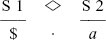
让我们回到主人话语的数学模型——也就是上文讨论过的能指定义——以阐明我们在精神病中所遭遇的异常处境:
S1 与 S2 被熔铸成一团无法区分的块状物,彼此黏连,拉康称之为“表句词”。这种融合不仅见于精神病,也可见于智力障碍及某些心身症状,这些状况可被归入“精神病性维度”。在那里,这对能指被石化了:S1 不断重复却无法生成意义,S1 与 S2 之间缺乏句法联结,彼此彻底且永久地割裂。在这两种情形下,作为社会纽带的话语都无法成立。若以主人话语的矩阵为参照,我们便可将精神病主体与言语的关系表述如下:
In the above, the lozenge has been displaced to the relation between S1 and S2. The cut between subject and object, the barrier that kept them apart and encouraged the imaginary of a search for an ulterior rediscovery, is gone.7 There is a double break in psychosis: of one signifier with another, and of fantasy as a barrier against jouissance. There is also a double clinical effect: the interruption of the intersubjective dialectic and an uncontrolled invasion of the Other’s jouissance, which is not subjected to phallic regulation or to the Law that orders desire. In psychosis, the hallucination substitutes desire and fantasy.
在上述情形中,菱形符号(◇)已被移置到S1与S2之间的关系上。主体与对象之间的割裂——那道曾将二者隔开、并催生出一种想象性追寻(即对某种终极重逢的幻想)的屏障——已然消失。精神病中存在双重断裂:一是能指与能指之间的断裂,二是幻想作为抵御享乐之屏障的崩解。相应地,也产生双重临床效应:其一,主体间辩证法的中断;其二,大他者的享乐不受控制地侵入,这种享乐既未受菲勒斯的规制,也不服从于为欲望赋序的律法。在精神病中,幻觉取代了欲望与幻想。
The metaphor of the Name-of-the-Father allows for the linking of the signifiers (S1 → S2) and produces an effect of signification linking signifier and signified.
父之名的隐喻使得能指之间得以联结(S1 → S2),并产生一种意指效果,将能指与所指连接起来。
Its failure makes the S1 lack meaning in the phrase that could receive it, retro-actively, from the S2. In such a situation, the signifier loses its symbolic dimension and, as Freud intelligently anticipated, the word-representation is real and cannot be distinguished from the thing-representation. The Real appears without the buffering of speech; the hallucination is its clinical manifestation. This is madness. The delusion is an attempt at a metaphor to make sense of the chaos of dissociated signifiers. Without it, we only have the harassment heard incessantly, the litany, the verbal stereotypes, the syllabic perseverance, and the allocutions without interval—in other words, the holophrase.
它的失败使得S1在本可由S2回溯性地赋予其意义的短语中,丧失了意义。在这种情况下,能指失去了其象征维度;正如弗洛伊德敏锐地预见到的那样,词表象变得实在,无法与物表象区分开来。实在界未经言语的缓冲便直接显现;幻觉正是其临床表现。这就是疯狂。妄想则是一种试图通过隐喻来为那些脱节的能指所造成的混乱赋予意义的努力。若无此妄想,我们面对的就只是那持续不断的侵扰:单调重复的祷文、言语刻板、音节固着,以及毫无间断的独白——换言之,即表句词。
We are left with an either/or: either jouissance, which is proper to madness, or discourse, which is proper to the subject. Lacan spoke of a “subject of jouissance” only twice. The “subject of jouissance” is a strange syntagm, because “[i]f the subject is not divided, he is mad,” as Lacan said with glaring clarity in 1958 (1998: 433). He used this syntagm first in 1963 (Lacan 2004: 203), when he proposed a mythical beginning that culminated in subjective division (a formula of subjective division and causation), and second in 1966, when he presented the publication of the French translation of the memoirs of Schreber (Lacan 2001a: 215). He referred then to the polarity between the “subject of jouissance” and the divided subject, who is represented by a signifier for another signifier.
我们面对一个非此即彼的选择:要么是享乐,它属于疯狂;要么是话语,它属于主体。拉康仅两次使用过“享乐的主体”这一表述。“享乐的主体”是一个奇特的词组,因为正如拉康在1958年(1998: 433)极为清晰地指出的:“如果主体未被分裂,他就是疯子。”他第一次使用这个表述是在1963年(Lacan 2004: 203),当时他提出了一种神话式的开端,最终导向主体的分裂(即主体分裂与成因的公式);第二次是在1966年(Lacan 2001a: 215),当时他谈及施雷伯回忆录法译本的出版。在那里,他指出了“享乐的主体”与被分裂的主体之间的对立极性——后者由一个能指为另一个能指所代表。
Foreclosure operates on the relation of the signifier of the Name-of-the-Father with the rest of the chain. Unmoored, the speaking being aimlessly roams the discourses, dependent on the Other’s response, trying to signify himself in his own speech, in existence. This is why for the psychotic, insofar as psychotic (and neither “full time” or completely), the word is not a symbol: it is not an invitation for exchange; it does not work as a diaphragm to filter and regulate jouissance.
除权作用于父之名这一能指与整个能指链之间的关系。一旦被除权,言说的存在便失去锚点,在话语中漫无目的地游荡,只能依赖大他者的回应,试图通过自己的言说在存在中为自己赋予意义。正因如此,对精神病主体而言——只要其处于精神病状态(既非“全时性”也非彻底的)——词语并非象征:它不是交换的邀约;也无法作为一道隔膜,用以过滤和调节享乐。
The signifier represents the subject who is not psychotic. The subject is in the place of meaning; he is what is meant; he is what is signified for (pour) another signifier, by/next to another (auprès d’un autre). Of course, this is never completely accomplished, because there is always a remainder: the object a. In psychosis, the articulation with the second signifier is missing. A signifier replaces the subject completely; it does not represent him. This signifier does not need to conjugate with another; there is a coalescence of signifier and subject (meaning). There is not an inassimilable remainder, a residue of the operation. The psychotic is invaded by a jouissance from which the common, “sane” person is excluded. Words are things for the psychotic. In psychosis, there is an S1 that represents the subject in an absolute manner, without remedy, remission or any symbolization of lack. This is why, let me insist, we speak of psychotic jouissance and not of psychotic desire. There is no lack that would put discourse into motion.
能指所代表的,是那个非精神病性的主体。该主体处于意义的位置上;他就是被意指之物;他是为另一个能指而被意指的,并且是在另一个能指之侧被意指的。当然,这一过程永远无法彻底完成,因为总有一个剩余:对象a。在精神病中,与第二个能指的联结缺失了。一个能指完全取代了主体;它并不“代表”主体。这个能指无需与其他能指共轭;能指与主体(即意义)在此融合为一。这里没有不可同化的剩余,也没有操作之后留下的残余。精神病者被一种享乐所侵袭,而这种享乐恰恰将普通人——所谓“正常人”——排除在外。对精神病者而言,词语即是事物。在精神病中,存在一个S1,它以绝对的方式代表主体,毫无补救、毫无缓解,也全然缺乏对匮乏的任何象征化。正因如此——我必须强调——我们谈论的是精神病性的享乐,而非精神病性的欲望。因为这里没有那种足以启动话语的匮乏。
The psychotic cannot maintain his distance from jouissance; he identifies with his jouissance. He is jouissance. In this regard, the hallucination is not an individual’s perception. There is no distinction between perceptum and percipiens. Since the lozenge that distances the subject of jouissance from the object a is missing, there is a condensation between the two terms of the fantasy: the subject and object are conglomerated. We should think of a word analogous to “holophrase” to designate this coalescence between $ and a, of which the most conspicuous example is the hallucination. In the subject’s perception, there is an object that can be subjected to the Freudian “reality testing.” In the hallucination, however, the subject is confused and fused with his object. They are not two but rather one; they do not maintain a relation of reciprocal exteriority.
精神病主体无法与享乐保持距离;他与自己的享乐认同——他就是享乐本身。就此而言,幻觉并非个体的知觉:在其中,被感知者与感知者之间毫无区分。由于那个将享乐主体与对象a隔开的菱形符号缺失了,幻想的两个项——主体与对象——便发生凝缩,彼此混为一体。我们应当设想一个类似于“表句词”的术语,用以指称$与a之间的这种融合,而幻觉正是其最显著的例子。在一般主体的知觉中,总存在一个可接受弗洛伊德所谓“现实检验”的对象;但在幻觉中,主体却与其对象混淆、融合为一。二者并非两个分离的实体,而是浑然一体;它们之间不再维持一种相互外在的关系。
In psychosis, jouissance is not localized in a bodily region. Not contained or limited by the phallic signifier (φ), the representative of what is lacking of the desired image in the body, it invades the body entirely. Transformed into a screen, where the most horrifying metamorphoses are projected, the subject is astonished and reduced to being the passive stage of transformations that obey the obscure will of an omniscient Other, who regulates the organic happenings. Influence, hypochondria, command hallucinations, persecution, magnetism, irradiations, trans sexualism, pousse à la femme, negation, putrefaction, and cadaverization of a body where no will but the Other’s reigns are all like the will governing the flesh of President Schreber for centuries to come.
在精神病中,享乐并不局限于身体的某个区域。由于未被菲勒斯能指(φ)所容纳或限定——而菲勒斯能指恰恰代表着身体中所缺失的欲望形象之表征——享乐便全面侵入整个身体。身体由此转变为一块屏幕,投射出最为骇人的变形;主体对此惊愕不已,只能被动地充当这些变形的舞台,而这些变形服从于一个全知的大他者的晦暗意志,由其调控着身体的种种有机事件。影响妄想、疑病症、命令性幻听、迫害妄想、磁力感应、辐射感、跨性别冲动、否定、腐烂感,以及身体的尸化——在这样一个唯有大他者之意志得以主宰的身体中,这一切都如同数百年来支配着施雷伯法官肉体的那种意志一般运作。
Before, after, and in lieu of: these are the three temporal and spatial vectors along which jouissance8 deploys itself facing speech in its rapport with the Other. We situate the jouissance of the psychotic before speech, as we have seen, but not beyond language. There is indeed a mythical jouissance of being posited at the beginning, anterior to the entrance into the world of exchanges inherent to life itself. This mythical jouissance is unable to sustain its life without appealing to the Other as capable of satisfying needs and demands. This jouissance of being, screaming and senseless, precedes the existence of the subject and of the ego. This is the jouissance of the flesh thrown (geworfen) into the world.9 It precedes the imaginary and symbolic representation of the body.
在前、在后、以及取而代之:这三重时空向度,正是享乐面对言语与其同大他者之关系时所展开的路径。如前所述,我们将精神病者的享乐置于言语之前——但并非置于语言之外。确实存在一种神话般的“存在之享乐”,它被设定于开端之处,先于主体进入生命所固有的交换世界。然而,这种神话般的享乐若不诉诸大他者——即那个被认为有能力满足需求与要求的大他者——便无法维系自身。这种存在之享乐是尖叫的、无意义的,它先于主体与自我的存在,乃是那被抛入世间的肉身之享乐。它先于身体的想象界与象征界表征。
But also after speech: in the speaking being (parlêtre), jouissance must go through customs, passing through the flexible diaphragm of the speech that doses it out, subjecting it to phallic signification. Through the palliative force of speech, the subject can traverse the barriers of narcissism and the pleasure principle so that the drive historicizes and inscribes the subject, marking her passage into the world. Speech allows the subject to leave an imprint on the Other, who is ready to receive her baggage.
但言语之后亦然:在言在之中,享乐必须经过海关——它穿过言语那富有弹性的横膈膜,被剂量化,并服从于菲勒斯的意指。凭借言语的姑息之力,主体得以穿越自恋与快乐原则所设下的屏障,使冲动得以历史化,并将主体铭刻其中,标记她进入世界的踪迹。言语让主体能在大他者那里留下印记,而大他者早已准备好接收她的行囊。
In lieu of speech, instead of speech: as the underside of speech, jouissance appears in the neurotic symptom in its perverse staging, under the banner of the supposedly strong ego. There jouissance flaunts itself as a curse, while not quite in speech; it is pure being, prior to the fall of man that resulted from his using speech. This incommunicable jouissance independent of the Other escapes symbolization and lodges in the body. This is the material used by the psychotic to express himself or herself without an addressee. For psychotics, speech does not function as a regulating diaphragm; they are inundated and displaced by a jouissance resistant to exchange. This jouissance proliferates so invasively that it does not allow for speech or for the other, thus preventing the Other or the semblant from containing and limiting it.
取而代之的不是言语,而是言语的背面:在神经症症状中,享乐以倒错的方式上演,打着所谓“强大自我”的旗号现身。在这里,享乐作为一种诅咒招摇过市,却尚未真正进入言语;它是一种纯粹的存在,先于人类因使用言语而堕落的那个时刻。这种无法言传、独立于大他者的享乐逃逸了象征化,并寄居于身体之中。精神病者正是利用这种材料来表达自己,却并无特定的言说对象。对精神病者而言,言语并不起调节横膈膜的作用;他们被一种抗拒交换的享乐所淹没、所驱逐。这种享乐如此侵袭性地增殖,以至于既不容言语,也不容他者,从而阻止了大他者或假相对其加以容纳与限制。
The imaginary Phallus Φ (capitalized, impossible to negativize) is the signifier of the jouissance interdicted from the speaking being. Not yet symbolized, the body has not yet been emptied of jouissance. Since lack in being has not been installed, the subject is not yet desiring. This is why psychoanalysts should never speak of psychotic desire. Without the space for this fertile lack, without the realization of the imaginary function of castration (– φ), there is nothing to look for, or to expect as a response, in the field of the Other.
想象界的菲勒斯Φ(大写,无法被否定)是言在被禁止享乐的能指。在尚未被象征化之前,身体尚未被掏空享乐。由于“存在之缺”尚未确立,主体也尚未成为欲望的主体。正因如此,精神分析家绝不应谈论精神病性的欲望。若没有这一丰饶之缺所开辟的空间,若没有阉割的想象功能(–φ)得以实现,那么在大他者的场域中,便无物可寻,亦无回应可期。
The Phallus does not fulfill its function of signifier per se, except through another signifier, the Name-of-the-Father. It allows for the establishment of a foundational pivot: the S1 to which the S2 of unconscious knowledge can be linked. The Phallus cancels out the Thing, allowing for the emergence of the subject as represented by the Name-of-the-Father.10 If the stem of the Name-of-the-Father is missing, the branches break loose; there is no tree or root system to hold them. This quick approximation of the notion of “foreclosure”11 is key to understanding psychosis. There is no limit to jouissance, no spigot able to bear the pouring speech that spills every which way without a container. The localized and temporal absence of a signifier of the Law leaves the subject at a loss, deprived of the identifying references that would allow him to navigate the world.
菲勒斯本身并不能单独履行其能指功能,唯有通过另一个能指——父之名——才能实现。它确立了一个奠基性的支点:即S1,无意识知识的S2得以与之联结。菲勒斯取消了原质,从而使主体得以在父之名的代表下浮现。如果父之名这一主干缺失,枝干便会散落无依;既无树干,也无根系将其维系。这种对除权概念的简要勾勒,正是理解精神病的关键所在。此时,享乐毫无界限,没有任何阀门能够承载那四处漫溢、无容器可收束的倾泻性言语。当律法的能指局部且暂时地缺席,主体便陷入迷失,丧失了赖以辨识自身、从而在世间定向的参照坐标。
Another effect of the non-regulation of jouissance is that, lacking the paternal orientation of the superego and the inheritance of the Oedipus complex, the psychotic cannot be guided towards a woman, as promised and possible. Unstoppable and incoercible, the obscene and ferocious order of the maternal, Kleinian, and archaic superego commands an impossible “Enjoy!”—the unlimited jouissance of the Thing before castration.
快感缺乏规制的另一后果是:由于缺失父性导向的超我以及俄狄浦斯情结的传承,精神病主体无法被引向一个女人——那个曾被允诺且本有可能实现的方向。取而代之的是,一种不可阻挡、无法遏制的母性—克莱因式—原始超我秩序,以淫秽而凶暴的方式发出一道不可能的命令:“去享乐吧!”——这正是阉割前原质所要求的那种无限制的快感。
His defective integration into the Symbolic order makes distance from the Real impossible. This produces a complete disorganization of the Imaginary of the body. Over this background of fragmentation, over this radical disturbance of existence, the restitutive function of the delusion tries to link the subject to the signifying chain and account for his lived experience. The whole of the psychotic adventure results from this dispersion of signifiers that are left unrelated to the social link. The delusional metaphor attempts to remedy the failure in the paternal metaphor, bestowing meaning on the lack in the Other. It tries to return the subject to the network of social relations, restoring the link between the Bindung of jouissance and speech.
他未能充分整合进象征界,使得与实在界保持距离变得不可能。这导致身体的想象界彻底瓦解。在此碎片化的背景之上,在此存在层面的根本性扰动之中,妄想的修复功能试图将主体重新接回能指链,并为其亲历的经验赋予意义。整个精神病性的历程,正源于这些能指的离散——它们无法再被纳入社会纽带之中。妄想性隐喻试图弥补父性隐喻的失败,为大他者中的匮乏赋予意义,并力图将主体重新带回社会关系网络,重建享乐的联结与言语之间的联系。
What I have summarized in these pages corresponds to the later revision of Lacan’s thoughts on the relations between jouissance and speech. Such revision raises many questions. It is not a coincidence that Lacan presented the theory of the paternal metaphor and the “foreclosure” of the Name-of-the-Father as the essence of psychosis in January 1958, some time after finishing his Seminar III on “The Psychoses,” and introducing the theme of jouissance in March of that year. The development of the concept of “jouissance” forced him to rethink the issue of madness, reworking the theses centered on disturbances in the organization of signification. The “desire of the Mother” that had to be substituted for the “Name-of-the-Father” to save the subject from psychosis had to account in theory and practice for the enigmatic “jouissance of the Other,” that real substance that subsists, resisting dissolution into the relations between signifier and signifier. The quotient that is impossible to settle in language exchanges will be transformed into the object a.
我在这些篇幅中所概括的内容,对应于拉康后期对其关于享乐与言语之间关系思想的修订。这一修订引发了许多问题。值得注意的是,1958年1月——即在完成其第三期研讨班《精神病》之后不久,并在其同年3月首次引入“享乐”主题之前——拉康提出了父姓隐喻理论,并将父之名的除权界定为精神病的核心机制。随着享乐概念的发展,他不得不重新思考疯狂的问题,从而对原先以能指秩序组织紊乱为中心的论点进行重构。为了使主体免于陷入精神病,必须用父之名来隐喻式替代母亲的欲望。然而,这一替代在理论与临床实践中,必须同时解释那神秘莫测的“大他者的享乐”——一种实在界的原质,它持续存在,抗拒被消解于能指与能指之间的关系之中。这种在语言交换中无法被结算的剩余,最终将被转化为对象a。
Finally, with the later introduction of jouissance, the strict distinction between neurosis and diverse forms of madness was impugned every time surplus jouissance appeared outside speech in every motion of the drive. The frontiers of madness became blurred, forcing a “nosological revision” (Lacan 1965). Lacan wonders whether Joyce can be called mad or not. He adds that “to be mad is not a privilege.” He also says that “for most people the Symbolic, the Imaginary, and the Real are entangled to the point that they bleed into each other for want of an operation that would distinguish them as in the Borromean knot” (Lacan 2005: 87). Besides highlighting the evident (that Schreber had managed to become a distinguished jurist while suffering a dormant psychosis that was triggered when he was well into his forties; that Joyce was able to navigate all his life making of writing a “supplement of the Name-of-the-Father,” not because that signifier was foreclosed in the symbolic but because it was de facto foreclosed), Lacan states that madness remains within the horizon of all speaking beings. Madness lurks in the constitutive amalgam of jouissance and the signifier.
最后,随着享乐概念的引入,神经症与各种疯狂形式之间的严格界限便屡遭质疑——每当冲动的每一个动作中出现溢出言语之外的剩余享乐,这种区分就变得不再稳固。疯狂的边界由此模糊,迫使拉康提出一种“症状学的重估”(Lacan 1965)。他甚至追问:乔伊斯是否可以被称为疯狂?他补充道:“疯狂并非一种特权。”他还指出:“对大多数人而言,象征界、想象界与实在界彼此纠缠,以至于在缺乏某种操作(如博罗米结那样将三者清晰区分开来)的情况下,它们相互渗透、彼此渗漏。”(Lacan 2005: 87)拉康在此不仅强调了显而易见的事实——施雷伯虽患有潜伏性精神病,却仍能成为杰出法学家,其病态直到四十多岁才被触发;乔伊斯则终其一生以写作作为父亲名的增补,并非因为该能指在象征界中被除,而是事实上已被除权——更进一步指出:疯狂始终处于一切言说主体的地平线上。它潜伏于享乐与能指那构成性的混合体之中。
To conclude more simply and radically, we can say that madness is a transitory disruption of the relationship of the subject and the other. Madness is a separation, an interruption of the social link. It is in this sense that even if one cannot choose madness, a madman is the “last free man,” who has been freed from the restrictions imposed by shared conventions. Yet such separation is never complete or definitive; mad subjects never lose all their bonds to reality, at least to the Other’s reality. The responsibility of psychiatrists or psychoanalysts is then to place themselves on the psychotics’ side, to try and see things from their perspective and not from the perspective of cultural, familial, and political demands and social expectations. Such demands and expectations include the manual of psychiatric diagnostic standards, and concerns all the “norms” corresponding to the abstract construction of this fiction called the “common” or “normal” person. If madness asserts the impossibility or the rejection of life in the world of others, it is also a call to be heard, an appeal to be understood in a singular position.
更简单也更彻底地说,疯狂是一种主体与大他者之间关系的暂时性断裂。疯狂即分离,是社会纽带的中断。正因如此,即便人无法主动选择疯狂,疯子却可被视为“最后的自由人”——他挣脱了共享惯例所施加的种种限制。然而,这种分离从来不是彻底或最终的;疯狂的主体从未完全丧失与现实的联系,至少仍维系着与大他者之现实的某种纽带。因此,精神科医生或分析家的责任,便是站在精神病者的一边,尝试从他们的视角去看,而非从文化、家庭、政治的要求以及社会期待出发。这些要求与期待包括精神病诊断标准手册,也涵盖所有对应于那个被虚构出来的“普通人”或“正常人”这一抽象建构的所谓“规范”。如果说疯狂宣告了在他人世界中生活的不可能或拒绝,那么它同时也是一种呼求——一种希望被听见、被理解的诉求,要求人们承认其独一无二的位置。
第七章:精神病的治疗与当代精神分析——让-克洛德·马勒瓦尔(TREATMENT OF THE PSYCHOSES AND CONTEMPORARY PSYCHOANALYSIS)
Today, psychiatric practice finds itself split between two modalities of clinical procedure. The first is blinded by psychopharmacology as a cure-all and the second is crumbling to pieces as a result of the latest DSM. The hoped-for moment when the coming together of each of these two clinical paths would finally take place, when each syndrome would find its “partner molecule,” has continued to evade us.
如今,精神病学实践正分裂为两种临床操作模式。其一是被精神药理学所蒙蔽,将其奉为万能灵药;其二是因最新版DSM(《精神障碍诊断与统计手册》)的冲击而分崩离析。人们曾寄望于这样一个时刻:两条临床路径终将汇合,每一种综合征都能找到其对应的“配对分子”——然而这一时刻始终未能到来。
Psychopharmacological clinical work functions by trial and error, attending to the effects of each prescription on the patient. From the discovery of neuroleptics, anti-depressants, and anxiolytics, one can presumably “deduce” the existence of psychotic, depressive, or anxious patients. Such a clinical approach doesn’t have much use for the semiological knowledge garnered by classical psychiatry since it is only the authority of the drug that matters for this sort of work. It can, at most, pick and choose little tidbits of older clinical knowledge all the while remaining totally indifferent to the formal envelope of the symptom.1 For instance, if the anti-depressants aid the disappearance of patients’ complaints, it is because, according to this “logic,” the subject was “depressed without knowing it.” Ergo, we invent “masked depression,” often called “cheerful” or “smiling” depression, while the Freudian notion of conversion is relegated to the clinical garbage can.
精神药理学的临床工作依靠试错法展开,关注的是每一种处方对患者所产生的效果。自神经阻滞剂、抗抑郁药和抗焦虑药被发现以来,人们似乎便可以“推断”出精神病性、抑郁性或焦虑性患者的存在。这种临床取向几乎用不上古典精神病学所积累的症候学知识,因为在此类工作中,唯一重要的只是药物本身的权威。它至多会从旧有的临床知识中零星拣选一些片段,却对症状的形式结构完全漠不关心。例如,如果抗抑郁药促使患者的主诉消失,那么按照这种“逻辑”,主体便被认定为“在不知情的情况下处于抑郁状态”。于是,我们便发明了所谓“隐匿性抑郁”——常被称为“愉快型”或“微笑型”抑郁,而弗洛伊德所提出的转换概念,则被扔进了临床的垃圾堆。
The last DSM did not completely ignore the gains made by classical psychiatry, since it initially used them to invent its principle syndromes. However, by trying to objectivize them, to render the knowledge of them statistically relevant and reliable, it ignored the data about the dynamics of the “disorder.” The rich observations made at the end of the nineteenth century, for example, on the stages of the evolution of chronic delirium, would be lost (Maleval 2011). Aiming to reduce the clinical criteria to a few simple traits to obtain a “true evaluative diagnosis,” we arrive at a veritable decomposition of the psychiatric clinic by way of an exponential increase in syndromes, difficulties, and disorders. We note 106 such disorders in DSM-I; 182 in DSM-II; with DSM III there are already 265; we find 292 in the DSM-III-R; and in the DSM-IV we see a jump to 392. The DSM-IV-R operates on a significant new advance: being able to distinguish 542 disorders.2 The logic of this approach aims for a standardized precision that the singularity of the subject continues to resist. This accounts for the persistent multiplication of the syndromes, ad infinitum. In amplifying the DSM, we will only end up with more and more diversified descriptions of the modalities of the human subject’s jouissance. This quest for formulaic diagnostic rigor results in failure, since as we continue to enlarge the field of mental disorders, we blur the distinction between normal and pathological, ultimately dissolving any real or useful concept of mental illness.
上一版《精神障碍诊断与统计手册》(DSM)并未完全无视古典精神病学的成果,最初正是借助这些成果构建了其核心综合征。然而,它试图将这些成果客观化,使其知识具备统计上的相关性与可靠性,却因此忽略了关于“障碍”动力机制的数据。例如,19世纪末对慢性妄想演变阶段所作的丰富临床观察,如今已几近湮没(Maleval, 2011)。为了将临床标准简化为少数几个易于操作的特征,以达成所谓“真正可评估的诊断”,结果却导致精神病理学临床被彻底肢解——综合征、困难与障碍的数量呈指数级增长:DSM-I 列出106种障碍;DSM-II 增至182种;到 DSM-III 已达265种;DSM-III-R 进一步增至292种;而 DSM-IV 更是跃升至392种。DSM-IV-TR 又迈出关键一步,竟能区分出542种障碍。这种逻辑追求一种标准化的精确性,但主体的独特性始终对此加以抵抗。正因如此,综合征才不断增殖,永无止境。若继续扩充 DSM,我们最终只会得到越来越多样化的描述,用以刻画人类主体享乐的诸种模态。这种对公式化诊断严谨性的执着,注定失败:随着精神障碍范畴的无限扩张,正常与病态之间的界限日益模糊,最终消解了任何真实且有用的精神疾病概念。
Long before the publication of the DSM in the 1950s, the eminent psychiatrist Eugene Minkowski clearly discerned the consequences of a clinical practice centered on isolating symptoms:
There is hallucination and hallucination, just like there is anxiety and anxiety. Separated from its lived context, the isolated and generalized symptom [is already] excessively, an “abstraction.” In this sense, it is placed automatically in terms of a neurological perspective, while in reality, it draws its signification in the mental depths it stems from […]. It’s obvious […] that maniacal euphoria, paralytic euphoria, and the beatific euphoria of the idiot are not the same [despite all having the name euphoria]. It is the mental depths, [what Minkowski calls the “mental fundament”], that is the most important. It is the same for anxiety and depression, and in reality, for all symptoms […]. Psychopathology arises from the symptom, but the various mental fundament, is characterized by structure. It is thus closer to the syndrome than to the symptom. However, the syndrome is not necessarily the appropriate term to speak of the mental fundament and its dynamism.(Minkowski 1997: 150)
早在20世纪50年代《精神障碍诊断与统计手册》(DSM)出版之前,著名精神病学家欧仁·明科夫斯基就已清晰地指出,那种以孤立症状为中心的临床实践会带来怎样的后果:
“幻觉有幻觉之别,焦虑亦有焦虑之分。一旦脱离其活生生的情境,被孤立出来并加以泛化的症状,本身就已然是一种过度的‘抽象’。在此意义上,它自动被纳入神经学的视角,而实际上,它的意义恰恰源于其所出自的精神深处……显然,躁狂性欣快、麻痹性欣快,以及痴呆者的恬然欣快,尽管都名为‘欣快’,却绝非同物。真正关键的是精神深处——即明科夫斯基所称的‘精神根基’。焦虑与抑郁亦复如是;事实上,所有症状皆如此……精神病理学虽由症状出发,但各种精神根基却以其结构为特征。因此,它更接近于‘综合征’而非单一症状。然而,‘综合征’一词也未必足以恰当地言说精神根基及其动力。”(Minkowski 1997: 150)
The clinical approaches of modern psychiatry based on the DSM, as well as that of medication concerned with the objectivization of disorders, impose an epistemic reduction that is quite costly for the patient. This cost concerns what Minkowski named the “mental fundament and its dynamics”—in other words, the subjective dimension, the subject’s desire and his demands.
当代精神病学以DSM为基础的临床取向,以及那种将障碍客观化的药物治疗模式,强加了一种代价高昂的认识论缩减。这种代价关乎明科夫斯基所称的“精神根基及其动力”——换言之,即主体的维度、主体的欲望及其要求。
Psychoanalysis advocates a different clinical approach, which stems from the classical psychiatric clinic. Contemporary psychoanalysis has become the heir apparent to the treasure trove of clinical knowledge gathered between 1860 and 1930. This seminal work began with the brilliance of Jean-Pierre Falret (1794–1870), who passed the flame to Gaétan de Clérambault (1872–1934), whose work was then codified by Emil Kraepelin (1856–1926). Psychoanalysis has kept this heritage alive, enriching it with new observations and adding a dynamic dimension by introducing the notion of transference. As a result, since 1950, many psycho-analysts have ceased to doubt the ability of psychotic patients to enter into a transference relationship, but they continue to debate how to best manage it. A decisive step was taken in the 1980s with the hypothesis of the foreclosure of the Name-of-the-Father, affecting the direction of the cure. Since then, many psychoanalytic treatments have demonstrated the possibility of relying on the psychotic subject’s capacity for invention as a way of treating his suffering. Two major points at the turn of the twentieth century were responsible for the future of psychoanalytic work with psychotic patients. The first of these was the continuing compilation of symptoms and modes of functioning. Second, we have learned, and the subsequent analyses of psychotic patients have shown, that it is more beneficial to wager on the psychotic subject’s capacity for invention than to think of him as someone suffering from a deficit.
精神分析提出了一种不同于传统精神病学临床的路径。当代精神分析已然成为1860至1930年间所积累的临床知识宝库的当然继承者。这一开创性工作始于让-皮埃尔·法尔雷(Jean-Pierre Falret,1794–1870)的卓见,其后由加埃唐·德·克莱朗博(Gaétan de Clérambault,1872–1934)接续薪火,并由埃米尔·克雷佩林(Emil Kraepelin,1856–1926)加以系统化。精神分析不仅延续了这一遗产,更通过引入“转移”的概念,为其注入了动态维度,并以新的临床观察不断丰富之。自1950年代起,许多分析家已不再怀疑精神病患者进入转移关系的可能性,但关于如何最恰当地引导这种转移,争论仍在继续。1980年代迈出了决定性的一步:提出了“父之名”的除权假说,这一理论深刻影响了治疗的方向。自此,诸多精神分析实践表明,可以倚重精神病主体自身的发明能力,以此作为缓解其痛苦的途径。在二十世纪之交,有两个关键点奠定了此后与精神病患者开展精神分析工作的未来方向。其一,是对症状及其运作模式的持续记录与整理;其二,也是更重要的,是我们逐渐认识到——并通过后续对精神病患者的分析得到印证——与其将精神病主体视为某种缺陷的承载者,不如赌一把他所拥有的发明能力。
Freud essentially adopted Kraepelin’s nosology. “It is certain,” noted Jacques-Alain Miller in 1979, “that we have to use the language that the psychiatric clinic has handed down to us, to the extent that Lacan could say: in fact, it is the only clinic that we have” (Miller 1979: 244). However, the power of this clinical knowledge has diminished, having lost its dynamism in the 1930s. “In the last 30 years,” Lacan told his audience in 1967, “there hasn’t been any discovery in psychiatry concerning its rapport with the madman, not the slightest clinical modification, no contribution whatsoever. We are left with the beautiful tradition of the nineteenth century; all we have since are a few touch-ups by Clérambault” (Lacan 1967). Obviously, we could note a few minor discoveries after de Clérambault: Kanner’s autism (1943), Asperger’s syndrome (1944), transsexualism (1949), Munchausen’s syndrome (1951), typus melancholicus (1961), Ferjol’s syndrome (1967), and Munchausen by proxy (1977). Notwithstanding appear ances, this list seems to confirm that classical psychiatry approaches its own internal limit when we observe that only two of the discoveries just listed are due to the work of a psychiatrist (Kanner, Tellenbach); all the others are credited to non-psychiatrists and endocrinologists (H. Benjamin), a hematologist (J. Bernard), an internist (R. Asher) and two pediatricians (H. Asperger, R. Meadow).3 Since the 1980s, the classical clinic has been fragmented in a mini-syndrome format with nothing solid to sustain it.
弗洛伊德基本上采纳了克雷佩林的疾病分类体系。雅克-阿兰·米勒在1979年指出:“我们确实不得不使用精神病学临床传统留给我们的语言,以至于拉康可以说:事实上,这是我们唯一拥有的临床。”(Miller 1979: 244)然而,这种临床知识的力量已然衰落,早在1930年代就已丧失其原有的动力。1967年,拉康对听众说道:“过去三十年里,精神病学在与疯子的关系上没有任何新发现,丝毫没有临床上的修正,也毫无贡献可言。我们只剩下十九世纪那套漂亮的传统;此后所增添的,不过是克莱朗博做的一些小修小补罢了。”(Lacan 1967)当然,我们也可以指出克莱朗博之后的一些零星发现:坎纳的自闭症(1943)、阿斯伯格综合征(1944)、易性症(1949)、孟乔森综合征(1951)、忧郁型人格(typus melancholicus,1961)、费若尔综合征(Ferjol’s syndrome,1967),以及代理型孟乔森综合征(Munchausen by proxy,1977)。但表面现象之下,这份清单恰恰印证了古典精神病学正逼近其内在极限:上述发现中,仅有两项出自精神病学家之手(坎纳、泰伦巴赫/Tellenbach);其余皆归功于非精神病学领域的研究者——内分泌学家(H. Benjamin)、血液学家(J. Bernard)、内科医生(R. Asher),以及两位儿科医生(H. Asperger、R. Meadow)。自1980年代起,古典临床便进一步碎裂为各种“微型综合征”的拼凑,却再无坚实的基础予以支撑。
Psychoanalysis proposes a new clinical practice: treatment under transference. It can only succeed by introducing the presence of the analyst as a surrogate for the Other. The psychoanalytic clinic is able to note three structures: neurotic, perverse, and psychotic. These structures introduce the dynamic of desire into these fixed nosologies. “There are of course phenomena that resist transference,” Miller notes:
But it allows a scientific or para-scientific knowledge that is much more refined than what is obtained by pharmacological substance use. This use erodes phenomena; they disappear without ever having been understood, confusing very different symptoms—for example, under the name of “depression.” The differentiation that allows for psychoanalysis is incomparably more powerful. I am sure that in the United States, an impressive number of hysterical women are treated as schizophrenics. The first thing that American feminism ought to do is to carry the militant movement towards re-establishing the diagnosis of hysterical neurosis.(Etchegoyen and Miller 1996: 24)
精神分析提出了一种新的临床实践:在转移中进行治疗。这种治疗唯有通过引入分析家作为大他者的替代者,才可能成功。精神分析的临床能够辨识出三种结构:神经症、倒错与精神病。这些结构将欲望的动力学引入了原本固定的疾病分类之中。“当然,也存在一些抵抗转移的现象,”米勒指出:
“但(精神分析)所允许的是一种比药物使用所能获得的更为精细的科学或准科学知识。药物的使用会侵蚀现象本身——它们在未被理解之前就消失了,并将截然不同的症状混为一谈,比如统统归入‘抑郁’之名下。精神分析所提供的区分能力则无可比拟地更强。我敢肯定,在美国,大量患有癔症的女性被误诊为精神分裂症患者。美国女性主义首先应当做的,就是推动一场激进运动,重新确立对癔症性神经症的诊断。(Etchegoyen 与 Miller,1996:24)
In short, Miller continues today, “Psychiatry says to molecular biology: ‘I love you!’ and it answers back, ‘Die!’ We psychoanalysts are the true friends of psychiatry. If psychiatry would cut itself from its roots and cease to pay meticulous attention to what Lacan calls, ‘the formal envelope of the symptom,’ it would be lost” (Etchegoyen and Miller 1996: 19).
简言之,米勒如今继续说道:“精神病学对分子生物学说:‘我爱你!’而对方回敬道:‘去死吧!’我们精神分析家才是精神病学真正的朋友。倘若精神病学斩断自己的根基,不再细致关注拉康所说的‘症状的形式外壳’,它就完了。”(埃切戈延与米勒,1996:19)
Today’s psychiatric clinic, championing the argument that all the manifestations of the madman are classifiable, has become incompatible with the experience of psychoanalysts. If Freud makes of the Memoirs of President Schreber a Freudian text, it is because he introduces the notion of the subject. This means that he does not evaluate the madman in terms of a deficit or a dissociation of functions; a simple reading of Freud’s text shows that nothing of the sort is relevant in this case (Lacan 1966: 70). Contrary to the opinion of many clinicians and of most Freudian analysts, the psychoses are not a failure of thought. The philosopher Jean-Jacques Rousseau, the physicist and founder of thermodynamics Julius von Mayer, the mathematician and founder of non-Euclidian geometry János Bolyai, the founder of sociology Auguste Comte and many others would attest to the fact that delirium is compatible with very high functioning intellectual faculties. Those who advocate an approach to psychosis that concerns “deficiency” usually object to the theoretical concept of foreclosure of the Name-of-the-Father and risk stigmatizing the psychotic by emphasizing what is missing. What a proper approach really concerns is a dynamic concept that places the emphasis on the psychotic’s creative resources, and opens new possibilities for the treatment while freeing the subjective capacity to supplement (suppléances).4 The flaw in the Symbolic that the psychotic bears no more interferes with thought than does the neurotic’s repression or the pervert’s disavowal. The flaw in the Symbolic no more precludes the psychotic subject’s position from being modified and elaborated in analytic treatment than it would with a neurotic subject.
当今的精神科临床实践主张,疯子的所有表现均可被分类归档,这已与精神分析家的经验格格不入。弗洛伊德之所以将施雷伯法官的《回忆录》视为一篇弗洛伊德式文本,正是因为他引入了“主体”这一概念。这意味着,他并非从功能缺失或功能解离的角度去评判疯子;只要简单读一读弗洛伊德的原文就能看出,在这个案例中,这类评判完全不适用(拉康,1966:70)。与许多临床工作者乃至多数弗洛伊德派分析家的看法相反,精神病并非思维的失败。哲学家卢梭、热力学奠基人物理学家迈尔、非欧几何创始人数学家鲍耶、社会学之父孔德,以及众多其他人物都足以证明:妄想完全可以与高度发达的智力功能共存。那些主张以“缺陷”视角理解精神病的人,往往反对“父之名”的除权这一理论概念,并在强调“缺失”时,无意中对精神病者造成污名化。真正恰当的理解应立足于一个动态概念——它聚焦于精神病者自身的创造性资源,不仅为治疗开辟新的可能性,也释放其主观的增补能力。精神病者所承载的象征界裂隙,并不比神经症者的压抑或倒错者的拒认更妨碍思维。这一象征界的裂隙,也并不比在神经症主体那里更阻碍其在分析治疗中对其主体位置进行修正与展开。
For some time, the notion of the foreclosure of the Name-of-the-Father more set up barriers to the treatment of psychotics than opened new perspectives. Let’s recall that although he told us not to recoil before psychosis, Lacan also advocated an attitude of prudence in its treatment. His rare technical indications pertain largely to what the clinician should avoid doing: one should not authenticate the Imaginary, not interpret homosexuality, not make meaning resonate, and not demand that the subject lie down on the couch. He could see in the “Preliminary Question” that a specific maneuvering of transference would have to be invented to guide the cure of psychotics, but he himself was not able to design it in advance. For the next thirty years, from the 1950s to the 1970s, Lacanian works were rarely concerned with the treatment of psychotic adults. It is logical, then, that the main principle in the research produced on this theme in the Freudian school of Paris was dedicated to institutional psychotherapy (Jean Oury, Ginette Michaux) and not to individual cures. In the Freudian Field Collection directed by Lacan (1964–81), no one was able to surpass Lacan’s formulations in “A Question Preliminary to Any Possible Treatment of Psychosis”: no work was dedicated to it. We also note that the only published work in this field, Psychiatry and Anti-Psychiatry, came from someone who was not a member of the Freudian school of Paris, David Cooper. This research gives no credit to the analytic cure, but it demonstrates the benefits of an institutional approach without medication of subjects said to be schizophrenics (Cooper 1970). Lacan only once alluded to work from outside his school in his collection (Champ Lacanian), in reference to the treatment of psychotic patients. This has left a hole in his teaching, revealing a heuristic lack in his conceptualization of the 1950s.
一段时间以来,“父之名”的除权这一概念,与其说为精神病的治疗开辟了新视角,不如说更多地设置了障碍。我们不妨回想一下:尽管拉康曾告诫我们不要在精神病面前退缩,但他同时也主张在治疗中保持谨慎态度。他所给出的为数不多的技术性指示,大多聚焦于临床工作者应当避免什么:不要去确认想象界,不要对同性恋进行解释,不要让意义产生共鸣,也不要强迫主体躺到躺椅上。他在《精神病治疗的先决问题》一文中已经意识到,必须发明一种特殊的转移操作方式,才能引导精神病的治疗,但他本人并未能事先设计出这种操作。从1950年代到1970年代的三十年间,拉康派的工作很少关注成年精神病患者的个体治疗。因此,在巴黎弗洛伊德学派围绕这一主题所开展的研究中,主要原则自然倾向于制度性心理治疗(如让·乌里、吉内特·米肖等人),而非个体分析。在拉康主编的《弗洛伊德场域文集》(1964–1981)中,无人能超越他在《精神病治疗的先决问题》中的论述——甚至没有一部专著专门探讨这一议题。我们还注意到,该领域唯一出版的著作《精神病学与反精神病学》出自非巴黎弗洛伊德学派成员大卫·库珀之手。这项研究并不认可分析性治疗的价值,但它展示了对所谓精神分裂症患者采取无药物干预的制度性方法所带来的益处(Cooper, 1970)。拉康在其主编的《文集》中,仅一次提及学派之外关于精神病患者治疗的工作。这在其教学中留下了一道空白,也暴露出他在1950年代对精神病概念化时所存在的启发性缺失。
Insofar as the hypothesis of the foreclosure of the Name-of-the-Father (Maleval 2000) prevented the opening of a new orientation to treat psychotics, those who followed Lacan were tempted to dress up antiquated practices in a new vocabulary. In the 1970s, some of them affirmed that one must analyze the “foreclosed desire” of psychotic children; these include, for instance, Françoise Dolto (1971: 249). Others considered that one must trust the possible hystericization of psychosis—for instance, Maud Mannoni (1979: 133). These analysts conceived foreclosure as a modality of repression, certainly more profound, but analyzable in the classical manner. In 1956, Lacan already warned against a “fundamental Imaginary” that is too widespread. He said that “there is something that must communicate between neurosis and psychosis, between the pre-conscious and the unconscious in a way that would ‘push, nibble,’ and be able to ‘break through the fortification’” (Lacan 1981: 187).
就父之名的除权假说(Maleval,2000)而言,它曾阻碍了为精神病患者开辟新的治疗方向,因此追随拉康的一些人便倾向于用一套新术语来包装那些陈旧的临床实践。在1970年代,有人主张应当分析精神病儿童身上被“除权的欲望”——比如弗朗索瓦兹·多尔托(Françoise Dolto,1971: 249)便是如此。另一些人则认为,应寄望于精神病可能发生的癔症化过程——例如莫德·马诺尼(Maud Mannoni,1979: 133)就持此观点。这些分析家将除权理解为一种压抑形式,尽管更深一层,却仍可沿用经典方式加以分析。然而早在1956年,拉康就已警示过一种过于泛滥的“根本性想象界”。他指出:“在神经症与精神病之间,在前意识与无意识之间,必须存在某种能够‘推挤、啃噬’并最终‘突破堡垒’的东西”(Lacan,1981: 187)。
The concept of the foreclosure of the Name-of-the-Father nevertheless allowed for certain diminished functions observed in psychotics in treatment to become more precise. It was not through new therapeutic perspectives that this arose; Lacan was betting on his new work in 1967. He thought a new approach would emerge due to his research and he named this “an other centering” (Lacan 1967). Lacan progressively put in place the possibility of “an other centering” through scattered notations, all of them post-1964, no longer stemming from the logic of the signifier but founded on the axiom of jouissance. He situates the psychotic as a subject who is out of discourse, who is invaded by a deregulated jouissance the major utterances (enoncés) of which are “holophrased,”5 and who is therefore at risk of developing an erotomanic transference. In 1958, he had already affirmed that when the subject is no longer divided, “he is mad.”6 He resumes this line of thought in his final research, highlighting the fact that it is not only in the field of the signifier that the schism of the subject has failed. Now, he will place the accent on the invasion of a deregulated jouissance. The psychotic has the object in his pocket, he adds in 1967; that is why the voice tends to sonorize in verbal hallucinations and the gaze tends to present in the feeling of being watched. Moreover, the psychotic subject presents a paradoxical normality in the sense that his major difficulty demonstrates the primacy of the discourse of Other, which is manifested in a mental automatism that exposes the neurotic illusion that we speak for ourselves when, in fact, we are spoken. “Mental automatism is normal” says Lacan in 1977 (1979: 22). Automatism is a rejection of the unconscious, conceived of as something that lends itself to interpretation. We must add a difficulty inherent to the transference. Here the mortifying erotomania hardly hides the presence of the Other’s jouissance, an Other who is always inclined to make the psychotic his thing. This is where we locate the risk in the transferential relation to the analyst (reported by Lacan in “On a Question Preliminary to Any Possible Treatment of Psychosis”), which can precipitate an outbreak of the psychosis (Lacan 2006: 582), constituting the clinician as the persecutor.
然而,父之名的除权这一概念,使得我们在临床中观察到的精神病患者某些功能的削弱得以更精确地界定。这并非源于新的治疗视角;拉康在1967年所押注的,是他当时正在进行的新工作。他认为,自己的研究将催生一种新的取向,并称之为“另一种中心化”(Lacan 1067)。自1964年之后,拉康通过一系列零散的笔记逐步确立了这种“另一种中心化”的可能性——这些笔记不再基于能指的逻辑,而是奠基于享乐的公理之上。他将精神病主体定位为一个处于话语之外的主体,被一种失序的享乐所侵袭,其主要言说以表句词的形式呈现,因而极易发展出钟情妄想式的转移。早在1958年,拉康就已断言:当主体不再分裂时,他就疯了。在其晚期研究中,他重拾这一思路,并进一步指出:主体的分裂失败不仅发生在能指领域。如今,他更强调那种失序享乐的入侵性。1967年,他补充道:精神病主体“把对象a揣在口袋里”——正因如此,声音倾向于在言语幻觉中发出声响,而凝视则倾向于表现为“被注视”的感觉。此外,精神病主体呈现出一种悖论性的“正常”:其核心困难恰恰揭示了大他者话语的优先性。这种优先性体现为一种精神自动症,它揭穿了神经症的幻觉——即我们以为自己在说话,实则我们是被言说的。“精神自动症是正常的”,拉康在1977年(1979: 22)如是说。这种自动症是对无意识的拒斥,而无意识本应是可以被诠释的东西。我们还需加上转移本身固有的困难。在此,那种令人窒息的钟情妄想几乎无法掩盖大他者享乐的存在——这个大他者总是倾向于将精神病主体据为己有。正是在这里,我们定位到与分析家之间转移关系的风险(拉康在《关于任何可能的精神病治疗之前的一个问题》中曾指出):这种转移可能触发精神病的爆发(Lacan 2006: 582),并将临床工作者建构为迫害者。
His varied teachings pertaining to the psychotic’s modality of jouissance nevertheless maintained a great coherence. Each of them proved the result of the same process: the non-extraction of the object places the subject outside of discourse; this lack of a barrier to jouissance predisposes the psychotic to be subjected to the Other’s jouissance.
他关于精神病者享乐模式的种种论述,始终保持着高度的一致性。每一种论述都源于同一个过程:对象a未能被提取,致使主体被置于话语之外;这种对享乐缺乏屏障的状态,使精神病者易于屈从于大他者的享乐。
The new approach to psychosis through jouissance does not seem to open therapeutic perspectives further. On the contrary, they seem to augment the obstacles already encountered; they underline the difficulties inherent in the transferential relation, block the interpretation of the delusion, and situate the subject outside of discourse. However, they no longer place the accent on the unchaining of the signifier but on the invasion of jouissance, the very one that Schreber attested to with extraordinary precision. He writes, “An excess of voluptuousness will render man unfit to fulfill his other obligations: […] God demands constant enjoyment” (Schreber 2000: 249–50). God demanded to see Schreber as both man and woman, as a unique person, in order to have intercourse with himself. God demanded a constant state of jouissance.
通过享乐来理解精神病的新路径,似乎并未进一步打开治疗的前景。恰恰相反,它似乎加剧了既有的障碍:突显了转移关系中固有的困难,阻断了对妄想的诠释,并将主体置于话语之外。然而,这一路径不再强调能指的脱链,而是聚焦于享乐的入侵——正是这一点,施雷伯以非凡的精确性予以见证。他写道:“过度的快感会使人无法履行其他义务:……上帝要求持续的享乐”(Schreber 2000: 249–50)。上帝要求将施雷伯同时视为男人与女人,视为一个独一无二的人,以便与自身交合。上帝所要求的,是一种持续不断的享乐状态。
In exposing the implications of the deregulation of jouissance, in 1967, Lacan was able to elaborate the concept of “the other centering” that he hoped would overcome the challenges stated in the essay “On a Question Preliminary to Any Possible Treatment of Psychosis.” However, he did not realize the implications of this for the direction of the cure. If one accepts the thesis that ultimately it is the invasion of jouissance that the psychotic subject suffers from, does it not make sense that the analysis should oppose it? Michel Silvestre was the first to draw this conclusion during the years following Lacan’s death. “If in his initial request,” he writes in 1984, “the psychotic expects signifiers from the analyst able to organize the upheavals of his world, in his second request, the transferential one, the psychotic offers his jouissance to the analyst so that the analyst will regulate it” (Silvestre 1984: 55).
1967年,拉康在揭示享乐去管制化所引发的后果时,提出了“他者中心化”这一概念,希望借此克服他在《关于任何可能的精神病治疗之前的一个先决问题》一文中所指出的难题。然而,他并未充分意识到这一观点对治疗方向所产生的影响。如果我们接受这样一个论点:精神病主体最终所遭受的,正是享乐的入侵,那么分析难道不应当对此加以抵抗吗?米歇尔·西尔韦斯特是首位在拉康去世后的几年中得出这一结论的人。他在1984年写道:“如果精神病主体在其最初的请求中,期待分析家提供能组织其世界动荡的能指;那么在其第二个、即转移性的请求中,他则是将自己的享乐交付给分析家,以期分析家为其加以调节。”(Silvestre 1984: 55)
In the 1980s, following the establishment of these fundamental orientations, many psychoanalytic treatments of psychotics, conducted by analysts of the Ecole de la Cause Freudienne, confirmed this to be effective. When the psychotic subject addresses himself to the psychoanalyst, he first asks for help to bring order to his world and supposes that the physician knows better than he does how to go about it. At the same time, the psychotic affirms that he possesses certain knowledge, transmitted to him by the elementary phenomena at the onset of the triggering that he was witness to without his consent. “What the psychotic wants to affirm,” claims Briole, “is on the order of an affirmation that does not leave room for any doubt, nor does it allow for dialectic—at least not at first. The psychoanalyst can only be the witness to the psychotic’s experience of victimization, wherein he is unable to act. The analyst can’t do anything about it either. And in the end, the psychotic doesn’t ask him to do anything about it—and even, if one really listens well, the psychotic will warn the analyst not to get mixed up in it” (Briole 2006: 7). Indeed, to answer the request to structure the psychotic’s invasive jouissance with a pre-fabricated knowledge tends to mobilize the mortifying erotomania rather than hinder it. It is in acting against the delocalized jouissance that the psychotic transference will actually be appeased. The resulting feelings of persecution are effectively counter-balanced by transference love; the treatment can continue, even until the dissolution of the transferential bond. In the case of neurosis, the analysand addresses the analyst insofar as he is supposed to know. In the case of psychosis, the analysand presents a certitude with which he tries to interest the analyst.
20世纪80年代,在这些基本取向确立之后,由弗洛伊德事业学派的分析家所进行的大量对精神病患者的治疗实践,证实了这一路径的有效性。当精神病主体向精神分析家求助时,他首先请求帮助,以期为自己的世界重新建立秩序,并假定医生比自己更清楚该如何着手。与此同时,精神病主体又坚称自己掌握着某种知识——这种知识是由触发发作初期出现的基本现象传递给他的,而他本人是在未经同意的情况下被迫成为这些现象的见证者。布里奥勒指出:“精神病主体想要肯定的东西,是一种不容置疑、也不容辩证的肯定——至少在最初阶段如此。精神分析家只能作为精神病主体受害经验的见证者,而在这一体验中,主体自身无法行动,分析家对此也无能为力。最终,精神病主体甚至并不指望分析家去改变什么;而且,若我们真正仔细倾听,他会警告分析家不要卷入其中。”(Briole 2006: 7)的确,若以一套预制的知识来回应精神病主体关于结构其侵入性享乐的请求,往往非但不能遏制,反而会激发那种致死性的色情狂爱。唯有通过对去定位化的享乐采取行动,精神病性的转移才可能真正得到平息。由此产生的迫害感,会被转移之爱有效抵消;治疗得以继续,甚至可以持续到转移纽带的消解。在神经症的情形中,分析者是基于“被假设知道的主体”这一位置而向分析家言说的;而在精神病的情形中,分析者则带着一种确定性走向分析家,并试图以此引起后者的兴趣。
Since the 1950s, all psychoanalysts have agreed that psychotic subjects are able to develop massive fusional and ambivalent transferential relations. Federn (1952) and Rosenfeld (1967) proposed naming this “transference psychosis.” At the end of the day, it is nothing but an extension of the transference neurosis in the field of psychosis bringing about a concept of psychosis on the model of acute neurosis and the postulate of the existence of a psychotic core in neurosis itself. The decisive division between neurosis and psychosis, the foreclosure of the Name-of-the-Father, challenges the concept of transference psychosis with a new concept that we can designate by a more precise term: “erotomaniacal transference.”
自1950年代以来,所有精神分析家都承认,精神病主体能够发展出强烈融合性且充满矛盾的转移关系。费登(Federn, 1952)与罗森菲尔德(Rosenfeld, 1967)提议将这种现象称为“转移型精神病”。归根结底,这不过是将神经症中的转移机制延伸至精神病领域,从而以急性神经症为模型来构想精神病,并预设了神经症内部本身就存在一个“精神病核心”。然而,神经症与精神病之间那道决定性的分界——即“父之名”的除权——对“转移型精神病”这一概念提出了根本挑战。由此,我们需要引入一个更精确的术语来替代它,即:“情爱妄想性转移”。
In 1967, the concept of erotomaniacal transference was introduced. This term indicates a certain inversion of the protagonists in comparison to what we observe in the transference of neurotics. Such erotomania shows the feeling that the psychotic subject experiences as the object of the clinician’s love, but it is a cumbersome love and cannot be compared to the transference love of the neurotic. This phenomenon, Freud affirms, is not actually an avatar of love; it cannot be mistaken with the erotomaniacal test imposed on the psychotic during which he sees himself as the object incurring the abuse of the malicious Other. The erotomania shows that psychotic transference tends to articulate itself within the web of the delusion. Erotomania, according to the classics, is characterized by an assumption: the absolute knowledge of being loved, often by an eminent person, one who took the initiative. We know that this delusion goes through several phases: from hope to rancor. Erotomaniacal transference does not take place in every treatment of a psychotic; as a paranoicizing relation, it can often remain quite temperate. We nevertheless note a downward slope of the subject’s relation to the Other that must be countered, in both the cure and in its direction. Failing to construct a fundamental fantasy, the psychotic subject finds himself in a rapport of intimate proximity with the Other of jouissance. What marks the psychotic structure within the analytic treatment under transference is the propensity of the subject to answer with a sacrifice of himself that he supposes is expected by the Other. Auto-mutilation and suicide, as well as many failures including alcoholism, substance abuse, and other existential problems, can be resorted to in this regard. Moreover, the specular relation to the semblant excites the subject to carry out this sacrifice through others with whom he identifies.
1967年,“情爱妄想性转移”这一概念被提出。该术语指涉一种与神经症患者在转移中所呈现的主角位置相反的情形。这种情爱妄想表现为精神病主体感受到自己是临床工作者所爱的对象,但这种爱是沉重而令人不堪的,无法与神经症者的转移之爱相提并论。弗洛伊德指出,这一现象并非爱的某种化身;它不应与精神病者所经历的那种情爱妄想性考验混淆——在那种考验中,主体将自己视为恶意大他者施加侵害的对象。情爱妄想表明,精神病性的转移倾向于在妄想的网络内部进行言说。按照经典描述,情爱妄想具有一种基本预设:即绝对确信自己被爱,通常是由某位显赫人物主动发起的爱。我们知道,这种妄想会经历若干阶段:从希望走向怨恨。情爱妄想性转移并非出现在每一位精神病患者的治疗中;作为一种偏执化的关系,它往往可以保持相当克制。然而,我们仍需注意到主体与大他者之间关系的滑落趋势,这种趋势必须在治疗及其导向中加以对抗。由于无法建构基本幻想,精神病主体发现自己与享乐的大他者处于一种亲密而迫近的关系之中。在分析治疗的转移情境下,精神病结构的标志在于:主体倾向于以自我牺牲作为回应,并认为这种牺牲正是大他者所期待的。自残、自杀,以及包括酗酒、药物滥用和其他存在性困境在内的诸多失败,都可能成为这种牺牲的表达方式。此外,主体与假相之间的镜像关系,还会激发他通过那些他所认同的他人来实施这种牺牲。
note:这种在妄想背景下发生的转移之爱有着强烈的侵凌性。
To establish the dynamic of the cure, many psychotics want to keep the analyst in the position of witness, so as to protect themselves from desire, yet this remains insufficient. The analyst must try to direct the jouissance, at times limiting it by blocking the de-regulated jouissance, and at other times in a positive manner by sustaining certain of the subject’s ideals. Therefore, it is not appropriate for the analyst to use “the rule of free association” with the psychotic. It is best to initiate a directed conversation with him, inspired from the “free flowing exchanges” Lacan used in his sessions with Aimée (Lacan 1975: 213), conversations directed by the idea of preserving the subject from the menacing jouissance of the Other.
为了确立治疗的动力,许多精神病患者希望将分析家固定在见证者的位置上,以此来抵御欲望;然而,这种做法仍显不足。分析家必须尝试引导享乐:有时通过阻断失控的享乐来加以限制,有时则以积极的方式支持主体的某些理想。因此,对精神病患者使用“自由联想规则”并不恰当。最好是以一种有方向的对话开启治疗——这种对话受到拉康在其与艾梅会谈中所采用的“自由流动式交流”(Lacan 1975: 213)的启发,并始终以一个目标为导向:保护主体免受大他者那具有威胁性的享乐侵袭。
The end of the analytical work with a psychotic varies greatly with regards to the modes of stabilization. Usually these involve the shoring up on a partner, and the construction of a suppléance through the intermediary of an object (Laurent 1987) by the work of the letter, with the will to make a name for oneself (Laurent 1992). This regulates the distance to the Other and encapsulates the delusion (Maleval 1997). The same subject may develop several of these succinctly: some of them remain entirely dependent on the presence of the analyst, some less so, and some not at all. Consequently, it is not inevitable that the psychoanalytic treatment of the psychotic be interminable.
与精神病患者的分析工作之终结,其形式因稳定化模式的不同而大相径庭。通常,这类稳定化涉及倚靠某个伴侣,并通过“字母”的运作(Laurent 1987),借助某一对象建构一种增补,以达成“为自己立名”的意愿(Laurent 1992)。这一过程调节了主体与大他者之间的距离,并将妄想包裹起来(Maleval 1997)。同一个主体可能简明地发展出多种此类增补:其中一些完全依赖分析家的在场,另一些则依赖较少,还有一些则全然不依赖。因此,对精神病者的心理分析治疗并非必然永无止境。
note:精神病分析的终结其实就是妄想代替幻想,“为自己立下的名”代替父之名,最终形成一个稳定的秩序。
Let us note that during the last decades, several analysts, after many years of working with psychotics, related stabilizations built on the construction of a delusional order: Dominique Laurent (1993), Collete Chouraqui-Sepel (1993), Colette Soler (1987), Yves Kaufmant (1987), Didier Cremniter (1987), and Augustin Ménard (1987). Let us note in this case that the Lacanian approach radically breaks with what had previously been presented under the name of the psychoanalysis of psychoses. It is important to take seriously Freud’s discovery that the delusion is already an attempt at a cure. The delusion constitutes a metaphor that functions as a suppléance to the foreclosed paternal metaphor so that in its most elaborate forms (paranoid and paraphrenic) it succeeds in framing the subject’s jouissance. Wedded to idealized signifiers, it can stabilize reality. At times it happens that a favorable end of a psychotic cure can in fact be the structuration of a delusion. Because of the popularity of psychoanalysis in today’s world, some subjects are able to formulate original requests in this regard that should be taken seriously. We know of one recently addressed to L. Solano: “What I expect from my analytic sessions with you, is to be able to exit this destiny that has driven me to a psychiatric hospital three times. Perhaps you could help me produce a delusion that would make sense […] a delusion that would match the collective one. It doesn’t bother me to have a different perception. What bothers me are the police, the hospital security and the highly stressful situations I find myself in” (Solano 1937: 108–11). Indeed, as early as 1984, Broca related a treatment in which the patient was constructing a pacifying delusion. As a starting point, Broca saw his role as one of consent. The staff perceived the patient to have experienced a certain horror in response to her delusion, “always marked by a pejorative note justifying repeated psychiatric interventions” of the kind that essentially, Broca says, the psychotic can find in the person of the analyst, someone who consents to incarnate or become the place of address. “It is not sufficient to be an analyst to incarnate this in a good way. For proof, I note what had happened with the past four psychiatrist-psychoanalysts she had met with. She says of this failure: ‘They butchered my transference’” (Broca 1984: 50). According to an elegant formula used by a group of Argentinean psychoanalysts, in such analyses, in order to avoid similar failures, it is necessary to “be able to tolerate the certitude without being complicit with the delusion” (Casenave 1992: 178).
近几十年来,多位分析家在长期与精神病主体工作后指出:某些稳定状态正是建立在妄想秩序的建构之上。例如多米尼克·洛朗(1993)、科莱特·舒拉基-塞佩尔(1993)、科莱特·索莱尔(1987)、伊夫·考夫曼(1987)、迪迪埃·克雷姆尼特(1987)以及奥古斯丁·梅纳尔(1987)都曾报告过类似案例。在此需特别强调:拉康派对精神病的理解,彻底打破了此前所谓“精神病的精神分析”这一提法。我们必须认真对待弗洛伊德的发现——妄想本身已是一种疗愈的尝试。妄想构成了一种隐喻,它作为对被除权的父姓隐喻的增补,在其最精致的形式中(如偏执型与类偏执型妄想),能够框定主体的享乐。当妄想与理想化的能指结合时,便可能起到稳定现实的作用。有时,一次精神病分析的有利结局,恰恰就是妄想结构的形成。在当今精神分析广为传播的语境下,有些主体甚至会提出颇具原创性的请求,而这些请求理应被认真对待。例如,我们得知一位主体最近向L. 索拉诺提出的诉求:“我期待通过和您的分析会谈,能摆脱那个已三次把我送进精神病院的命运。也许您能帮我构建一个有意义的妄想……一个能与集体妄想相契合的妄想。我对自己的感知与众不同并不介意,让我痛苦的是警察、医院保安,以及那些让我极度紧张的情境。”(Solano 1937: 108–11)事实上,早在1984年,布罗卡(Broca)就曾报告过一例治疗:病人正在建构一种具有安抚作用的妄想。布罗卡将自己在此过程中的角色理解为“给予同意”。当时医疗团队观察到,病人对自己的妄想始终怀有一种恐惧感——这种妄想“总是带有贬义色彩,从而不断招致精神病学干预”。而布罗卡指出,精神病主体恰恰能在分析家身上找到一个愿意“同意”成为其言说对象的人。“仅仅身为分析家,并不足以恰当地承担这一位置。对此,只需看看她此前接触过的四位精神科医生兼精神分析师所遭遇的失败。她对此评论道:‘他们把我的转移给宰了。’”(Broca 1984: 50)、正如一群阿根廷精神分析家所提出的精妙表述:在这类分析中,为避免重蹈覆辙,分析家必须“能够承受妄想中的确定性,却不与妄想共谋”。(Casenave 1992: 178)
The direction of the cure oriented on the tempering of jouissance cannot be planned. What sort of suppléance might the subject find to elaborate in the work? In this respect, the gap between psychiatry and psychoanalysis only widens; the clinician armed with the DSM sees the delusion with horror. He takes this invention as a cancer of the psyche, and not for the black flower it is. He does not allow for the positive perspective that would permit the delusional subject to find a place of address in the analyst.
以节制享乐为导向的治疗方向无法被预先规划。主体在分析工作中可能找到何种增补来加以建构?就此而言,精神病学与精神分析之间的鸿沟只会愈发扩大:手持《精神障碍诊断与统计手册》(DSM)的临床医生以惊恐之眼看待妄想,将其视为心灵的癌症,而非那朵黑色之花。他无法采纳一种积极的视角,使妄想性主体得以在分析家那里找到一个言说的位置。
The developments in psychoanalytic theory within the past two decades have opened new perspectives on the direction of the cure for psychotic patients, including knowledge about their termination. Still obscure, knowledge about termination is only now being tapped. This touches on the current proliferation of psychoanalytic theory concerning analytic work with psychotic patients.
过去二十年间,精神分析理论的发展为精神病患者的治疗方向开辟了新的视角,也包括对其分析终结的认识。尽管关于终结的知识仍显模糊,但如今才刚刚开始被触及。这一点正与当下精神分析理论在精神病临床工作中的蓬勃发展相呼应。
There are other incidents in which psychoanalytic theory has affected clinical practice. Certain merit mention: a renewal of the clinical case presentations, the triggering of certain clinical phenomena (the push-towards-Woman, the gap in phallic signification), and, finally, the development of the notion of ordinary psychosis where the signs are discrete, since they are not medicated and remain untriggered.
精神分析理论还以其他方式影响了临床实践,其中一些值得特别指出:临床个案报告形式的更新;某些临床现象的触发(例如“朝向女人的推力”、菲勒斯能指化中的裂隙);以及“日常精神病”概念的发展——在这种状态中,精神病迹象是细微而离散的,因为它们既未被药物干预,也尚未被触发。
These last two points of the psychoanalytic clinic would of necessity have consequences not only for the direction of certain cures but for their practice and expertise. We note that these are diminished before subjects who are otherwise “normal” in every way but who have committed serious acts. The DSM does not permit us to discern a psychotic structure in subjects who do not manifest signs of psychosis. Analytic listening allows us a more refined ear, in discerning the first signs of the push-towards-Woman, by noting initial misuses of the signifier, or alerting us to fugitive de-localizations of jouissance. Such elements can have a predictive value in alerting us to a danger for the subject. When the experts—psychiatrists and psychologists—orient themselves on behavior, they consider all subjects perverse if their delusion concerns sex. This mistake considers phallic jouissance (that of the neurotic or the pervert) to be the same as the jouissance of the Other (that of the psychotic). It is also a mistake insofar as the diagnosis of perversity stigmatizes the subject, without discerning that the disorder of their world is far more radical.
精神分析临床的最后这两点,必然不仅会影响某些治疗的方向,也会影响其实践方式与专业判断。我们注意到,面对那些在其他方面完全“正常”、却实施了严重行为的主体时,这种影响尤为明显。DSM(《精神障碍诊断与统计手册》)无法让我们识别出那些未表现出精神病征兆的主体所具有的精神病结构。而分析性倾听则赋予我们更敏锐的耳朵:通过捕捉能指最初的误用,或留意享乐短暂而游移的去锚定,我们得以辨识出“朝向女性的推力”的最初迹象。这些迹象具有预警价值,可提示主体正面临某种危险。当专家——如精神科医生和心理学家——仅以行为为导向时,他们往往将所有妄想涉及性的主体都视为倒错者。这是一种误判:它把神经症或倒错者所体验的菲勒斯享乐,等同于精神病主体所触及的大他者享乐。此外,这种误判还在于,将主体草率地贴上“倒错”的标签,却未能察觉其世界秩序的紊乱远比倒错更为根本——那是一种更为激进的结构性崩解。
Sergeant Bertrand was considered a “monomaniacal erotomaniac” by psychiatric experts who examined him in 1849.7 They understood him to be a madman, someone who today would be classed in the catch-all term of “sadism with necrophiliac features,” a common current diagnosis for serial killers. The diagnostic mistake was not to notice that his jouissance was of a very particular sort. One only has to listen to what the subjects themselves insist on. Unfortunately, the DSM categories get in the way of listening. What was Sergeant Bertrand telling us? “Jouissance with a live woman,” he said, “was nothing compared to jouissance with a dead woman” (Dansel 1991: 149). He strongly underlined this point, and there are good reasons to believe him; by checking with other references, his extreme jouissance was obtained not through coitus with the cadaver, but by actually cutting it up. This is why, to counter Dr. Michéa’s diagnosis of “monomaniacal erotomania,” Bertrand insisted that his jouissance would be better characterized as “destructive monomania.” “Yes!” he averred,
the destructive monomania was always stronger than a monomaniacal erotic one. This is incontestable. And I believe that I would have never raped a cadaver had I not been able to destroy it afterwards. Thus the destruction wins over the erotic dimension, and whatever one says, no one is able to prove the contrary; I know better what is going on in me than anyone else. The mutilation of bodies had only as a goal, as some people had wanted to say, to hide my passion, and the excesses to which I delivered myself: the desire to mutilate was more imperious in me than the one to rape.
1849年,对贝特朗中士进行鉴定的精神科专家将他界定为“单狂型情爱妄想症”患者。在他们眼中,他是个疯子——若按今日的诊断标准,大概会被笼统归入“带有恋尸特征的施虐症”,这正是当下对连环杀手常见的诊断标签。然而,这种诊断的失误在于未能察觉到他的享乐具有极为特殊的性质。我们只需倾听主体本人反复强调的内容即可。可惜的是,DSM的分类体系恰恰阻碍了这种倾听。那么,贝特朗中士究竟在向我们诉说什么?他说:“与活女人的享乐,根本无法与和死人一起的享乐相比。”(Dansel 1991: 149)他对此再三强调,而且有充分理由相信他所言非虚:参照其他资料可知,他那种极端的享乐并非通过与尸体性交获得,而是通过肢解尸体实现的。正因如此,为了反驳米歇亚医生所下的“单狂型情爱妄想症”诊断,贝特朗坚持认为,自己的享乐更应被称作“破坏性单狂症”。“没错!”他断言道:
“破坏性单狂症始终比情爱型单狂症更强烈,这是无可争议的。我相信,若不是事后能毁坏尸体,我绝不会去奸尸。因此,是破坏压倒了情欲维度。无论别人怎么说,没人能证明相反的情况;我自己比任何人都更清楚我内心发生了什么。有人声称我肢解尸体只是为了掩盖自己的激情和放纵行为,但事实并非如此——在我身上,肢解的欲望远比奸尸的欲望更为迫切。”
note:这里有一个很明显的状态,即相比于性结合,贝特朗更倾向于对身体的破坏。
Bertrand’s most destructive jouissance did not concern sex: it exceeded the limits of phallic jouissance, opening up onto the Other jouissance. When phallic mediation does not operate, an Other jouissance emerges that gives direct access to the body. Or, we could say that in order to get off on the body of the other, Bertrand had to have total power over it by cutting it to pieces. Such phenomena disengage the death drive from the sexual drive and only happen when the jouissance of the subject is crushed by the constraints imposed by the signifying chain. More recently, Schaeffer, a serial killer, condemned in the United States, expressed similar views. He writes in his Journal of a Killer: “When one looks up close, particularly in terms of these murders, there is nothing particularly sexy in this thing. The popular authors give the impression that the murder is something erotic, as if it were the height of sexual excitation, but in reality, it is quite something else. It’s dirty” (Dansel 1991: 64). He reports that one of his victims “thought she was in the hands of a sexual beast”; his perception of himself is decidedly different: “this was not at all the case,” he clarifies. “She was actually in the hands of a murderous maniac” (Dansel 1991: 98). His description of his victims as stinking and disgusting, his fascination for bodily decomposition confirms that Schaefer, in the manner of most killers, finds his jouissance in a de-sexualized object: none other than a drive object, and in his case, an anal object. When the phallic function fails and an other, unsublimated jouissance emerges, one that finds direct access to the body of the Other, the sexual drive withdraws and the object cause unveils its affinity with necrophilia. What is left is a purification of the drive, reduced to its fundament, i.e. the death drive. The most evident manifestations are discernible in diverse behaviors: from lust killing to auto-erotic suicide to necrophilia. Certain forms of alcoholism and drug addictions can find a place in this series when they extend beyond phallic jouissance towards a total degeneration of being, sometimes even aiming at a quick death. All of this is quite different than the staging of the pervert where the rapport with the object is mediated by the semblant. A form of “lack of seriousness,” Lacan notes, “is all there is to define perversion” (Lacan 2006b: 74). There is no doubt that the psychoanalytic approach is helpful in distinguishing, diagnosing and treating psychosis today.
贝尔特朗最具破坏性的享乐并不关乎性:它超出了菲勒斯享乐的界限,通向了大他者的享乐。当菲勒斯的中介作用失效时,一种大他者的享乐便浮现出来,使人得以直接触及身体。或者说,为了从他者身体上获得快感,贝尔特朗必须通过将其肢解来获得对这具身体的绝对掌控。这类现象将死亡冲动从性冲动中剥离出来,唯有当主体的享乐被能指链所施加的约束彻底压垮时,才会发生。更近的例子是美国已被定罪的连环杀手谢弗。他在《杀手日记》中写道:“当你近距离观察,尤其是就这些谋杀而言,这件事本身其实毫无性感可言。通俗作家总让人觉得谋杀是某种情色行为,仿佛那是性兴奋的顶点,但事实上,完全是另一回事——它很肮脏。”(Dansel 1991: 64)他提到,其中一名受害者“以为自己落入了一个性兽手中”;但他对自己的认知却截然不同:“根本不是这么回事,”他澄清道,“她实际上落入了一个杀人狂魔之手。”(Dansel 1991: 98)他对受害者“散发恶臭、令人作呕”的描述,以及对肉体腐烂的迷恋,都表明谢弗——如同大多数杀手一样——在其去性化的对象中找到了享乐:那正是一个冲动对象,在他这里,具体表现为肛门对象。当菲勒斯功能失效,一种未经升华的、大他者的享乐便浮现出来,直接通向大他者之身体,此时性冲动退场,而对象a则暴露出其与恋尸癖的亲缘性。剩下的,是一种被提纯的冲动,还原为其根本——即死亡冲动。这种冲动最明显的显现可见于多种行为之中:从纵欲式谋杀、自淫性自杀到恋尸癖。某些形式的酗酒与药物成瘾也可纳入这一序列,只要它们超越了菲勒斯享乐,走向存在的彻底崩解,有时甚至直指速死。这一切与倒错者的表演截然不同——在倒错中,主体与对象的关系始终经由假相加以中介。正如拉康所指出的:“一种‘不认真’的态度,便是定义倒错的全部所在。”(Lacan 2006b: 74)毫无疑问,精神分析的方法在今日对于区分、诊断和治疗精神病具有切实的帮助。
We should also note that the “clinical case presentation” as practiced by Lacan had few commonalities with classical psychiatric practice. Lacan already had reservations about this practice in his youth. He writes in his doctoral thesis (1932): “Interviewing has few advantages being nearly always disadvantageous” (Lacan 1975: 212). In 1955, his critique becomes more radical: “Three quarters of the time that we show the subjects how to proceed, we note nothing else but what we ask of them—what we suggest they respond to us. We introduce distinctions and categories in what they experience that are of concern only to us. […] Proceed according to order, and the chapters are already written” (Lacan 1981: 126, 137). Contrary to this practice oriented towards classification, Lacan emphasizes that the first approach to good interviewing and to a “good investigation concerning psychosis” involves “letting the patient talk as long as he or she wants to.” It concerns a presentation where one “listens” (Lacan 1972: unpublished conference), founded on the supposition that the subject can teach us and not on trying to insert him into a grid. By way of this alone we come to see a subject as dynamic in his own treatment, and this will reverberate on the attitude of the treatment team where such listening will be practiced. It makes for a rupture with the DSM modality of treatment, allowing a humanization in psychiatry.
我们还应注意到,拉康所实践的“临床个案呈现”与传统精神病学的做法几无共通之处。拉康早在青年时期就对此类做法抱有保留态度。他在1932年的博士论文中写道:“访谈几乎毫无益处,且往往弊大于利”(Lacan 1975: 212)。到了1955年,他的批判更为激进:“我们花去四分之三的时间指导主体如何作答,结果所记录的不过是我们在向他们索要的东西——我们暗示他们回应的内容。我们将仅关乎我们自身的区分与范畴强加于他们的体验之上。……只要按部就班行事,章节早已写就”(Lacan 1981: 126, 137)。与这种以分类为导向的实践相反,拉康强调,要进行有效的访谈,以及对精神病展开“恰当的探究”,首要之事便是“让病人想说多久就说多久”。这是一种以“倾听”为基础的呈现方式(Lacan 1972:未刊会议讲稿),其前提在于假定主体能够教导我们,而非试图将其塞入既定的框架之中。唯有如此,我们才能在治疗中视主体为动态的存在,而这种视角也将回响于整个治疗团队的态度之中——在那里,真正的倾听才得以践行。这构成了一种对DSM式诊疗模式的断裂,并为精神病学带来一种人性化可能。
We conclude on this point concerning the ethics of the psychoanalytic approach to the psychiatric patient that breaks with the idea of approaching the patient scientifically. According to Lacan, such scientism denotes an ideology of the suppression of the subject of the unconscious. Science is animated by one goal—knowledge—such that neither desire nor guilt would hinder the development of its logic. No one today takes notice of this, and this is why we need to have so many ethical committees. This lack of awareness can have, Lacan says in 1973, “stifling consequences for what we call humanity.” Psychoanalysis finds itself in the place of exception in terms of the discourse of science. With regard to this place of exception, as well as to the effects that are sometimes “stifling,” Lacan assigns the function of an “artificial lung thanks to which one tries to find jouissance in speech so that history will continue” (Lacan 1974: 46–7). The psycho analytic practice of one by one is a counter-balance to the scientific treatment of the subject by universalization. The task of the psychoanalyst in the modern world, Lacan affirms, must be “compensatory.”
我们在此就精神分析对精神病患者的伦理立场作一结语:这一立场彻底打破了以科学方式对待患者的理念。拉康指出,这种科学主义体现了一种压制无意识主体的意识形态。科学仅受一个目标驱动——知识——以至于欲望与罪疚都无法阻碍其逻辑的展开。如今无人留意这一点,正因如此,我们才需要设立如此之多的伦理委员会。拉康在1973年曾言,这种无意识的缺失可能对“我们所谓的人性”造成“窒息性的后果”。精神分析在科学话语中占据着例外的位置。针对这一例外位置,以及科学有时带来的“窒息性”效应,拉康赋予精神分析一种功能:“一种人工肺,借由它,人们试图在言说中寻得享乐,以使历史得以延续”(Lacan 1974: 46–7)。精神分析“一对一”的实践,正是对科学通过普遍化来处理主体的一种制衡。拉康强调,在当代世界中,分析家的任务必须是“补偿性的”。